Best Terpenes for Anxiety: What the Research Actually Says
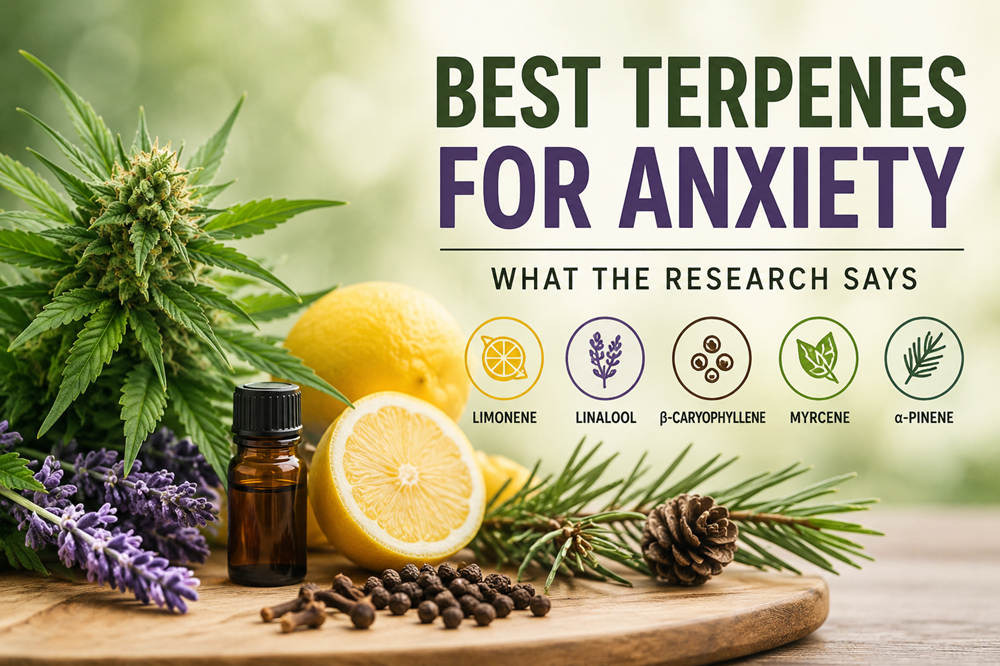
Limonene, linalool, beta-caryophyllene, and myrcene are frequently described as calming cannabis terpenes, but the evidence behind those claims is far from equal. D-limonene has some of the most notable controlled human evidence among the terpenes studied so far, specifically for reducing certain anxiety-like effects caused by THC. Research on linalool, beta-caryophyllene, and myrcene remains much more dependent on animal studies or indirect evidence.
The short answer: no terpene has been proven to treat an anxiety disorder, and there is no established terpene percentage that reliably makes cannabis calming. Terpene profiles can provide useful chemical information, but THC dose, CBD content, individual sensitivity, and the overall composition of a product can be just as important.
What Are Terpenes?
Terpenes are aromatic compounds produced by cannabis and many other plants. They contribute much of the scent associated with different cannabis varieties: limonene has a citrus-like aroma, linalool is floral and lavender-like, beta-caryophyllene is peppery or spicy, myrcene is earthy and herbal, and pinene smells distinctly pine-like.
Terpenes are different from cannabinoids such as tetrahydrocannabinol (THC) and cannabidiol (CBD). THC produces most of the familiar intoxicating effects of cannabis, while terpenes have their own biological properties and generally do not create a cannabis-like high on their own.
Laboratory and animal studies suggest that certain terpenes can influence biological pathways related to stress, inflammation, mood, and behavior. The challenge is translating those findings to people. An effect observed in a mouse or isolated cell does not establish that the same terpene will relieve anxiety when someone uses cannabis.
Which Terpenes Have the Most Evidence for Anxiety?
| Terpene | Typical Aroma | Evidence Level | What the Research Supports |
|---|---|---|---|
| D-Limonene | Citrus | Limited human evidence | Reduced some THC-induced anxiety-like ratings in a small controlled study |
| Linalool | Floral, lavender-like | Preclinical and indirect human evidence | Animal results are mixed; human lavender studies cannot isolate linalool’s contribution |
| Beta-Caryophyllene | Peppery, spicy | Preclinical | Produced anxiolytic-like effects in mouse experiments |
| Myrcene | Earthy, herbal | Preclinical | Some mouse experiments show anxiolytic-like effects, but direct human evidence is lacking |
| Alpha-Pinene | Pine | Limited human interaction research | Did not substantially alter the measured acute effects of THC in one controlled human study |
D-Limonene: The Most Notable Direct Human Evidence
D-limonene occurs naturally in citrus fruits and is also present in some cannabis varieties. Unlike most cannabis-terpene claims involving anxiety, researchers have directly tested D-limonene alongside THC in a controlled human experiment.
In a double-blind study of 20 healthy adults who intermittently used cannabis, participants completed sessions involving THC, D-limonene, combinations of the two, or placebo. The main study included D-limonene doses of 1 mg and 5 mg, which did not produce significant pharmacodynamic effects when administered alone.
A subset of 12 participants completed an additional session involving 30 mg of THC combined with 15 mg of D-limonene. Compared with 30 mg of THC alone, that combination significantly reduced specific subjective ratings including feeling anxious or nervous and paranoid.
The result is promising, but there are several reasons not to turn it into a claim that limonene treats anxiety. The strongest finding came from only 12 participants, and the 15 mg D-limonene dose was not tested alone. A broader state-anxiety measure also did not meet the study’s planned threshold for statistical significance in that comparison.
The most accurate conclusion is therefore narrow: D-limonene may modify certain acute anxiety-like effects of THC under controlled conditions. The study did not establish limonene as a treatment for generalized anxiety, panic disorder, or other anxiety disorders, and its experimental doses should not be treated as a formula for choosing cannabis products.
Linalool: Promising but Not Proven
Linalool is best known for its floral scent and its presence in lavender. Its calming reputation has some scientific basis, although much of the evidence frequently attributed to linalool actually comes from studies of lavender or from experiments in animals.
A 2024 study of inhaled linalool and beta-myrcene in mice found anxiolytic-like behavioral effects under certain exposure conditions. The results differed according to sex and how the terpenes were delivered, highlighting how dependent these findings can be on experimental conditions.
There is also substantial human research on lavender. A systematic review and meta-analysis of randomized trials found reductions in anxiety with lavender interventions. That evidence cannot be transferred directly to isolated linalool, however. Lavender contains numerous chemical constituents, so researchers cannot assume that linalool alone produced the observed effects.
Preclinical results are not entirely consistent either. A 2026 toxicology study investigating inhaled linalool in a mouse model relevant to multiple chemical sensitivity found anxiety-like behavior following exposure. That experiment was not designed to model normal cannabis use or anxiety treatment, but it illustrates why linalool should not be described as universally anxiolytic.
Overall, linalool remains scientifically interesting, but human research with isolated linalool is not strong enough to call it a proven anti-anxiety terpene.
Beta-Caryophyllene: An Interesting CB2-Active Terpene
Beta-caryophyllene occurs in cannabis as well as black pepper, cloves, and other plants. It stands apart from many terpenes because laboratory research has shown that it can act as an agonist at the cannabinoid CB2 receptor.
That property has encouraged research into beta-caryophyllene’s possible effects on inflammation, pain, stress, and emotional behavior.
In a 2014 mouse study, beta-caryophyllene produced changes in several behavioral tests that researchers interpreted as anxiolytic- and antidepressant-like effects. Pretreatment with a CB2 antagonist blocked those effects, suggesting CB2 signaling played an important role.
This is meaningful preclinical evidence, but it remains preclinical. A mouse behavioral test cannot determine whether beta-caryophyllene will relieve anxiety in a person, what human dose might be relevant, or whether the amounts found in ordinary cannabis products are sufficient to create the same effects.
Beta-caryophyllene is therefore a promising research candidate rather than an established anxiety treatment.
Myrcene: A Calming Reputation Ahead of the Clinical Evidence
Myrcene is one of the most familiar cannabis terpenes and is often associated with relaxing or sedating strains. Terms such as “couch-lock” are frequently linked to high-myrcene cannabis, but those descriptions are based more on cannabis culture and product marketing than strong controlled human evidence.
The 2024 mouse experiment involving linalool also found anxiolytic-like effects from beta-myrcene under particular inhalation conditions. As with linalool, those results varied according to sex and exposure pattern.
What is missing is direct clinical evidence showing that isolated myrcene reduces anxiety in humans. Research has also not established a myrcene percentage that consumers can use to predict whether a cannabis product will feel relaxing.
Myrcene may contribute to the overall effects of certain products, but its presence on a laboratory report should not be treated as a guarantee of sedation or anxiety relief.
What About Alpha-Pinene?
Alpha-pinene appears frequently in terpene guides, sometimes with claims that it helps counter unwanted THC effects. A recent human experiment tested one version of that idea directly.
In a 2025 controlled study involving 19 healthy adults, researchers compared alpha-pinene alone, THC alone, several THC-plus-alpha-pinene combinations, and placebo. The study was primarily designed to test whether alpha-pinene could reduce THC-related memory impairment.
Fifteen milligrams of alpha-pinene alone produced no significant pharmacodynamic effects compared with placebo. Adding alpha-pinene to 30 mg of THC also did not meaningfully reduce THC-induced cognitive impairment or significantly change the other measured acute subjective, cognitive, or physiological effects.
This was not a clinical trial of alpha-pinene for anxiety, so it cannot establish that pinene has no anxiety-related activity. It does, however, provide a reason to be skeptical of broad claims that alpha-pinene reliably counteracts THC.
Terpenes vs. THC and CBD: What Matters More for Anxiety?
A terpene profile is only one part of a cannabis product. For someone concerned about anxiety, cannabinoid content deserves at least as much attention.
THC can produce very different effects depending on dose and individual response. Some people report relaxation, while others experience nervousness, fear, racing thoughts, or paranoia. The National Institute on Drug Abuse notes that THC-containing cannabis can change mood, thinking, and perception, with higher exposure capable of producing anxiety, fear, distrust, or panic in some users.
CBD behaves differently from THC and has a separate research base. A 2025 systematic review of 49 controlled studies found that higher doses of CBD showed some of the more consistent short-term anxiety-related benefits among the cannabis formulations studied. The same review also emphasized considerable variation between studies and found that THC was more commonly associated with dose-dependent adverse effects.
Those findings do not mean a high-CBD cannabis product will reliably treat anxiety. They do show why evaluating a product only by its dominant terpene can miss a major part of its pharmacology.
Can a Terpene Prevent THC-Induced Anxiety?
There is an important difference between modifying an acute side effect of THC and treating an underlying anxiety disorder.
The D-limonene experiment provides evidence that a terpene can alter certain THC-related subjective effects under carefully controlled conditions. What it does not show is that adding limonene, linalool, or another terpene makes high-THC cannabis reliably comfortable for someone who is sensitive to THC.
Commercial cannabis products contain different amounts of THC, CBD, terpenes, and other compounds. Route of administration, dose, tolerance, previous experience, and individual biology can further change the response.
A product therefore should not be considered low-risk for anxiety simply because its label lists a terpene associated with relaxation.
Does the Entourage Effect Explain Calming Cannabis?
The “entourage effect” generally refers to the idea that cannabinoids, terpenes, and other cannabis constituents can interact to produce effects different from those of individual compounds.
Specific interactions are scientifically plausible, and the D-limonene experiment shows why testing them is worthwhile. Evidence does not support assuming that every cannabinoid-terpene combination is synergistic, however.
A review of entourage-effect research found an evidence base that remained relatively young and contradictory, particularly when broad marketing claims were compared with controlled pharmacological data. Laboratory experiments have also found that several common cannabis terpenes do not enhance cannabinoid activity through some of the molecular pathways proposed as explanations for an entourage effect.
A more useful approach is to assess individual interactions as evidence develops rather than assuming that a “full-spectrum” product is automatically more calming or therapeutic.
How to Read a Cannabis Terpene Profile
Terpene information can still be useful when it is available from reliable laboratory testing. The key is treating it as one piece of a larger chemical profile rather than a prescription.
- Check THC concentration first. A terpene associated with relaxation does not cancel the effects of a large THC dose.
- Look at CBD as well. The balance of major cannabinoids can be more informative than the terpene list alone.
- Identify dominant and secondary terpenes. Laboratory results provide more useful chemical information than relying solely on a strain name.
- Do not chase a therapeutic terpene percentage. Research has not established an ideal limonene, linalool, myrcene, or caryophyllene level for anxiety.
- Do not expect identical effects from the same strain name. Cannabis sold under one name can vary in cannabinoid and terpene composition between growers, batches, and products.
A laboratory profile can help describe what is in a particular product. It cannot predict with certainty how an individual will feel after using it.
Can Cannabis Make Anxiety Worse?
Yes. Cannabis is not universally calming, and this remains important even when a product contains terpenes commonly associated with relaxation.
The Centers for Disease Control and Prevention states that cannabis can cause disorientation as well as unpleasant feelings of anxiety and paranoia. NIDA also identifies anxiety, fear, distrust, and panic among possible acute THC effects, particularly after greater exposure.
Someone who consistently experiences intense anxiety, panic, paranoia, confusion, or other distressing psychological effects after cannabis use should not assume that selecting a different terpene will necessarily solve the problem. Changing or avoiding the exposure may be more relevant than finding another strain with a different terpene profile.
Persistent or severe anxiety that interferes with sleep, work, school, relationships, or everyday functioning deserves appropriate medical or mental-health evaluation. Terpenes have not been established as substitutes for evidence-based anxiety care.
Final Thoughts
There is no scientifically established “best terpene” for treating anxiety. If the question is narrowed to which terpene has the most notable direct controlled human evidence among commonly discussed cannabis terpenes, D-limonene currently stands out because a small experiment found reductions in specific THC-induced anxiety-like effects.
Linalool has intriguing preclinical research and indirect evidence from lavender studies. Beta-caryophyllene and myrcene have produced potentially relevant effects in animal experiments but lack convincing clinical evidence for anxiety. Alpha-pinene, meanwhile, offers a useful reminder that popular terpene claims do not always hold up when tested in controlled human studies.
For people concerned about anxiety and cannabis, terpene content is better treated as a clue than a guarantee. THC dose, CBD content, overall chemistry, and individual response remain essential parts of the picture.