What Flowers Are Safe for Cats? Cat-Friendly Bouquets and Dangerous Blooms Explained
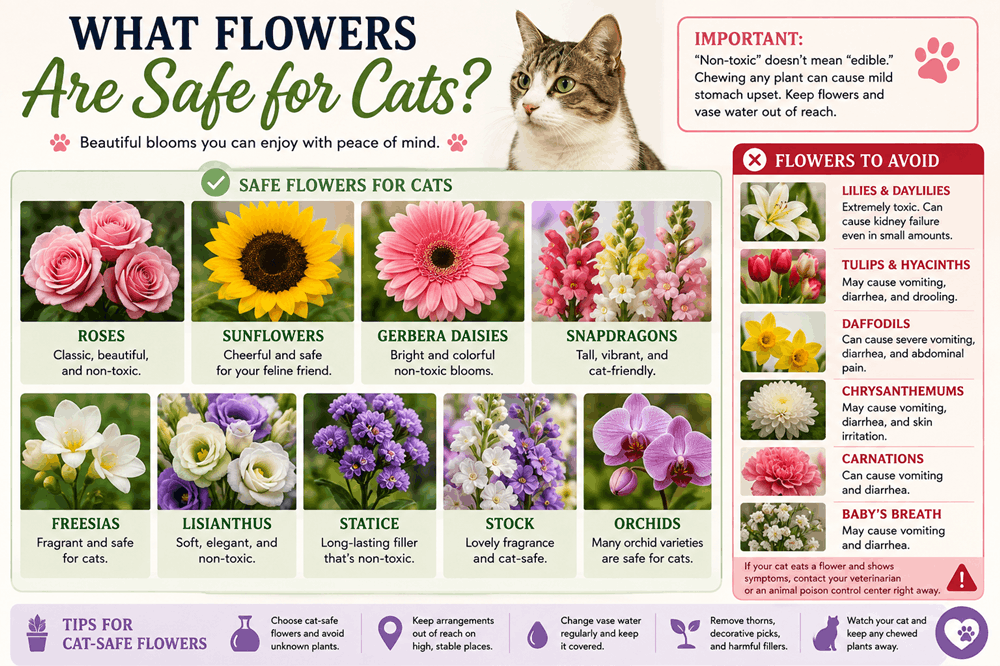
Flowers considered safer for cats include roses, sunflowers, Gerbera daisies, snapdragons, freesias, lisianthus, statice, stock, and several common florist orchids. However, “non-toxic” does not mean a cat should eat them. Any plant material can cause vomiting or diarrhea, and bouquets may contain dangerous filler plants, pesticides, ribbons, thorns, or contaminated vase water.
What Does Cat-Safe Mean?
A flower described as cat-safe is generally not known to contain substances expected to cause serious systemic poisoning in cats. This is different from saying that the flower is edible, completely harmless, or suitable as a treat.
Cats may chew leaves and petals because they are curious, bored, attracted to moving stems, or interested in unfamiliar smells. Even a non-toxic flower can irritate the stomach when enough plant material is swallowed.
The ASPCA’s toxic and non-toxic plant database explains that eating any plant material may cause vomiting or gastrointestinal discomfort. A non-toxic classification usually means serious or life-threatening poisoning is not expected from the plant itself.
Safety also depends on the complete arrangement. A bouquet made mostly from safe roses can become dangerous when the florist adds lilies, eucalyptus, chrysanthemums, or unidentified greenery.
Roses
True roses in the Rosa genus are considered non-toxic to cats. Their familiar appearance, wide range of colors, and year-round availability make them one of the easiest options for a cat-friendly bouquet.
The ASPCA identifies roses as non-toxic to cats, but the flowers still require sensible handling.
Rose stems contain thorns that can injure a cat’s mouth, paw, eye, or digestive tract. Remove the thorns or place the arrangement somewhere the cat cannot reach the stems.
Also avoid roses treated with glitter, artificial snow, essential oils, paint, or decorative chemicals. These additions are not covered by the flower’s non-toxic classification.
Sunflowers
Sunflowers are another recognizable cat-friendly choice. The ASPCA classifies sunflowers as non-toxic to cats.
Their large yellow flower heads can create a bright bouquet without relying on lilies or chrysanthemums. Smaller sunflower varieties may be easier to display securely because tall, heavy stems can be knocked over by an inquisitive cat.
A cat that eats petals or leaves may still develop mild digestive upset. Loose seeds can also become scattered around the home, so remove deteriorating flower heads before they begin shedding heavily.
Gerbera Daisies
Gerbera daisies, also called Gerber daisies, are considered non-toxic to cats. They are available in yellow, orange, red, pink, purple, and white and can replace some potentially toxic daisy-like flowers in a bouquet.
The specific name matters. The ASPCA lists the Gerbera daisy as non-toxic, but the word “daisy” is used for many unrelated plants.
Some plants sold or commonly described as daisies may cause irritation or poisoning. Ask for Gerbera daisies by name instead of assuming every daisy-shaped flower is safe.
Orchids
Several common florist orchids are considered non-toxic to cats. Cat-friendly examples include orchids in the following genera:
- Phalaenopsis
- Cymbidium
- Dendrobium
- Oncidium
The ASPCA includes these varieties in its guidance on pet-safe bouquets. Phalaenopsis, commonly called the moth orchid, is especially common in homes and flower shops.
Orchid leaves and flowers can still cause stomach upset when chewed in quantity. Potted orchids may also contain fertilizer, pesticide granules, decorative moss, bark, support clips, or wires that present separate hazards.
Check the botanical name when buying an unfamiliar orchid rather than assuming every plant casually labeled “orchid” has been assessed.
Snapdragons
Snapdragons are colorful, upright flowers considered non-toxic to cats. The common garden snapdragon is usually identified as Antirrhinum majus.
The ASPCA classifies common snapdragons as non-toxic. Their tall stems make them useful for adding height to a bouquet without using gladioli or true lilies.
Snapdragons can taste bitter. A cat that bites one may drool briefly or spit it out because of the taste, even without true poisoning.
Freesias
Freesias are fragrant, trumpet-shaped flowers commonly available in white, yellow, pink, red, orange, and purple. They are included among the non-toxic bouquet choices recommended by the ASPCA.
They offer fragrance without the extreme feline danger associated with true lilies. However, strongly scented flowers may still encourage a curious cat to investigate the arrangement closely.
Place the bouquet in a sturdy vase and remove fallen petals before the cat begins playing with them.
Lisianthus
Lisianthus, also known as Eustoma grandiflorum, has soft, rose-like flowers and is generally considered non-toxic to cats.
It is a useful choice for people who want an elegant bouquet without actual lilies. Lisianthus flowers are commonly available in white, pink, purple, blue, and cream.
The plant is still not intended as cat food. A cat that consumes a large amount may experience vomiting or diarrhea from the physical irritation of the plant material.
Statice and Limonium
Statice is a long-lasting filler flower commonly used in fresh and dried arrangements. It belongs to the Limonium group and is included on the ASPCA’s list of safer bouquet flowers.
Its tiny purple, blue, white, yellow, or pink flowers can replace baby’s breath in a cat-friendly arrangement. Baby’s breath is not considered a safe substitute because it can cause gastrointestinal upset in cats.
Dried statice may become brittle and shed small pieces. Keep fallen stems and fragments off the floor so the cat does not swallow them.
Stock Flowers
Stock, botanically known as Matthiola incana, is another generally non-toxic flower used in bouquets. Its tall stems carry clusters of fragrant flowers in white, lavender, pink, red, or yellow.
Stock can provide height and scent while avoiding true lilies. As with any flower, chewing may still cause mild digestive symptoms.
Are Zinnias Safe for Cats?
Zinnias are commonly considered non-toxic to cats and can be a colorful option for home gardens or seasonal bouquets. Their blooms come in many shades and resemble daisies, dahlias, or pom-poms depending on the variety.
Because common names can be confusing, confirm that the flowers are true zinnias rather than another plant being sold under a regional or informal name.
Flowers That Are Extremely Dangerous to Cats
The most important flowers to exclude from a cat household are true lilies and daylilies.
True Lilies and Daylilies
Flowers in the Lilium and Hemerocallis genera can cause rapid, potentially fatal kidney failure in cats. Dangerous examples include:
- Easter lilies
- Asiatic lilies
- Oriental lilies
- Stargazer lilies
- Tiger lilies
- Japanese show lilies
- Daylilies
Every part can be dangerous, including the flower, leaf, stem, pollen and bulb. Even drinking water from a lily vase or licking pollen from the coat may be enough to create an emergency.
The Pet Poison Helpline’s lily guidance warns that exposure to any portion of a true lily can lead to acute kidney failure. Cornell’s Feline Health Center similarly emphasizes that lily exposure requires immediate veterinary attention.
Do not wait for symptoms. Early treatment offers the best chance of preventing irreversible kidney injury.
Plants With “Lily” in the Name
Not every plant called a lily causes kidney failure, but many are still unsafe.
Peace lilies and calla lilies contain calcium oxalate crystals that can cause severe mouth irritation, drooling, pawing at the mouth, and difficulty swallowing. Lily of the valley contains compounds capable of disrupting heart rhythm.
Because the name is confusing and the consequences can be serious, the safest rule in a cat household is to avoid all flowers sold with “lily” in the name unless a veterinarian or poison specialist has confirmed the exact species.
Other Common Flowers to Avoid
Tulips and Hyacinths
Tulips and hyacinths can cause drooling, vomiting, diarrhea, and mouth irritation. The bulbs contain the highest concentration of toxins, but cats should not have access to any part of the plants.
Daffodils and Narcissus
Daffodils can cause severe vomiting, diarrhea, abdominal pain, drooling, and, in serious exposures, changes in heart rate or blood pressure. The bulb is especially dangerous.
Chrysanthemums
Chrysanthemums are common in mixed bouquets but are toxic to cats. Exposure can cause vomiting, diarrhea, drooling, skin irritation, and loss of coordination.
Carnations
Carnations usually cause milder poisoning than lilies, but they are not considered non-toxic. A cat may develop vomiting, diarrhea, or skin irritation after chewing them.
Baby’s Breath
Baby’s breath is a popular bouquet filler but may cause vomiting and diarrhea in cats. Statice or limonium provides a safer-looking alternative.
Hydrangeas
Hydrangeas contain compounds that can cause vomiting, diarrhea, weakness, or other symptoms when enough material is eaten.
Oleander
Oleander is highly dangerous. It contains cardiac glycosides capable of causing abnormal heart rhythms, weakness, collapse, and death. All parts of the plant are toxic.
Azaleas and Rhododendrons
These plants can cause drooling, vomiting, diarrhea, weakness, low blood pressure, abnormal heart rhythms, coma, and other serious effects.
Mixed Bouquets Require Extra Care
A bouquet should not be considered cat-safe merely because the main flowers are roses or sunflowers. Florists frequently add filler flowers and greenery that customers do not recognize.
Before bringing an arrangement home:
- Ask for the name of every flower and leaf.
- Request a bouquet made without lilies of any kind.
- Remove unidentified greenery.
- Check each plant in a veterinary toxic-plant database.
- Remove ribbons, wire, plastic picks, pins, and decorative mesh.
- Use a heavy vase that cannot be tipped easily.
Terms such as seasonal greenery, mixed foliage, wildflower blend, or florist’s choice do not provide enough information for a cat household.
Vase Water Can Also Be Unsafe
Cats may drink from flower vases because the water is accessible and smells unusual. The water may contain bacteria, flower food, fertilizer residue, pesticides, or toxins released by dangerous plants.
Lily vase water is particularly concerning because it may contain enough plant material to poison a cat.
Cover the top of the vase where possible, change the water frequently, and prevent the cat from reaching it. Do not add bleach, aspirin, sugar mixtures, coins, or homemade preservatives when a cat may drink the water.
What to Do if Your Cat Eats a Flower
Remove the plant from the cat’s reach and identify it as accurately as possible. Keep the label, bouquet card, receipt, photograph, or remaining plant material.
Do not induce vomiting or give milk, oil, salt, hydrogen peroxide, or another home remedy unless a veterinarian specifically instructs you to do so. Some home treatments can worsen the injury.
Contact a veterinarian or animal poison-control service promptly when:
- The flower is a lily or may be a lily.
- The plant cannot be identified.
- The cat is vomiting, drooling, weak, trembling, or unsteady.
- The cat has difficulty breathing or swallowing.
- The cat refuses food or becomes unusually quiet.
- A large amount of any plant was swallowed.
The ASPCA Animal Poison Control Center provides professional guidance for suspected pet poisonings. A consultation fee may apply.
How to Build a Cat-Friendly Bouquet
A simple safer arrangement could combine:
- Roses with the thorns removed
- Gerbera daisies
- Sunflowers
- Snapdragons
- Freesias
- Lisianthus
- Statice
- Stock
Choose two or three flower types rather than a complicated mixed bouquet with unidentified filler. Tell the florist that the arrangement is going into a home with cats and must contain no lilies, chrysanthemums, carnations, baby’s breath, tulips, daffodils, or toxic greenery.
Even a cat-friendly bouquet should be displayed out of reach. This protects both the cat and the flowers while reducing the risk of stomach upset, choking, cuts, or a broken vase.
The Bottom Line
Flowers considered safer for cats include roses, sunflowers, Gerbera daisies, several common orchids, snapdragons, freesias, lisianthus, statice, stock, and zinnias. These flowers are not expected to cause serious systemic poisoning, although chewing any plant may still cause vomiting or diarrhea.
True lilies and daylilies should never enter a home with cats. Tiny amounts of petals, leaves, pollen, or vase water can cause life-threatening kidney failure. Tulips, daffodils, chrysanthemums, carnations, baby’s breath, hydrangeas, oleander, and azaleas also belong outside a cat-friendly bouquet.
Always identify every flower and piece of greenery, remove thorns and decorations, prevent access to vase water, and keep the arrangement out of reach. When the plant is unknown or lily exposure is possible, contact a veterinarian immediately rather than waiting for symptoms.