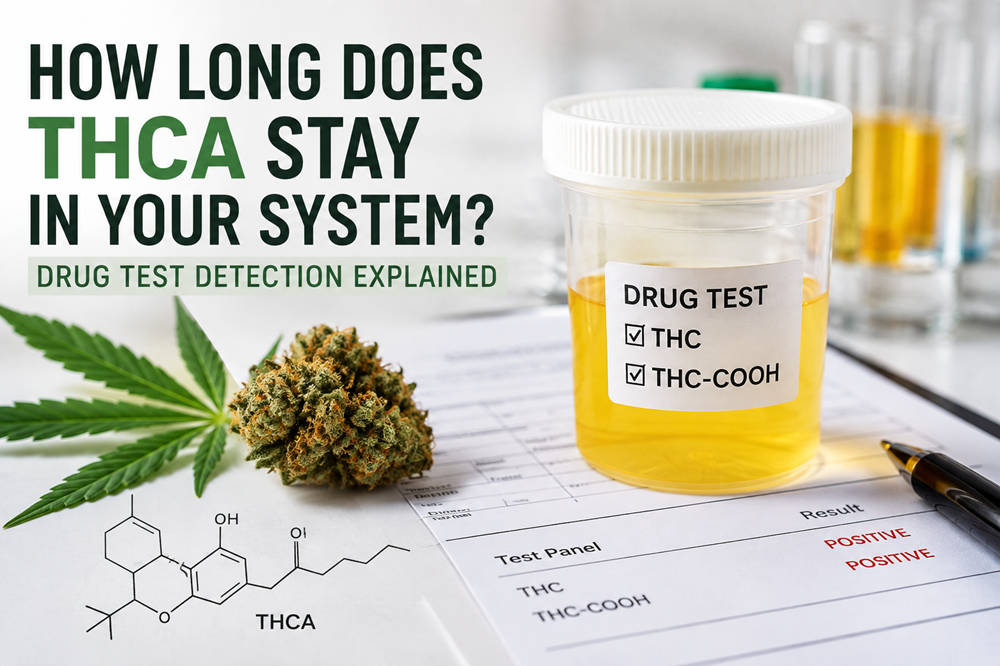
How Long Does THCA Stay in Your System? Drug Test Detection Explained
There is no single number of days that THCA stays in everyone’s system. If a THCA product is smoked, vaped, or otherwise heated, THCA can convert to delta-9 THC. The THC and metabolites produced afterward may then be detectable on a cannabis drug test.
For occasional exposure, THC metabolites in urine may remain detectable for several days. With frequent or heavy use, residual metabolites can persist for much longer—sometimes weeks. Blood and oral-fluid testing generally emphasize more recent exposure, while hair can reflect a much longer period. Exact detection time depends on the product, dose, frequency of use, testing method, laboratory cutoff, and individual biology.
The key distinction is that how long you feel effects and how long a test can detect cannabinoid-related compounds are not the same thing.
THCA Detection at a Glance
| Test Type | What It Usually Detects | General Detection Pattern |
|---|---|---|
| Urine | Primarily THC metabolites | Often several days after isolated exposure; potentially weeks with frequent use |
| Blood | THC and metabolites | Usually more useful for recent exposure, although residual cannabinoids can persist longer in frequent users |
| Oral fluid | Usually THC | Generally emphasizes relatively recent use; timing varies greatly with cutoff and route of consumption |
| Hair | Cannabinoids and metabolites | Can reflect a much longer historical period, but THCA interpretation is complicated by external contamination |
These are general patterns, not guaranteed clearance times. A person cannot use this table to determine the exact day a particular drug test will become negative.
How THCA Becomes THC
THCA, or tetrahydrocannabinolic acid, is a naturally occurring cannabinoid in cannabis and the direct chemical precursor of delta-9 THC. In fresh cannabis material, much of the potential THC can initially exist in its acidic THCA form.
THCA and THC are not interchangeable compounds. The important change occurs when THCA undergoes decarboxylation. Heat promotes this reaction, converting THCA toward THC.
That is why the method of consumption matters so much. Smoking or vaping THCA-rich flower exposes it to enough heat for substantial conversion to occur. Heated concentrates and foods can also deliver THC depending on how they were processed.
Once THC enters the body, it is metabolized into additional compounds. One of the most important for drug testing is the carboxy THC metabolite commonly called THC-COOH. Routine urine testing frequently looks for this metabolite rather than trying to identify the original cannabis product a person used.
Can THCA Cause a Positive Drug Test?
Yes. Using a THCA product can result in a positive cannabis drug test.
A drug test generally measures a specified drug or metabolite above a defined cutoff. It does not necessarily determine whether the original exposure came from a product marketed as marijuana, hemp, or THCA. The National Institute on Drug Abuse explains that drug tests may measure drugs themselves or substances produced as the body metabolizes them.
This is particularly important with THCA flower. Smoking or vaping converts THCA toward THC, creating the type of THC exposure that can produce metabolites detected by conventional cannabis testing.
Commercial products can create another complication. A THCA product may contain some delta-9 THC before the consumer heats it, while heating can further change its cannabinoid composition. A THCA label therefore should not be interpreted as a guarantee that the product cannot affect a cannabis drug test.
How Long Can THCA-Related Compounds Be Detected?
The practical detection window depends heavily on the specimen being tested. Urine, blood, oral fluid, and hair do not provide the same information and should not be treated as interchangeable tests.
Urine Tests
Urine is one of the most important specimens for cannabis testing, particularly in workplace programs. Rather than showing whether someone is currently impaired, urine testing generally identifies metabolites left after the body processes THC.
Controlled studies demonstrate why a single number is misleading. In one controlled study of adults who infrequently used cannabis, participants consumed brownies containing 10, 25, or 50 mg of THC. The average time to the last positive urine specimen increased with dose, from roughly two days at the lower doses to nearly four days after the 50 mg dose. Individual results varied substantially.
Frequency of use can have an even larger effect. Research conducted during continuously monitored abstinence has found residual urinary cannabinoid excretion in chronic cannabis users for days or weeks after stopping. In some research settings using sensitive analytical methods, cannabinoid-related findings have persisted even longer.
For that reason, a statement such as “THCA leaves urine in three days” is not scientifically defensible. A single low exposure in an infrequent user and repeated high exposure in a daily user can produce very different results.
Blood Tests
Blood testing is generally more closely associated with relatively recent cannabinoid exposure than urine testing. After inhalation, blood THC levels rise rapidly and then decline as THC is distributed and metabolized.
That does not mean every frequent user will have cannabinoid-free blood within a few hours. Controlled abstinence research involving chronic users has found measurable THC in some participants for days after their last use. Studies using highly sensitive laboratory techniques have documented cannabinoid findings even later in some frequent users.
This also illustrates why detection is not the same as impairment. Detecting residual THC in a biological sample does not by itself establish that a person is experiencing the acute effects associated with recent consumption.
Saliva and Oral-Fluid Tests
Oral-fluid testing commonly targets THC itself and generally focuses on a more recent window than urine testing.
The route of consumption matters considerably. Smoking or vaping can deposit THC directly in the mouth, producing high concentrations soon after use. Oral ingestion follows a different pattern because there may be much less direct contamination of the mouth with THC.
Controlled oral-fluid research has also found meaningful differences between frequent and occasional cannabis users. Test cutoff, collection device, dose, route of administration, and elapsed time can all change whether a sample is considered positive.
For these reasons, it is more accurate to describe oral fluid as a test that generally emphasizes recent exposure than to promise that it will always become negative after a particular number of hours.
Hair Tests
Hair testing can provide information about a considerably longer historical period than blood or oral fluid because compounds associated with drug exposure can be examined along a growing hair segment.
THCA creates an unusual problem, however. Research on THCA in human hair has shown that THCA can reach hair through external cannabis contamination, including direct contact with cannabis material or transfer from contaminated hands.
Other research has similarly demonstrated that detecting certain plant cannabinoids in hair does not automatically prove that those compounds entered the hair through the bloodstream. Laboratories therefore have to consider the analyte, contamination controls, washing procedures, and the interpretation of cannabinoid metabolites.
Hair testing is also separate from the current HHS federal workplace panel discussed below, which covers urine and oral-fluid specimens.
What Changes the Detection Window?
The amount of time cannabinoids remain measurable is influenced by several variables. These factors help explain why two people can use similar products and still receive different test results.
Frequency of Use
Repeated exposure is one of the biggest factors affecting detection. A frequent user may already have residual THC-related compounds in the body before another use session occurs.
Studies of chronic daily cannabis users under monitored abstinence have documented residual urinary cannabinoid excretion over extended periods. This makes detection windows from one-time-use studies poor predictors for frequent users.
Dose and Product Composition
A higher THC exposure can produce higher concentrations of metabolites and potentially extend the period during which concentrations remain above a test’s cutoff.
With THCA products, the amount printed on a label also does not necessarily represent the exact THC dose that ultimately reaches the bloodstream. Product composition, heating, method of administration, and absorption all affect actual exposure.
Method of Consumption
Inhalation and ingestion produce different pharmacokinetic patterns. Smoking and vaping deliver cannabinoids rapidly, while oral cannabinoid products usually produce slower and more variable absorption.
A controlled human oral-cannabis study, for example, found substantially different blood and oral-fluid profiles from those typically observed after inhalation. Route of administration therefore matters when interpreting both concentration and timing.
Testing Cutoff and Laboratory Method
A drug test does not simply ask whether any trace of THC-related material exists. It determines whether a specified compound reaches or exceeds a particular cutoff concentration.
Highly sensitive research instruments can sometimes measure residual compounds at concentrations below the thresholds used by routine screening programs. That is one reason detection periods reported in scientific studies cannot always be applied directly to a workplace test.
Individual Variation
Cannabinoid absorption and elimination also vary among individuals. Previous cannabis exposure, physiology, body composition, metabolism, and other factors can affect cannabinoid concentration over time.
There is no dependable formula based on weight, exercise level, water intake, or a self-described “fast metabolism” that can calculate an exact negative-test date.
Raw THCA vs. Smoked or Vaped THCA
Raw THCA should not automatically be assigned the same detection window as a THCA product that has been smoked or vaped.
The difference is exposure. A heated THCA product can deliver substantial THC because of decarboxylation. An unheated product containing predominantly THCA creates a different pharmacokinetic situation.
Human THCA-specific evidence is still much thinner than the evidence available for THC. A 2025 human pharmacokinetic study examined an oral full-spectrum hemp extract containing approximately equal proportions of THC and THCA, along with CBD and CBDA. The study helps expand what is known about THCA exposure in humans, but because participants received a cannabinoid mixture rather than isolated THCA, it does not establish a universal THCA clearance period.
That limitation matters. It would be misleading to take established THC urine-detection figures and simply relabel them as exact “THCA detection times.”
From a practical drug-testing perspective, however, someone using smoked, vaped, or otherwise heated THCA products should assume there is a genuine possibility of THC exposure and a subsequent positive cannabis test.
What Do Federal Workplace Tests Look For?
Current federal testing rules provide a useful example of why the chemical target matters.
Under the 2026 HHS authorized federal workplace drug-testing panels, urine cannabis testing targets Δ9THCC, the carboxy metabolite of delta-9 THC. The initial urine cutoff is 50 ng/mL, and the confirmatory cutoff is 15 ng/mL.
Federal oral-fluid testing instead targets delta-9 THC itself. Its initial cutoff is 4 ng/mL, with a 2 ng/mL confirmatory cutoff.
| Federal Specimen | Cannabis Target | Initial Cutoff | Confirmatory Cutoff |
|---|---|---|---|
| Urine | Δ9THCC | 50 ng/mL | 15 ng/mL |
| Oral fluid | Delta-9 THC | 4 ng/mL | 2 ng/mL |
These panels illustrate why a THCA product cannot be assumed to be “drug-test safe.” A federal urine test is concerned with whether the specified THC metabolite exceeds its cutoff, not with the marketing category of the product that produced the exposure.
Can You Know Exactly When You Will Test Negative?
No reliable method can predict the exact time an individual’s cannabis drug test will become negative.
A person who uses a small amount once may have a very different cannabinoid profile from someone who uses THCA flower every day. The product may deliver a different THC dose, and the test itself may measure a different compound at a different cutoff.
This is also why online detox calculators and fixed countdowns should be treated cautiously. Research shows substantial variation between individuals even when the dose and conditions are carefully controlled.
Drinking excessive amounts of water, exercising, or using a commercial “detox” product does not provide a scientifically guaranteed deadline for a negative result. If a drug test has important employment, medical, athletic, or legal consequences, it is better to understand what specimen and testing standard will actually be used rather than relying on a universal clearance estimate.
Key Takeaways
- There is no universal THCA detection window. The answer varies with exposure, frequency of use, specimen type, testing cutoff, and individual factors.
- THCA can become THC when heated. Smoking or vaping THCA-rich products can therefore produce meaningful THC exposure.
- THCA products can lead to positive cannabis drug tests. A product’s THCA or hemp label does not guarantee a negative result.
- Urine testing usually focuses on THC metabolites. After isolated exposure they may remain detectable for several days, while frequent use can result in substantially longer residual excretion.
- Blood and oral fluid generally emphasize more recent exposure. Frequent cannabis use and sensitive analytical methods can nevertheless extend observed detection periods.
- Hair testing covers a much longer historical period, but THCA in hair has special contamination issues.
- Detectability does not equal intoxication. Cannabinoid-related compounds can remain measurable after noticeable effects have ended.