Is Delta-8 Legal in Tennessee? Current Rules for 2026
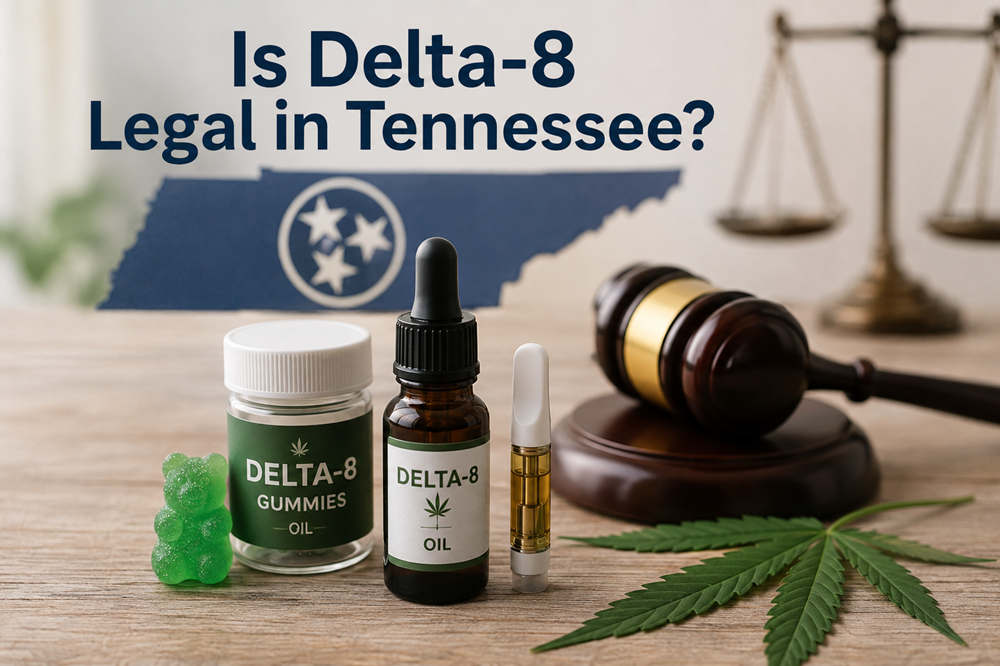
Yes. As of August 2026, qualifying Delta-8 products can legally be sold and possessed by adults 21 and older in Tennessee, but only when the product and seller comply with the state’s hemp-derived cannabinoid rules. Tennessee regulates intoxicating hemp products through the Tennessee Alcoholic Beverage Commission (TABC), with rules covering THC concentration, testing, labeling, licensing, distribution, and where products may be sold.
There is also an important date ahead. Federal hemp law is scheduled to change on November 12, 2026, and the new definition could affect the legal status of many Delta-8 products. This article describes the rules in effect as of August 2026.
Is Delta-8 Legal in Tennessee in 2026?
Delta-8 has not been completely banned in Tennessee. It can be sold within the state’s regulated hemp-derived cannabinoid product, or HDCP, market when the product meets Tennessee’s requirements.
The key distinction is between Delta-8 as a cannabinoid and a particular Delta-8 product. A package labeled “Delta-8” is not automatically legal simply because the manufacturer says it came from hemp. Its THC concentration, cannabinoid profile, testing, source, and route to market all affect whether it can lawfully be sold.
The current system comes largely from Public Chapter 526, which transferred regulation of HDCP suppliers, wholesalers, and retailers to the TABC beginning in 2026.
How Old Do You Have to Be to Buy Delta-8 in Tennessee?
You must be at least 21 years old to legally buy regulated hemp-derived cannabinoid products in Tennessee.
Tennessee law prohibits sales or distribution to people under 21 and requires age verification. State law also prohibits a person under 21 from knowingly purchasing, possessing, or accepting receipt of a product containing a hemp-derived cannabinoid.
In other words, the age limit applies to the consumer as well as the retailer. Someone under 21 does not make possession lawful simply by obtaining the product from another person rather than purchasing it directly.
What Makes a Delta-8 Product Legal in Tennessee?
Tennessee’s rules look at more than the cannabinoid name. Products sold under a TABC HDCP license must satisfy several product-level requirements.
The 0.3% Total THC Limit
Under current TABC guidance for licensed hemp products, an HDCP must contain no more than 0.3% total THC.
Tennessee calculates total THC using:
Total THC = (THCA × 0.877) + delta-9 THC
This is an important distinction from older explanations of hemp law that focused only on whether delta-9 THC was below 0.3%. A product cannot establish Tennessee compliance merely by putting “less than 0.3% delta-9 THC” on its package.
THCp and Synthetic Cannabinoids Are Prohibited
TABC guidance also states that products regulated under the current framework may not contain THCp or synthetic cannabinoids.
This issue can become complicated with manufactured cannabinoid products, so consumers should be cautious about assuming that a particular manufacturing method is lawful based on marketing language alone. The relevant question is whether the finished product meets Tennessee’s definitions and regulatory requirements.
Testing and a Certificate of Analysis Are Required
Products sold through licensed retailers must be tested by a laboratory approved and registered by the TABC. Their labeling must also provide access to a certificate of analysis, commonly called a COA.
A 2026 amendment, Public Chapter 698, updated the QR-code rules. A QR code may now lead to a webpage containing COAs for multiple products or batches rather than requiring a completely separate page for each one, but the COA for the specific batch must remain readily accessible.
What Changed With Tennessee’s New Hemp Rules?
Tennessee significantly reorganized its intoxicating-hemp market beginning January 1, 2026. The TABC became the primary regulator of HDCP businesses, and the state established separate supplier, wholesaler, and retailer licenses.
For most products entering the retail market today, the basic supply chain is straightforward: a licensed supplier provides compliant products through a licensed wholesaler, and the licensed wholesaler supplies the licensed retailer. Testing laboratories also operate under TABC oversight.
The state has actively enforced the new licensing system. For consumers, that makes the identity of the retailer more meaningful than it was under the earlier, less centralized hemp market.
Where Can You Legally Buy Delta-8 in Tennessee?
Tennessee now limits HDCP sales to specified types of licensed establishments. Depending on the type of establishment and license, these can include businesses restricted to customers 21 and older, certain establishments licensed to sell alcoholic beverages, and qualifying licensed hemp businesses operating at approved locations.
Gas stations are no longer eligible for HDCP retail licenses as of January 1, 2026.
The TABC maintains current HDCP licensing information and lists of licensed retailers, wholesalers, suppliers, and testing laboratories. Checking the seller’s license is more useful than relying on signs such as “legal hemp” or “Farm Bill compliant” in a store window.
Can Delta-8 Be Shipped to Your Home in Tennessee?
No. Tennessee’s current HDCP framework prohibits direct-to-consumer shipping.
Retail sales and transfers from a retailer to a consumer are required to take place at a licensed retail location in a face-to-face transaction. The law also prohibits the use of delivery services to deliver HDCPs to Tennessee consumers.
This makes some older Delta-8 buying guides outdated. An online company accepting a Tennessee shipping address does not, by itself, mean the shipment complies with Tennessee law.
How Can You Check a Delta-8 Product Before Buying It?
Consumers cannot audit every part of a manufacturer’s compliance process, but a few checks can reduce the chance of purchasing a questionable product.
- Confirm that the retailer is licensed. TABC publishes lists of current HDCP licensees.
- Scan the QR code. It should provide access to laboratory information for the relevant product and batch.
- Match the batch number. Make sure the COA actually corresponds to the package being sold rather than an unrelated product.
- Review the cannabinoid results. Laboratory results provide more useful information than front-label claims such as “hemp legal.”
- Look for complete labeling. Regulated products are subject to Tennessee packaging, warning, and labeling requirements.
A COA does not independently prove that every legal requirement has been satisfied, but it gives consumers a way to compare the package with actual batch testing instead of relying entirely on advertising.
Can You Drive After Using Delta-8 in Tennessee?
No. A product’s lawful retail status does not create an exception to impaired-driving laws.
Delta-8 can be intoxicating. Anyone who feels impaired should not drive or operate machinery, regardless of whether the product was purchased legally from a licensed hemp retailer.
Workplace rules are separate as well. Employers may maintain drug-free workplace policies or restrict drug use and impairment, particularly in safety-sensitive jobs. Legal purchase of a Delta-8 product does not guarantee protection from an employer’s testing or workplace policies.
Is Delta-8 the Same as Marijuana Under Tennessee Law?
No. Tennessee treats compliant hemp-derived cannabinoid products and marijuana as legally distinct categories.
That does not mean their effects can never overlap. Delta-8 THC can be intoxicating, but Tennessee’s legal classification depends on the applicable statutory definitions and the composition of the product rather than intoxication alone.
Marijuana has not become generally legal for adult recreational use in Tennessee simply because the state allows certain regulated hemp-derived cannabinoid products.
A Federal Delta-8 Change Is Scheduled for November 2026
Anyone reading about Delta-8 legality in 2026 should also know that the federal definition of hemp is scheduled to change.
Section 781 of Public Law 119-37, enacted November 12, 2025, takes effect 365 days after enactment. The new definition excludes certain cannabinoid products from the federal definition of hemp, including final products containing cannabinoids that can occur naturally in cannabis but were synthesized or manufactured outside the plant.
The law also creates a new threshold for final hemp-derived cannabinoid products: more than 0.4 milligrams per container of combined total tetrahydrocannabinols and certain other cannabinoids with similar effects would fall outside the new federal hemp definition.
Those provisions could have a major effect on the Delta-8 market when they take effect on November 12, 2026. Bills have been introduced in Congress that would repeal, delay, or replace parts of this framework, but introduced legislation is not the same as enacted law. The federal situation should therefore be checked again as that date approaches.
The Bottom Line
Delta-8 can currently be legal in Tennessee for adults 21 and older, but only within the state’s regulated hemp-derived cannabinoid system.
For a product sold today, the important questions are whether it satisfies Tennessee’s THC and cannabinoid restrictions, has been properly tested and labeled, and is being sold through a licensed retailer. Direct-to-consumer shipping is prohibited, and gas stations are no longer eligible for HDCP retail licenses.
The answer may become substantially different after November 12, 2026, when the scheduled federal hemp-definition changes take effect. Because both Tennessee and federal hemp laws have changed rapidly, consumers and businesses should check current TABC and federal guidance before relying on older information about Delta-8 legality.