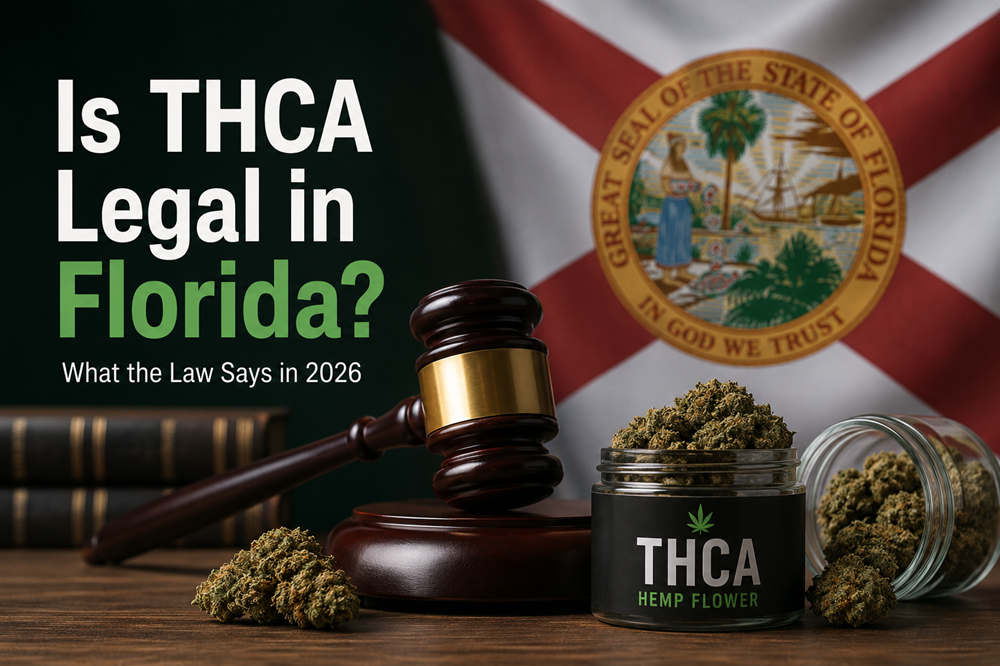
Is THCA Legal in Florida? What the Law Says in 2026
THCA-containing products can qualify as hemp in Florida, but only when they meet the state’s THC limits and other hemp requirements. Florida does not determine compliance by looking only at the amount of delta-9 THC already present. Its total-THC calculation also accounts for THCA.
That distinction is especially important for flower marketed as high-THCA hemp. Even when a product contains less than 0.3% delta-9 THC by itself, a substantial amount of THCA can push its calculated total THC far above Florida’s hemp limit.
Is THCA Legal in Florida in 2026?
Under Florida’s state hemp program, hemp includes Cannabis sativa L. and its parts, cannabinoids, acids, derivatives, extracts, and related compounds when total delta-9 THC does not exceed 0.3% on a dry-weight basis. Hemp extract is subject to a 0.3% total-delta-9-THC limit on a wet-weight basis.
That means Florida does not prohibit every product merely because it contains THCA. A product with a sufficiently low THCA concentration may still fit within the state’s definition of hemp.
However, the product must meet the actual total-THC standard. Descriptions such as “hemp,” “THCA,” or “Farm Bill compliant” do not determine legal status on their own.
For consumers, the important distinction is between a product that happens to contain a small amount of THCA and cannabis flower specifically marketed for having a high THCA percentage.
How Florida Calculates Total THC
Florida Administrative Code Rule 5K-4.034 accounts for THCA when determining total delta-9 THC.
The calculation is:
Total delta-9 THC = delta-9 THC + (0.877 × THCA)
The 0.877 factor reflects the difference in molecular weight when THCA converts into THC.
For example, imagine a flower sample with:
- Delta-9 THC: 0.20%
- THCA: 20%
The calculation would be:
0.20 + (20 × 0.877) = 17.74% total delta-9 THC
Looking only at the 0.20% delta-9 result could make the product appear to be below the 0.3% threshold. Once THCA is included, however, the calculated total THC is much higher.
This is why a claim such as “under 0.3% delta-9 THC” does not necessarily establish that a THCA product complies with Florida law.
What This Means for High-THCA Flower
High-THCA flower is where Florida’s total-THC approach becomes especially important.
Flower marketed with concentrations such as 15%, 20%, or 25% THCA would ordinarily calculate to a total-THC level far above 0.3%.
As a result, the common claim that THCA flower is automatically legal because its existing delta-9 THC is below 0.3% does not accurately describe Florida’s rules.
A more precise way to understand the situation is that a product can contain THCA and still qualify as hemp, but products containing large amounts of THCA generally have difficulty remaining within Florida’s total-THC threshold.
Florida’s Rules for Hemp Products Sold to Consumers
THC concentration is only one part of Florida’s hemp regulations. Products sold for human ingestion or inhalation are also subject to testing, labeling, packaging, and age requirements.
Certificates of Analysis
Hemp extract sold in Florida must have a certificate of analysis, commonly called a COA, from an independent testing laboratory.
The COA provides information about the tested batch, including its cannabinoid concentrations and required contaminant testing. Florida’s current hemp testing and consumer-protection requirements also require COAs to include laboratory information, total delta-9 THC concentration, and information about specified prohibited substances and pathogens.
Batch identification matters. A laboratory report from a different production run does not establish the composition of the product being purchased.
Labels and QR Codes
Qualifying hemp-extract products must provide information that connects the retail package to its laboratory testing.
Required information can include:
- a scannable barcode or QR code connected to the COA;
- a batch number;
- an expiration date;
- access to batch information; and
- the amount of marketed cannabinoids per serving.
These requirements make it easier to compare the physical product with the laboratory report instead of relying only on advertising claims.
Packaging Requirements
Florida imposes safety requirements on hemp-extract packaging, including child-resistant packaging standards.
Packaging and marketing also must not be designed in a way that improperly appeals to children.
These rules are separate from the THC threshold. A product can have acceptable cannabinoid concentrations and still fail other consumer-product requirements.
Buyers Must Be 21 or Older
Florida prohibits the sale of hemp-extract products intended for ingestion or inhalation to people under 21.
Retailers therefore have age-related obligations even when the products they sell otherwise qualify as hemp.
What the 2026 Chronic Guru Decision Means
Florida’s total-THC rule was challenged in litigation involving EXSPO Retail, LLC, doing business as Chronic Guru.
The Florida Division of Administrative Hearings dismissed the company’s challenge to the state’s hemp rule. The dispute later reached Florida’s Fifth District Court of Appeal.
On February 10, 2026, the court affirmed the administrative result.
The court did not issue a lengthy written opinion analyzing every possible THCA question. For that reason, it is more accurate to say that the decision left the administrative outcome and Florida’s existing enforcement approach in place rather than treating the ruling as a comprehensive new THCA law.
For consumers and retailers, the practical point is that Florida regulators continue to use total THC rather than standalone delta-9 THC when applying the state’s hemp rules.
THCA Hemp and Medical Marijuana Are Different Legal Categories
Florida’s hemp program is separate from the state’s medical-marijuana system.
Cannabis that satisfies Florida’s statutory definition of hemp receives the legal treatment provided to hemp. Cannabis that falls outside that definition does not become compliant merely because a retailer markets it as hemp.
Florida separately regulates marijuana for qualifying patients through its medical use of marijuana law.
The place where a cannabis product is sold does not determine its legal classification. A smoke shop, convenience store, or website cannot turn a noncompliant product into legal hemp simply by putting “THCA” or “hemp” on the label.
Can You Buy THCA in Florida?
Products containing THCA can be sold when they genuinely meet Florida’s hemp standards and other applicable product requirements.
The phrase “THCA product,” however, covers products with very different cannabinoid concentrations.
A low-THC hemp product may contain a small amount of THCA and remain within the state’s threshold. High-THCA flower promoted specifically for its substantial THCA content is a different situation because its total THC may be far above 0.3%.
Retail availability alone should therefore not be treated as proof that a product complies with Florida law.
Can THCA Be Shipped to Florida?
Ordering a product online does not create an exemption from Florida’s hemp rules.
A business in another state may describe a THCA product as federally compliant, but products sold or distributed in Florida can still be subject to Florida requirements.
Age restrictions also matter for delivered hemp products intended for human consumption.
Consumers should be skeptical of blanket statements such as “legal in all 50 states.” Hemp laws and enforcement standards vary among states, and Florida’s treatment of THCA in the total-THC calculation is particularly relevant to high-THCA flower.
How to Read a THCA Certificate of Analysis
A COA can provide useful information about what is actually in a cannabinoid product, but it is not an automatic guarantee of legality.
First, make sure the batch or lot number on the laboratory report matches the product.
Then look for:
- total delta-9 THC;
- delta-9 THC;
- THCA;
- cannabinoid measurement units;
- batch or sample identification; and
- contaminant testing.
If the laboratory already reports total delta-9 THC using the applicable testing method, that figure is generally more informative than looking only at standalone delta-9 THC.
Be careful when making manual calculations. Cannabinoid concentrations may be reported as percentages, milligrams per gram, milligrams per serving, or in other units. Values cannot always be combined directly without proper conversion.
A particularly important warning sign is a product promoted primarily because it contains less than 0.3% delta-9 THC when its COA also shows a much larger THCA concentration.
Federal Hemp Law Is Scheduled to Change in Late 2026
Federal hemp law is also in transition.
Public Law 119-37 was approved on November 12, 2025. Its Section 781 hemp amendments are scheduled to take effect 365 days after enactment, placing the current effective date on November 12, 2026.
Among other changes, the new federal definition expressly includes THCA when determining total tetrahydrocannabinol concentration. It also introduces additional restrictions affecting certain final hemp-derived cannabinoid products.
Congress is currently considering legislation that could temporarily change how those provisions take effect.
On August 8, 2026, the Senate passed an amended version of H.R. 6500, the Continuing Appropriations and Extensions Act, 2027. The Senate language would temporarily limit the application of most of the upcoming Section 781 hemp amendments until December 11, 2026.
That Senate amendment has not yet become law as of August 9, 2026. The currently enacted federal timetable therefore remains in place unless Congress completes additional legislation.
Because the situation is changing quickly, this section should be reviewed whenever the article is updated.
The Bottom Line
THCA is not best described as automatically legal or automatically illegal in Florida.
A product containing THCA can qualify as hemp only when it stays within Florida’s total-THC threshold and complies with the other applicable hemp rules. Because Florida’s calculation accounts for THCA, high-THCA flower can have a very different legal status from genuinely low-THC hemp.
For consumers, the batch-specific COA is one of the most useful places to start. Check the total-THC result, confirm that the laboratory report matches the product’s batch, and do not assume that a low standalone delta-9 THC number answers the entire legal question.
Florida’s total-THC enforcement approach remains in place, while separate federal hemp changes are scheduled for later in 2026. THCA legality should therefore be treated as a date-sensitive legal question rather than a permanent loophole or a simple yes-or-no rule.
This article is for general educational purposes only and is not legal advice. Hemp and cannabis laws, regulations, court decisions, and enforcement policies can change.