Is THCA Legal in Kansas? Current Laws and Restrictions Explained
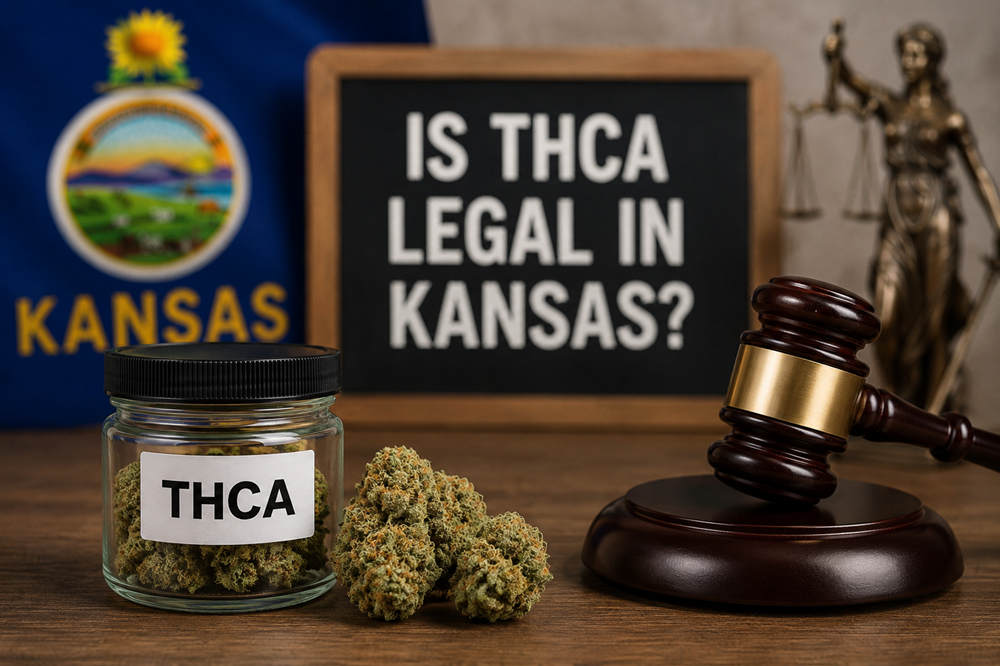
Typical high-THCA flower is not legal for ordinary retail sale in Kansas. State law does not rely only on the amount of delta-9 THC already present in cannabis. Kansas includes THC acids in its THC concentration rules, and it separately restricts the retail sale and distribution of industrial hemp buds and floral material.
Some finished hemp products containing only small amounts of THCA may still qualify under Kansas law if they meet the state’s THC limit and all rules that apply to their product type. That is very different from the high-THCA flower commonly marketed online as federally compliant hemp.
Is THCA Legal in Kansas?
THCA is not broadly legal in Kansas simply because a product contains less than 0.3% delta-9 THC.
Under the Kansas Commercial Industrial Hemp Act, industrial hemp must contain no more than 0.3% of the state’s defined delta-9 tetrahydrocannabinol concentration on a dry-weight basis. Kansas defines that concentration to include delta-9 THC and its acids, salts, optical isomers, and related forms, reported as free THC.
That distinction is especially important for THCA products. Cannabis flower can contain little delta-9 THC while carrying a much larger amount of THCA, but Kansas law does not simply disregard the acidic form when determining whether cannabis fits its hemp definition.
Final hemp products are also limited to a tetrahydrocannabinol concentration of no more than 0.3%. The applicable definition in K.S.A. 65-6235 includes tetrahydrocannabinol and its acids.
How Kansas Treats THCA When Measuring THC
THCA, or tetrahydrocannabinolic acid, is a naturally occurring cannabinoid in cannabis and the chemical precursor to delta-9 THC. Heat can convert THCA into delta-9 THC through decarboxylation.
Kansas’s testing approach accounts for that relationship. The Kansas Department of Agriculture laboratory explains that its hemp-testing method measures both THC and THCA. After analysis, the laboratory calculates total THC and reports the result on a dry-weight basis.
This makes the delta-9 number alone an unreliable way to judge whether a THCA-rich product fits Kansas’s hemp rules. A certificate of analysis showing 0.2% delta-9 THC, for example, does not establish Kansas compliance if the same product contains substantial THCA.
Why THCA Flower Is Particularly Restricted in Kansas
THCA flower faces another problem beyond cannabinoid concentration: Kansas directly regulates hemp flower itself.
Under K.S.A. 2-3908, industrial hemp buds, ground industrial hemp floral material, and ground industrial hemp leaf material generally cannot be marketed, sold, or distributed to a person in Kansas unless that person is a registered hemp processor or holds a qualifying hemp license.
That means ordinary retail consumers cannot rely on an otherwise favorable laboratory result to make retail hemp buds lawful. The form of the product creates a separate restriction.
Kansas law also prohibits the manufacture, marketing, sale, or distribution of several other hemp products within the state, including hemp cigarettes, hemp cigars, smokeless hemp material, hemp teas, and liquids, solids, or gases containing industrial hemp for use in vaporizing devices.
For consumers, this makes THCA flower and inhalable hemp products substantially different from many other finished hemp products.
What Hemp Products Can Be Legal in Kansas?
Kansas does not prohibit every hemp-derived product. Finished products may qualify as lawful hemp products when they remain within Kansas’s THC concentration limits and do not fall into a prohibited product category.
Product type matters. An oil, food, cosmetic, extract, or other finished item may be subject to different rules from raw hemp flower and may also need to comply with Kansas food, drug, cosmetic, or other applicable regulations.
A certificate of analysis can help consumers see how much delta-9 THC, THCA, and other cannabinoids were detected in a tested batch. It does not, however, override Kansas law or guarantee that the form in which a product is being sold is permitted.
Is It Legal to Possess THCA in Kansas?
The possession question depends heavily on whether a product actually falls within Kansas’s hemp exemptions.
Under the Kansas criminal code, the definition of marijuana excludes industrial hemp as defined by K.S.A. 2-3901 when it is cultivated, produced, possessed, or used for activities authorized by the Commercial Industrial Hemp Act.
That qualification is important. It would be too broad to say that anything labeled “hemp” is automatically lawful for a Kansas consumer to possess. A product that does not meet Kansas’s statutory hemp definition, or does not fall within an applicable authorized hemp activity, may instead be subject to the state’s controlled-substance laws.
K.S.A. 21-5706 prohibits unlawful possession of controlled substances, including marijuana and regulated tetrahydrocannabinols. For marijuana or tetrahydrocannabinols covered by the statute, a first possession offense is generally a class B nonperson misdemeanor, with higher classifications possible for repeat offenses.
Anyone facing an actual possession, seizure, or criminal-charge issue should get advice from a Kansas attorney because the outcome can depend on the specific product, its laboratory results, how it was possessed, and the circumstances of the case.
Federal Hemp Law Does Not Override Kansas Restrictions
The confusion surrounding THCA largely comes from the current federal hemp definition. As of August 11, 2026, federal law still defines hemp using a delta-9 THC concentration of no more than 0.3% on a dry-weight basis.
That federal definition has been used to market cannabis products containing low measured delta-9 THC but much higher THCA. States, however, can impose additional restrictions, and Kansas law is more restrictive in ways that directly affect THCA products.
A federal amendment already enacted in 2025 is scheduled to take effect on November 12, 2026. The amended federal definition will use total tetrahydrocannabinols, expressly including THCA, along with additional restrictions affecting hemp-derived cannabinoid products. Until then, Kansas’s existing state restrictions remain independently important.
Can You Order THCA Online in Kansas?
An online retailer’s willingness to ship THCA to a Kansas address does not prove that the product is lawful under Kansas law.
Labels such as “Farm Bill compliant” often focus on the existing federal delta-9 THC threshold. They may not account for Kansas’s treatment of THC acids or its restrictions on hemp buds and certain inhalable products.
Before relying on an online product description, consumers should pay attention to the full cannabinoid profile, whether the laboratory report matches the current batch, and whether Kansas permits that particular product form. A shipping policy or checkout system is not a legal determination.
Kansas Has Enforced Its THC Product Laws
Kansas authorities have taken enforcement action against retailers suspected of selling products that violate the state’s THC restrictions.
On October 1, 2025, the Kansas Bureau of Investigation announced a statewide enforcement operation involving search warrants at vape shops and CBD dispensaries in multiple cities. Authorities reported seizing marijuana vegetation, THC vape cartridges, and other products containing suspected illegal concentrations of THC.
The announcement cited K.S.A. 21-5705 and K.S.A. 2-3908 and stated that case findings would be submitted to prosecutors after investigations concluded. The operation therefore shows active enforcement of Kansas’s THC rules, although a seizure itself should not be treated as proof that every seized item was ultimately determined illegal.
Did Kansas Change Its THCA Laws in 2026?
Kansas lawmakers considered changes to cannabis and hemp policy during the 2025–2026 legislative session, but two notable proposals did not become law.
Senate Bill 292 proposed a regulatory framework for hemp-derived cannabinoid products. Among other provisions, it would have prohibited transfers to people under 21, established packaging and labeling requirements, and changed definitions relating to industrial hemp and hemp products. The Kansas Legislature lists SB 292 as having died.
House Bill 2679 proposed an Adult Use Cannabis Regulation Act that would have regulated adult-use cannabis cultivation, manufacturing, possession, and sales. That proposal also died.
Neither measure changed the Kansas laws currently governing THCA and hemp products.
What Kansas Consumers Should Know
- Do not judge a THCA product solely by its delta-9 THC percentage.
- Kansas includes THC acids when applying important THC concentration definitions.
- Industrial hemp buds and certain floral materials are specifically restricted from ordinary retail sale.
- Several hemp smoking and vaping products are separately prohibited.
- A certificate of analysis provides laboratory information but is not proof that a product is legal to sell or possess.
- An online seller’s decision to ship to Kansas does not determine Kansas legality.
The Bottom Line
Typical high-THCA flower should not be treated as legal retail hemp in Kansas. Kansas includes THC acids in its relevant THC calculations and separately prevents industrial hemp buds from being sold or distributed to ordinary retail consumers.
Some finished hemp products containing trace amounts of THCA may qualify under Kansas law if they stay within the state’s THC limits and comply with all other applicable product rules. Because hemp and cannabis laws continue to change, consumers should check current Kansas law rather than relying on older articles or retailer claims.
This article is for general educational purposes and is not legal advice.