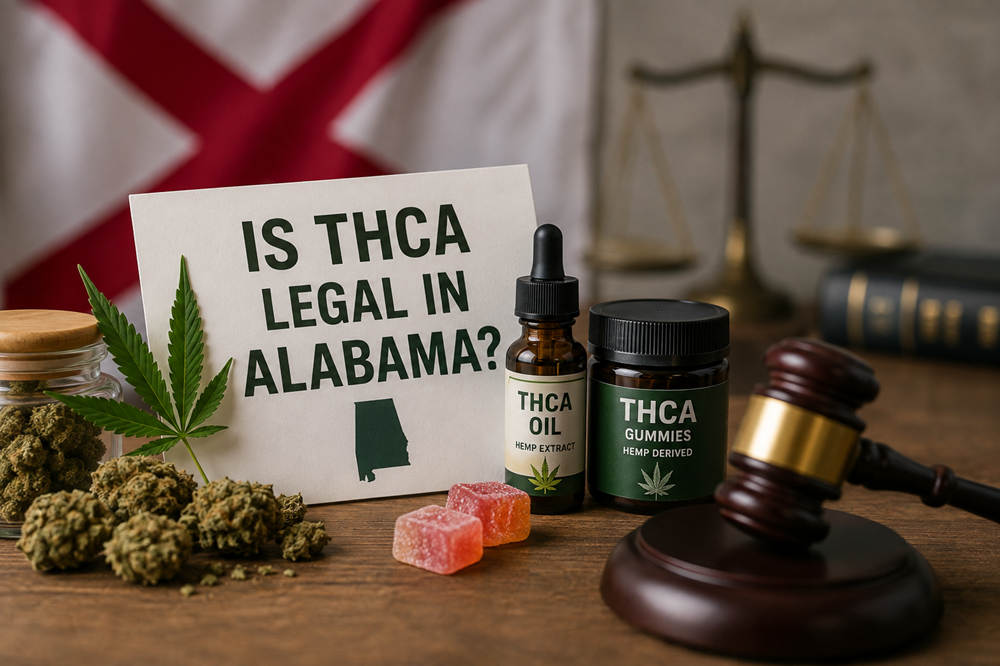
Is THCA Legal in Alabama? What the 2026 Law Actually Allows
Updated August 9, 2026. THCA is not broadly legal in Alabama simply because a product contains no more than 0.3% delta-9 THC. Alabama now regulates finished hemp products under a stricter system that considers the type of product, its Total THC content, testing, packaging, where it is sold, and the buyer’s age.
For consumers, the most important distinction is straightforward: THCA flower, hemp buds, joints, pre-rolls, and similar smokable hemp products marketed to consumers are prohibited in Alabama. Certain non-smokable hemp-derived products can still be sold if they meet the state’s requirements.
There is another date worth watching. A major change to the federal definition of hemp is scheduled to take effect on November 12, 2026, which could further restrict hemp-derived cannabinoid products that currently fit within Alabama’s state rules.
Is THCA Legal in Alabama Right Now?
As of August 9, 2026, the answer depends primarily on the form of the product.
| Product | General Alabama Status |
|---|---|
| THCA flower or buds marketed to consumers | Prohibited |
| Hemp joints and pre-rolls | Prohibited |
| Other smokable hemp flower | Prohibited |
| Compliant hemp edibles | Potentially legal |
| Compliant hemp beverages | Potentially legal |
| Compliant sublingual products | Potentially legal |
| Products exceeding Alabama’s Total THC limits | Not compliant for legal retail sale |
Alabama’s current framework comes from Act 2025-385, which became operative for consumable hemp products on January 1, 2026. The law created a regulated market overseen by the Alabama Alcoholic Beverage Control Board while specifically excluding certain products from that market.
That means the familiar claim that “THCA is legal because it has less than 0.3% delta-9 THC” does not accurately describe Alabama law.
Why THCA Flower Is Prohibited in Alabama
Alabama specifically excludes smokable hemp products from its definition of legal consumable hemp products.
The statute describes smokable hemp products as including plant products or raw hemp material marketed to consumers as hemp cigarettes, cigars, joints, buds, flowers, leaves, ground flowers, or variations of those terms. The definition applies whether the cannabinoid involved is psychoactive or non-psychoactive.
For that reason, consumer products sold as “THCA flower,” “hemp buds,” or similar smokable raw plant material fall squarely within the type of products Alabama sought to prohibit.
The possession rule is also unusually important. Alabama law states that the sale or possession of a hemp product specifically excluded from the definition of a consumable hemp product is prohibited, and a violation of that provision is classified as a Class C felony.
This penalty should not be interpreted to mean that every technical violation of Alabama’s hemp regulations automatically becomes a Class C felony. The provision specifically addresses products excluded from the legal consumable-hemp category, including the smokable hemp products described above.
Alabama Uses Total THC, Not Just Delta-9 THC
THCA stands for tetrahydrocannabinolic acid. It is an acidic cannabinoid naturally present in cannabis and can convert into THC when exposed to heat through decarboxylation.
This matters because a product can contain relatively little measured delta-9 THC while containing much more THCA.
Alabama’s testing law directly addresses that distinction. Independent laboratories testing consumable hemp products must measure Total THC as THC + THCA.
As a result, looking only at the delta-9 THC percentage on a product is not enough to determine whether a regulated hemp product complies with Alabama law.
Why the Federal 0.3% Rule Does Not Give the Full Answer
Under federal law currently in effect in August 2026, hemp is still generally defined by a delta-9 THC concentration of no more than 0.3% on a dry-weight basis. That definition helped create the market for products containing large amounts of THCA but relatively little measured delta-9 THC.
Even federal hemp-production testing, however, is not based solely on the immediate delta-9 reading. USDA laboratory guidance requires testing methods that account for the potential conversion of THCA into THC when determining total THC concentration in hemp crops.
More importantly, federal hemp status does not prevent Alabama from regulating how finished hemp products may be possessed or sold within the state. Alabama’s smokable-hemp prohibition and consumable-hemp rules therefore remain important even when a seller describes a product as “Farm Bill compliant.”
Which Hemp-Derived Products Can Still Be Sold?
Alabama did not prohibit every finished product containing hemp-derived cannabinoids. Instead, the state created a licensed market for qualifying consumable hemp products.
Potentially permitted products include certain edibles, beverages, topical products, and sublingual products. To qualify for sale, a product must meet requirements that include laboratory testing, Total THC limits, approved packaging and labeling, and sale through an authorized Alabama retailer.
The Alabama ABC Board’s consumable hemp program currently lists separate retail license categories for specialty retailers, pharmacies, and qualifying retail food stores.
A product therefore cannot be assumed legal merely because it comes in gummy, beverage, tincture, or another non-smokable form. Its actual composition and compliance with Alabama’s rules still matter.
What Are Alabama’s THC Limits?
For products that qualify as consumable hemp, Alabama establishes specific Total THC limits:
- Edibles and beverages: No more than 10 milligrams of Total THC per serving.
- Edible cartons: No more than 40 milligrams of Total THC in the entire carton, with edible products individually wrapped in single-serving packaging.
- Topical, sublingual, and other qualifying products: No more than 40 milligrams of Total THC per container.
- Beverages: A serving may contain no more than 12 fluid ounces, and a carton may contain no more than four 12-ounce containers.
Because Alabama requires testing for Total THC as THC plus THCA, THCA content is relevant when determining whether a finished product meets these limits.
You Must Be 21 or Older to Buy Consumable Hemp Products
Alabama restricts retail sales of consumable hemp products to adults who are at least 21 years old. Retail employees must verify the customer’s age before completing the sale.
Most specialty consumable-hemp establishments are also restricted to people 21 and older. The law makes exceptions to the general store format for qualifying pharmacies selling certain topical and sublingual products and qualifying retail food stores selling approved beverages.
Consumers looking for a legitimate seller can use information published through the Alabama ABC Board, which administers the state’s consumable-hemp retail licensing system.
Can You Order THCA Online in Alabama?
Alabama prohibits online sales and direct shipment of consumable hemp products to Alabama residents.
The law also prohibits direct delivery and drive-through sales. It defines direct shipment as shipment of a consumable hemp product from a producer or retailer directly to an Alabama resident.
Legal retail purchases are designed to take place on licensed premises.
This is especially important for consumers shopping on national hemp websites. A company accepting an Alabama shipping address does not establish that the transaction complies with Alabama law. Seller availability and state legality are two different questions.
How to Recognize a Compliant Hemp Product
For non-smokable products that are eligible for Alabama’s regulated market, the packaging and laboratory documentation should provide several pieces of information.
Among other requirements, Alabama calls for a certificate of analysis tied to the product batch. Testing covers cannabinoid potency as well as contaminants such as heavy metals, residual solvents, microbial contaminants, mycotoxins, and certain agricultural chemicals.
Labels must include information such as:
- Ingredients
- A scannable barcode or QR code connected to the certificate of analysis
- Manufacture and expiration dates
- A batch number corresponding to the laboratory analysis
- The total amount of THC cannabinoids in the container
- Serving size
- THC cannabinoids per serving
- Required safety warnings
Packaging must also be child-resistant and cannot use certain designs or imagery likely to appeal to children.
These features can help consumers identify regulated products, but they are not a guarantee of legality by themselves. A COA or QR code cannot make prohibited smokable flower legal, nor can it cure a product that exceeds Alabama’s potency limits.
A Major Federal Hemp Change Is Coming November 12, 2026
Alabama’s current rules are not the only reason this subject needs to be treated carefully. Federal hemp law is scheduled to change on November 12, 2026.
Public Law 119-37, enacted November 12, 2025, provides that its hemp amendments take effect 365 days after enactment.
Once effective, the federal definition of hemp will use a total tetrahydrocannabinols concentration, including THCA, of no more than 0.3% on a dry-weight basis rather than relying solely on delta-9 THC for the basic plant definition.
The law also creates new exclusions for hemp-derived cannabinoid products. Among them, a final hemp-derived cannabinoid product containing more than 0.4 milligrams combined per container of total tetrahydrocannabinols, including THCA, and certain other cannabinoids with similar effects would fall outside the amended federal hemp definition.
That federal threshold is dramatically lower than Alabama’s current state limits for many consumable hemp products. Alabama’s law also expressly says that a federal law enacted after July 1, 2025 that conflicts with its consumable-hemp chapter supersedes the conflicting state provision.
For those reasons, the legal market could look substantially different after November 12, 2026. Congress could amend federal law again before the effective date, so readers checking this article later in 2026 should verify whether the scheduled change actually took effect as written.
What Else Changes in Alabama in 2026?
Alabama enacted another narrower hemp-related amendment in 2026. Act 2026-504 allows certain businesses holding specialty electronic nicotine delivery system retailer permits to qualify for consumable-hemp retailer licenses.
That amendment does not take effect until October 1, 2026. It changes retailer eligibility rather than reversing Alabama’s prohibition on smokable hemp or its Total THC standards.
Lawmakers also considered broader proposals during the 2026 legislative session that would have further changed the treatment of psychoactive hemp cannabinoids. Those proposals should not be confused with enacted law. Alabama’s 2026 regular session adjourned on April 9, and the existing consumable-hemp framework remains operative as of August 9, 2026.
Can THCA Cause a Positive Drug Test?
Yes. A product’s legal status does not make it safe for someone who must pass a drug test.
THCA can ultimately contribute to THC exposure and the metabolites conventional cannabis drug tests are designed to detect. Alabama’s own labeling rules require consumable hemp products to warn that use may result in a failed drug test because THC is present.
Anyone subject to workplace, military, probation, athletic, or other drug testing should not assume that a hemp label protects against a positive result.
THCA, Hemp, and Marijuana Are Not the Same Legal Question
The term “THCA” describes a cannabinoid, not a legal category that automatically determines whether a product may be sold or possessed.
Alabama has separate systems governing industrial hemp production, consumable hemp retail products, controlled substances, and medical cannabis. The Alabama Department of Agriculture and Industries administers the state’s industrial hemp program, while the Alabama ABC Board regulates the retail market for consumable hemp products.
For consumers, the practical lesson is that a package saying “hemp,” “THCA,” or “federally legal” does not settle the question. Product form, Total THC, state restrictions, and the way the product is sold all matter.
The Bottom Line: Is THCA Legal in Alabama?
THCA has only a limited legal pathway in Alabama in 2026. Consumer products marketed as THCA flower, hemp buds, joints, pre-rolls, and similar smokable raw hemp products are prohibited under Alabama’s consumable-hemp law. The law also prohibits possession of hemp products specifically excluded from its legal consumable-hemp category.
Certain non-smokable products can remain legal if they satisfy Alabama’s Total THC limits, testing, packaging, labeling, retail-licensing, and 21-and-older requirements. Alabama measures Total THC as THC plus THCA, so a low delta-9 THC result alone is not enough to establish compliance.
Online sales and direct shipment to Alabama residents are also prohibited.
Finally, the answer could change significantly on November 12, 2026, when a new federal hemp definition and finished-product restrictions are scheduled to take effect. Because cannabis and hemp laws are changing quickly, anyone dealing with a possession charge, commercial shipment, manufacturing decision, or other high-stakes legal issue should confirm the current statutes and obtain qualified legal advice rather than relying solely on general online information.