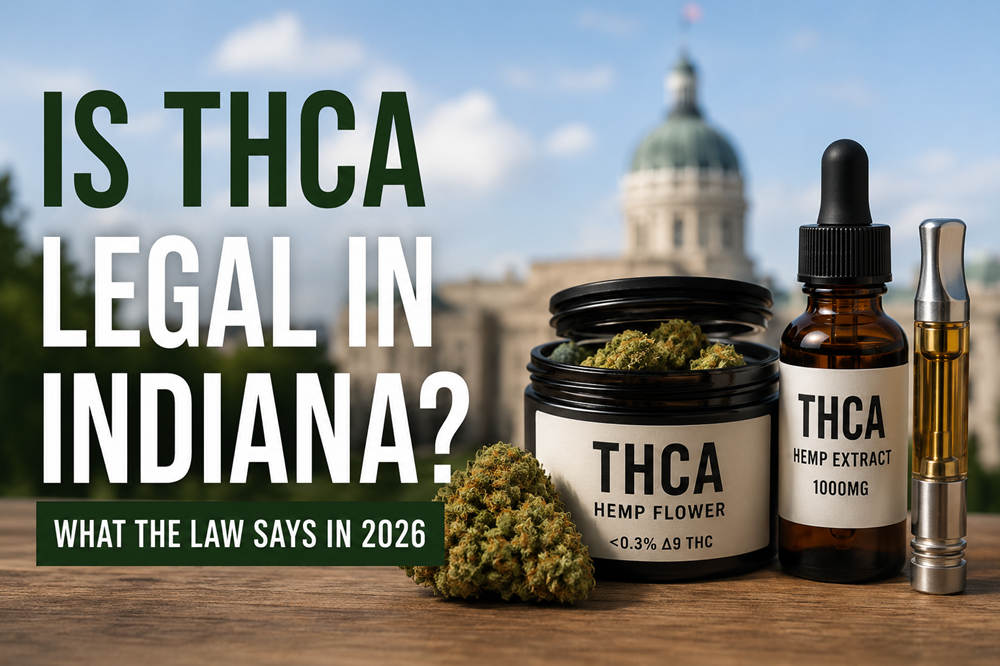
Is THCA Legal in Indiana? What the Law Says in 2026
THCA is not broadly legal in Indiana simply because a product contains less than 0.3% delta-9 THC. Indiana allows qualifying hemp, but state law separately prohibits possession, manufacture, and delivery of “smokable hemp,” a category that expressly includes hemp bud and flower. That makes THCA flower and many THCA pre-rolls especially problematic under Indiana law.
Other THCA products require a closer look at their cannabinoid content and product form. The rules are also approaching a major federal change: beginning November 12, 2026, the federal definition of hemp is scheduled to use total THC, expressly including THCA.
This guide reflects the law as of August 2026 and is intended for general information, not individual legal advice.
Is THCA Legal in Indiana? The Quick Answer
The answer depends heavily on the product.
THCA flower and other products that meet Indiana’s definition of smokable hemp are prohibited to possess, manufacture, or deliver. Indiana defines smokable hemp to include hemp bud and hemp flower when the product contains no more than 0.3% delta-9 THC, including THC precursors and derivatives, and is in a form that allows THC to enter the body through inhaled smoke.
Non-smokable THCA products are not automatically covered by that particular prohibition, but that does not make them automatically legal. Indiana’s definitions for hemp products, low-THC hemp extract, marijuana, and controlled substances still matter, especially when a product contains substantial amounts of THCA.
How Indiana’s Hemp Law Treats THCA
Under the current Indiana Code, hemp generally means Cannabis sativa L. and its parts and derivatives containing no more than 0.3% delta-9 THC on a dry-weight basis.
That basic definition resembles federal hemp law, but it does not answer every question about finished cannabis products sold in Indiana. State law creates additional categories that can impose stricter rules based on what the product contains and how it is intended to be used.
Why THCA Complicates the 0.3% Rule
THCA, or tetrahydrocannabinolic acid, is a naturally occurring cannabinoid and a chemical precursor to delta-9 THC. Heating THCA can convert part of it into delta-9 THC through decarboxylation.
As a result, a cannabis flower may test below 0.3% delta-9 THC while containing a much larger amount of THCA. Looking only at the delta-9 number can therefore give an incomplete picture of its potential THC content.
This distinction already matters for hemp cultivation. USDA hemp-testing rules require compliance laboratories to account for the potential conversion of THCA into THC when measuring total THC.
Those agricultural production rules do not mean every finished retail product is currently judged under a federal 0.3% total-THC definition. The federal statutory definition in effect before November 12, 2026 still uses delta-9 THC. That distinction is one reason THCA products have occupied such a complicated legal space.
Is THCA Flower Legal in Indiana?
THCA flower presents the clearest issue under Indiana law because the state’s definition of smokable hemp specifically includes hemp bud and hemp flower.
Indiana Code § 35-48-4-10.1 provides that a person who knowingly or intentionally manufactures, finances the manufacture or delivery of, delivers, or possesses smokable hemp commits dealing in smokable hemp, a Class A misdemeanor. Possession with intent to manufacture or deliver is covered as well.
That means a THCA flower product does not become lawful in Indiana merely because its certificate of analysis shows 0.3% or less delta-9 THC. If it fits the statutory definition of smokable hemp, Indiana’s separate prohibition applies.
Pre-rolls made with THCA or hemp flower raise the same basic concern because they are specifically prepared for combustion and smoke inhalation.
Indiana’s Smokable-Hemp Ban Has Been Challenged in Court
Indiana’s restrictions have already been the subject of federal litigation.
In C.Y. Wholesale, Inc. v. Holcomb, hemp businesses argued that the 2018 Farm Bill prevented Indiana from prohibiting smokable hemp.
The Seventh Circuit rejected the broader argument that federal law automatically prevented Indiana from regulating possession and sale within the state. The court explained that the Farm Bill’s express protection was much clearer when hemp was simply being transported through Indiana in interstate commerce.
Indiana law now expressly recognizes that distinction. Its smokable-hemp offense does not apply to certain shipments from an out-of-state licensed producer that remain in continuous transit through Indiana to a licensed handler.
That interstate-transit protection should not be confused with a general right for an Indiana consumer to possess THCA flower after it has been delivered to them.
What About THCA Gummies, Oils, Vapes, and Concentrates?
The smokable-hemp statute does not provide the entire answer for products that are not hemp flower. These products must be considered under Indiana’s other hemp and controlled-substance definitions.
THCA Gummies, Oils, and Other Extracts
Indiana defines “low THC hemp extract” more narrowly than someone looking only at delta-9 THC might expect. Among other requirements, the substance must contain no more than 0.3% total delta-9 THC, including precursors, by weight and must contain no other controlled substances.
That reference to precursors is particularly relevant to THCA. A product containing a high concentration of THCA may have difficulty fitting Indiana’s low-THC hemp-extract definition even when its measured delta-9 THC concentration alone is below 0.3%.
The definition also excludes smokable hemp and harvested reproductive material from a female hemp plant.
For gummies, oils, tinctures, and similar products, the important question is therefore not simply whether the label says “hemp-derived.” The actual cannabinoid profile and the statutory category into which the product falls matter more.
THCA Vapes
A THCA vape should not be assumed legal merely because it does not contain conventional flower.
Indiana’s smokable-hemp definition specifically refers to THC entering the body through inhalation of smoke, which creates a distinction between combustion and vaporization. But being outside that particular definition would not itself establish that a high-THCA vape is lawful.
The cannabinoid concentration, extract definition, controlled-substance provisions, and other applicable product rules still need to be considered.
THCA Concentrates
Concentrates can contain much higher cannabinoid percentages than ordinary plant material. A concentrate marketed as “hemp-derived THCA” therefore cannot be evaluated only by its source or marketing language.
Its THCA concentration, delta-9 THC level, total potential THC, ingredients, and finished-product classification can all affect its legal status.
What Has the Indiana Attorney General Said About Hemp-Derived THC?
Indiana officials have generally taken a restrictive approach to certain intoxicating hemp-derived cannabinoids.
In Official Opinion 2023-1, the Indiana Attorney General concluded that several THC variants and designer cannabinoids, including delta-8 THC, delta-10 THC, THC-O, and THC-P, can fall within Indiana’s Schedule I controlled-substance provisions.
The opinion is useful context, but it should not be overstated. It is not a court ruling declaring every THCA product illegal, and THCA was not the principal cannabinoid analyzed. The more direct issue for THCA flower remains Indiana’s smokable-hemp statute, while extracts and other products must be considered under the relevant hemp and controlled-substance definitions.
Can You Order THCA Online in Indiana?
The fact that an online retailer accepts an Indiana shipping address does not prove that the product is legal to possess in Indiana.
This is particularly important with THCA flower. Federal law protects qualifying hemp moving through states in interstate commerce, and Indiana provides an exception for qualifying smokable-hemp shipments that remain in continuous transit through the state.
A package being transported through Indiana to a licensed handler elsewhere is different from an online order whose final destination is an Indiana consumer.
Retailers also make their own decisions about where they will ship products. A seller’s shipping map, “Farm Bill compliant” claim, or successful checkout process cannot override Indiana law.
What Happens if a Product Does Not Qualify as Hemp?
Indiana has not generally legalized adult-use marijuana. Under Indiana Code § 35-48-4-11, knowingly or intentionally possessing marijuana is generally a Class B misdemeanor, although prior drug convictions, quantities, and other circumstances can increase the potential offense level.
For THCA products, this means product classification matters. If cannabis material does not fall within an applicable hemp exception, other marijuana or controlled-substance provisions may become relevant.
Labels such as “legal hemp,” “THCA hemp,” or “2018 Farm Bill compliant” do not determine legal status by themselves. Nor does a certificate of analysis act as a legal permit.
Federal THCA Law Changes on November 12, 2026
A significant federal change is already scheduled to take effect later in 2026.
The Federal Rule Before November 12, 2026
The federal hemp definition currently uses a limit of no more than 0.3% delta-9 THC on a dry-weight basis.
That language helped support the commercial argument behind high-THCA hemp: cannabis could contain little measured delta-9 THC while retaining substantial THCA.
Federal cultivation testing has been more restrictive in practice because USDA compliance testing already accounts for THCA’s potential conversion into delta-9 THC. Even so, the statutory definition itself has remained focused on delta-9 THC.
THCA Will Be Included in the New Total-THC Limit
Congress amended the federal hemp definition in legislation enacted on November 12, 2025. The amendment is scheduled to become effective 365 days later, on November 12, 2026.
The forthcoming federal hemp definition will limit Cannabis sativa L. and its derivatives to no more than 0.3% total tetrahydrocannabinols, including THCA, on a dry-weight basis.
This is a major change for high-THCA flower. A product containing substantial THCA will no longer be able to rely on a low delta-9 THC result alone when determining whether it fits the federal hemp definition.
The amended law also excludes certain final hemp-derived cannabinoid products containing more than 0.4 milligrams combined total per container of total THC, including THCA, and other cannabinoids determined to have similar effects.
Unless Congress modifies or delays these provisions, the federal definition will therefore become substantially more restrictive for many products currently sold as high-THCA hemp.
Did Indiana Change Its Hemp Law in 2026?
Indiana lawmakers considered additional restrictions on hemp-derived cannabinoid products during the 2026 legislative session, including Senate Bill 250.
However, proposals in an introduced or partially advanced bill should not be confused with current law. The Indiana General Assembly’s record for SB 250 shows its latest listed action in the House in February 2026 rather than enactment into law.
For consumers, the rules that matter today are the statutes actually in force, together with the federal changes already scheduled for November 12, 2026.
How to Read a THCA Certificate of Analysis
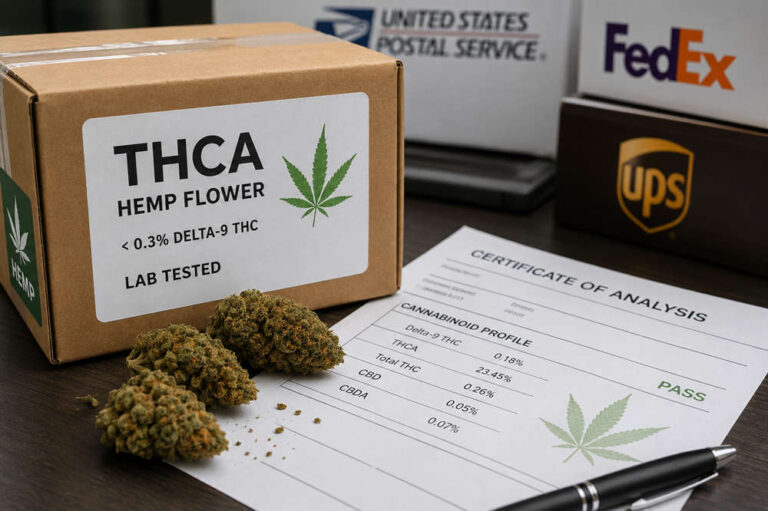
A certificate of analysis, or COA, can help identify what is actually in a product. Useful information to check includes:
- Delta-9 THC: the measured concentration of delta-9 THC.
- THCA: the amount of tetrahydrocannabinolic acid present.
- Total THC: a calculation accounting for both THC and the potential conversion of THCA.
- Batch number: the report should correspond to the product being sold.
- Testing date: an old test may not describe a current batch.
- Laboratory information: the testing facility should be clearly identified.
A COA is evidence about chemical composition, not a guarantee of legality. A flower can have a low measured delta-9 THC result and still fall within Indiana’s prohibited smokable-hemp category.
What Indiana Consumers Should Know
- THCA flower is the clearest legal concern. Indiana’s smokable-hemp definition expressly includes hemp flower and bud.
- Non-smokable does not automatically mean legal. High-THCA extracts can raise separate issues under Indiana’s low-THC hemp-extract and controlled-substance definitions.
- Online availability proves little. A retailer’s willingness to ship to Indiana is not a legal determination.
- A COA cannot override state law. Laboratory testing identifies cannabinoid content but does not grant permission to possess a prohibited product.
- Rules change across state lines. A cannabis product legally purchased in another state can still create legal problems once brought into Indiana.
- November 12, 2026 is an important federal deadline. The federal hemp definition is scheduled to begin counting THCA within the 0.3% total-THC limit.
Anyone dealing with an actual criminal charge, seizure, business-compliance dispute, or other specific legal situation should consult an attorney familiar with Indiana cannabis and hemp law.
The Bottom Line
THCA is not simply legal throughout Indiana whenever delta-9 THC is 0.3% or less. Indiana’s smokable-hemp law specifically reaches hemp flower and bud and makes knowing or intentional possession, manufacture, or delivery of qualifying smokable hemp a Class A misdemeanor.
Other THCA products are more product-specific because their legality depends on composition and how they fit Indiana’s hemp-extract and controlled-substance definitions. And beginning November 12, 2026, federal law is scheduled to make the distinction considerably narrower by expressly counting THCA toward a 0.3% total-THC hemp limit.
For Indiana consumers, a “hemp-derived” label, low delta-9 number, online shipping policy, or laboratory certificate should never be treated by itself as proof that a THCA product is lawful.