Can You Ship THCA? Federal Rules, Carrier Policies, and State Restrictions
This article provides general educational information and is not legal advice.
THCA products can sometimes be sent through domestic parcel networks, but a label describing a product as “hemp” does not automatically make it lawful or acceptable to a carrier. The answer depends on the product’s cannabinoid content, its production history, the laws at both ends of the shipment, and the policy of the selected carrier.
Scheduled federal change: The federal hemp definition is scheduled to change on November 12, 2026. The new language will measure total tetrahydrocannabinols, expressly including THCA, rather than focusing only on the concentration of delta-9 THC. The discussion below distinguishes the rules currently in effect from that approaching change.
Can You Legally Ship THCA?
A THCA product may sometimes be shipped through an ordinary domestic parcel service when it legally qualifies as hemp and complies with the carrier’s conditions and the laws in the origin and destination jurisdictions.
Under the federal definition currently in effect, hemp includes cannabis plants and derivatives containing no more than 0.3% delta-9 THC on a dry-weight basis. Cannabis outside that definition may be treated as marijuana under federal law.
Marijuana cannot ordinarily be sent across state lines through USPS, UPS, or FedEx simply because it is permitted under a state medical or adult-use cannabis program. State-licensed delivery within a state is a separate issue governed by that state’s cannabis laws and is not the same as ordinary interstate parcel shipping.
For a hemp shipment, the sender must consider more than the delta-9 THC number on a retail laboratory report. The product must come from a lawful supply chain, remain permitted under applicable state rules, and meet the carrier’s current acceptance requirements.
Why THCA Creates a Legal Complication
THCA, or tetrahydrocannabinolic acid, occurs naturally in raw cannabis. It is chemically different from delta-9 THC, but heat can convert THCA into delta-9 THC through decarboxylation.
This relationship creates a distinction between the current statutory definition of hemp and the testing rules used during hemp production. The federal definition now refers to no more than 0.3% delta-9 THC on a dry-weight basis. USDA production testing, however, must account for the potential conversion of THCA into delta-9 THC.
USDA describes total THC with the following calculation:
Total THC = delta-9 THC + (THCA × 0.877)
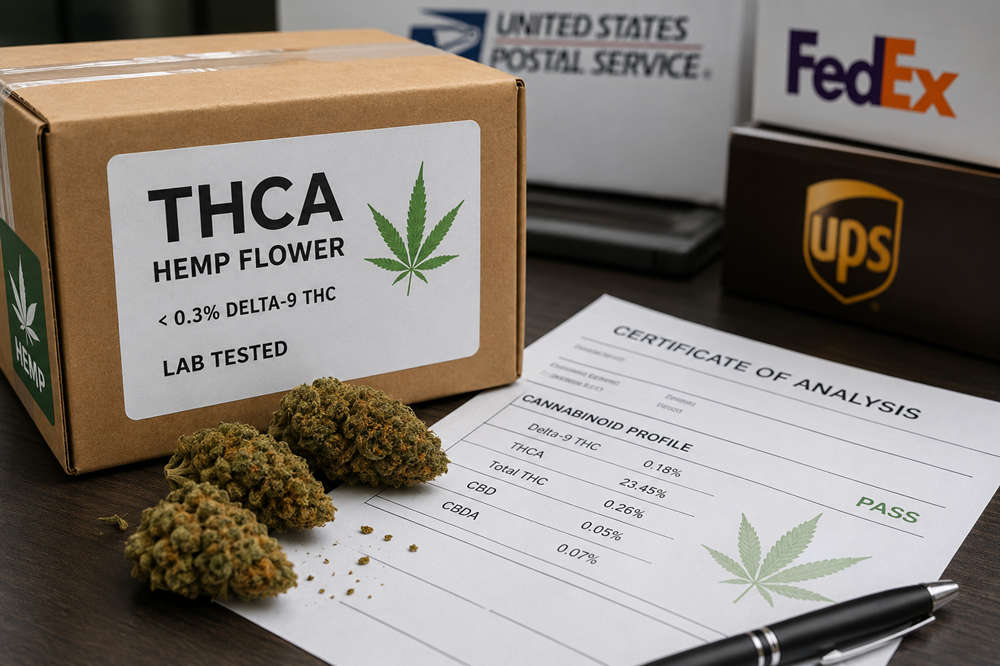
Licensed hemp producers are tested before harvest using a method that reflects this total available THC. A finished flower product may later carry a certificate of analysis showing less than 0.3% delta-9 THC while reporting a much higher concentration of THCA.
That retail result may describe the tested sample accurately, but it does not answer every legal question. It may not establish how the original crop was produced, whether the report matches the package being shipped, or whether the destination state permits high-THCA flower.
How Federal Shipping Rules Apply
The 2018 Farm Bill removed qualifying hemp from the federal definition of marijuana and established production systems administered through approved state, tribal, or USDA plans. To produce hemp lawfully, a grower must be licensed or otherwise authorized under one of those programs.
Federal regulations also protect the transportation of lawfully produced hemp through a state or tribal territory. A state generally may not stop compliant hemp merely because its own laws are more restrictive.
That transit protection does not necessarily authorize a sale or delivery within the state. A jurisdiction may still regulate the possession, processing, retail sale, online sale, or delivery of hemp-derived cannabinoid products at the destination.
What Changes on November 12, 2026?
Public Law 119-37, approved on November 12, 2025, changes the federal hemp definition 365 days after enactment. Unless Congress alters the provision before it takes effect, hemp will need to contain no more than 0.3% total tetrahydrocannabinols on a dry-weight basis, expressly including THCA.
This change is especially important for flower containing substantial THCA. A product with a low measured delta-9 THC concentration may still exceed the future total-THC threshold once its THCA content is included.
The law also creates separate exclusions for intermediate and final hemp-derived cannabinoid products. Among them is a limit of 0.4 milligrams per container for combined total tetrahydrocannabinols and certain other cannabinoids in final consumer products.
Several bills have been introduced to delay or repeal these provisions, but an introduced bill does not change the law unless it completes the legislative process and is enacted. Businesses and consumers should recheck the status before shipping near or after November 12, 2026.
USPS, UPS, and FedEx Policies
A product’s legal classification does not require a carrier to accept it. USPS applies federal mailability standards, while UPS and FedEx may impose narrower contractual restrictions.
USPS
USPS Publication 52 permits hemp and hemp-based products in domestic mail when the applicable THC concentration does not exceed the federal 0.3% limit and the sender complies with all relevant federal, state, and local laws.
The mailer must retain records establishing compliance for at least three years after the mailing date. USPS identifies laboratory reports, licenses, and compliance reports as examples of supporting records.
These documents generally do not have to be placed inside each package, but the sender must be able to produce them when requested. The package must also be prepared securely so its contents are not damaged or dislodged during transportation.
USPS prohibits hemp and hemp-based products in international mail, including shipments addressed to overseas APO, FPO, and DPO locations.
UPS
UPS treats hemp as a restricted category. A shipper must use a dedicated account, provide requested licensing information, and enter into an approved UPS agreement for the transportation of hemp.
All domestic UPS shipments containing hemp or hemp derivatives must use Adult Signature Required service. Raw hemp is accepted only from preapproved shippers and must be accompanied by test results showing less than 0.3% delta-9 THC on a dry-weight basis.
UPS also states that it will not accept hemp or hemp-derivative shipments from a location that sells marijuana or marijuana products. This restriction may affect a business that conducts hemp and state-licensed marijuana operations from the same premises.
Marijuana, synthetic cannabinoids, laboratory-made cannabinoids, and cannabinoid products intended for consumption through an aerosolized solution are prohibited under the relevant UPS policies.
FedEx
FedEx publicly states that customers cannot ship cannabis, THC, marijuana, or marijuana-derived CBD through its network, even when the substance is permitted under the laws of the origin or destination state.
The published FedEx guidance provides a limited exception for parcel shipments of hemp-derived CBD containing no more than 0.3% THC and complying with federal, state, and local rules.
That exception specifically discusses CBD. It does not provide equally clear authorization for high-THCA flower. The policy should therefore not be interpreted as permission to ship THCA merely because the product is advertised as hemp. A business considering FedEx should review the current service guide and obtain carrier approval before tendering such a package.
Why the Destination State Matters
Federal hemp status does not guarantee that a THCA product may be sold or delivered everywhere in the country. States have adopted different approaches to flower, inhalable hemp, potentially intoxicating cannabinoids, and products measured by total THC.
A destination jurisdiction may impose rules concerning:
- Total THC or post-decarboxylation testing
- THCA flower and other inhalable hemp products
- Minimum purchasing ages
- Online identity and age verification
- Adult signatures at delivery
- Serving-size or package limits
- Product registration and licensing
- Laboratory testing and label disclosures
- Child-resistant or tamper-evident packaging
The sender should examine the law where the business operates and where the package will be delivered. Local ordinances may add further limits in some cities or counties.
Online sellers often publish restricted-state lists, but those lists are not definitive summaries of state law. A business may decline a destination because of legal uncertainty, carrier conditions, insurance requirements, payment processing rules, or its own risk policy.
What Records May Be Needed?
Some records are expressly required by a carrier or regulator. Others are prudent business documents that help connect the package to a lawful supply chain.
Records That May Be Required
- Laboratory results: USPS may request records establishing compliance, while UPS requires test results for accepted raw-hemp shipments.
- Production licenses or authorizations: These can help establish that the source crop was produced under an approved hemp program.
- Carrier approval: UPS requires an approved agreement and qualifying account before accepting hemp shipments.
- State licenses or registrations: These may apply to manufacturers, processors, distributors, or retailers in particular jurisdictions.
Useful Supporting Records
- A batch-specific certificate of analysis: It should identify the laboratory, product or sample, batch number, test date, and cannabinoid results.
- A complete cannabinoid panel: Reporting delta-9 THC, THCA, and total THC provides more context than a single isolated result.
- Matching labels and invoices: The product name, lot number, quantity, and business information should be consistent across the package and records.
- Destination reviews: Businesses may document when they checked state rules and why a shipment was approved or declined.
A COA can support a compliance review, but it cannot override a state prohibition, a carrier restriction, an inaccurate label, or a disconnect between the tested sample and the product in the package.
Can THCA Be Shipped Internationally?
Domestic U.S. hemp rules should not be used as a basis for sending THCA internationally. Other countries may classify THCA, cannabis flower, or any detectable THC-related compound as a controlled substance.
International shipments are also subject to customs declarations, import laws, permits, carrier restrictions, and destination-specific testing standards. USPS prohibits hemp and hemp-based products in international mail, and private carriers may impose their own broader restrictions.
Describing the contents vaguely or concealing their nature does not make the shipment lawful and may create additional customs or criminal consequences.
What Buyers Should Check Before Ordering THCA Online
- Confirm that the seller serves your state. Avoid relying on broad claims that THCA is legal throughout the country.
- Match the COA to the product. The report should correspond to the name, batch, or lot being purchased.
- Read the full cannabinoid panel. Check delta-9 THC, THCA, and total THC rather than focusing only on the lowest figure.
- Check the test date. An old or generic report may not describe the current batch.
- Review delivery requirements. Determine whether age verification or an adult signature will be required.
- Look for transparent policies. A responsible seller should clearly disclose shipping exclusions, testing information, contact details, and delivery conditions.
- Recheck current rules. The legal status may change between the publication of an article and the date an order is placed.
A retailer’s decision to accept an order does not by itself establish that receiving the product is lawful in the buyer’s jurisdiction.
The Bottom Line
THCA can sometimes be shipped domestically when the product qualifies as lawful hemp, the destination permits it, and the selected carrier accepts it under its current rules.
USPS allows qualifying domestic hemp mailings when the sender follows applicable laws and retains records. UPS requires approved shippers, an agreement, and adult-signature service. FedEx’s public exception addresses qualifying hemp-derived CBD but does not clearly authorize THCA flower.
The answer will become more restrictive if the scheduled federal total-THC definition takes effect on November 12, 2026. Until then, every shipment should be evaluated according to the product, its documentation, the carrier, the destination, and the law in effect on the shipping date.