Is THCA Legal in South Carolina? What the Law Says in 2026
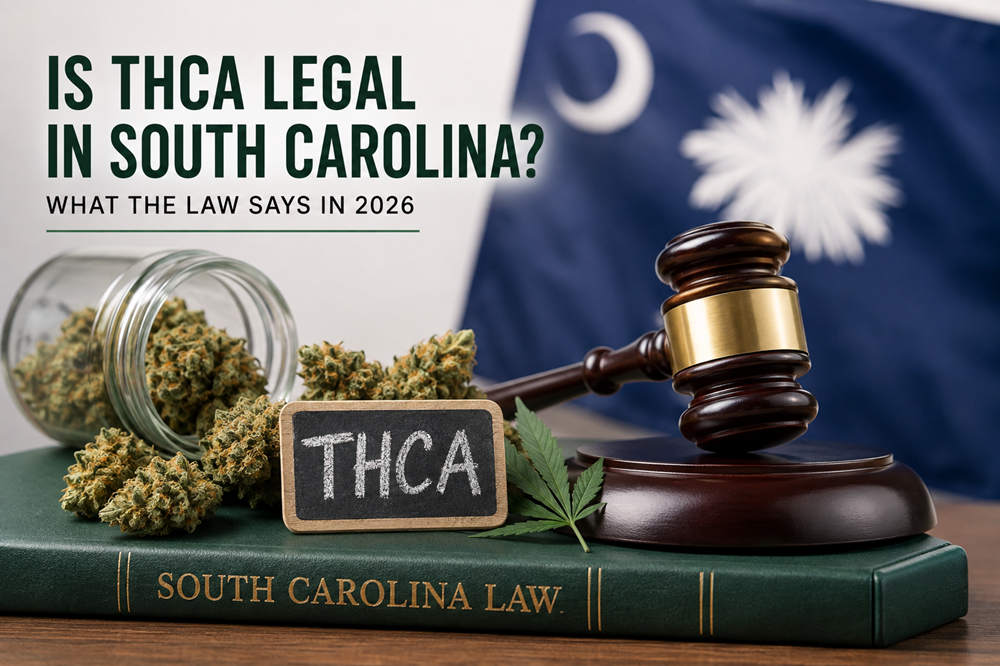
Is THCA legal in South Carolina? The answer is not a simple yes or no. South Carolina allows hemp that meets the applicable legal THC limit, but state law does not provide a clear THCA-specific retail safe harbor for high-THCA products. Hemp production is also subject to testing that accounts for THCA’s potential conversion into delta-9 THC.
That makes high-THCA flower and similar intoxicating products legally risky even when they are advertised as “hemp” or “Farm Bill compliant.” Recent South Carolina enforcement has reinforced that uncertainty, and federal hemp law is scheduled to change significantly on November 12, 2026.
Is THCA Legal in South Carolina in 2026?
South Carolina recognizes lawful hemp, but that does not automatically mean every product containing large amounts of THCA is legal to possess or sell.
The South Carolina Hemp Farming Act currently defines hemp by reference to the federally defined THC level. Under the present framework, that generally means cannabis containing no more than 0.3% delta-9 THC on a dry-weight basis.
That statutory language is one reason businesses have marketed cannabis with low measured delta-9 THC but high THCA as legal hemp.
However, South Carolina’s regulated hemp program uses post-decarboxylation testing that accounts for the THC potentially produced from THCA. State enforcement actions have also shown that authorities do not necessarily accept a THCA or hemp label as proof that a retail product is lawful.
The most accurate conclusion is therefore that high-THCA products should not be treated as unquestionably legal in South Carolina.
What South Carolina’s Hemp Law Actually Says
South Carolina defines hemp broadly enough to include the cannabis plant and its parts, derivatives, extracts, cannabinoids, isomers, acids, salts, and salts of isomers when they fall within the applicable THC limit.
The statute separately defines a “hemp product” as a commercially prepared product derived from or made by processing hemp or hemp plant parts. It states that unprocessed or raw plant material is not considered a hemp product.
This distinction needs to be read carefully. It does not mean that all raw hemp is automatically illegal. Rather, raw plant material is treated differently from a finished hemp product under the Hemp Farming Act.
That distinction matters for THCA flower because rules that apply specifically to finished hemp products should not automatically be treated as controlling every legal question involving raw cannabis material.
Why THCA Creates a Legal Problem
THCA, or tetrahydrocannabinolic acid, is a cannabinoid naturally produced by cannabis. It is the chemical precursor to delta-9 THC.
When THCA is heated, some of it converts into delta-9 THC through a process called decarboxylation. That is why cannabis flower can contain relatively little delta-9 THC when tested in one form while still containing enough THCA to produce substantially more THC when heated.
This chemistry is central to the THCA legal debate. A product may appear to satisfy a rule that looks only at its immediate delta-9 THC concentration while failing a standard that considers the amount of THC available after THCA conversion.
South Carolina Hemp Production Uses Total-THC Testing
The South Carolina Department of Agriculture states that hemp testing must measure delta-9 THC post-decarboxylation. In practical terms, this means the regulated hemp-production program considers total THC rather than simply looking at the amount of delta-9 THC present before THCA conversion.
The USDA’s hemp guidance explains the same concept. For licensed hemp production, total available THC is generally calculated using:
Delta-9 THC + (THCA × 0.877)
Hemp that exceeds the acceptable THC concentration under the production rules does not qualify as compliant hemp simply because its initial delta-9 THC reading is below 0.3%.
There is an important limitation to this point: agricultural production testing does not by itself answer every retail possession or sales question. USDA regulates hemp production, while finished products and retail commerce can involve other federal and state laws.
Still, the production standard explains why claims that high-THCA cannabis is automatically legal whenever delta-9 THC alone is below 0.3% are incomplete.
What the South Carolina Attorney General Has Said About Hemp-Derived THC
In an October 2021 legal opinion, the South Carolina Attorney General considered how the Hemp Farming Act interacts with the state’s controlled-substance laws.
The opinion focused primarily on delta-8 THC and THC isomers rather than issuing a specific ruling on THCA flower. It therefore should not be described as an Attorney General declaration that “THCA is illegal.”
What the opinion does show is a relatively narrow interpretation of the hemp exception. The Attorney General reasoned that THC remains controlled under South Carolina law unless it falls within a valid statutory exception and acknowledged that some parts of the state’s hemp laws are ambiguous.
Attorney General opinions provide legal guidance to public officials, but they are not statutes enacted by the General Assembly or binding appellate-court decisions. The legality of a particular product can still depend on its composition and the facts of the case.
Why THCA Flower Is Especially Risky
THCA flower creates more uncertainty than straightforward non-intoxicating hemp products for several reasons.
First, flower may contain a large amount of THCA even when its measured delta-9 THC concentration is comparatively low. That means its legal characterization can change depending on whether the relevant standard examines delta-9 THC alone or potential total THC.
Second, raw plant material does not fall within South Carolina’s statutory definition of a finished “hemp product.” That does not automatically make compliant raw hemp unlawful, but it means flower should not simply be treated the same way as a processed CBD product.
Third, South Carolina enforcement has included cannabis products marketed specifically as THCA.
Recent South Carolina Enforcement Has Included “THC-A” Products
South Carolina authorities have taken an increasingly visible enforcement approach toward allegedly unlawful intoxicating hemp products.
In March 2026, the South Carolina Attorney General announced indictments stemming from searches of distributors and vape shops as part of Operation Ganjapreneur.
According to the Attorney General’s announcement, laboratory testing was used to identify products authorities alleged contained marijuana or illegal amounts or types of THC. The products described in connection with the investigation included merchandise marketed with “THC-A” labeling.
An indictment is an allegation, not a conviction, and the announcement does not establish a statewide judicial ruling that every THCA product is illegal.
It does demonstrate something important for consumers and businesses: the fact that a product is openly sold or labeled THCA does not settle its legal status in South Carolina.
Does a COA Prove That THCA Is Legal?
A certificate of analysis, or COA, can provide useful information about a product’s cannabinoid profile, but it is not a legal guarantee.
A detailed COA may list delta-9 THC, THCA, total THC, the tested batch, sample date, and laboratory information. Those details can help a buyer understand what a laboratory reported about the tested sample.
However, a manufacturer’s COA does not bind regulators, police, prosecutors, or courts. If authorities test the product itself, those results may become more significant than the document supplied with the package.
The same principle applies to marketing phrases such as “Farm Bill compliant.” A label describes the seller’s position; it does not independently determine how the product will be classified under South Carolina law.
Can You Buy THCA Online and Ship It to South Carolina?
Online availability should not be treated as proof that a product is legal in South Carolina.
Federal law protects interstate transportation of hemp produced in accordance with applicable hemp-production requirements. But that protection depends on the material actually qualifying as lawful hemp. A retailer’s willingness to ship a product does not independently establish its legal status after it reaches South Carolina.
This distinction is especially important for high-THCA products because sellers may base their compliance claims primarily on delta-9 THC while state authorities or laboratories may examine the product differently.
Can You Travel With THCA in South Carolina?
Traveling with THCA flower can create practical problems because high-THCA hemp flower can look and smell like marijuana.
Packaging and laboratory paperwork may help identify what a seller claims the product is, but they cannot guarantee that law enforcement will accept that classification without further investigation or testing.
Anyone dealing with an actual seizure, arrest, probation condition, criminal charge, or other legal proceeding should obtain advice from a South Carolina attorney based on the specific circumstances.
South Carolina’s Proposed Hemp Law Has Not Taken Effect
The South Carolina General Assembly has spent much of the 2025-2026 session considering H.3924, legislation intended to regulate hemp-derived consumable products more explicitly.
Versions of the legislation define “total THC” to include delta-9 THC, THCA after conversion, and certain other intoxicating cannabinoids. The conference language also addresses smokable flower and pre-rolls.
Those provisions are important for understanding where South Carolina policy may be headed, but they are not current law as of August 2026.
On June 25, 2026, the Senate adopted the conference report, while the House rejected it 28-69. A motion to reconsider the House’s rejection remained on the House calendar afterward.
Until the legislative process produces an enacted law, the proposed THCA and smokable-hemp provisions in H.3924 should not be presented as existing legal requirements.
Federal THCA Rules Are Scheduled to Change November 12, 2026
A much clearer change is already scheduled under federal law.
Public Law 119-37, enacted November 12, 2025, changes the federal hemp definition effective 365 days after enactment. Unless Congress changes the law before then, the new definition takes effect on November 12, 2026.
The revised definition covers cannabis with no more than 0.3% total tetrahydrocannabinols, including THCA, on a dry-weight basis.
That is a significant change for high-THCA flower because federal law will expressly count THCA when determining whether cannabis meets the 0.3% hemp threshold.
The law also creates separate restrictions for hemp-derived cannabinoid products. Among other exclusions, a final hemp-derived cannabinoid product falls outside the new hemp definition if it contains more than 0.4 milligrams combined total per container of total tetrahydrocannabinols, including THCA, plus certain cannabinoids with similar effects as determined under the statute.
These product-level rules are separate from the 0.3% dry-weight standard for the cannabis plant itself. Both changes are scheduled to take effect at the same time.
THCA, Hemp, and Marijuana: What’s the Difference Legally?
| Product or Material | What to Know |
|---|---|
| Compliant hemp | Cannabis must meet the applicable legal THC standard and relevant production requirements. |
| CBD-dominant hemp product | May qualify as a lawful hemp product when properly derived, processed, and within applicable limits. |
| High-THCA flower | Legally uncertain and higher-risk because THCA can contribute substantially to total THC and enforcement has included products marketed as THC-A. |
| Marijuana | Remains prohibited under South Carolina law outside limited legal exceptions. |
The product name itself does not determine the legal category. What matters more is what the material contains, how it was produced, which legal definition applies, and how relevant authorities interpret and enforce those rules.
What South Carolina Consumers Should Know
- Do not assume high-THCA flower is clearly legal. South Carolina has no simple THCA-specific retail safe harbor.
- Delta-9 THC is not the only relevant number. Hemp-production testing accounts for THCA’s potential conversion into THC.
- Raw flower and finished hemp products are legally distinct concepts. The raw-material distinction alone does not determine whether cannabis qualifies as hemp.
- A product label or COA is not a legal ruling. Authorities may independently test or classify the actual product.
- H.3924 remains proposed legislation. Its THCA and smokable-hemp provisions should not be described as current law.
- Federal law is scheduled to become substantially stricter on November 12, 2026. The new hemp definition expressly counts THCA toward the total-THC limit.
So, Is THCA Legal in South Carolina?
South Carolina permits qualifying hemp, but high-THCA products occupy a much less certain legal position than the simple “under 0.3% delta-9 THC” claim often suggests.
The state’s current hemp statute still uses the federally defined THC level, while its agricultural hemp program tests for THC after accounting for THCA conversion. South Carolina authorities have also pursued cases involving products marketed as THC-A, although those enforcement actions should not be mistaken for a blanket court ruling on every THCA product.
For consumers, the practical takeaway is that high-THCA flower and similarly intoxicating products carry meaningful legal risk in South Carolina. That uncertainty is likely to narrow further on November 12, 2026, when federal law is scheduled to expressly count THCA toward the hemp THC limit.
This article reflects publicly available law and government guidance as of August 2026 and is intended for general informational purposes, not individual legal advice.