Is THCA Legal in Texas? What the 2026 Rules Mean
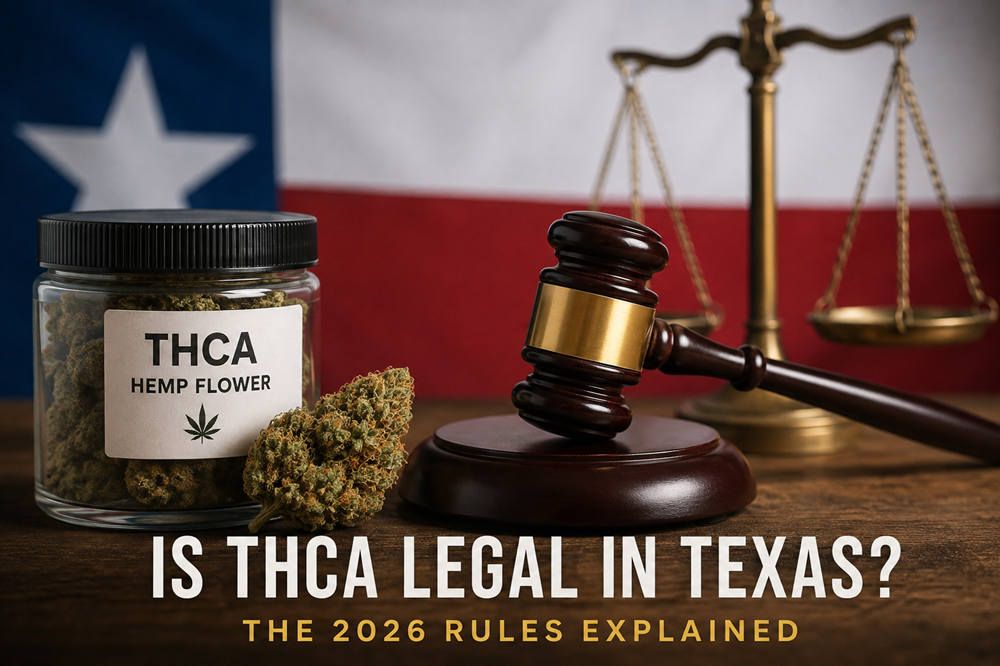
Texas has significantly tightened its rules for THCA and other consumable hemp products. Under regulations that took effect March 31, 2026, the Texas Department of State Health Services (DSHS) counts THCA when calculating a product’s total delta-9 THC.
In practical terms, most high-THCA flower and concentrates cannot meet Texas’s current consumable-hemp standard because their THCA content pushes total delta-9 THC above the permitted 0.3% level. However, saying that every product containing THCA is automatically illegal would go too far. The product’s actual cannabinoid concentrations, laboratory testing, and the part of Texas law being applied all matter.
The rules are also being challenged in court, and federal hemp law is scheduled to change again in November 2026. For that reason, the date of any THCA legal guidance is especially important.
Is THCA Legal in Texas Right Now?
Texas no longer treats a laboratory result showing less than 0.3% delta-9 THC by itself as enough to establish compliance for a consumable hemp product.
The state’s consumable hemp rules adopted in March 2026 use a total delta-9 THC standard. That calculation accounts for both delta-9 THC already present in the product and the delta-9 THC that could result from converting THCA.
A consumable hemp product must test within the state’s acceptable hemp THC level. The rules also address the sale, offering for sale, possession, distribution, and transportation of consumable hemp products that do not meet the required hemp and testing standards.
This makes high-THCA products particularly difficult to qualify as compliant hemp. A product can have less than 0.3% measured delta-9 THC yet still exceed the Texas threshold once its THCA is included.
What Is THCA?
THCA, short for tetrahydrocannabinolic acid, is a naturally occurring cannabinoid in cannabis. It is chemically different from delta-9 THC, but it is also the precursor from which delta-9 THC can form.
When THCA is heated, it can undergo decarboxylation and convert into delta-9 THC. Smoking, vaping, and cooking cannabis can promote that conversion.
That potential conversion explains why a regulator may look beyond the amount of delta-9 THC present in an unheated sample. Texas’s current rules account for THCA when calculating the product’s potential total delta-9 THC.
How Texas Calculates Total Delta-9 THC
When liquid chromatography is used and THCA remains intact during testing, Texas uses this formula:
Total delta-9 THC = (0.877 × THCA) + delta-9 THC
For example, consider flower containing 20% THCA and 0.2% delta-9 THC:
(20 × 0.877) + 0.2 = 17.74% total delta-9 THC
Although the product contains only 0.2% delta-9 THC before the calculation, its potential total is far above 0.3%. This illustrates why conventional high-THCA flower generally cannot meet the new standard.
Texas also requires laboratories to report measurement uncertainty. The acceptable hemp THC level is defined so that the laboratory’s uncertainty range must include a result of 0.3% or less. Compliance therefore is not always determined by looking at a single reported number without its uncertainty range.
What Changed in March 2026?
Texas’s hemp program dates to 2019. The Texas Agriculture Code defines hemp using a delta-9 THC concentration of no more than 0.3% on a dry-weight basis.
The regulatory test applied by DSHS to consumable hemp products became more restrictive in 2026. The March rules require testing for delta-9 THC, total delta-9 THC, and total THC and expressly include THCA when calculating total delta-9 THC.
The changes also expanded requirements involving laboratory reports, labeling, packaging, recordkeeping, inspections, and other parts of the consumable hemp market.
DSHS has since told Texas lawmakers that it is enforcing the March rules, including the inclusion of THCA in total delta-9 THC.
Does This Effectively Exclude THCA Flower?
For the high-THCA flower commonly sold for smoking or vaping, the total-delta-9 requirement is a major obstacle.
These products are typically marketed precisely because they contain substantial concentrations of THCA. Once most of that THCA is included in the total-delta-9 calculation, the resulting percentage generally exceeds 0.3% by a wide margin.
That is different from saying that all hemp flower is prohibited. The DSHS guidance for consumable hemp products explains that retail sale and wholesale distribution of certain smoking products manufactured outside Texas can still occur when the products otherwise comply with state requirements. Manufacturing or processing consumable hemp products for smoking within Texas remains prohibited.
The deciding issue for THCA flower is therefore not simply that it is flower. It is whether the finished product satisfies the applicable cannabinoid-testing standard.
What Happened to Texas Senate Bill 3?
The 2025 debate over Senate Bill 3 is one reason older explanations of Texas hemp law can be confusing.
The Texas Legislature passed SB 3, which would have imposed broad restrictions on consumable hemp products containing THC. Governor Greg Abbott vetoed Senate Bill 3 in June 2025, so the legislation itself never became law.
The veto did not end efforts to tighten hemp regulation. In September 2025, Abbott issued Executive Order GA-56 directing state agencies to strengthen areas such as age verification, testing, labeling, packaging, and enforcement.
The March 2026 regulations followed that broader regulatory effort. As a result, saying only that “Texas’s THC ban was vetoed” no longer gives an accurate picture of the current rules.
The Texas THCA Rules Are Still Being Challenged
Hemp businesses and industry organizations have challenged portions of the March regulations, arguing in part that DSHS exceeded the authority given to it by the Texas Legislature when it adopted the broader THC-testing framework.
A trial court temporarily blocked challenged provisions in spring 2026. On June 5, the Fifteenth Court of Appeals declined to keep the temporary injunction in place, allowing the rules to operate again while the dispute continues. The ongoing Texas hemp court challenge remains important because a later ruling could affect how the regulations are applied.
The practical point for consumers is that the court dispute has not made the March rules disappear. DSHS currently says it is enforcing them.
Can You Still Buy THCA in Texas?
THCA products may still appear on websites or in stores, but availability does not by itself prove that a particular product complies with current Texas requirements.
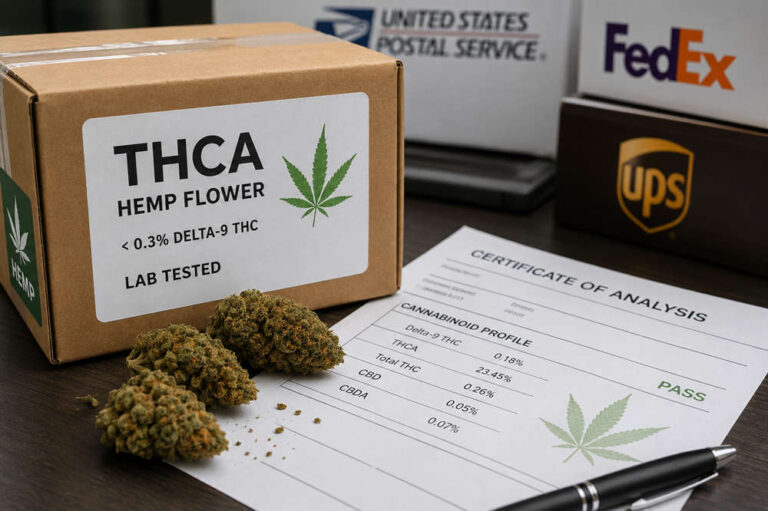
Consumers should pay attention to the certificate of analysis, or COA, for the actual product batch. Current Texas testing rules require reports to include information such as delta-9 THC, total delta-9 THC, and total THC.
A label emphasizing “less than 0.3% delta-9 THC” can therefore leave out the most important part of the current Texas test. If the product has substantial THCA, its total delta-9 result may be much higher.
Texas also treats expired COAs as invalid. Products covered by an expired report must be retested and may be subject to detention or embargo.
Can THCA Be Shipped to Texas?
Ordering from an out-of-state website does not create an exemption from Texas requirements.
The state’s rules apply to consumable hemp products introduced into commerce in Texas and also address their distribution and transportation. A retailer being willing to ship a product to a Texas address is therefore not reliable evidence that the product meets Texas law.
Out-of-state manufacture can matter for smokable hemp because Texas permits retail sale and wholesale distribution of compliant smoking products manufactured elsewhere. Those products still have to satisfy applicable testing, labeling, and other requirements.
What About Gummies, Concentrates, and CBD Products?
Texas’s framework is based largely on the finished product’s composition and compliance rather than on a marketing name alone.
| Product Type | What Matters Under Current Texas Rules |
|---|---|
| High-THCA flower | Usually cannot meet the 0.3% total delta-9 THC standard because of its THCA concentration. |
| High-THCA concentrates | Face the same basic problem when THCA causes calculated total delta-9 THC to exceed the limit. |
| Hemp-derived edibles and beverages | Must satisfy applicable finished-product cannabinoid testing, labeling, packaging, and other requirements. |
| CBD products | Can remain within the consumable-hemp market when they meet applicable Texas requirements. |
Terms such as “hemp-derived,” “Farm Bill compliant,” or “legal hemp” should not substitute for the actual laboratory results.
Texas Also Requires Buyers to Be 21
Texas requires sellers of consumable hemp products to verify that customers are at least 21 years old using valid government-issued identification. The age requirement applies to consumable hemp products generally rather than only to THCA.
A separate cannabinoid development also took effect July 31, 2026. The Texas Consumable Hemp Program says only naturally occurring trace amounts of delta-8 THC are permissible under the state’s current controlled-substance scheduling position. That issue is separate from the total-delta-9 rule affecting THCA and should not be confused with it.
Federal Hemp Law Changes in November 2026
Texas’s changes come shortly before a major federal hemp-law shift.
Public Law 119-37, enacted November 12, 2025, is scheduled to amend the federal definition of hemp 365 days after enactment. The new definition uses a total-tetrahydrocannabinols threshold of no more than 0.3% on a dry-weight basis and expressly includes THCA.
The federal law also creates additional exclusions for hemp-derived cannabinoid products, including a limit affecting certain final products containing more than 0.4 milligrams combined per container of specified cannabinoids.
The federal framework is therefore not simply a copy of the Texas rule. It uses a similar total-THC concept but adds further restrictions for hemp-derived cannabinoid products.
Unless federal law changes again before the effective date, the new definition is scheduled to take effect November 12, 2026.
Texas Hemp Regulations and Criminal Drug Law Are Different Questions
It is important not to reduce every Texas THCA issue to the same legal question.
DSHS’s consumable-hemp rules expressly address more than retail sales. They govern circumstances involving the sale, offering for sale, possession, distribution, and transportation of consumable hemp products and require qualifying products to satisfy applicable hemp and laboratory-testing standards.
Criminal classification and prosecution under the Texas Controlled Substances Act are nevertheless separate legal matters. Texas’s statutory definition of hemp continues to refer to a delta-9 THC concentration of no more than 0.3% on a dry-weight basis, while the DSHS consumable-hemp regulations use the broader total-delta-9 calculation.
That difference is one reason statements such as “all THCA possession is legal” or “any THCA automatically results in an illegal marijuana product” are too broad.
Anyone dealing with a seizure, citation, arrest, criminal charge, or other individual enforcement matter should seek advice from a qualified Texas attorney rather than relying on a product label or general online article.
What Should Texas Consumers Check?
If a hemp product is being sold as compliant in Texas, several details are more useful than promotional claims on the package:
- Total delta-9 THC: Check the calculated total rather than relying only on measured delta-9 THC.
- THCA concentration: Significant THCA can substantially change the compliance result.
- Batch-specific COA: Make sure the laboratory report applies to the exact batch being sold.
- COA expiration: Texas rules state that expired certificates are not valid.
- Measurement uncertainty: The state’s acceptable THC level takes the laboratory’s uncertainty range into account.
- Current information: Texas hemp rules changed substantially in 2026, and federal law is scheduled to change again in November.
So, Is THCA Legal in Texas?
The most useful answer as of August 2026 is that most products deliberately made or sold with high concentrations of THCA cannot satisfy Texas’s current consumable-hemp THC standard.
DSHS now counts THCA when determining total delta-9 THC, and a qualifying consumable hemp product must fall within the state’s 0.3% standard after the required testing and measurement-of-uncertainty rules are applied. This makes conventional high-THCA flower and concentrates particularly difficult to qualify.
At the same time, Texas’s statutory hemp language, DSHS regulations, and criminal controlled-substance laws should not be treated as interchangeable. The agency rules are also the subject of continuing litigation.
The legal landscape may change again when the new federal hemp definition is scheduled to take effect on November 12, 2026. Until then, Texas consumers and businesses should rely on current laboratory results and current state guidance rather than older explanations based only on the pre-2026 delta-9 THC test.