THCP vs THCA: Potency, Effects, Chemistry, Safety, and Legal Differences
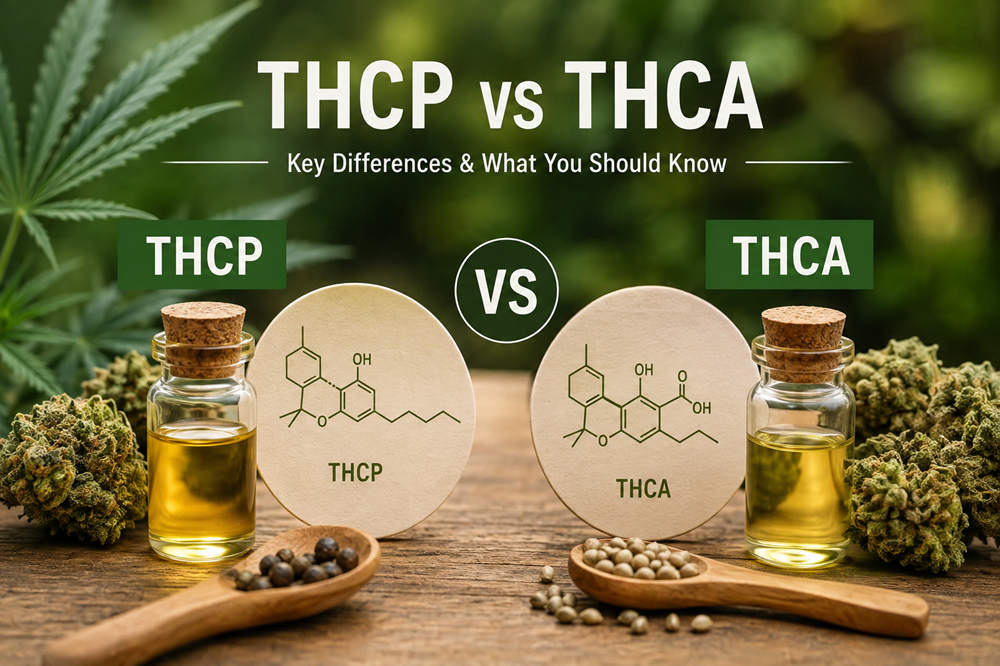
THCP and THCA have similar abbreviations, but they are very different cannabinoids. THCA is the acidic precursor that can convert into delta-9 THC when heated. THCP is a separate THC homolog with unusually strong binding affinity for cannabinoid CB1 receptors in laboratory research.
That distinction clears up two common misconceptions. THCP has not been proven to make people “33 times higher” than THC, and THCA-rich flower should not automatically be considered non-intoxicating if it will be smoked, vaped, or otherwise heated.
THCP vs THCA at a Glance
| Feature | THCP | THCA |
|---|---|---|
| Full name | Delta-9-tetrahydrocannabiphorol | Delta-9-tetrahydrocannabinolic acid |
| Occurs naturally in cannabis? | Yes | Yes |
| Relationship to THC | A distinct THC homolog with a longer alkyl side chain | The acidic precursor to delta-9 THC |
| CB1 activity | Very high binding affinity in laboratory research | Low affinity and efficacy compared with THC |
| Intoxicating potential | THC-like activity demonstrated in animal research; human potency is not established | THCA itself does not behave like THC at CB1, but heating can convert it into intoxicating THC |
| Effect of heating | Does not simply convert into ordinary THC | Decarboxylates into delta-9 THC |
| Human research | Extremely limited | Chemically well characterized, but clinical research on THCA itself remains limited |
| Main safety uncertainty | Limited human dose, impairment, and toxicology data | THC exposure and impairment after decarboxylation |
What Is THCA?
THCA, or tetrahydrocannabinolic acid, is one of the major acidic cannabinoids produced by many cannabis plants. It is closely related to delta-9 THC but contains an additional carboxyl group that changes how the molecule behaves.
Fresh or minimally processed THC-dominant cannabis can contain much of its potential THC in the form of THCA rather than neutral delta-9 THC.
THCA Becomes THC When It Is Decarboxylated
When THCA undergoes decarboxylation, it loses carbon dioxide and becomes delta-9 THC. Heat greatly accelerates this reaction.
That is why smoking, vaping, baking, or otherwise strongly heating THCA-rich cannabis changes its cannabinoid profile. The cannabinoid concentrations measured in raw flower do not remain identical during consumption.
Some conversion can also occur more gradually during storage and processing, particularly when cannabis is exposed to heat over time.
Does THCA Itself Get You High?
THCA-A has shown low affinity and efficacy at CB1 and CB2 receptors compared with THC in experimental receptor research. That helps explain why THCA itself is not expected to produce the characteristic intoxication associated with delta-9 THC.
The way a THCA product is used is therefore critical. Raw THCA and a high-THCA flower that is being smoked are not equivalent exposures. During smoking or vaping, a substantial portion of the THCA can become THC.
What Is THCP?
THCP, short for delta-9-tetrahydrocannabiphorol, is a naturally occurring homolog of delta-9 THC. Researchers isolated and characterized it from cannabis in 2019.
The structure closely resembles ordinary THC, but one difference has attracted considerable scientific attention.
THCP Has a Seven-Carbon Side Chain
Delta-9 THC has a five-carbon alkyl side chain. THCP has seven carbons in this part of the molecule.
Side-chain length can strongly affect how THC-like compounds interact with cannabinoid receptors. In THCP’s case, the longer chain is associated with particularly strong CB1 binding.
What the Original THCP Study Found
In the original THCP research published in Scientific Reports, the cannabinoid had a measured CB1 binding affinity of approximately 1.2 nM. The THC comparison cited by the researchers was approximately 40 nM.
Because lower Ki values indicate stronger binding affinity in this type of experiment, the result represented roughly a 33-fold difference in CB1 receptor affinity.
The researchers also administered THCP to mice. It produced several effects associated with cannabinoid receptor activation, including reduced movement, decreased body temperature, catalepsy, and antinociceptive responses.
Those findings establish strong cannabinoid activity in laboratory and animal models. They do not establish an equivalent human potency ratio.
Is THCP Really 33 Times Stronger Than THC?
No human research has demonstrated that THCP produces 33 times the intoxication of THC.
The “33 times” figure refers specifically to receptor binding affinity. It describes how strongly THCP interacted with CB1 receptors in an in-vitro assay compared with the THC value used in the study.
Binding affinity is not the same measurement as subjective intoxication.
The effects of a cannabinoid in a person can depend on receptor activation, dose, absorption, metabolism, route of administration, product composition, tolerance, and individual physiology. Animal potency also cannot be converted directly into a human “times stronger” number.
For that reason, claims that THCP is “5 times,” “10 times,” or “33 times” stronger than THC should be treated cautiously unless the claim clearly states what type of potency is being measured.
There is currently no validated human THCP-to-THC intoxication ratio.
THCP vs THCA: Which Has Greater Intoxicating Potential?
The two cannabinoids reach THC-like effects through very different routes.
THCP directly shows high CB1 affinity and has produced THC-like effects in animal models. THCA-A itself shows low affinity and efficacy at CB1 compared with THC.
THCA’s major relevance to intoxication is its ability to become delta-9 THC when heated.
- THCP: a distinct THC homolog that directly interacts strongly with CB1 receptors in laboratory research.
- THCA: an acidic precursor that can become intoxicating delta-9 THC through decarboxylation.
That distinction is more useful than simply calling THCP “psychoactive” and THCA “non-psychoactive,” because a high-THCA product can become a significant source of THC during use.
THCA Does Not Turn Into THCP
THCA and THCP belong to different cannabinoid pathways.
When THCA is decarboxylated, it produces delta-9 THC. It does not become THCP.
THCP has its own acidic counterpart, tetrahydrocannabiphorolic acid, or THCPA. The original researchers identified THCPA alongside THCP and demonstrated its relationship to the neutral THCP molecule.
The simplified relationships are:
THCA → delta-9 THC
THCPA → delta-9 THCP
THCP is therefore not a stronger or more processed version of THCA.
How Much THCP Occurs Naturally in Cannabis?
THCP is a genuine phytocannabinoid rather than a molecule that exists only in laboratories. However, its natural abundance varies and should not be inferred from the concentration found in a commercial THCP product.
A 2021 study quantitatively examined THCP in six cannabis chemotypes representing 14 plants. THCP was detected in all 13 inflorescence samples from the THC-dominant chemotypes examined, while it was not detected in the CBD-dominant sample.
That research confirms that THCP can occur naturally across more than one cannabis genotype. It does not mean that cannabis flower naturally contains the concentrations found in products formulated specifically to deliver THCP.
A concentrated commercial THCP gummy, vape, or extract can therefore represent a substantially different type of exposure from encountering THCP as one component of the plant’s wider cannabinoid profile.
What Do We Know About THCP Safety?
Human safety data remain one of the largest gaps in THCP research.
There is not yet a strong body of controlled human research establishing predictable relationships among THCP dose, blood concentration, subjective effects, impairment, duration, or adverse reactions.
That uncertainty is particularly important when products contain concentrated THCP or combine it with other intoxicating cannabinoids.
A Serious Adverse-Event Case Has Been Reported
A 2025 case report described a patient who developed psychotic symptoms and attempted suicide after reportedly consuming a product labeled as containing 8 mg of delta-9 THCP. The patient was described as a regular user of conventional THC products without a previous history of psychotic symptoms.
A single case cannot establish how often such reactions occur or prove that THCP alone caused the event. Commercial-product composition and individual susceptibility can also complicate interpretation.
The report is nevertheless relevant because controlled human safety evidence for THCP remains so limited. Strong receptor activity should not be interpreted as evidence that concentrated THCP products have a well-understood safety profile.
Manufacturing Method and Product Composition Matter
The words “hemp-derived THCP” do not fully describe how a commercial cannabinoid product was made.
A product might contain cannabinoid isolated from plant material, concentrated during processing, or produced through chemical conversion from another cannabinoid. Those manufacturing routes are not chemically or legally interchangeable.
Laboratory testing is also important for concentrated cannabinoid products because the cannabinoid amount, unwanted reaction byproducts, residual solvents, and other contaminants can affect the final exposure.
What Are the Safety Considerations With THCA?
The primary practical safety issue with high-THCA products is conversion to THC during heating.
Once THCA becomes delta-9 THC, familiar THC-related effects become relevant, including impaired coordination and reaction time, altered attention and judgment, anxiety or panic in some people, and other dose-dependent adverse effects.
This distinction is particularly important for driving. A flower product with low measured delta-9 THC before heating should not be assumed to be non-intoxicating if it contains substantial THCA and is going to be smoked or vaped.
THCP vs THCA and Drug Testing
Drug testing is another area where simple yes-or-no claims are unreliable.
THCA-rich flower that is smoked or vaped can generate delta-9 THC, which the body subsequently metabolizes. Using high-THCA cannabis in this way can therefore create the same kinds of THC exposure that conventional cannabis testing is designed to identify.
THCP presents a less established testing picture.
Research on cannabinoid immunoassays shows that detection depends heavily on the assay and the compound being measured. In a 2024 whole-blood ELISA study, increasing the alkyl side-chain length of THC homologs generally reduced cross-reactivity with the tested cannabinoid assay.
A later urine study evaluating dozens of cannabinoid analogs and metabolites similarly found limited cross-reactivity for longer-chain parent THC homologs. Parent delta-9 THCP was not detected on the tested THC-carboxy immunoassay platforms under the study conditions.
That should not be interpreted to mean THCP use is guaranteed to escape drug testing. Immunoassays are screening tools, laboratories use different methods, and THCP metabolism is still being characterized. A 2026 study using human liver systems identified metabolic pathways for THCP and other THC homologs, but potential testing biomarkers remain an evolving area of forensic research.
There is therefore no reliable basis for promising that a particular THCP product will or will not produce a positive result on a specific drug test.
Are THCP and THCA Legal?
U.S. cannabinoid law is particularly complicated in 2026. The manufacturing method, cannabinoid concentration, product type, and state all matter.
The Current Federal Hemp Definition Still Uses Delta-9 THC
As of August 9, 2026, the currently operative federal statutory definition of hemp still describes cannabis and its derivatives containing no more than 0.3% delta-9 THC on a dry-weight basis.
That does not mean THCA is ignored everywhere in the existing regulatory framework.
For hemp production, USDA laboratory guidelines require total-THC testing using post-decarboxylation or similarly reliable methods. The calculation must account for the potential conversion of THCA into THC.
In other words, the wording of the existing statutory hemp definition and the testing rules applied to hemp crops are related but not identical concepts.
The Federal Hemp Definition Is Scheduled to Change November 12, 2026
Congress enacted a substantially different hemp definition in Public Law 119-37 on November 12, 2025. Section 781 states that the amendments become effective 365 days after enactment, making the scheduled effective date November 12, 2026.
Under the new definition, hemp is based on a total tetrahydrocannabinol concentration of no more than 0.3% on a dry-weight basis, explicitly including THCA.
The law also excludes certain intermediate and final cannabinoid products containing cannabinoids that are capable of occurring naturally in cannabis but were synthesized or manufactured outside the plant.
For final hemp-derived cannabinoid products, the statute establishes a limit of greater than 0.4 milligrams combined total per container for total tetrahydrocannabinols, including THCA, together with certain other cannabinoids determined to have or be marketed as having similar effects.
That is a per-container quantity, not a 0.4% concentration limit.
Several bills have been introduced seeking to repeal or delay these changes, but introduced legislation does not change the effective law unless it is enacted. Because the scheduled implementation date is approaching, the federal status should be checked again for articles or purchasing decisions made after November 12, 2026.
DEA’s Chemical-Conversion Position Adds Another Issue
Manufactured THC-like cannabinoids raise a separate Controlled Substances Act question.
In a May 2026 final rule specifically addressing HHC, the Drug Enforcement Administration reiterated its broader interpretation of the existing hemp exclusion.
DEA stated that tetrahydrocannabinols produced through chemical conversion are considered synthetically produced for purposes of the Controlled Substances Act, even when the material used to make them came from hemp. Under the agency’s interpretation, those compounds do not qualify as “tetrahydrocannabinols in hemp.”
The rule itself specifically lists HHC, so it should not be described as a THCP-specific regulation. Its broader discussion of chemically converted tetrahydrocannabinols is nevertheless relevant when evaluating how commercial minor cannabinoids are manufactured.
State Laws Can Be Stricter
Federal law is only part of the legal analysis. States can separately restrict intoxicating hemp cannabinoids, THCA products, THC analogs, manufacturing methods, product concentrations, age limits, and retail sales.
A product being sold or described as “hemp-derived” is therefore not enough to establish that it is lawful in every jurisdiction.
THCP vs THCA: The Bottom Line
THCP and THCA are fundamentally different cannabinoids.
THCA is the acidic precursor to delta-9 THC. THCA-A itself has low affinity and efficacy at CB1 compared with THC, but heating THCA-rich material can generate intoxicating delta-9 THC.
THCP is a separate THC homolog with a seven-carbon side chain and unusually strong CB1 receptor affinity. The widely repeated “33 times stronger” figure comes from an in-vitro receptor-binding comparison, not from a human study showing 33 times greater intoxication.
Human THCP research remains sparse, so reliable dose equivalence, duration, impairment, and safety ranges have not been established. Commercial formulations add further uncertainty because concentration and manufacturing method can differ substantially from naturally occurring cannabis chemistry.
The legal comparison is also changing. Current federal hemp law and USDA crop-testing rules treat THC measurements differently, while a new federal definition explicitly incorporating THCA and additional cannabinoid-product restrictions is scheduled to take effect on November 12, 2026 unless federal law changes before then.
For both THCP and THCA, understanding the chemistry, how the product is used, how it was manufactured, and what current law says is more informative than relying on the cannabinoid name alone.