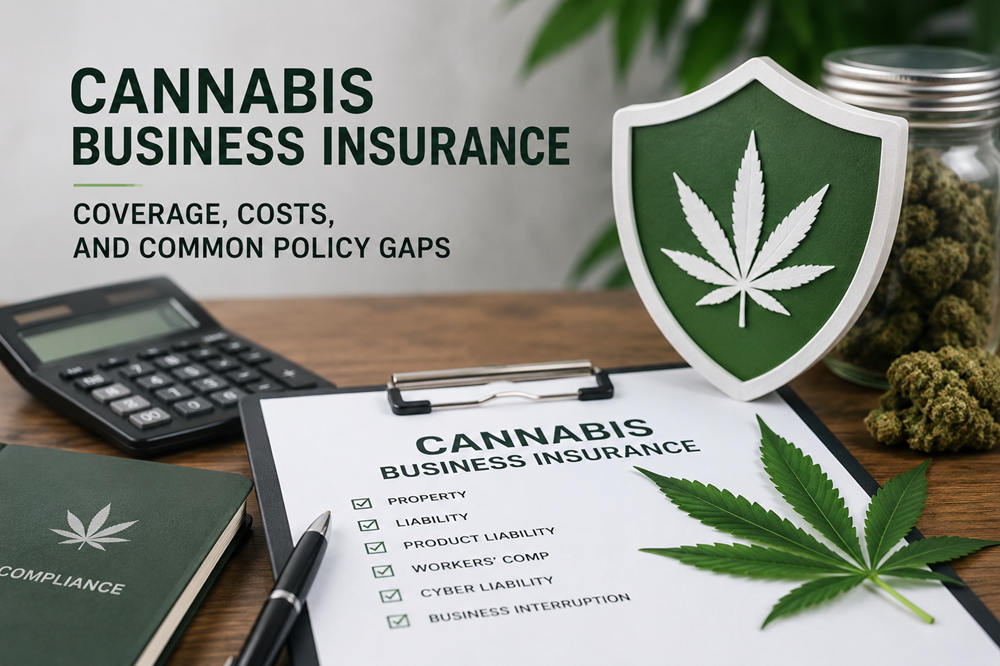
Cannabis Business Insurance: Coverage, Costs, and Common Policy Gaps
Cannabis businesses face many familiar commercial risks, including fires, workplace injuries, theft, vehicle accidents, data breaches, and customer lawsuits. They also handle regulated products, valuable inventory, specialized equipment, living plants, and—in some cases—large amounts of cash.
Cannabis business insurance is designed to address this combination of conventional and industry-specific exposures. It is not a single policy, however. A dispensary, cultivation facility, testing laboratory, manufacturer, and delivery service will usually need different forms of protection.
The most important question is not simply whether a business has insurance. It is whether the policy definitions, limits, and exclusions match what the company actually does.
What Is Cannabis Business Insurance?
Cannabis business insurance is a collection of commercial policies written or adapted for companies involved in the cultivation, production, testing, distribution, sale, or transportation of cannabis products.
A complete insurance program may combine general liability, commercial property, product liability, workers’ compensation, commercial auto, cyber insurance, crime coverage, and other specialized policies. The right combination depends on the company’s operations rather than the word “cannabis” appearing in the policy’s name.
This type of insurance should not be confused with personal health insurance or medical cannabis reimbursement. Cannabis business insurance protects an organization from operational losses and liability claims.
Ordinary small-business coverage may not be enough. A standard policy could insure office furniture and computers while excluding cannabis plants, finished products, extraction activities, or claims connected to controlled substances. Businesses should therefore disclose their cannabis-related activities and confirm how the policy defines covered property, products, and services.
Why Cannabis Companies Often Need Specialized Coverage
Cannabis remains subject to conflicting state and federal laws in the United States. A company may be licensed to operate under state and local rules while still encountering federal restrictions that affect banking, contracts, insurance, and other financial services.
This legal uncertainty has limited participation by some conventional insurers. According to the National Association of Insurance Commissioners, insurance capacity has improved, but much of the commercial coverage for cannabis-related businesses remains in the non-admitted market.
Non-admitted coverage, commonly called surplus-lines insurance, is used for specialized or unusual risks that admitted insurers may decline to cover. These insurers must generally be eligible to accept surplus-lines business under applicable state rules, even though they are not admitted in the policyholder’s state.
The surplus-lines market can provide valuable coverage that is difficult to obtain elsewhere. However, policy forms and rates may receive less regulatory review, and policyholders generally do not receive state guaranty-fund protection if the insurer becomes insolvent.
Cannabis operations can also present complex underwriting questions. Insurers may need to evaluate high-powered electrical systems, irrigation equipment, extraction methods, product testing, security controls, cash handling, delivery vehicles, employee training, and the value of plants at different growth stages.
Core Types of Cannabis Business Insurance
Each insurance policy addresses a different category of risk. Buying one form of coverage does not automatically provide the protection offered by another.
General Liability Insurance
Commercial general liability insurance covers specified claims involving third-party bodily injury, property damage, and personal or advertising injury.
For example, it can respond when a customer slips inside a dispensary or an employee accidentally damages property while working at an off-site event. The policy may cover legal defense costs, settlements, and judgments up to its limits.
General liability should not be assumed to cover injuries allegedly caused by cannabis products. Product-related claims may require separate coverage.
Product Liability Insurance
Product liability insurance addresses claims alleging that a cannabis product caused injury, illness, or property damage. It can apply to flower, edibles, concentrates, beverages, tinctures, vape products, and topicals, depending on the policy.
Claims may involve contamination, inaccurate labeling, unexpected potency, defective packaging, foreign materials, or inadequate warnings. Retailers can also be named in product lawsuits even when another company manufactured the item.
Product Recall Insurance
Product recall insurance covers a different set of expenses. It can help pay specified costs associated with removing a product from the market, notifying customers, transporting affected stock, destroying inventory, or managing a covered recall.
A product liability policy primarily addresses third-party claims. A company’s own recall expenses usually require a dedicated recall policy or endorsement.
Commercial Property Insurance
Commercial property insurance protects listed physical assets against covered causes of loss. These assets may include buildings, tenant improvements, furniture, security systems, machinery, computers, raw materials, and finished products.
The policy should clearly identify whether cannabis inventory is covered. Plants, harvested flower, extracts, packaged goods, and products owned by other companies may be treated differently or assigned separate sublimits.
Business Income Insurance
Business income insurance can replace part of the income lost when a covered property event temporarily interrupts operations. It may also pay specified continuing expenses during the restoration period.
This protection can be particularly important for companies that rely on specialized facilities or equipment. Restoring a cultivation room or replacing extraction machinery may take considerably longer than reopening an ordinary retail space.
Business income coverage usually applies only when the interruption results from a covered event under the associated property policy.
Crop and Living Plant Coverage
Cultivators may need coverage written specifically for cannabis plants. Standard property policies do not always treat living plants as ordinary business inventory.
A cannabis crop policy may separate seedlings, vegetative plants, flowering plants, harvested material, and finished stock. Limits or valuation methods can change as plants move through the growing cycle.
Coverage is commonly written for named or specified causes of loss. Mold, pests, disease, nutrient problems, gradual deterioration, and environmental fluctuations may be restricted or excluded.
Equipment Breakdown Insurance
Property insurance does not necessarily cover the internal failure of cultivation, refrigeration, ventilation, electrical, or manufacturing equipment. Equipment breakdown insurance can cover specified mechanical or electrical failures and the resulting physical damage.
Cultivators and manufacturers should also examine whether the policy addresses losses caused by utility interruptions, temperature changes, or the failure of climate-control systems.
Workers’ Compensation Insurance
Workers’ compensation covers qualifying job-related injuries and illnesses. Benefits can include medical treatment, partial replacement of lost wages, disability payments, and death benefits under state law.
Cannabis employees may work around agricultural equipment, chemicals, repetitive tasks, heavy products, hot machinery, wet floors, or security risks. Requirements depend on state law and the business’s employment structure.
Employment practices liability insurance is separate. It addresses certain claims involving discrimination, harassment, retaliation, wrongful termination, and other employment practices.
Crime and Cash Coverage
Cannabis businesses may hold substantial cash and compact, high-value inventory. Commercial crime insurance can cover selected losses involving robbery, employee dishonesty, forgery, computer fraud, and stolen money.
Cash coverage often carries specific limits and conditions. The policy may require approved safes, alarms, surveillance cameras, access controls, or documented cash-handling procedures.
Commercial Auto and Cargo Insurance
Commercial auto insurance covers listed vehicles and specified liability arising from business driving. Companies using employee-owned or rented vehicles may also need hired and non-owned auto coverage.
Products being transported require separate attention. Auto liability may cover injuries caused by a collision without covering cannabis inventory stolen from or damaged inside the vehicle. Cargo or inland marine insurance can protect products while they are away from the primary premises.
Cyber Insurance
Cannabis businesses commonly use point-of-sale systems, online ordering platforms, inventory software, payment services, and databases containing customer or employee information.
Cyber insurance can cover specified expenses arising from data breaches, ransomware, network interruptions, privacy claims, forensic investigations, customer notifications, and data restoration.
Businesses that depend on third-party technology providers should determine which losses are covered by the vendor’s insurance and which remain the cannabis operator’s responsibility.
Management and Professional Liability
Directors and officers insurance addresses certain claims alleging errors in company leadership or breaches of managerial duties. It can be important for businesses with investors, boards, or complicated ownership arrangements.
Errors and omissions insurance applies more directly to professional services. Testing laboratories, consultants, software providers, accountants, security companies, and other service businesses may face claims that their work caused a client’s financial loss.
Insurance Priorities by Type of Cannabis Business
Insurance needs change as cannabis moves through cultivation, processing, testing, distribution, and retail. Each business should concentrate on the exposures most closely connected to its role.
Cultivation Facilities
Cultivators typically place greater emphasis on living plants, lighting systems, irrigation, environmental controls, electrical equipment, harvested material, and lost income following a shutdown.
Plant valuation is especially important. A policy based only on the original cost of seeds, soil, and nutrients may not reflect the value of mature plants approaching harvest.
Manufacturers and Extractors
Manufacturers need strong protection for machinery, production facilities, ingredients, finished products, contamination, and business interruption. Insurers may examine extraction methods, solvents, ventilation, fire-suppression systems, maintenance schedules, and employee training.
Companies producing edibles or beverages also need controls for sanitation, allergens, dosing, testing, packaging, and traceability.
Dispensaries
Dispensaries commonly prioritize customer injuries, product claims, inventory loss, cash theft, cyber incidents, and temporary closures. Security measures such as cameras, safes, alarms, employee access controls, and cash-transfer procedures can affect both coverage and pricing.
Testing Laboratories
Testing laboratories need protection for expensive analytical equipment and professional liability arising from their services. An inaccurate or disputed result can delay product releases, trigger recalls, affect regulatory compliance, or cause a client to lose inventory.
Distributors and Delivery Services
Transportation businesses face vehicle accidents, theft in transit, driver safety, off-site inventory, and contractual questions about when responsibility for a shipment transfers between companies.
Every vehicle and driver used in the operation should be identified, including employee-owned or hired vehicles where applicable.
Ancillary Cannabis Businesses
Landlords, software companies, packaging suppliers, consultants, event organizers, equipment vendors, marketing agencies, and security providers may face cannabis-related exposures even when they never handle the product.
These businesses should disclose the nature and extent of their cannabis-industry work. A conventional policy written for a general consultant or technology company may contain exclusions that become relevant when cannabis operators make up a significant portion of its clients.
Cannabis Insurance Requirements
There is no single nationwide insurance rule for cannabis businesses. Requirements can come from state licensing agencies, local governments, workers’ compensation laws, vehicle regulations, leases, lenders, investors, and commercial contracts.
Washington provides one example. Under WAC 314-55-082, cannabis licensees must maintain commercial general liability or umbrella insurance with limits of at least $1 million for bodily injury and property damage arising from licensed activities.
Local rules can be more specific. San Francisco, for example, requires distributors and delivery operators to provide proof of vehicle insurance and may impose additional insurance obligations on businesses participating in certain city programs. Its cannabis insurance bulletin also illustrates how workers’ compensation, commercial auto, product liability, and additional-insured requirements can apply in particular circumstances.
Businesses may be required to provide a certificate of insurance showing the insurer, policy dates, coverage types, and limits. A certificate summarizes coverage but does not change the policy or guarantee that a specific claim is covered.
Contracts may also require another party to be listed as an additional insured. That status normally must be supported by the appropriate policy language or endorsement rather than the certificate alone.
Regulatory minimums should be treated as a starting point. A company can comply with a licensing rule while remaining underinsured for the actual value of its property, inventory, products, or operations.
What Determines the Cost of Cannabis Insurance?
Cannabis insurance does not have a reliable nationwide price. Premiums vary according to the type and scale of the operation, its location, and the protections selected.
Common underwriting factors include:
- State and local jurisdiction
- License type and business activities
- Annual revenue and payroll
- Building size, age, and construction
- Value of equipment, plants, cash, and finished inventory
- Indoor, outdoor, or greenhouse cultivation methods
- Extraction and manufacturing processes
- Fire protection and electrical systems
- Security, surveillance, and cash controls
- Product categories and testing procedures
- Vehicles, delivery areas, and driver records
- Previous claims and insurance history
- Policy limits, deductibles, and sublimits
Insurers may charge more for activities involving flammable extraction methods, limited fire protection, weak security, inexperienced drivers, high-value inventory, or a history of claims.
A lower premium does not necessarily represent better value. It may reflect narrower protection, higher deductibles, lower theft limits, restrictive plant definitions, or exclusions for important products and processes.
Policy Gaps to Examine Carefully
Coverage names can be misleading. The policy’s insuring agreements, definitions, exclusions, conditions, endorsements, deductibles, and sublimits determine how it responds to a loss.
Cannabis and Controlled-Substance Exclusions
A policy may cover ordinary premises risks while excluding claims connected to cannabis, controlled substances, or activities prohibited under federal law. These restrictions can remove protection from the part of the business that creates its greatest exposure.
Incomplete Inventory Coverage
The definition of inventory should include every relevant stage of production and ownership. Raw ingredients, living plants, harvested flower, bulk extracts, packaged products, customer property, and goods stored off-site may not receive identical treatment.
Contamination and Mold Exclusions
Property policies frequently restrict losses caused by mold, bacteria, pests, disease, pollution, or gradual deterioration. Product liability may address a covered customer claim without reimbursing the business for contaminated inventory that must be destroyed.
Limited Recall Protection
A company may have product liability insurance but no meaningful protection for recall expenses. Notification, disposal, replacement, transportation, testing, crisis management, and lost sales should be reviewed separately.
Security Conditions
Theft coverage may depend on maintaining specific alarms, cameras, vaults, locks, guards, or access controls. Cash and inventory stored outside approved areas may be subject to lower limits or no coverage.
Product Restrictions
Policies may treat flower, edibles, vape products, inhalable items, hemp-derived cannabinoids, and high-potency products differently. New products should be reported before they are manufactured, transported, or sold.
Off-Site Property
Products located at a testing laboratory, warehouse, event, customer address, or inside a vehicle may fall outside location-based property coverage. Businesses should confirm when cargo or inland marine protection begins and ends.
Insufficient Business Income Limits
A business income policy may include a waiting period, a limited restoration period, or a maximum payout that is too low for a lengthy rebuilding process. Financial records should support the amount of income and continuing expenses being insured.
Unreported Operational Changes
Moving to a new location, adding delivery, changing extraction methods, acquiring a company, or entering another state can create exposures that were never evaluated by the insurer. Coverage should be reviewed before a material change takes effect.
How to Prepare for an Insurance Application
Accurate and organized information helps an insurer understand the business and reduces the risk of important activities being overlooked.
- Document the operation. Gather licenses, ownership information, location details, building uses, and descriptions of every business activity.
- Calculate insured values. Record the replacement cost of buildings, tenant improvements, machinery, computers, security equipment, plants, ingredients, and finished inventory.
- Describe all products and services. Include every item the business grows, makes, tests, transports, stores, or sells, including products produced by outside companies.
- Prepare financial records. Insurers may request revenue, payroll, inventory values, sales projections, and previous loss information.
- Explain safety and security controls. Document fire protection, electrical inspections, equipment maintenance, ventilation, sanitation, employee training, cameras, alarms, safes, and cash-handling procedures.
- Identify transportation exposures. List vehicles, drivers, delivery areas, cargo values, and any use of employee-owned or rented vehicles.
- Review contracts and legal requirements. Collect leases, loan agreements, vendor contracts, permit conditions, minimum limits, and additional-insured obligations.
- Compare complete policy terms. Evaluate definitions, exclusions, deductibles, sublimits, valuation methods, reporting duties, and claims procedures rather than comparing premiums alone.
Final Considerations
Cannabis insurance should reflect the company’s actual products, facilities, equipment, employees, and transportation activities. A policy that works for a retail dispensary may leave major gaps for a cultivator, manufacturer, testing laboratory, or delivery service.
Business owners should review the policy whenever they launch a product, add a location, purchase major equipment, change a manufacturing process, or expand into delivery. Because insurance rules and available coverage vary by jurisdiction, local requirements and contractual obligations should also be confirmed with appropriately licensed insurance and legal professionals.
This article provides general educational information and is not legal, insurance, or financial advice.