
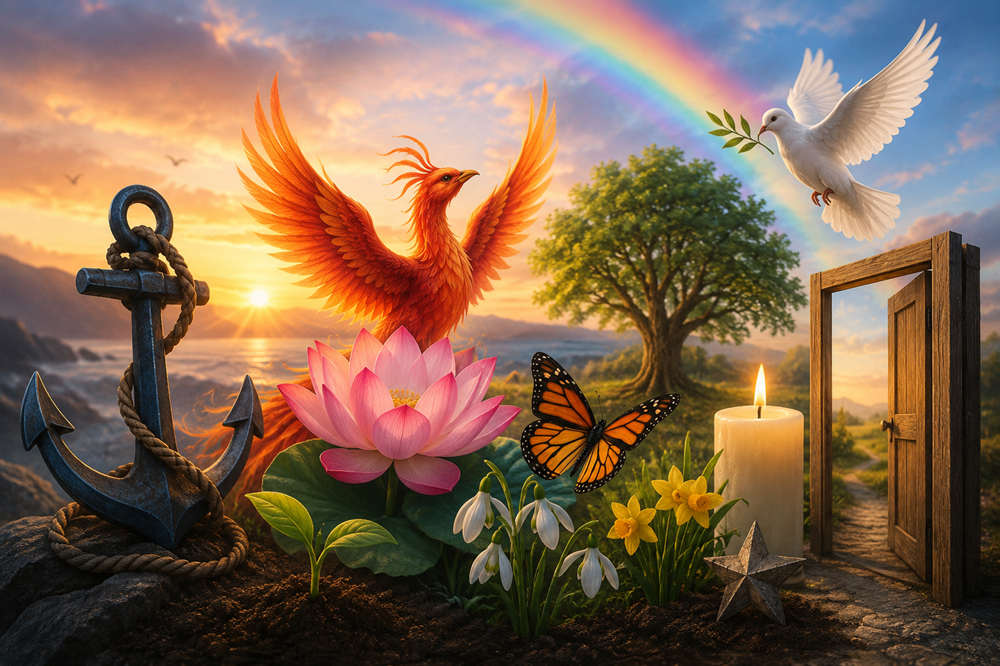
15 Symbols of Hope and What They Mean
Hope is difficult to represent because it concerns something that has not happened yet. Symbols make that feeling visible through images of returning light, new growth, safe passage, peace, and transformation.
Some symbols have a documented place in religion, mythology, or historical art. Others communicate hope indirectly through ideas such as renewal or opportunity. Their meanings can also change across cultures and personal experiences.
What Makes Something a Symbol of Hope?
A hopeful symbol usually points beyond present circumstances. A sunrise marks the end of night, a seed contains future growth, and an anchor offers stability in unsettled water.
These images often express one of several related ideas:
- Renewal after an ending
- Direction during uncertainty
- Peace following conflict
- Patience before visible change
- The ability to survive and rebuild
Not every symbol below represents hope exclusively. Some are more closely associated with resilience, peace, transformation, or growth, but those meanings allow them to convey hope in the right context.
15 Symbols of Hope and Their Meanings
1. Rising Sun
Sunrise marks a definite transition: night is ending and a new day has begun. It can represent a fresh start, restored clarity, or the chance to approach a familiar situation differently.
The rising sun is especially fitting when hope involves steady progress rather than an immediate solution. Daylight appears gradually, revealing what was previously difficult to see.
2. Rainbow
Because a rainbow may appear as a storm is clearing, it is often interpreted as a sign of relief, promise, or beauty emerging from difficult conditions.
The image carries several cultural meanings rather than one universal definition. Rainbows appear in religious and literary traditions, while the rainbow flag has become an internationally recognized expression of LGBTQ+ identity and pride. The Smithsonian’s history of rainbow symbolism also traces its associations with new beginnings and different stages of life.
3. Anchor
An anchor keeps a vessel from drifting, making it a natural image of steadiness during uncertainty. It may represent emotional security, loyalty, endurance, or confidence that difficult conditions can be weathered.
The anchor also has a documented historical connection with hope. An eighteenth-century object in the Metropolitan Museum of Art uses an anchor as an allegory of hope alongside symbols of love and plenty.
4. Dove and Olive Branch
A dove carrying an olive branch commonly represents peace, reconciliation, and the possibility that conflict will end. The pairing can express hope that damaged relationships or communities will move toward safety and cooperation.
The olive branch also appears in public and political symbolism. On the Great Seal of the United States, the olive branch represents the power to make peace, while the arrows in the eagle’s other talon represent the power to make war.
5. Lotus Flower
A lotus grows through muddy water before its flower opens above the surface. That growth pattern has made it a powerful image of beauty, dignity, and development under challenging conditions.
Its precise meaning varies among traditions. The Smithsonian notes that the lotus can represent hope, rebirth, resilience, and enlightenment. In other settings, it may be associated more specifically with purity, regeneration, or sacred figures.
6. Phoenix
The phoenix is a mythical bird that is destroyed and then born again. It represents a form of hope centered on rebuilding rather than returning to life exactly as it was before.
Its symbolism is especially relevant after loss, failure, or major change. In European religious art, the phoenix could also serve as an attribute of Hope. The Metropolitan Museum of Art describes a work in which a phoenix appears at the feet of Hope as a symbol of resurrection.
7. Butterfly
The butterfly’s life cycle gives it a close association with transformation. Its adult form emerges only after an enclosed stage during which the most important changes are largely hidden from view.
For that reason, a butterfly can express hope during a period that appears still or uncertain. Smithsonian Gardens notes that its life cycle has come to symbolize transformation in nature and the passage of time.
8. Candle or Flame
A candle does not remove all surrounding darkness, but it creates enough light to make the next step visible. It can therefore represent guidance, endurance, spiritual presence, or a hope that remains alive despite difficult circumstances.
Flames also appear in vigils and memorials. In that setting, they may express remembrance and continued connection rather than the expectation that grief will simply disappear.
9. Seed or New Sprout
A seed represents potential that cannot yet be seen. Planting one requires patience and trust because the earliest stages of growth take place beneath the soil.
A sprout is the first visible sign that this process has begun. It is a useful symbol when hope depends on small actions whose results will take time to develop.
10. Tree
A tree combines permanence with change. Its roots suggest stability, while its branches continue to grow and adapt to their surroundings.
Seasonal trees also demonstrate that an apparently bare or inactive period is not necessarily an ending. As a symbol, the tree can represent continuity through change, family connections, recovery, or a life that keeps developing over time.
11. Spring Flowers
Snowdrops, crocuses, daffodils, and other early flowers often appear before winter has fully released its hold. They provide visible evidence that a new season is already arriving.
The hopeful meaning comes from this timing. Spring flowers do not suggest that all difficulty has passed; they show that change can begin while traces of the previous season remain.
12. Swallow
Swallows complete long seasonal migrations and return as warmer weather approaches. Their arrival has therefore become associated with homecoming, safe passage, and the turning of the seasons.
The RSPB describes swallows as a sign that summer is on the way and notes that the first sighting of the year was traditionally considered a good omen. The bird is particularly meaningful when hope concerns waiting, separation, or reunion.
13. Star
A star offers a distant point of light rather than immediate warmth or daylight. It can represent direction, aspiration, constancy, or an ideal that remains visible even when it has not yet been reached.
In stories and visual art, a guiding star often helps travelers keep their course. This makes it a suitable symbol for hope built around purpose: the destination may be far away, but there is still something to move toward.
14. Open Door
An open door is primarily a modern metaphor for opportunity. It suggests that the current situation is not the only possible one and that movement into a different space has become available.
Because the destination beyond the doorway may not be fully visible, the symbol also acknowledges uncertainty. It can represent freedom, a second chance, a new relationship, or the courage to take an unfamiliar path.
15. Green
Green is not exclusively a symbol of hope. Its hopeful quality comes from its close visual connection with vegetation, new leaves, and landscapes returning to life.
The Smithsonian identifies nature, growth, harmony, and renewal among the color’s common associations. Those ideas allow green to work as a visual shorthand for regeneration, although color meanings still vary by culture and historical period.
How Symbols of Hope Are Used
The meaning of a symbol depends not only on the image itself but also on where it appears, who uses it, and what experience surrounds it.
Art, Literature, and Film
Creative works often introduce a hopeful image at a turning point. Light entering a room, a bird returning, or a flower emerging from damaged ground can suggest change before a character expresses it directly.
Symbols can also remain ambiguous. An open door may look inviting in one story and threatening in another, so the wider scene determines how it should be understood.
Memorials and Ceremonies
Candles, trees, stars, butterflies, and doves often appear in memorial settings. Here, hope may refer to spiritual belief, collective healing, continued love, or the determination to preserve a person’s memory.
Such imagery does not have to minimize grief. It can hold sorrow and hope together without implying that loss has been resolved.
Jewelry, Tattoos, and Personal Objects
A small symbol can serve as a private reminder of an experience or commitment. Someone might choose an anchor after a period of instability, a phoenix after rebuilding, or a sprout to mark the beginning of a long-term change.
Personal meaning may differ from a symbol’s traditional interpretation. Understanding its broader history is still useful, particularly when it comes from a specific religious or cultural setting.
Community and Public Symbols
Groups use colors, flowers, birds, flames, and other recognizable images to communicate shared goals. Repeated use can turn a familiar object into a sign of solidarity, remembrance, peace, or social change.
In these situations, meaning develops collectively. A symbol may become powerful not because of its appearance alone, but because people connect it with a particular event, movement, or community.
Final Thoughts
No symbol represents hope in exactly the same way for everyone. An anchor emphasizes stability, a seed asks for patience, a phoenix speaks to rebuilding, and an open door points toward opportunity. What they share is the suggestion that present circumstances are not the end of the story.