Where Does Cannabis Grow Naturally? Its Native Range and Wild Habitats
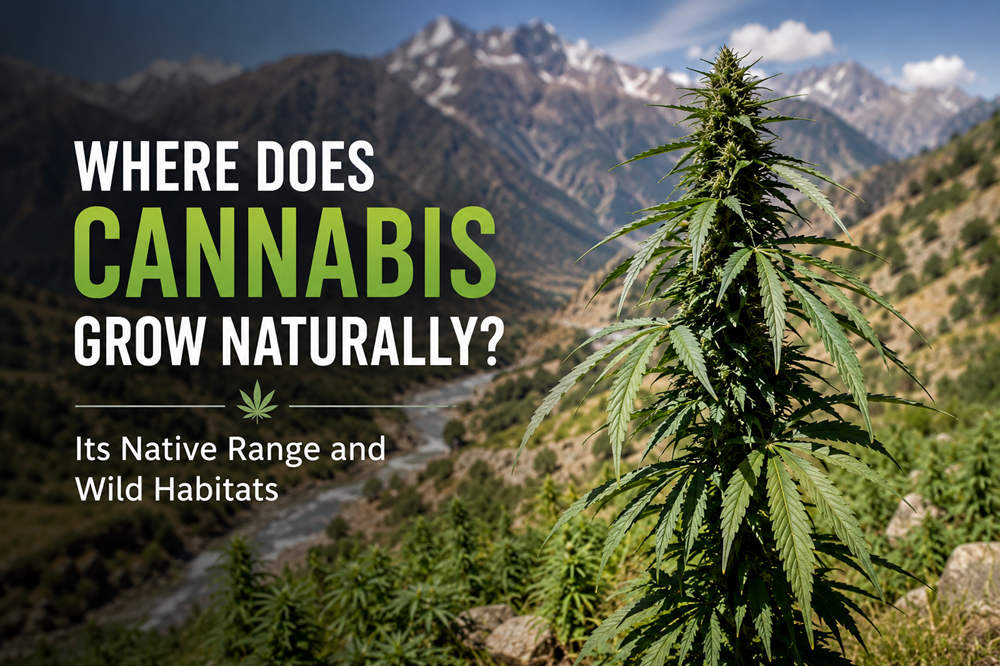
Cannabis is considered native mainly to Central Asia, extending into Afghanistan, Pakistan, and Xinjiang in western China. Although it now grows independently across much of the world, most populations outside this Asian range are feral or naturalized rather than native.
Its modern distribution reflects both environmental adaptation and thousands of years of human movement. People carried cannabis seeds between regions for fiber, food, oil, medicine, and intoxicating use, making its earliest history more difficult to trace than a present-day distribution map might suggest.
Where Is Cannabis Native?
According to Kew Science’s botanical record for Cannabis sativa, the plant’s native range extends from Central Asia to Xinjiang and Pakistan. The countries and regions specifically identified within that range include:
- Afghanistan
- Kazakhstan
- Kyrgyzstan
- Pakistan
- Tajikistan
- Turkmenistan
- Uzbekistan
- Xinjiang in western China
This zone contains continental grasslands, river valleys, dry foothills, and mountain environments. Cannabis is an annual plant associated primarily with temperate conditions, although individual populations have adapted to considerable differences in elevation, rainfall, and seasonal temperature.
A native range describes the part of the world where a species occurs without being introduced by people. It does not include every country where cannabis can now survive or reproduce independently.
Where Did Cannabis Originate and Become Domesticated?
The plant’s native range, evolutionary origin, and place of domestication are related but separate questions.
A synthesis of fossil pollen and archaeological evidence proposed that the cannabis lineage originated near Qinghai Lake on the northeastern Tibetan Plateau. The researchers associated ancient cannabis-type pollen with early steppe vegetation in the region, although separating cannabis pollen from that of its close relative, hops, remains challenging. The full pollen-based origin study explains the evidence behind this theory.
Genomic research points to East Asia as an important center of domestication. A whole-genome study of cannabis domestication found results consistent with a single early domestication origin in East Asia. It also identified Chinese landraces and feral plants that remain closely connected to the ancestral gene pool from which modern hemp and drug cultivars diverged.
These findings do not establish one exact modern location as the unquestioned birthplace of cannabis. Ancient plant movement, cultivation, cross-pollination, and incomplete archaeological evidence leave parts of the story unresolved.
The clearest conclusion is that cannabis has deep roots across Asia. Its evolutionary history may reach toward the Tibetan Plateau, while its early domestication appears closely connected to East Asia.
What Do Native, Wild, Feral, and Naturalized Mean?
“Wild cannabis” is often used for any cannabis plant growing without visible care, but it can describe several different situations.
Native cannabis
Native cannabis grows within the plant’s accepted original geographic range. It may reproduce without cultivation, but its location is what distinguishes it from an introduced population.
Wild-growing cannabis
Wild-growing cannabis is a broad, informal term for plants surviving and reproducing without active management. It does not reveal whether those plants are native or descended from escaped crops.
Feral cannabis
Feral cannabis descends from cultivated plants that escaped farms, gardens, processing areas, or transportation routes. After escaping, the plants continue reproducing without regular human care.
Naturalized cannabis
Naturalized cannabis is established outside its original range and can maintain a population over multiple generations. People introduced the plant to the region, but it no longer depends on repeated planting.
Wild-type cannabis
Researchers sometimes use “wild-type” for plants with traits associated with less-domesticated populations. The term does not prove that a population has remained completely separate from cultivated cannabis or later cross-pollination.
Regions Where Cannabis Grows Without Cultivation
Because cannabis has traveled with people for thousands of years, free-growing populations can have complicated ancestry. The following regions include different combinations of native, feral, naturalized, and long-established cannabis.
Central Asia
Kazakhstan, Kyrgyzstan, Tajikistan, Turkmenistan, and Uzbekistan form much of the plant’s accepted native range. Their landscapes include open steppes, irrigated valleys, river corridors, and dry continental environments.
Cannabis may grow along waterways, field boundaries, roadsides, and disturbed ground where seedlings receive direct sunlight and face less competition from dense vegetation. Local populations often endure hot summers, cold winters, and pronounced seasonal changes.
The region is especially important to botanical research because it contains both spontaneously growing populations and a long history of cultivation. Some plants may retain locally adapted characteristics, while others show the influence of crops grown nearby.
Afghanistan and Pakistan
Afghanistan and Pakistan contain mountain valleys, foothills, plateaus, and agricultural landscapes capable of supporting cannabis. Both countries fall within the plant’s recognized native range.
In Pakistan, free-growing hemp populations have been studied across the Potohar Plateau and Lesser Himalayas. Research into their geographic and climatic variation found differences in plant height, flowering behavior, leaf characteristics, seed traits, and other physical features across locations.
These differences reflect the combined influence of genetics and local conditions, including elevation, temperature, humidity, and rainfall. Plants surviving in a cool mountain area may therefore look and mature differently from those growing in a warmer lowland environment.
The Himalayan Region
Cannabis commonly grows without deliberate care in parts of northern India, Nepal, Bhutan, and neighboring Himalayan areas. It may appear beside roads, around villages, near farmland, on open slopes, and in mountain valleys.
Many of these populations have persisted for generations, but their presence does not necessarily establish them as native. Seeds have moved through the Himalayas through farming, livestock activity, local trade, and traditional use.
The region’s sharp elevation changes create varied growing conditions within relatively short distances. Lower valleys can offer warm, extended seasons, while high-elevation plants must complete their life cycle during a shorter period.
China and the Tibetan Plateau
Xinjiang falls within the accepted native range, while cannabis in other parts of China may include old landraces, cultivated plants, feral descendants, and naturalized populations.
China is particularly important to the plant’s history because both pollen-based and genomic studies point toward areas within or near the country. The northeastern Tibetan Plateau has been proposed as an evolutionary center, while genetic evidence links East Asia to early domestication.
Some surviving Chinese landraces and feral populations preserve genetic diversity that is less evident in heavily selected modern cultivars. This makes them valuable to researchers studying domestication, adaptation, and plant breeding.
Europe and Russia
Cannabis can be found growing independently in parts of Europe and Russia, particularly where hemp was historically cultivated for rope, canvas, textiles, paper, seed, and oil.
Plants escaped from fields, transport routes, mills, and storage areas. Their descendants sometimes became established beside railways, rivers, roads, farms, and abandoned industrial land.
Kew currently classifies cannabis in Europe as introduced. Some fossil-pollen research has proposed that cannabis may have been present in European steppe environments much earlier, but identifying ancient cannabis pollen is difficult because of its similarity to hop pollen.
Whatever its deeper prehistoric history, many roadside and field-edge populations seen in Europe today are associated with past cultivation and repeated human introduction.
North America
Cannabis is not generally considered native to North America. Free-growing populations in the United States and Canada largely descend from hemp once planted for agricultural or industrial purposes.
Hemp was grown for fiber and seed over several centuries. During World War II, the United States expanded domestic hemp cultivation when imported fiber became difficult to obtain. A historical USDA account of American hemp production notes that output peaked in 1943 and 1944.
Seeds that escaped production established populations around old fields, drainage areas, river systems, transportation corridors, and roadsides. In the United States, these plants are often called ditch weed.
A recent genetic study of feral cannabis in the United States examined plants collected across 12 states. It found distinct regional groups and confirmed that most sampled plants carried cannabinoid profiles associated with hemp rather than high-THC commercial cannabis.
Ditch weed is therefore not a native North American form of cannabis. It is a lasting botanical trace of earlier hemp production.
Where Is Wild-Growing Cannabis Most Likely to Survive?
Cannabis can adapt to different climates, but free-growing populations are most often associated with open, sunny places where seeds can reach exposed soil.
Common habitats include:
- Riverbanks and floodplains
- Open valleys and grasslands
- Roadsides and railway corridors
- Field margins
- Drainage areas
- Abandoned farmland
- Disturbed ground near settlements
These locations often provide sunlight, seasonal moisture, and reduced competition from established vegetation. River systems can also deposit fertile sediment and carry seeds into new areas.
There is no single ideal habitat for every wild-growing cannabis population. Plants in Pakistan, Central Asia, the Himalayas, and the American Midwest experience different combinations of rainfall, elevation, humidity, temperature, and soil.
Long-term survival depends on whether plants can germinate, mature, flower, and produce viable seeds within the local growing season. Dense shade, permanently waterlogged ground, severe competition, or a season that ends before seeds mature can prevent a population from becoming established.
How Humans Spread Cannabis Around the World
People began moving cannabis beyond its original Asian range because nearly every part of the plant had a practical use.
Stems supplied fiber for rope, cloth, fishing nets, and paper. Seeds were eaten or pressed for oil. Flowers and other plant material were used in medicine, ritual practices, and intoxicating preparations.
As farming and trade expanded, seeds traveled across Eurasia and eventually reached Africa, the Americas, and other regions. Some escaped during harvesting, storage, processing, or transportation. Others were intentionally planted and later abandoned.
Repeated introductions allowed plants from different regions to cross with one another. This history created genetically mixed populations and made it difficult to identify cannabis that has never been influenced by cultivation.
Is Wild Cannabis the Same as Commercial Cannabis?
Wild-growing cannabis is not automatically comparable to the cannabis sold by licensed retailers or produced by specialized growers.
Commercial cultivars are deliberately selected for characteristics such as cannabinoid content, aroma, flowering time, plant size, flower density, and resistance to certain pests or diseases. Controlled breeding makes those qualities more consistent.
Feral and naturalized plants face different pressures. Their ability to survive winter, drought, short growing seasons, pests, and competition may matter more than flower size or cannabinoid production.
Compared with modern commercial cultivars, wild-growing plants often have:
- Less predictable cannabinoid levels
- Smaller or looser flower clusters
- More seeds
- Greater variation between individual plants
- Traits adapted to local weather and seasonal conditions
Many feral populations descend from fiber hemp and contain relatively low levels of THC. A plant’s appearance cannot reliably reveal its potency or chemical composition.
Is It Legal or Safe to Collect Wild Cannabis?
Cannabis growing without human care is not automatically legal to harvest or possess. Laws depend on the country, state, province, land designation, plant classification, and cannabinoid content. Removing plants from private property, public parks, or protected land may create additional legal problems.
Free-growing plants can also be contaminated by roadside pollution, herbicides, pesticides, mold, animal waste, or unsafe soil. Their identity and chemical content cannot be confirmed simply by looking at them.
Conclusion
Cannabis is considered native mainly to Central Asia, Afghanistan, Pakistan, and Xinjiang. Its deeper evolutionary history may lead toward the northeastern Tibetan Plateau, while genomic evidence identifies East Asia as an important center of early domestication.
Cannabis now grows independently in the Himalayas, Europe, Russia, North America, and many other regions. Most of those populations are feral or naturalized descendants of plants originally transported and cultivated by people.
A cannabis plant may be growing wild without being truly native. Understanding that distinction provides a clearer picture of how one Asian plant became established across much of the world.