What Happens When You Sleep High? How Cannabis Can Change Your Sleep
Sleeping high can feel different from sleeping sober. THC may make you feel drowsy and, for some people, make falling asleep seem easier. But being high can also change normal sleep patterns, affect REM sleep, influence dreaming, and sometimes leave you feeling less refreshed the next morning. The effects depend on the amount consumed, the cannabis product, your tolerance, how often you use it, and your individual response. Research on cannabis and sleep remains mixed, so feeling sedated should not automatically be confused with getting better-quality sleep.
What Does It Mean to Sleep High?
Sleeping high generally means falling asleep while THC is still producing noticeable psychoactive effects.
THC is the main intoxicating cannabinoid in cannabis. It interacts with cannabinoid receptors throughout the brain and can change mood, perception, attention, coordination, and alertness. Sleepiness and relaxation can occur among its short-term effects.
That explains why someone who uses cannabis in the evening may feel ready for bed sooner than usual.
But sedation and natural sleep aren’t exactly the same thing.
You can feel extremely tired after cannabis while still experiencing changes in the normal sequence and duration of your sleep stages.
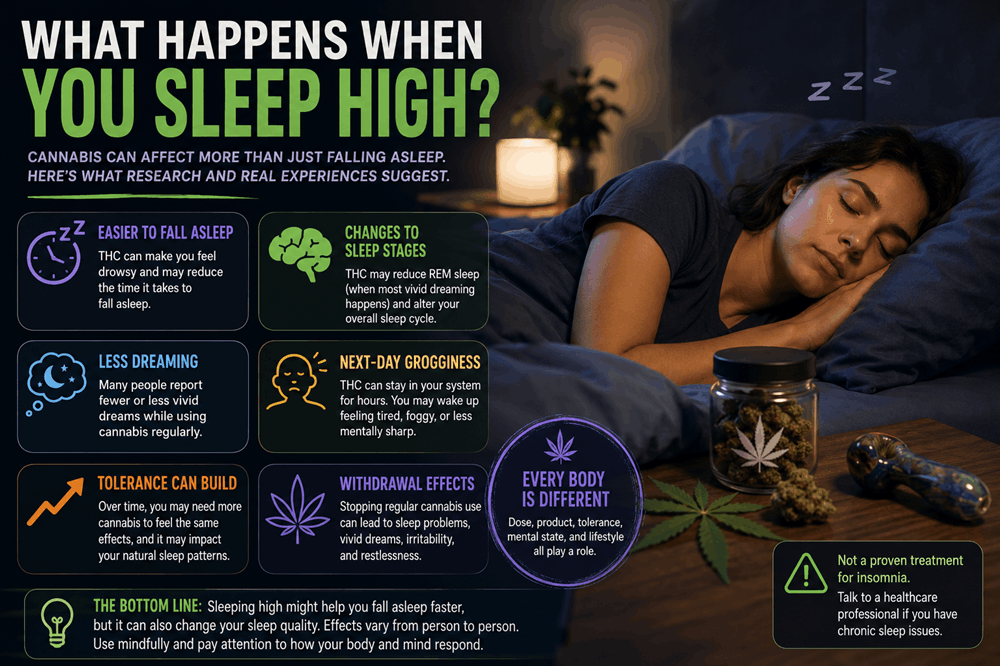
You May Feel Like You Fall Asleep Faster
One of the most noticeable effects of being high before bed is drowsiness.
THC has been associated in some research with shorter sleep-onset latency, meaning it may take less time to fall asleep after getting into bed. This is one reason cannabis is commonly used by people who say they struggle to switch off at night.
The experience can feel something like this:
You get into bed, your body feels heavier, your thoughts become less focused, and staying awake suddenly seems less appealing.
That doesn’t happen to everyone.
Some people experience the opposite response, particularly after consuming a large amount of THC. Anxiety, racing thoughts, increased awareness of bodily sensations, or general discomfort can make falling asleep more difficult rather than easier.
So being high isn’t a guaranteed shortcut to sleep.
Cannabis Can Change Your Sleep Architecture
Sleep isn’t one continuous state.
Throughout a normal night, your brain cycles through different stages, including lighter non-REM sleep, deeper sleep, and rapid eye movement—or REM—sleep.
These stages perform different functions, which means total hours asleep don’t tell the entire story.
Research suggests THC can alter this normal architecture. Earlier studies and reviews have reported reductions in REM sleep after acute THC exposure, although findings vary depending on the dose, population, pattern of cannabis use, and study design.
A more recent randomized pilot study involving people with insomnia also found that a single oral THC/CBD dose reduced REM sleep and total sleep time compared with placebo. Because that trial included only 20 participants and used a specific THC/CBD combination, it should not be interpreted as proof that every cannabis product produces the same result.
The important takeaway is simple:
Cannabis can make you sleepy while simultaneously changing what happens after you fall asleep.
Why Might You Dream Less When You Sleep High?
Many cannabis users report remembering fewer dreams while regularly using THC.
One possible explanation involves REM sleep.
The most vivid dreaming commonly occurs during REM, and THC has been associated with reductions or alterations in REM sleep in some laboratory research. If you spend less time in REM—or your REM pattern changes—you may notice fewer memorable dreams.
That doesn’t necessarily mean you’re not dreaming at all.
You may simply remember fewer dreams after waking.
Individual responses vary considerably, so some people still experience vivid dreams after consuming cannabis.
Why Can Dreams Become Intense After You Stop Using Cannabis?
This is where things become particularly interesting.
People who regularly use cannabis and then stop sometimes report unusually vivid, strange, or unpleasant dreams.
Sleep disturbance and unusual dreams are recognized features of cannabis withdrawal. Research has also observed changes involving REM sleep during abstinence after frequent cannabis use.
This is sometimes loosely described as a REM rebound, although the exact sleep response can vary.
Someone who rarely remembers dreams while using cannabis may suddenly begin waking from elaborate, emotional, or bizarre dreams after stopping.
The effect can be noticeable enough that some regular users interpret it as cannabis having completely eliminated their dreams beforehand.
Can You Sleep Longer When You’re High?
You might, but cannabis doesn’t reliably increase total sleep time.
This is one of the places where personal experience and objective sleep measurements don’t always agree.
Some people report feeling that cannabis helps them sleep longer or more deeply. However, a systematic review of recreational cannabis users found that the majority of included studies reported negative rather than positive associations between cannabis use and sleep quality.
A large sleep-clinic analysis published in 2025 similarly found that chronic cannabis use was not associated with straightforward improvements in objective sleep measures, highlighting how uncertain the relationship remains.
So if you sleep eight hours while high, you can’t assume those eight hours were automatically more restorative.
Can You Wake Up Still High?
Yes, particularly when the intoxicating effects last longer than expected.
This possibility depends heavily on what was consumed and when.
If THC is still affecting you when you wake up, you may feel mentally slowed, groggy, unfocused, or impaired. THC-containing cannabis affects attention, thinking, perception, and coordination, so activities requiring alertness should be approached cautiously while those effects remain.
This matters especially when you have to drive, operate equipment, work in a safety-sensitive environment, or make important decisions the next morning.
Feeling awake doesn’t necessarily mean all impairment has disappeared.
Why Edibles Can Be Different Before Bed
The experience of sleeping after an edible can differ considerably from sleeping after inhaled cannabis.
An edible may continue producing effects for a long time after you’ve gone to bed. That means the period of intoxication can extend further into your sleep—and potentially into the following morning—than you expected.
The delayed onset can also make it easier to consume more before the first serving has fully taken effect.
For that reason, someone who feels only mildly affected at bedtime can experience substantially stronger effects later.
The general lesson is that how cannabis is consumed matters, not just whether the product is labeled indica, sativa, or hybrid.
Does Sleeping High Give You Better Deep Sleep?
Not necessarily.
Some older research has suggested acute THC exposure may increase certain measures of slow-wave or deeper sleep, but findings across studies are inconsistent, especially when researchers examine repeated cannabis use rather than a single exposure.
That’s an important limitation.
A cannabis product might make your body feel heavy and deeply relaxed without producing objectively better restorative sleep.
Subjective sleep—how good you think you slept—and objectively measured sleep aren’t always identical.
What Happens If You Sleep High Every Night?
Regular nightly use introduces another factor: tolerance.
Effects that are noticeable at first may become weaker with repeated exposure. That can lead some people to consume more cannabis in an attempt to reproduce the same degree of relaxation or sleepiness.
Regular cannabis use can also make sleep more difficult when cannabis is suddenly stopped.
Sleep disturbance is a recognized cannabis-withdrawal symptom, along with possible irritability, anxiety, restlessness, appetite changes, and unusual dreams.
This can create an unpleasant cycle:
Cannabis initially seems to help with falling asleep, regular use develops, stopping causes poor sleep, and cannabis then feels necessary simply to sleep normally.
That doesn’t happen to everyone, but it is one reason cannabis shouldn’t automatically be regarded as a harmless long-term sleep solution.
Why Do Some People Sleep Great High While Others Sleep Terribly?
Cannabis effects can vary enormously between people.
Your experience may be influenced by factors such as:
- THC exposure
- Other cannabinoids in the product
- The amount consumed
- Method of consumption
- How recently you consumed it
- Cannabis tolerance
- Frequency of use
- Individual sensitivity
- Other medications or substances
- Existing sleep problems
- Anxiety or mood at the time
That’s why two people can consume the same cannabis product before bed and describe completely different nights.
One person may fall asleep quickly and wake feeling fine.
Another may become anxious.
Another may sleep for hours but wake feeling foggy.
And someone else may barely notice any effect on sleep at all.
Is Sleeping High Bad for You?
There isn’t a universal yes-or-no answer.
Occasionally falling asleep while cannabis is still affecting you is different from depending on high-THC cannabis every night to initiate sleep.
Current evidence does not support the simple idea that cannabis reliably improves sleep quality for everyone. Reviews continue to describe mixed findings, and recent objective sleep research has raised questions about whether regular use may sometimes be associated with poorer sleep rather than better sleep.
If cannabis consistently leaves you groggy, disrupts your routine, requires progressively larger amounts, or feels necessary before you can sleep at all, those patterns are worth paying attention to.
Does Being High Help Insomnia?
Cannabis and cannabinoids are often discussed as possible sleep aids, but that doesn’t make ordinary cannabis a proven treatment for insomnia.
A small 2025 randomized trial demonstrates why the issue isn’t simple: participants receiving a THC/CBD combination experienced changes in sleep architecture, including reduced REM and total sleep time, even though cannabinoids are frequently promoted for sleep.
Persistent insomnia can also have many underlying causes.
If you’re regularly unable to fall asleep, stay asleep, or function normally during the day because of poor sleep, focusing only on becoming sedated can overlook the underlying problem.
What Happens When You Stop Sleeping High?
If you’ve been using cannabis regularly at bedtime, sleep may temporarily feel worse after stopping.
You may experience:
- Difficulty falling asleep
- More nighttime waking
- Restlessness
- Vivid dreams
- Strange dreams
- Nightmares
- Changes in perceived sleep quality
Sleep problems and unusual dreams are established symptoms reported during cannabis withdrawal, especially after frequent or heavy use.
That doesn’t necessarily mean cannabis was improving your underlying sleep.
In some cases, it means your body has adapted to regular exposure and is readjusting when THC is removed.
Frequently Asked Questions
Do you sleep deeper when you’re high?
You may feel as though you’re sleeping more deeply, but objective research doesn’t consistently show that cannabis improves deep or restorative sleep. THC can alter sleep stages, and the effects depend on dose, frequency of use, and individual factors.
Why don’t you dream when you sleep high?
THC can reduce or alter REM sleep in some circumstances. Because vivid dreaming commonly occurs during REM, this may help explain why some regular cannabis users report remembering fewer dreams.
Why do dreams get crazy after quitting weed?
Vivid or unusual dreams can occur during cannabis withdrawal. Changes in REM sleep after stopping regular THC exposure may contribute to the experience.
Can you still be high after sleeping?
Yes. If THC’s effects haven’t completely worn off, you can wake up feeling impaired, groggy, or mentally slower than normal.
Does getting high before bed improve sleep quality?
Not necessarily. Cannabis can make some people feel sleepy, but studies evaluating actual sleep quality have produced inconsistent results, with several finding associations between regular cannabis use and poorer sleep.
The Bottom Line
When you sleep high, THC may make you feel relaxed and help you fall asleep more easily, but the story doesn’t end when you close your eyes.
Cannabis can alter normal sleep architecture, including REM sleep, which may affect dreaming and how refreshed you feel afterward. Regular use can also lead to tolerance, while stopping after frequent use can temporarily cause sleep problems and vivid dreams.
So being high can make falling asleep feel easier without necessarily making your sleep better.
That’s the key distinction.
If your only measure is how quickly you pass out, cannabis may appear to help. If you look at the entire night—sleep stages, sleep continuity, dreaming, next-day alertness, tolerance, and dependence—the relationship between cannabis and sleep becomes much more complicated.