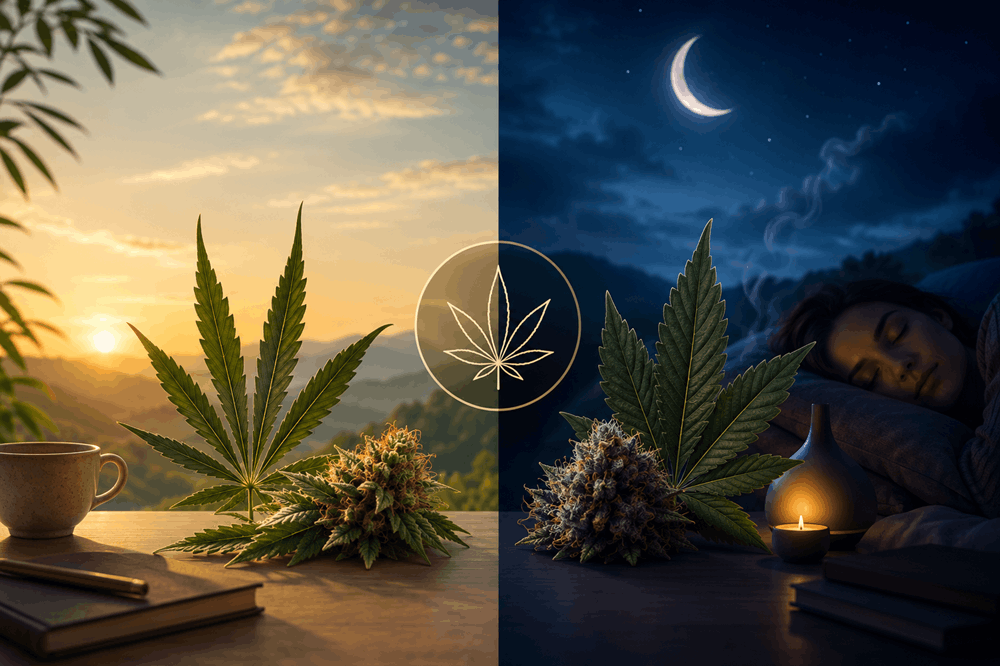
Does Sativa or Indica Make You Sleepy? What Cannabis Labels Really Mean
If you’re wondering whether sativa or indica makes you sleepy, indica is traditionally associated with relaxation and drowsiness, while sativa is traditionally associated with more alert or energetic effects. But those labels are not reliable enough to predict exactly how a cannabis product will affect you. THC concentration, other cannabinoids, chemical composition, amount consumed, tolerance, and individual response can matter more than whether the package says indica or sativa.
Important: This article is for general education only. Cannabis should not be treated as a proven remedy for insomnia or other sleep disorders without appropriate medical guidance.
Does Indica Make You Sleepy?
Indica products are commonly marketed as the sleepier side of cannabis.
You’ve probably encountered descriptions such as:
- Relaxing
- Calming
- Heavy
- Body-focused
- Sedating
- Better suited to nighttime
This is where the familiar phrase “indica = in-da-couch” comes from.
The problem is that an indica label doesn’t tell you exactly which cannabinoids and terpenes are present, how much THC you’re consuming, or how your body will respond.
Large-scale research into commercial cannabis has found that products labeled indica, sativa, and hybrid do not consistently separate into distinct chemical groups. In one analysis involving 89,923 commercial cannabis samples, the traditional labels poorly reflected the underlying cannabinoid and terpene chemistry.
So an indica product may make you feel sleepy, but being labeled indica is not what guarantees that effect.
Does Sativa Make You Sleepy?
Sativa is usually marketed in the opposite way.
Commercial descriptions commonly associate sativa strains with:
- Energy
- Alertness
- Creativity
- Social activity
- Mental stimulation
- Daytime use
That doesn’t mean a sativa can’t make you tired.
A THC-containing product labeled sativa can still cause drowsiness, especially depending on its potency, how much is consumed, your tolerance, and your individual sensitivity to THC.
Cannabis responses also aren’t perfectly predictable. The National Institute on Drug Abuse notes that THC-containing cannabis can produce a wide variety of effects, and today’s products vary considerably in THC concentration and formulation.
Someone could therefore use a product marketed as an energizing sativa and still end up feeling relaxed, mentally foggy, or sleepy.
So Which Is More Likely to Make You Tired?
Indica is more commonly marketed as sleepy or relaxing, but the indica label alone is a weak predictor of whether you’ll actually become tired.
That’s the distinction that matters.
Traditional cannabis culture often presents the choice like this:
| Label | Traditionally associated with |
|---|---|
| Indica | Relaxation, body heaviness, sleepiness |
| Sativa | Energy, alertness, cerebral stimulation |
| Hybrid | Combination of indica- and sativa-like qualities |
These descriptions can be useful for understanding how a product is being marketed. They should not be treated like pharmacological guarantees.
Two products both called indica can have substantially different chemical profiles. Likewise, an indica and a sativa can sometimes be chemically more similar than their labels suggest.
Why Indica and Sativa Don’t Reliably Predict Effects
Indica and sativa originally have much more to do with cannabis classification, history, cultivation, and plant characteristics than with a scientifically validated system for predicting whether someone will become sleepy.
Modern commercial cannabis complicates matters further.
Years of breeding and hybridization mean many products sold today contain mixed genetic backgrounds. At the same time, growers, breeders, dispensaries, and databases do not always use strain names or indica/sativa classifications in exactly the same way.
Researchers examining commercial cannabis chemistry have found considerable overlap among indica, sativa, and hybrid products.
For a consumer, that means:
“Indica” does not equal sedative.
And:
“Sativa” does not equal stimulant.
They are better understood as broad commercial descriptors than dependable instructions for how your brain and body will respond.
THC May Matter More Than the Indica or Sativa Label
THC is the principal intoxicating cannabinoid in cannabis and is one reason cannabis can alter perception, attention, mood, coordination, and alertness.
Sleep-related effects of THC are more complicated than simply saying it “helps you sleep.”
Research has found that THC can be associated with sleepiness and, under some circumstances, shorter sleep latency—the amount of time it takes to fall asleep. One controlled study of chronic cannabis users found higher evening THC concentrations were associated with less difficulty falling asleep, although tolerance appeared to develop and the researchers described their findings as preliminary.
More recent sleep research also shows why the story isn’t straightforward. A small randomized trial involving THC and CBD found changes in sleep architecture, including reduced REM sleep, rather than a simple across-the-board improvement in sleep.
Feeling sleepy after cannabis and getting consistently better-quality sleep are therefore not necessarily the same thing.
Does Higher THC Mean More Sleepiness?
Not automatically.
More THC can mean stronger intoxication, but stronger intoxication doesn’t always translate into pleasant relaxation or better sleep.
Depending on the person and circumstances, THC may also contribute to unwanted effects such as anxiety, confusion, dizziness, impaired judgment, or altered perception.
Someone’s response can also change with tolerance.
A person who rarely consumes cannabis may react very differently from someone who uses THC regularly. Research involving chronic users suggests some of THC’s sleepiness-producing effects may diminish with repeated exposure.
That is another reason a simple indica-versus-sativa rule doesn’t work very well.
What About Terpenes?
You’ll often hear that terpenes explain why one strain makes you sleepy while another makes you energetic.
Terpenes are aromatic compounds responsible for many of the distinctive smells associated with cannabis. Different products can contain different combinations and concentrations of them.
Looking at a product’s actual chemical profile can provide more information than relying only on an indica or sativa label. Research has found identifiable terpene-based chemical patterns in commercial cannabis that don’t line up neatly with traditional strain-category labels.
However, this doesn’t mean you can look at a single terpene and confidently predict sleepiness.
Statements such as “this terpene makes you sleep” often go further than current human evidence supports. Cannabis contains numerous compounds, products vary significantly, and individual reactions are complicated.
A terpene profile can describe chemistry. It shouldn’t be treated as a guaranteed prediction of an effect or medical outcome.
Why the Same Strain Can Affect Two People Differently
Even when two people consume the same cannabis product, they may describe the experience differently.
Possible influences include:
- THC exposure
- Cannabinoid composition
- Amount consumed
- Method of consumption
- Previous cannabis experience
- Tolerance
- Individual sensitivity
- Medications
- Alcohol or other substances
- Expectations
- Surrounding environment
That variability explains why online strain reviews can conflict so dramatically.
One person may describe a strain as deeply relaxing. Another may say it made their thoughts race. A third may simply feel intoxicated without becoming particularly energetic or sleepy.
None of those experiences necessarily identifies the strain as “really” indica or sativa.
Can a Hybrid Make You Sleepy?
Yes.
Hybrid simply indicates that a cultivar is associated with mixed cannabis ancestry or is commercially positioned between the conventional indica and sativa categories.
You may encounter descriptions including:
- Indica-dominant hybrid
- Sativa-dominant hybrid
- Balanced hybrid
Once again, those descriptions shouldn’t be treated as precise predictions.
An indica-dominant hybrid isn’t guaranteed to be sedating, just as a sativa-dominant hybrid isn’t guaranteed to keep you awake.
The product’s actual chemistry and your response to it matter more.
Is Cannabis Proven to Help With Sleep?
Cannabis and cannabinoids are widely used by people seeking help with sleep, but the scientific evidence is considerably less straightforward than cannabis marketing sometimes suggests.
Research has reported subjective sleep benefits in some circumstances, while objective sleep studies have produced mixed findings.
A recent large sleep-clinic analysis noted that objective research on cannabis and sleep remains inconsistent. Chronic daily cannabis use in that study was associated with some indicators of poorer or more fragmented sleep rather than uniformly better sleep.
That distinction matters if the real question behind “Does indica make you sleepy?” is whether cannabis should be used to treat insomnia.
Drowsiness is an effect. Insomnia treatment is a medical question.
Those aren’t interchangeable.
Persistent trouble falling asleep, staying asleep, or functioning because of poor sleep deserves proper evaluation rather than relying exclusively on strain labels.
How Can You Evaluate a Cannabis Product More Carefully?
Instead of choosing solely according to the words indica or sativa, look at the product more critically.
For packaged cannabis where testing information is available, useful details may include:
- Measured THC or THCa concentration
- CBD and other reported cannabinoids
- Reported terpene profile
- Batch or lot number
- Testing date
- Laboratory identity
- Contaminant screening
Even laboratory information has limits. A Certificate of Analysis can tell you what was measured in the tested sample, but it cannot tell you exactly how you’ll feel.
Think of the COA as information about the product, not a prediction about your experience.
Frequently Asked Questions
Is indica or sativa better for nighttime?
Indica is traditionally marketed for nighttime use because it’s associated with relaxation and sleepiness. However, indica/sativa classifications do not reliably predict the chemical composition or effects of a particular cannabis product.
Can sativa keep you awake?
Some people describe sativa-labeled products as energizing or mentally stimulating, but that isn’t guaranteed. A THC-rich sativa can still cause tiredness or impairment.
Can sativa make you fall asleep?
Yes. An individual could become sleepy after consuming a sativa-labeled product. The label alone cannot determine the response.
Does indica always make you tired?
No. Indica products are associated with relaxing effects in cannabis marketing and tradition, but an indica classification does not guarantee drowsiness.
Is hybrid sleepy or energizing?
It can be described either way. “Hybrid” covers an enormous range of cultivars and chemical profiles, so the word itself provides little certainty about whether a particular product will feel relaxing or stimulating.
Is THC a sleep aid?
THC can produce drowsiness and can affect sleep, but research into cannabinoids and sleep has produced mixed and sometimes complicated results. Changes in falling asleep don’t necessarily mean improvements in overall sleep quality or sleep architecture.
The Bottom Line
If you’re choosing between sativa and indica because you want to know which one makes you sleepy, indica is the category traditionally associated with relaxation and drowsiness.
But don’t mistake that tradition for a reliable scientific rule.
Research examining tens of thousands of commercial cannabis samples shows substantial chemical overlap between products labeled indica, sativa, and hybrid. Those names don’t consistently predict what’s inside the flower, much less exactly how one person will respond to it.
THC exposure, cannabinoid composition, product chemistry, tolerance, amount consumed, and individual sensitivity can all influence whether cannabis feels relaxing, stimulating, uncomfortable, or sleepy.
So the more accurate answer isn’t simply “indica makes you sleepy.”
It’s this:
Indica is more commonly marketed as sleepy, but neither indica nor sativa reliably predicts sleepiness for an individual person.