How Long Does CBD Stay in Your System? What Detection Really Depends On
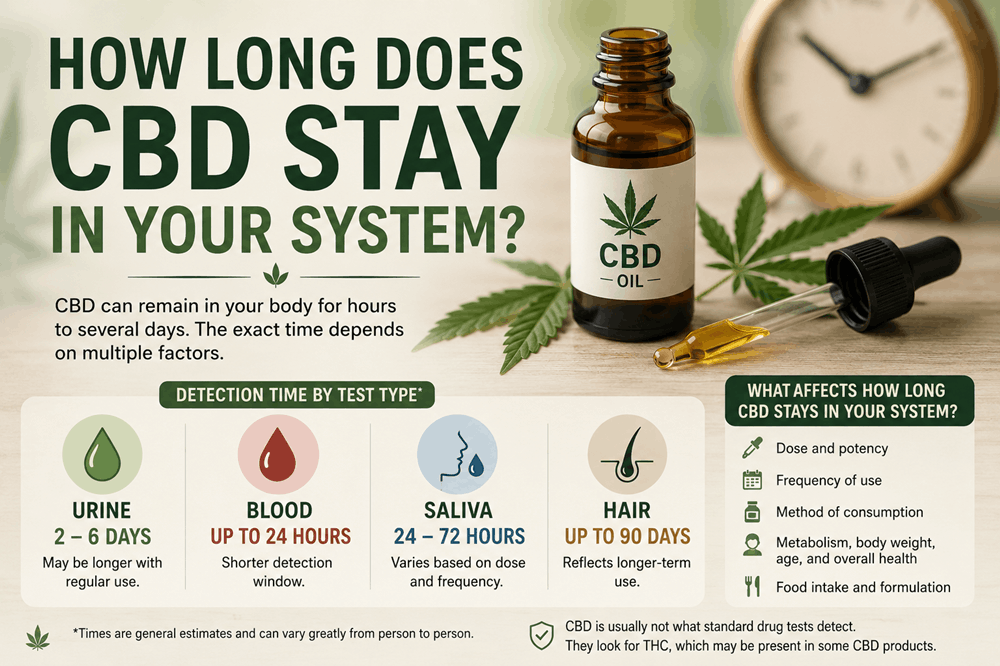
CBD can remain in your body for hours to several days, and with regular use, traces may persist longer. There is no single reliable number for everyone. How long CBD stays in your system depends on the dose, how often you use it, whether you swallow or inhale it, the formulation, food intake, your metabolism, and what type of biological sample is being tested. Human studies have reported particularly long elimination half-lives after repeated oral CBD use.
One important distinction is often missed: how long you feel CBD’s effects is not the same as how long CBD or its metabolites remain detectable in your body.
How Long Does CBD Usually Stay in the Body?
There isn’t one universal CBD elimination time.
Research has found substantial differences depending on how CBD is consumed. A systematic review of human studies reported CBD half-lives ranging from roughly 1.4 to 10.9 hours after an oromucosal spray, about 31 hours after smoking, and approximately 2 to 5 days after repeated oral administration.
A half-life is the amount of time required for the concentration of a substance in the body to fall by about half.
It doesn’t mean CBD disappears completely after one half-life.
For example, if CBD has a relatively long half-life in someone who takes it regularly, progressively smaller amounts can remain in the body for several days after the last dose.
That is why a person who takes CBD once may eliminate it differently from someone who takes an oral CBD product every evening.
Why Is There Such a Wide Range?
CBD pharmacokinetics are unusually variable.
A 2024 systematic review and meta-analysis examining 39 studies found that CBD exposure was influenced by several factors, including dose, administration method, formulation, and whether CBD was consumed with food.
Those differences make statements such as “CBD leaves your body in exactly 24 hours” misleading.
The actual timeline can be affected by:
- How much CBD you use
- How frequently you use it
- Whether you swallow, inhale, or use CBD through another route
- The formulation of the CBD product
- Whether you take it with food
- Your individual metabolism
- Other medications
- Your body’s distribution and elimination of cannabinoids
Even two people taking the same labeled amount may not produce identical blood concentrations.
How Long Does CBD Stay in Your System After One Use?
After a single CBD dose, concentrations generally rise and then decline as CBD is distributed and metabolized.
But there isn’t a reliable rule saying that every single dose is completely gone after a particular number of hours.
Research has included CBD doses ranging from very small amounts to thousands of milligrams, and the resulting pharmacokinetic measurements vary considerably. Higher doses generally produce higher CBD concentrations in the bloodstream.
Your method of consumption matters as well.
Inhaled CBD tends to reach the bloodstream faster than swallowed CBD, while oral products undergo digestion and metabolism before reaching systemic circulation.
So “one use” isn’t a particularly precise measurement unless you also know the dose and method of administration.
How Long Does CBD Stay in Your System If You Use It Every Day?
Regular use can extend the time CBD remains in your body.
One of the most frequently cited human pharmacokinetic reviews reported a CBD half-life of roughly 2 to 5 days following chronic oral administration.
That doesn’t mean everyone who takes CBD daily will test positive for CBD for a particular number of days.
It means repeated oral use may result in a considerably longer elimination period than some single-dose studies suggest.
With repeated exposure, there may still be CBD in the body when the next dose is taken. How much accumulates depends on dose, formulation, dosing schedule, and individual physiology.
This is one reason research involving daily pharmaceutical CBD cannot automatically be applied to someone occasionally using a low-dose consumer product.
Does the Type of CBD Product Matter?
Yes.
CBD products can differ substantially in formulation and cannabinoid content.
You may encounter:
CBD isolate: intended to contain cannabidiol without other cannabinoids.
Broad-spectrum CBD: generally contains CBD plus additional cannabis compounds but is marketed as having THC removed or minimized.
Full-spectrum CBD: contains CBD along with other naturally occurring cannabinoids and may include some THC.
These distinctions matter particularly if your concern involves drug testing.
The FDA has previously found inconsistencies between the labeled and measured cannabinoid contents of some commercial CBD products, demonstrating that product labels are not always a perfect representation of what’s actually inside.
Can CBD Make You Fail a Drug Test?
Pure CBD itself is generally not what standard workplace marijuana testing is designed to detect.
For example, the U.S. Department of Transportation states that its regulated testing program tests for marijuana rather than CBD.
The concern is THC.
Some CBD products contain measurable THC, especially full-spectrum products. Products marketed as THC-free may also present uncertainty if their labeling or manufacturing quality is inaccurate.
Repeated use of a product containing THC could potentially expose you to enough THC for its metabolites to become relevant to a marijuana drug test.
The Department of Transportation specifically warns safety-sensitive employees that CBD-product use could lead to a marijuana-positive drug-test result because commercial products may contain THC.
So if you’re asking how long CBD stays in your system because you have a drug test, the more important question may actually be:
Does your CBD product contain THC?
Does CBD Show Up on a Urine Test?
Routine workplace urine drug screens generally aren’t looking specifically for CBD.
Marijuana testing typically focuses on THC-related metabolites rather than cannabidiol itself.
However, a CBD product that also contains THC creates a different issue.
Someone using a full-spectrum product, an inaccurately labeled product, or another hemp-derived product containing measurable THC shouldn’t assume that the word “CBD” on the package guarantees a negative marijuana test.
There is also no responsible way to give a universal “safe after X days” rule. THC detection depends on the actual exposure and the testing method, not merely the CBD label.
How Long Does CBD Stay in Your Blood?
CBD reaches the bloodstream after systemic administration and is then progressively distributed and eliminated.
How quickly this happens depends heavily on how the CBD is taken.
The 2024 pharmacokinetic meta-analysis found that administration route and formulation significantly influence CBD exposure. Oral, inhaled, and oromucosal CBD don’t produce identical concentration patterns.
Blood measurements can therefore vary dramatically between studies and individuals.
It is more accurate to say that CBD blood concentrations generally decline after use but can remain measurable beyond the period during which you notice any effects.
How Long Does CBD Stay in Saliva?
There is much less standardized information about CBD detection in saliva than many online detection charts suggest.
The answer depends on the testing method, amount consumed, formulation, timing, and whether the test is actually designed to identify CBD.
Someone might encounter charts claiming precise CBD saliva windows, but those numbers should be treated cautiously unless they are tied to a specific validated test and study population.
Again, most routine drug-testing concerns focus on THC rather than CBD.
Can CBD Stay in Your Hair?
Cannabinoids can potentially be incorporated into hair, but hair testing raises different questions from blood or urine testing.
Hair analysis is generally intended to look at exposure over a much longer period rather than determine whether a compound was consumed recently.
A simple statement such as “CBD stays in hair for 90 days” can be misleading because detectability depends on the laboratory method, the substance being measured, hair growth, sample collection, and possible external contamination.
For ordinary consumers, hair is therefore not a useful way to estimate when CBD has completely left the body.
How Long Do the Effects of CBD Last?
This is a different question from how long CBD stays in your system.
You can stop noticing an effect even though CBD remains present in your bloodstream or tissues.
Likewise, pharmacokinetic research measuring CBD concentration should not be interpreted as proof that someone will continue experiencing a noticeable effect for the entire elimination period.
CBD also does not affect everyone in the same way.
The FDA notes that important questions remain about CBD’s safety, long-term use, interactions, and effects from different methods of consumption.
Does Food Change How Long CBD Stays in Your Body?
Food can significantly influence CBD absorption.
Research has found that taking oral CBD with food—particularly under fed conditions—can increase CBD exposure compared with taking it while fasting.
This means the same CBD dose doesn’t necessarily produce the same blood concentration depending on how it’s taken.
It also demonstrates why dose alone cannot tell you exactly how long CBD will remain detectable.
Formulation matters too. Oil-based, water-based, and specialized CBD formulations can behave differently in the body.
Does Body Weight Determine How Long CBD Lasts?
Body size may play a role, but it isn’t possible to calculate a precise CBD clearance time simply from your weight.
CBD is lipophilic, meaning it interacts with fatty tissues, but human pharmacokinetics involve many additional variables.
Metabolism, liver function, dosage, frequency, administration method, medications, diet, and formulation may all influence what happens to CBD after consumption.
For that reason, online calculators that claim to tell you exactly when CBD will leave your system based only on weight and dosage should be viewed cautiously.
Can Medications Affect CBD?
Yes, and this is more important than merely estimating how many hours CBD stays in your body.
CBD can interact with enzymes involved in drug metabolism and may affect how certain medications behave. The FDA warns that CBD can interact with other medications and that these interactions can potentially cause significant side effects.
If you take prescription medications, especially medications with important dosing or monitoring requirements, CBD use is worth discussing with an appropriate healthcare professional.
Knowing that CBD is widely available does not mean it is pharmacologically inactive.
Frequently Asked Questions
How long does 10 mg of CBD stay in your system?
There isn’t enough information to calculate an exact elimination time from the 10 mg dose alone. Administration method, frequency of use, formulation, food, metabolism, and individual physiology all influence CBD pharmacokinetics.
How long does 25 mg of CBD stay in your system?
The same principle applies. A 25 mg dose doesn’t have one standardized clearance time. Someone taking 25 mg once may have a different profile from someone taking 25 mg every day.
How long does CBD oil stay in your system?
Oral CBD can have a relatively long elimination phase, particularly after repeated use. Research has reported half-lives of approximately 2 to 5 days after chronic oral CBD administration, although individual results vary considerably.
Will CBD show up on a drug test?
Standard marijuana drug testing generally targets THC-related compounds rather than CBD. The problem is that some CBD products contain THC, which can create a risk of a marijuana-positive result.
Does CBD leave your system in 24 hours?
You shouldn’t assume so. Some studies have reported CBD half-lives substantially longer than 24 hours, particularly with repeated oral administration.
Does drinking water remove CBD faster?
Normal hydration is important for health, but there is no dependable evidence that simply drinking extra water rapidly eliminates CBD from your body.
The Bottom Line
CBD can remain in your system for hours to several days, and regular oral use may produce a longer elimination period. Human research has reported markedly different CBD half-lives depending on administration route and frequency, including estimates of roughly 2 to 5 days after chronic oral use.
There is therefore no scientifically sound universal answer such as “CBD is completely gone after 24 hours.”
Dose, frequency, formulation, food intake, metabolism, and method of administration all matter.
And if your real concern is a drug test, remember the crucial distinction: standard marijuana tests generally aren’t looking for CBD. The greater concern is THC that may be present in the CBD product you’re using.
That’s why understanding what’s actually in the product can matter just as much as knowing when you last used it.