Best CBD for Sleep: How to Choose a Product That Actually Fits
The best CBD for sleep is not necessarily the strongest gummy, the highest-dose oil, or the product labeled “nighttime.” If you want to try CBD, a better choice is a clearly labeled product with independent laboratory testing, a measurable amount of CBD per serving, and little or no THC if you want to avoid intoxication. Just as importantly, current human research does not show that CBD reliably improves sleep for everyone. A 2024 randomized trial using 150 mg of CBD nightly found results similar to placebo for most major insomnia measures.
That makes choosing CBD for sleep less about finding a magical strain or brand and more about understanding the product, its ingredients, your reason for using it, and the limits of the evidence.
What Kind of CBD Is Best for Sleep?
For someone who specifically wants to evaluate CBD rather than THC, a simple oral CBD product is often easier to understand than a complicated blend containing numerous cannabinoids, herbs, and sleep ingredients.
The main options are:
- CBD isolate
- Broad-spectrum CBD
- Full-spectrum CBD
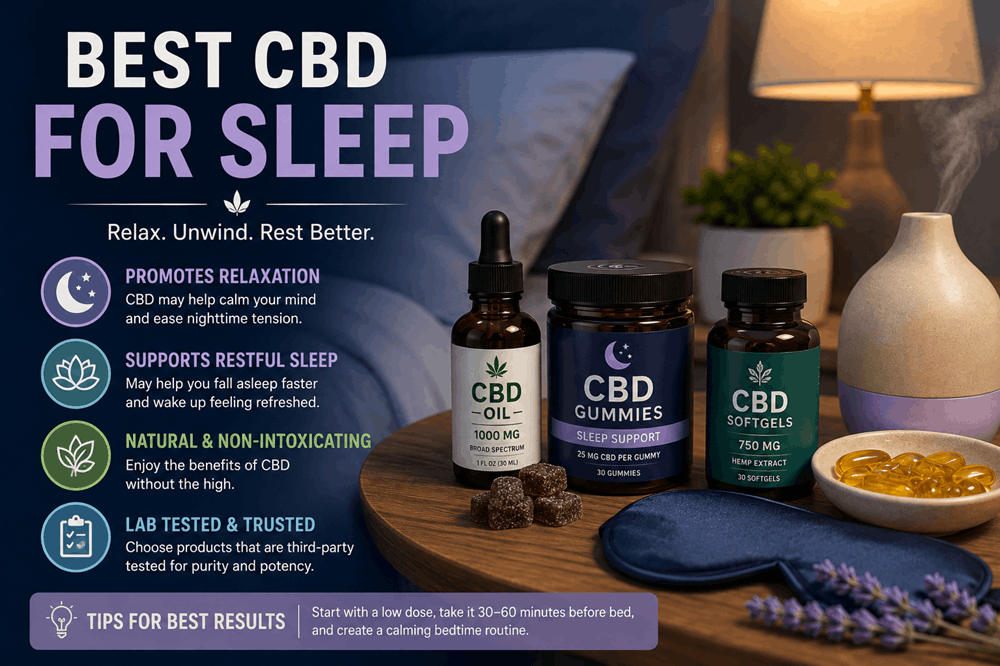
- CBD oil or tincture
- CBD gummies or capsules
- Products combining CBD with CBN, THC, melatonin, or other ingredients
There isn’t enough evidence to declare one form universally best for sleep.
Each has advantages and disadvantages.
The most useful approach is to choose based on what is actually in the product, rather than relying on words such as “deep sleep,” “nighttime,” “indica,” or “dream.”
CBD Isolate: The Simplest Option
CBD isolate is intended to contain cannabidiol without meaningful amounts of other cannabinoids.
If your primary goal is to understand how CBD itself affects you, isolate has an obvious advantage: fewer variables.
A simple CBD isolate product may make particular sense if you:
- Want to avoid THC
- Don’t want intoxicating effects
- Want a straightforward cannabinoid profile
- Need to minimize exposure to other cannabis compounds
- Want to know whether CBD itself makes a noticeable difference
However, isolate isn’t automatically better at improving sleep.
The idea that CBD alone is an effective sleep aid remains uncertain.
In a 2024 randomized placebo-controlled pilot trial, researchers gave adults with moderate-to-severe primary insomnia 150 mg of CBD sublingually each night for two weeks. CBD did not significantly improve insomnia severity, self-reported time required to fall asleep, wake time during the night, or several other major sleep outcomes compared with placebo. One objective measure of sleep efficiency improved after two weeks, and participants reported some improvements in well-being, but the overall sleep findings were limited.
So CBD isolate may be the cleanest way to try CBD, but don’t interpret “pure CBD” as “proven sleep medicine.”
Broad-Spectrum CBD: A Middle Ground
Broad-spectrum CBD generally contains CBD along with other compounds from hemp while being formulated to remove or minimize THC.
This makes it appealing to people who want more than isolated CBD but don’t want meaningful THC exposure.
The challenge is that “broad spectrum” is a product description, not a guarantee that every bottle contains exactly the same cannabinoid profile.
If choosing broad-spectrum CBD, pay close attention to the product’s laboratory report rather than relying entirely on front-label claims.
Look for a report that identifies:
- CBD concentration
- Other cannabinoids detected
- THC concentration
- Batch or lot number
- Testing date
- Laboratory name
- Contaminant testing
If avoiding THC is particularly important because of work, drug testing, sensitivity, or personal preference, verify the actual THC test result.
Full-Spectrum CBD: Does THC Make It Better for Sleep?
Full-spectrum CBD products contain a wider mixture of hemp compounds and may include THC within applicable legal limits.
Some people prefer them because of the commonly discussed “entourage effect”—the theory that cannabinoids and other cannabis compounds may act differently in combination than they do individually.
But this does not establish that full-spectrum CBD is better for sleep.
Including THC also changes the question.
You’re no longer evaluating CBD alone.
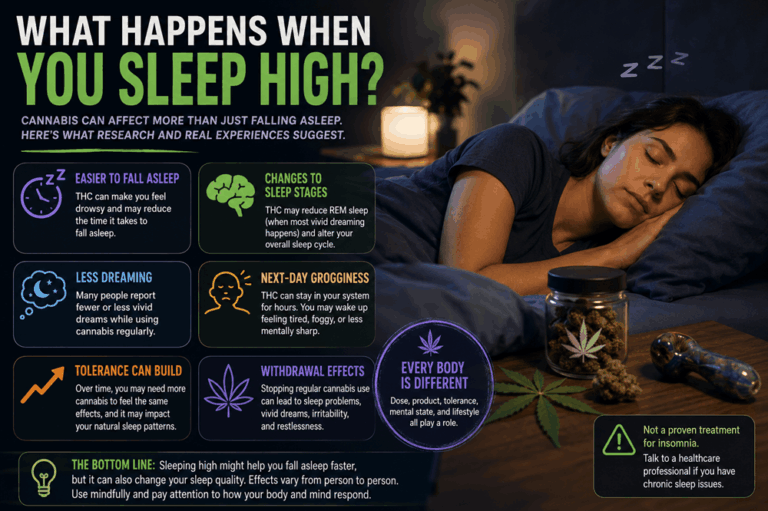
THC can produce intoxicating effects and can alter sleep architecture. A recent pilot randomized trial using a combination of 10 mg THC and 200 mg CBD in people with insomnia found reduced REM sleep and reduced total sleep time compared with placebo, even though participants did not show measurable next-day impairment on several tests.
That illustrates an important principle:
Feeling sedated isn’t necessarily the same as getting objectively better sleep.
If you want CBD specifically and would prefer to avoid psychoactive effects, full-spectrum CBD may therefore not be the most straightforward choice.
Are CBD Gummies Good for Sleep?
CBD gummies are popular largely because they’re convenient.
Each gummy usually provides a predetermined amount, making the serving size easier to understand than products that require measuring a liquid.
Advantages include:
- Convenient dosing
- Easy portability
- No measuring
- Longer-lasting oral administration
- Familiar format
But gummies also have drawbacks.
Because they are swallowed, the onset is not immediate. Effects can vary according to digestion, formulation, food intake, and individual metabolism.
That means taking another gummy simply because you “don’t feel anything yet” can make it harder to understand your actual response.
Gummies may also contain additional ingredients such as:
- Melatonin
- CBN
- THC
- L-theanine
- Herbal extracts
- Magnesium
- Added sugars
- Flavorings
Once multiple ingredients are included, you can’t assume any sleep effect came from CBD.
Is CBD Oil Better Than Gummies for Sleep?
CBD oil has one major advantage: dose flexibility.
A bottle with clearly stated CBD concentration lets you adjust the amount more precisely than a fixed-dose gummy, provided the dropper is accurately marked.
For example, if the bottle clearly tells you how many milligrams of CBD are contained in each milliliter, you can understand your exposure more easily.
Oil can therefore be useful if your priority is careful, consistent experimentation rather than convenience.
However, CBD oils vary tremendously in concentration.
Never assume “one dropper” means the same amount between brands.
One product might contain 10 mg in a serving while another contains 50 mg or substantially more.
Read the milligram information rather than judging potency by bottle size.
What About CBD and CBN for Sleep?
CBN has increasingly appeared in products marketed specifically for nighttime use.
You’ll see labels such as:
CBD + CBN Sleep Gummies
or:
Nighttime CBD + CBN Oil
Research into cannabinoids and sleep is growing. A 2026 systematic review of medical cannabis studies reported potentially beneficial sleep findings with several cannabinoid formulations, including CBD and CBN. However, the included studies involved different cannabinoids, doses, formulations, and populations, so they do not establish that every commercial CBD-CBN sleep gummy will work.
This distinction is important because marketing often moves faster than clinical evidence.
CBN shouldn’t automatically be interpreted as a proven natural sleeping pill just because it appears on a nighttime label.
What About CBD With Melatonin?
Products combining CBD and melatonin present another complication.
If the combination makes you sleepy, which ingredient is responsible?
It could be:
- CBD
- Melatonin
- Both
- Other ingredients
- Expectation or routine
- Natural night-to-night variation
Combination products aren’t necessarily inappropriate, but they make it much harder to evaluate CBD itself.
If you’re specifically trying to determine whether CBD benefits your sleep, a simpler formulation gives you a clearer answer.
How Much CBD Is Best for Sleep?
There is no universally established over-the-counter CBD dose for sleep.
That’s important because online recommendations often make CBD dosing sound far more precise than the research supports.
Studies have used considerably different doses.
The 2024 insomnia pilot trial used 150 mg nightly, which is substantially higher than the amount found in many common consumer gummies. Even at that dose, most primary sleep outcomes weren’t significantly better than placebo.
A 2026 review examining medical cannabis for insomnia included CBD doses across a much wider range and concluded that cannabinoids may have sleep-related benefits in some circumstances. However, differences among formulations and studies mean those findings shouldn’t be converted into a universal DIY dose.
More CBD isn’t automatically better.
CBD can produce side effects and interact with medications. The FDA specifically warns about potential liver injury, drug interactions, sedation, diarrhea, changes in appetite, and other adverse effects.
Does CBD Actually Make You Sleepy?
It can.
Drowsiness or somnolence is a known possible effect of cannabidiol. The FDA identifies changes in alertness, most commonly drowsiness or sleepiness, among CBD’s potential adverse effects.
But once again:
Sleepiness does not prove better sleep.
You can become drowsy without necessarily improving:
- Total sleep time
- Sleep efficiency
- Nighttime awakenings
- Deep sleep
- REM sleep
- Morning alertness
- Chronic insomnia
This is one of the biggest misconceptions surrounding CBD for sleep.
A product can make someone feel relaxed at bedtime while providing little measurable improvement in the sleep disorder they’re trying to address.
What Does Current Research Say About CBD and Sleep?
The evidence remains mixed.
The 2024 controlled CBD-only insomnia trial is especially useful because it tested cannabidiol against placebo rather than relying entirely on surveys or products containing multiple cannabinoids.
Most major sleep outcomes were similar between groups.
Broader research involving cannabinoids has produced more encouraging results. A systematic review and meta-analysis published in August 2026 examined randomized trials involving cannabinoids and reported improvements in several sleep outcomes. However, “cannabinoids” does not mean CBD alone; different studies may involve THC, CBD, CBN, or combinations.
That’s why you may encounter seemingly contradictory headlines claiming both that CBD works for insomnia and that it doesn’t.
They’re often discussing different products and different evidence.
How to Choose a Better CBD Product for Sleep
Rather than looking for the most impressive nighttime packaging, focus on product transparency.
1. Look for an independent Certificate of Analysis
A current COA should ideally correspond to the actual batch you’re buying.
Check whether the measured CBD amount is reasonably consistent with the label.
2. Check THC levels
This is particularly important if you don’t want intoxication or are concerned about drug testing.
“CBD product” does not automatically mean “zero THC.”
3. Prefer a clear CBD amount per serving
You should be able to determine how many milligrams you’re taking.
Avoid products that obscure cannabinoid quantities behind vague proprietary blends.
4. Avoid exaggerated medical claims
Be cautious with products promising to:
- Cure insomnia
- Guarantee eight hours of sleep
- Replace prescription medication
- Eliminate anxiety
- Fix sleep disorders permanently
The FDA has not approved ordinary retail CBD products as treatments for insomnia. Its approved prescription cannabidiol product is used for specific seizure disorders, not sleep problems.
5. Check the ingredient list
A “CBD sleep gummy” may actually contain several substances intended to influence sleep.
Know what you’re taking.
6. Check contaminant testing
A meaningful laboratory report may include testing for substances such as pesticides, heavy metals, residual solvents, or microbes where appropriate.
Beautiful packaging isn’t a substitute for quality-control information.
What Is the Best CBD for Sleep Without THC?
If avoiding THC is your priority, CBD isolate or a well-tested broad-spectrum product with non-detectable THC is the logical place to look.
That doesn’t mean either one is guaranteed to improve sleep.
It simply removes or minimizes THC as another variable.
This can be especially useful for someone who:
- Doesn’t want to feel high
- Is sensitive to THC
- Wants to assess CBD separately
- Wants to minimize THC exposure
However, anyone subject to drug testing should understand that no casual retail label can provide an absolute guarantee about test results.
What Is the Best CBD for Sleep and Anxiety?
This is another common question, but it combines two different outcomes.
Feeling less anxious may indirectly make bedtime easier for someone whose mind becomes busy at night, but that doesn’t mean CBD is treating insomnia itself.
The 2024 insomnia study found some psychological and well-being differences even though most sleep outcomes weren’t significantly improved.
That’s a useful reminder that someone can feel better at bedtime without showing dramatic changes in measured sleep.
Persistent anxiety or insomnia deserves appropriate evaluation instead of simply increasing a CBD dose.
Is CBD Safer Than THC for Sleep?
CBD does not produce the classic marijuana high associated with THC, which may make it preferable for people who don’t want intoxication.
That does not make CBD risk-free.
The FDA warns that CBD may cause liver injury, affect other medications, produce drowsiness, and cause other adverse effects. Combining it with alcohol or other drugs that depress brain activity can increase sedation.
THC introduces additional psychoactive and impairment-related considerations.
So if your goal is specifically to explore cannabidiol without becoming high, a THC-free formulation provides a simpler option—but not a guaranteed sleep treatment.
Who Should Be Especially Careful With CBD?
Extra caution is appropriate if you:
- Take prescription medications
- Take sedatives or sleep medication
- Drink alcohol around bedtime
- Have liver problems
- Are pregnant or breastfeeding
- Need to remain alert overnight
- Have persistent unexplained sleep problems
CBD can affect how other drugs work, and the FDA continues to emphasize unanswered questions about long-term CBD exposure and vulnerable populations.
Frequently Asked Questions
What strength CBD is best for sleep?
There is no scientifically established retail strength that works best for everyone. Human sleep research has used widely varying doses, and higher doses aren’t automatically more effective.
Are gummies or oil better for sleep?
Neither has been proven universally superior. Gummies offer convenience and fixed servings, while oils generally make dose adjustment easier.
Is full-spectrum CBD better for sleep?
Not necessarily. Full-spectrum products contain additional cannabinoids and may include THC. That changes both the effects and the risks, and current evidence doesn’t prove that full-spectrum CBD is universally superior for sleep.
Is CBD isolate good for sleep?
CBD isolate is useful if you want CBD without THC or additional cannabinoids. However, CBD alone has not consistently improved insomnia outcomes in controlled research.
Should CBD contain THC for better sleep?
There is no general rule saying it should. THC can produce sedation but can also alter normal sleep architecture. A recent THC/CBD trial found substantial changes in REM sleep and reduced total sleep time following the combination tested.
Does CBD work immediately for sleep?
Not necessarily. The onset depends partly on how it’s consumed, and individual effects vary. A product failing to produce an obvious immediate sensation doesn’t necessarily mean it contains no CBD.
The Bottom Line
The best CBD for sleep isn’t a particular brand, gummy flavor, strain name, or maximum-strength bottle.
If you decide to try CBD, look for a simple, accurately labeled, independently tested product with a clear CBD dose and a cannabinoid profile that matches what you actually want. CBD isolate or broad-spectrum CBD may make the most sense when you want to minimize THC, while full-spectrum products introduce additional cannabinoids—including potentially THC—that can change the experience.
Most importantly, don’t confuse CBD marketing with established sleep medicine.
A 2024 randomized CBD-only insomnia trial found that 150 mg nightly performed similarly to placebo on most major sleep outcomes, while newer reviews of cannabinoids have produced more positive results but combine evidence involving several different cannabinoid formulations.
CBD may make some people drowsy or relaxed, but there is currently no single type, dose, or retail CBD product proven to be “the best” for sleep for everyone.
If poor sleep is persistent, severe, or interfering with your daytime life, finding out why you aren’t sleeping well is more important than simply finding a stronger nighttime CBD product.