Is Hemp and CBD the Same? Key Differences Every Consumer Should Understand
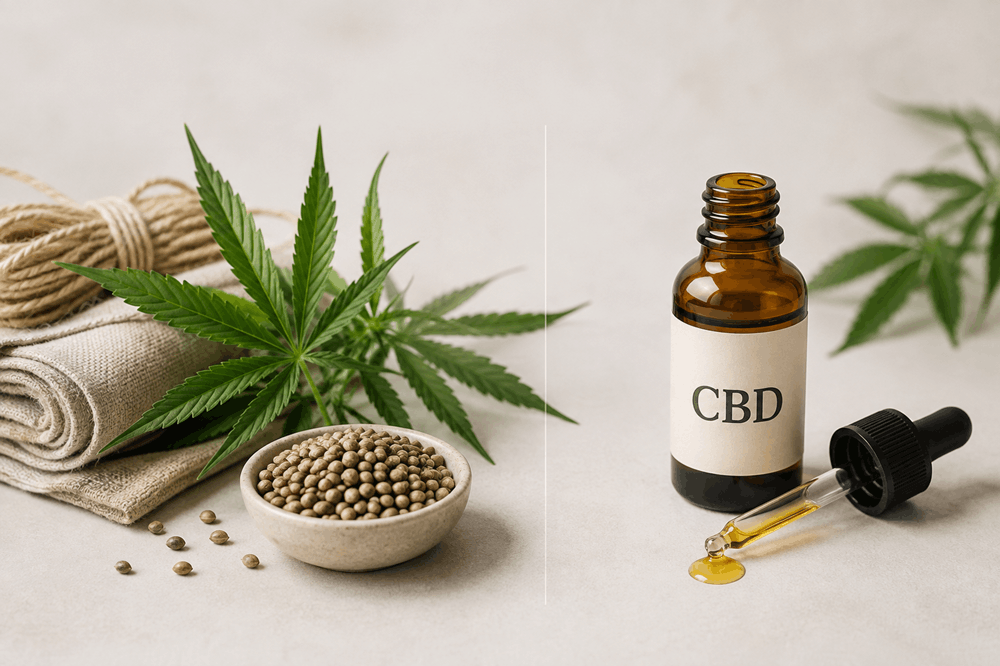
Hemp and CBD are not the same. Hemp is a type of cannabis plant, while CBD is a naturally occurring compound that may be extracted from that plant. Hemp can be used to produce fiber, seeds, food ingredients, cosmetics, building materials, and cannabinoid products. CBD is only one of the many substances that hemp may contain.
The Simple Difference Between Hemp and CBD
The easiest way to understand the distinction is to think of hemp as the source and CBD as one possible ingredient obtained from that source.
Hemp is a plant. CBD, short for cannabidiol, is a cannabinoid. Cannabinoids are chemical compounds found naturally in cannabis plants. Hemp can contain CBD, but the entire hemp plant is not CBD.
This is similar to the difference between an orange and vitamin C. An orange may contain vitamin C, but the fruit and the nutrient are not the same thing. In the same way, hemp may contain CBD, but hemp includes many other plant compounds, fibers, oils, proteins, and materials.
The confusion often comes from product labels. Terms such as hemp oil, CBD oil, hemp extract, cannabis extract, and hemp seed oil may appear similar even when the products contain very different ingredients.
What Is Hemp?
Hemp is a form of the Cannabis sativa plant cultivated for industrial, nutritional, or cannabinoid-related purposes. It is generally distinguished from marijuana by its low concentration of delta-9 THC, the cannabinoid most strongly associated with cannabis intoxication.
Different parts of the hemp plant can be used in different ways:
- The stalks may be processed into fiber, rope, paper, textiles, insulation, or building materials.
- The seeds may be used in food, protein powder, hemp milk, or cooking oil.
- The flowers and leaves may be processed to obtain CBD and other cannabinoids.
- The roots and remaining plant material may be used in agricultural or industrial applications.
A hemp product does not automatically contain CBD. A shirt made from hemp fiber contains no meaningful CBD. Hemp protein and ordinary hemp seed oil also generally contain little or no naturally occurring CBD.
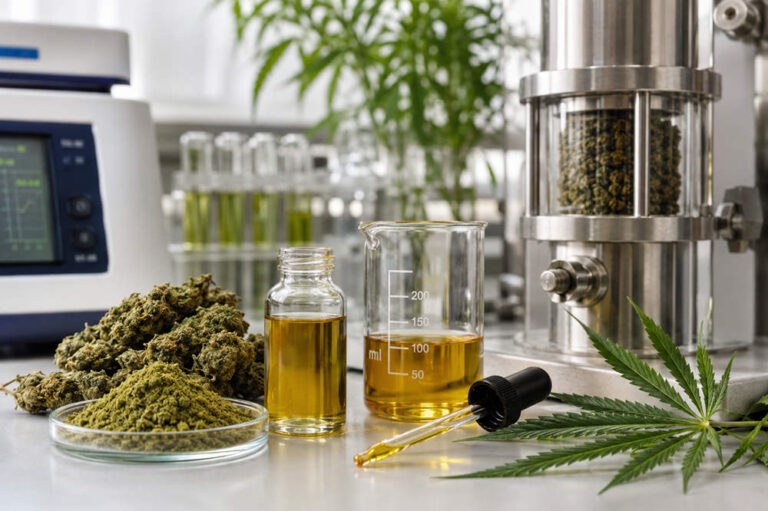
CBD is concentrated mainly in the resinous flowers and other above-ground parts of cannabinoid-rich hemp plants. Manufacturers must extract and process these compounds before creating most commercial CBD oils, capsules, gummies, and topical products.
What Is CBD?
CBD is one of many cannabinoids found in cannabis. It is generally described as non-intoxicating because it does not produce the typical high associated with delta-9 THC.
Non-intoxicating does not mean inactive. CBD interacts with biological systems in the body and may affect alertness, digestion, medication metabolism, appetite, and other functions. Its effects depend on the dose, product, individual, and other substances used at the same time.
CBD may be extracted from legally defined hemp or from cannabis plants containing higher levels of THC. The CBD molecule itself is the same regardless of the source. However, the legal status, accompanying cannabinoids, manufacturing process, and final product composition may differ.
Commercial CBD products may include:
- CBD oils and tinctures
- Capsules and softgels
- Gummies and other edibles
- Topical creams and balms
- Drink mixes and beverages
- Pet products
- Prescription cannabidiol medicine
These products should not be assumed to work in the same way simply because they contain CBD. A topical balm, oral oil, gummy, and prescription medicine may differ substantially in dose, ingredients, absorption, and quality control.
Hemp Oil and CBD Oil Are Not Always the Same
One of the most common labeling problems involves the phrase “hemp oil.” It can refer to CBD-rich hemp extract, ordinary hemp seed oil, or a mixture of both.
Hemp Seed Oil
Hemp seed oil is pressed from the seeds of the hemp plant. It is primarily a food and cosmetic ingredient. It contains fats, including omega fatty acids, but it does not naturally contain a meaningful amount of CBD.
Hemp seed oil may appear in salad dressings, skincare products, soaps, lotions, and nutritional supplements. It may also be used as the carrier oil in a CBD tincture. In that situation, the product contains both hemp seed oil and separately extracted CBD.
A bottle labeled only “hemp seed oil” should not be expected to produce the effects associated with concentrated CBD.
CBD Oil
CBD oil is usually made by combining a CBD-rich extract with a carrier oil. The carrier may be coconut-derived MCT oil, olive oil, sunflower oil, or hemp seed oil.
A legitimate CBD oil should clearly state how many milligrams of CBD it contains. The label may show the amount per serving, per dropper, or in the entire bottle.
If a product advertises “1,000 milligrams of hemp oil” without listing any CBD content, that number may describe the amount of carrier oil or hemp-derived ingredients rather than the quantity of cannabidiol.
Why Some Hemp Products Contain CBD and Others Do Not
The part of the plant used determines what the final product contains.
Hemp seeds naturally contain nutrients but not significant concentrations of cannabinoids. Hemp stalks are useful for fiber but are not usually the main source of commercial CBD. The flowers and nearby leaves contain the resin glands from which CBD-rich extracts are commonly produced.
Processing also matters. A raw hemp plant does not automatically become a finished CBD oil. Manufacturers must harvest the plant, extract its compounds, refine the extract, test it, and formulate it into a usable product.
A product may therefore be accurately described as hemp-derived while containing very little CBD. The phrase “made with hemp” does not establish the cannabinoid content.
Are Hemp and Marijuana the Same Plant?
Hemp and marijuana are both forms of cannabis, but the terms are generally used to distinguish plants and products according to THC content, legal classification, and intended use.
Hemp is typically associated with low-THC cannabis cultivated for fiber, food, seeds, or cannabinoid extraction. Marijuana is a common term for cannabis cultivated or sold for its higher THC content and intoxicating effects.
The plants may look similar because they belong to the same broader species. Their chemical composition can nevertheless differ significantly. One hemp variety may be bred for tall stalks and fiber, while another may be bred to produce CBD-rich flowers.
The distinction is partly botanical, partly agricultural, and partly legal. It is not accurate to assume that hemp has no THC at all. Hemp may contain small amounts of THC, and finished hemp-derived products may contain detectable THC depending on their formulation and quality control.
Does CBD From Hemp Make You High?
CBD itself does not normally produce the classic high associated with THC. However, a hemp-derived CBD product may contain THC, especially when it is labeled full-spectrum.
A person may experience unexpected intoxication when:
- The product contains more THC than expected.
- The label is inaccurate.
- A large serving of a full-spectrum product is used.
- The person is particularly sensitive to THC.
- The product contains other intoxicating cannabinoids.
Words such as hemp-derived, natural, or non-intoxicating do not prove that a product contains no THC. A current certificate of analysis is more useful than marketing language.
Full-Spectrum, Broad-Spectrum, and CBD Isolate
CBD products are often divided into three general types.
Full-Spectrum CBD
Full-spectrum products contain CBD along with other naturally occurring hemp compounds. These may include minor cannabinoids, terpenes, flavonoids, and small amounts of THC.
The exact composition varies between products and batches. Someone who wants to avoid THC for personal, employment, legal, or medical reasons should not assume that a full-spectrum product is THC-free.
Broad-Spectrum CBD
Broad-spectrum products are generally designed to contain CBD and other hemp compounds while removing THC. However, manufacturing and testing standards vary. A laboratory report is still necessary to confirm what was measured in the batch.
CBD Isolate
CBD isolate is a purified form of cannabidiol intended to contain little besides CBD. It may be sold as a powder or added to oils, gummies, and other products.
Isolate products are often chosen by people trying to avoid THC, although contamination and labeling errors remain possible.
How to Tell Whether a Hemp Product Contains CBD
Do not rely only on the image of a hemp leaf or the word “hemp” on the front of the package. Check the detailed label.
A CBD product should identify:
- The amount of CBD per serving
- The total CBD content in the package
- The serving size
- The type of extract used
- The ingredient list
- The batch or lot number
- A matching certificate of analysis
The laboratory report should show the measured cannabinoid content. Ideally, it should include CBD, delta-9 THC, THCA, and other relevant cannabinoids. It should also show contaminant testing for heavy metals, pesticides, solvents, microorganisms, or other substances appropriate to the product.
A QR code alone does not prove that a product has been tested properly. The report linked by the code should match the batch number printed on the bottle or package.
Can Hemp Products Cause a Positive Drug Test?
A hemp-derived product can potentially contribute to a positive drug test when it contains THC. Standard workplace drug tests generally look for THC metabolites rather than CBD.
Full-spectrum CBD products may contain small amounts of THC. Repeated use, larger servings, product inaccuracies, and individual metabolism may increase the possibility of detectable exposure.
A product labeled THC-free may reduce that risk, but no retail product can guarantee a negative result unless its content and testing are reliable. People subject to drug screening should consider avoiding cannabinoid products entirely rather than relying on marketing claims.
Ordinary hemp seed foods are much less likely to contain meaningful THC, but contaminated or poorly processed products can create uncertainty.
Is Hemp Safer Than CBD?
The question depends on the specific product. Hemp fiber, hemp seed protein, CBD oil, full-spectrum gummies, and concentrated cannabinoid extracts do not present the same risks.
Plain hemp foods are primarily nutritional products. Concentrated CBD products are pharmacologically active and may cause side effects or medication interactions.
Possible CBD-related effects include:
- Sleepiness
- Diarrhea
- Nausea
- Changes in appetite
- Fatigue
- Dizziness
- Medication interactions
- Changes in liver-enzyme levels
Risk may increase with larger servings, frequent use, alcohol, sedating medications, liver disease, pregnancy, breastfeeding, or the use of multiple cannabinoid products.
The plant origin does not make every hemp product harmless. Safety depends on the compounds present, concentration, manufacturing quality, and the person using it.
Why the Difference Matters
Confusing hemp with CBD can lead to incorrect expectations.
Someone may buy hemp seed oil believing it will provide a concentrated CBD dose. Another person may use a full-spectrum CBD product believing that all hemp products are completely free of THC. A third person may assume a hemp-derived cannabinoid cannot cause side effects because it is sold as a wellness product.
Understanding the distinction helps consumers ask better questions:
- Which part of the hemp plant was used?
- Does the product contain CBD?
- How many milligrams are in one serving?
- Does it contain measurable THC?
- Was the specific batch independently tested?
- Are there additional active ingredients?
These questions provide more useful information than the word “hemp” alone.
The Bottom Line
Hemp and CBD are related, but they are not the same. Hemp is a cannabis plant used to produce many different materials and ingredients. CBD is one cannabinoid that may be extracted from certain parts of that plant.
Some hemp products contain substantial amounts of CBD, while others contain little or none. Hemp seed oil, hemp protein, hemp fiber, and CBD oil should not be treated as interchangeable products.
To determine what a product actually contains, read the CBD amount per serving, review the ingredient list, identify whether the extract is full-spectrum, broad-spectrum, or isolate, and check a batch-specific laboratory report. The word “hemp” describes the source, but it does not reveal the complete contents or effects of the finished product.