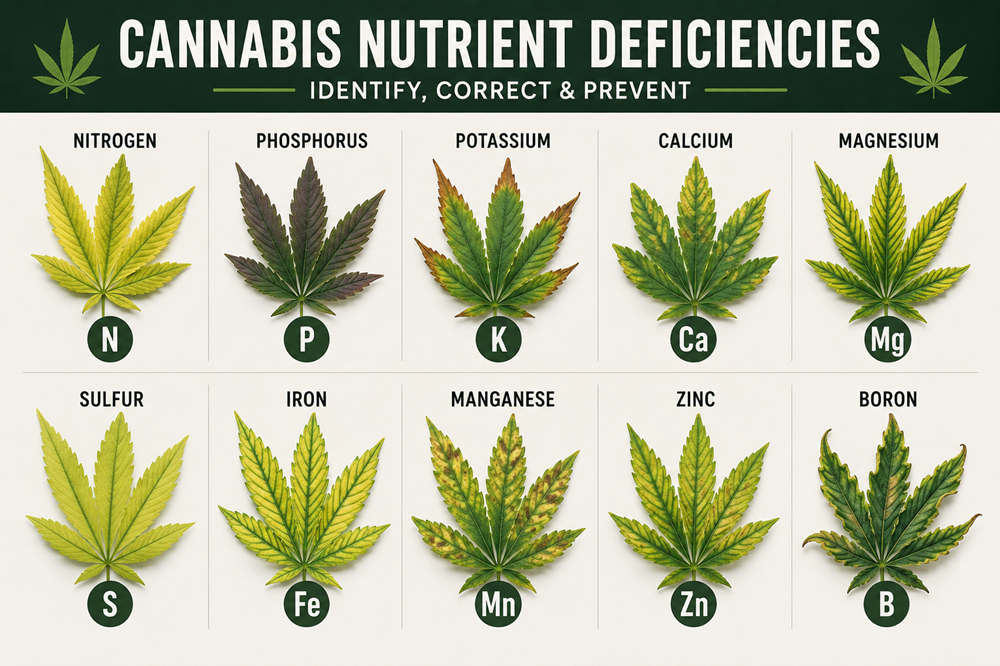
Cannabis Deficiencies: How to Identify Nutrient Problems and Avoid Misdiagnosis
Yellow leaves, scorched margins, rusty spots, and distorted new growth can indicate a nutrient problem in cannabis. However, none of these symptoms identifies a deficiency by itself. Similar damage can result from excessive fertilizer, unsuitable root-zone conditions, impaired roots, environmental stress, pests, or disease.
Scientific diagnosis begins by examining where symptoms appeared, how they progressed, and what changed before the damage developed. Measurements of the growing medium, irrigation solution, and plant tissue can then help determine whether the plant lacks a nutrient or is unable to absorb one that is already present.
A controlled hydroponic study of cannabis nutrient deficiencies found that visible symptoms did not always appear at the same time as abnormal foliar nutrient concentrations. Leaf appearance is therefore useful for narrowing the possibilities, but it should not be treated as laboratory confirmation.
What Is a Cannabis Nutrient Deficiency?
A nutrient deficiency occurs when a plant cannot obtain or use enough of an element required for normal growth, metabolism, or reproduction. Cannabis depends on primary macronutrients, secondary macronutrients, and micronutrients:
- Primary macronutrients: nitrogen, phosphorus, and potassium
- Secondary macronutrients: calcium, magnesium, and sulfur
- Micronutrients: iron, manganese, zinc, boron, copper, molybdenum, chlorine, and nickel
Plants require micronutrients in smaller quantities, but this does not make them less essential. A shortage of any essential element can interrupt a specific physiological process and eventually reduce plant growth.
Several different conditions may create a deficiency:
- Inadequate supply: The growing medium or nutrient solution contains too little of the required element.
- Reduced nutrient availability: The element is present but is not readily soluble or absorbable under current root-zone conditions. Cultivation literature often calls this “nutrient lockout.”
- Nutrient antagonism: A high concentration of one ion interferes with the uptake or physiological use of another.
- Impaired transport: Root injury, restricted water movement, or disrupted vascular function prevents a nutrient from reaching developing tissue.
These causes require different responses. Increasing fertilizer may correct an inadequate supply, but it can worsen a disorder caused by excessive salts or damaged roots.
Limits of Cannabis Deficiency Research
Many widely used symptom descriptions come from general plant physiology or controlled cannabis experiments in which researchers withheld one element at a time. These studies are valuable because they allow a specific nutrient response to be observed without many of the confounding factors found in commercial production.
Real plants may experience several stresses simultaneously. Symptoms in soil, peat, coco coir, hydroponics, or outdoor field production may not develop in the same order or at the same severity. Cultivars may also differ in nutrient uptake, tissue concentration, growth rate, and visible response.
The symptom patterns in this guide should therefore be interpreted as diagnostic clues rather than universal rules.
How to Interpret Cannabis Leaf Symptoms
The position of the first symptoms is often more informative than color alone. Some elements can be redistributed from older tissue to actively growing organs. When their supply becomes limited, symptoms are often first observed on mature lower leaves.
Deficiencies of nitrogen, phosphorus, potassium, and magnesium commonly follow this pattern, although the distribution may change as the disorder becomes more severe.
Other elements are less readily redistributed. Iron, manganese, boron, and calcium-related disorders often affect developing leaves, shoot tips, or roots first. Symptom position still cannot confirm the responsible nutrient because root damage and environmental conditions can alter nutrient movement.
Common Symptom Terms
- Chlorosis: Loss of green color associated with reduced chlorophyll or impaired chloroplast function.
- Interveinal chlorosis: Yellowing between the veins while the veins remain comparatively green.
- Necrosis: Irreversible death of tissue, usually appearing brown, gray, or black.
- Marginal scorch: Browning or drying concentrated along the leaf edges.
- Distortion: Twisting, cupping, thickening, curling, or incomplete leaf expansion.
- Stunting: Reduced development of roots, shoots, internodes, leaves, or flowers.
Quick Cannabis Deficiency Comparison
| Nutrient | Often first observed on | Possible pattern | Important look-alikes |
|---|---|---|---|
| Nitrogen | Older leaves | General yellowing that may begin near the leaf tips | Natural senescence, root injury, sulfur deficiency |
| Phosphorus | Older foliage | Slow growth, dark leaves, bronzing, or necrotic patches | Cold stress, genetic pigmentation, root damage |
| Potassium | Older leaf margins | Brown edges, rusty areas, curling, or weak stems | Salt injury, heat stress, excessive airflow |
| Calcium | Developing tissue | Irregular spots, distorted leaves, or damaged growing points | Root disease, boron deficiency, pesticide injury |
| Magnesium | Older leaves | Interveinal chlorosis with possible necrotic spotting | Iron deficiency, potassium imbalance, root stress |
| Sulfur | Younger foliage | General paling or yellowing of new growth | Nitrogen deficiency, low light, root dysfunction |
| Iron | Youngest leaves | Interveinal chlorosis that may progress to bleaching | Manganese deficiency, high-pH stress, root injury |
| Manganese | Younger leaves | Interveinal chlorosis with small necrotic spots | Iron deficiency, leaf disease, pesticide damage |
| Zinc | New shoots | Small leaves, short internodes, and distorted growth | Root restriction, excess phosphorus, genetic form |
| Boron | Growing tips | Brittle, thickened, twisted, or necrotic new tissue | Calcium disorders, herbicide injury, mites |
The table is most useful when combined with the plant’s history and root-zone measurements. A single damaged leaf is rarely enough to identify the cause.
Primary Macronutrient Deficiencies
Nitrogen Deficiency
Nitrogen is a component of amino acids, proteins, nucleic acids, chlorophyll, and many enzymes. Cannabis requires substantial nitrogen during periods of rapid leaf and stem development.
Deficiency usually begins as a gradual loss of green color on older foliage. Yellowing may start near the tip and move inward before the affected leaves dry and detach. Continued deficiency can reduce leaf expansion, stem growth, and overall plant vigor.
A few yellow lower leaves late in development may reflect normal senescence rather than a serious shortage. Nitrogen deficiency is more likely when discoloration begins prematurely, expands through the lower canopy, and occurs with declining growth.
Phosphorus Deficiency
Phosphorus contributes to energy transfer, nucleic acids, cell membranes, root development, and reproductive metabolism. Deficiency can reduce growth before dramatic leaf damage becomes visible.
Possible signs include unusually dark foliage, bronzing, lower-leaf chlorosis, downward curling, and irregular necrotic areas. Flower and root development may also slow.
Purple stems or leaves are weak evidence when considered alone. Anthocyanin production can be influenced by genetics, temperature, developmental stage, and other stresses. A phosphorus diagnosis should be based on the broader symptom pattern and analytical evidence rather than pigmentation by itself.
Potassium Deficiency
Potassium regulates stomatal behavior, water balance, enzyme activity, electrical charge, and the movement of solutes within plant tissue. It is especially important for maintaining cellular function under rapidly changing environmental conditions.
Deficiency commonly produces chlorosis or brown necrosis around the tips and margins of older leaves. Rust-colored patches, curling, reduced stem strength, and declining growth may follow as the condition progresses.
Marginal damage is not unique to potassium deficiency. Fertilizer burn, excessive heat, intense airflow, and poor water uptake can produce a similar scorched appearance.
Secondary Macronutrient Deficiencies
Calcium Deficiency
Calcium contributes to cell-wall structure, membrane stability, cellular signaling, meristem development, and root-tip growth. Once deposited in tissue, it is not readily redistributed to newly forming organs.
Calcium-related disorders may appear as irregular spotting, incomplete leaf expansion, hooked or distorted new growth, weakened shoot tips, or root-tip dieback. Developing tissues can be affected even when older foliage remains relatively normal.
Calcium movement depends strongly on root function and water transport. A plant may therefore develop calcium-related injury without a low total calcium concentration in the fertilizer solution.
Magnesium Deficiency
Magnesium occupies the central position in the chlorophyll molecule and supports enzyme activation, energy transfer, and carbohydrate metabolism. Because it can be redistributed within the plant, deficiency is commonly first observed on mature foliage.
The typical pattern is interveinal chlorosis on older leaves. The tissue between veins becomes yellow while the veins remain greener. Advanced damage may include rusty necrotic spots, upward curling, and premature leaf loss.
Iron deficiency can create a similar interveinal pattern, but it normally begins on younger growth.
Sulfur Deficiency
Sulfur is part of several amino acids, proteins, coenzymes, and plant defense compounds. Its deficiency commonly produces pale green or yellow young foliage and reduced shoot growth.
The general yellowing may resemble nitrogen deficiency. Leaf position provides one clue: nitrogen symptoms are usually more prominent on older foliage, whereas sulfur symptoms often appear first on younger leaves. Because the distinction is not absolute, testing is preferable when the pattern is unclear.
Micronutrient Deficiencies
Cannabis-specific evidence is more limited for some micronutrients than for the principal macronutrients. The following descriptions draw on both cannabis experiments and broader plant-nutrition research and should be confirmed through appropriate testing.
Iron Deficiency
Iron participates in electron-transfer reactions and supports chlorophyll formation. Deficiency often begins as interveinal chlorosis on the youngest leaves. Severe cases may produce nearly white new growth before dead tissue develops.
Iron deficiency frequently reflects reduced availability rather than an absence of iron. Root-zone chemistry can convert iron into forms that roots cannot absorb efficiently, making pH measurement particularly relevant to this pattern.
Manganese Deficiency
Manganese contributes to photosynthesis, enzyme activity, and oxidation-reduction reactions. Deficiency may cause interveinal chlorosis on younger foliage followed by small necrotic specks.
The pattern can be difficult to distinguish from iron deficiency or early leaf disease. Manganese problems should not be diagnosed from speckling alone.
Zinc Deficiency
Zinc supports enzyme function, protein synthesis, hormone metabolism, and internode development. Affected plants may develop pale, undersized, or distorted new leaves. Internodes can become unusually short, producing compact clusters of growth.
These features overlap with root restriction, excessive phosphorus, environmental stress, and natural cultivar structure. Tissue testing is valuable before applying a concentrated zinc product.
Boron Deficiency
Boron contributes to cell-wall formation, membrane function, carbohydrate movement, meristem activity, and reproductive development. Symptoms often appear at growing points because boron is not readily redistributed in many plants.
Young leaves may become thick, brittle, twisted, or incompletely expanded. Shoot tips can stop developing, and roots may show reduced elongation. Because the difference between insufficient and excessive boron can be narrow, supplementation should be based on measurement.
Less Common Micronutrient Problems
Copper and molybdenum deficiencies are possible but are not commonly confirmed in cannabis production. Their visible signs overlap substantially with root stress, chemical injury, and other nutrient imbalances.
When an uncommon deficiency is suspected, analysis of the water, growing medium, nutrient solution, and plant tissue is more reliable than adding several micronutrients experimentally.
Common Uptake Problems and Deficiency Look-Alikes
Unsuitable Root-Zone pH
Root-zone pH affects nutrient solubility, chemical form, microbial activity, and absorption. A nutrient may be present in sufficient quantity but become less available outside the range appropriate for the growing medium.
Soil, peat-based substrates, coco coir, and hydroponic solutions are managed differently. A pH measurement should therefore be interpreted according to the production system and the method used to collect the sample.
Excess Fertilizer and Salt Accumulation
High concentrations of dissolved salts make water uptake more difficult and can directly injure roots. Common signs include burned tips, dry margins, wilting, reduced growth, and the simultaneous appearance of several deficiency-like patterns.
Electrical conductivity can help distinguish a low nutrient supply from excessive root-zone salinity. The result must still be interpreted alongside the fertilizer formulation, source water, substrate, and stage of plant development.
Overwatering and Root Injury
Healthy roots require oxygen for respiration and active ion uptake. Persistently saturated media restrict gas exchange, while root pathogens, compaction, temperature extremes, and transplant damage reduce the functional root area.
Root-related problems often affect several nutrients at once. Discoloration may appear across different leaf ages rather than following the orderly pattern expected from a single-element deficiency.
Environmental Stress
Temperature, humidity, light intensity, and air movement influence photosynthesis, transpiration, water balance, and nutrient transport. Excessive light can bleach exposed upper leaves, while heat or dry airflow can produce marginal damage resembling potassium deficiency.
Localized injury concentrated near a lamp, heater, fan, doorway, or cooling outlet points toward an environmental cause. Nutritional disorders are more likely to follow plant age, tissue type, or root-zone distribution.
Pests, Diseases, and Chemical Injury
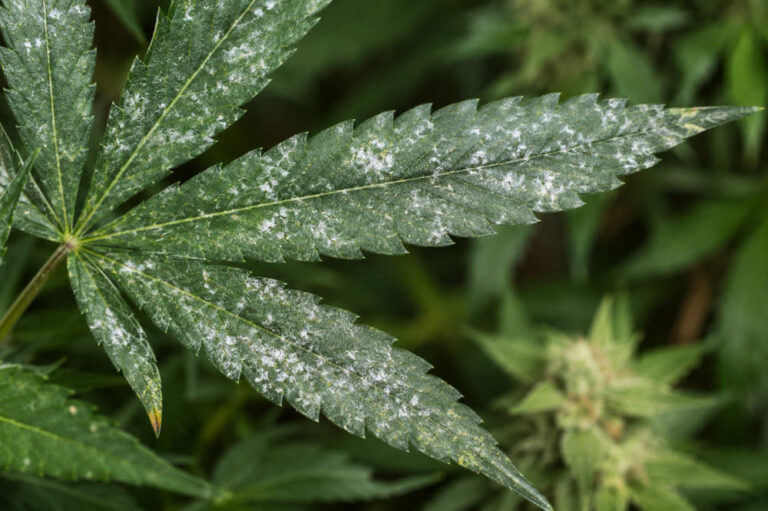
Mites, thrips, leaf-mining insects, fungal leaf spots, root pathogens, and chemical exposure can all cause chlorosis, spotting, deformation, or necrosis. Close inspection may reveal feeding scars, webbing, insects, spores, lesions, or a pattern linked to a recent spray.
University extension guidance on hemp nutrient disorders also emphasizes comparing nutritional symptoms with pests, diseases, and other sources of plant stress before treatment.
Normal Senescence
Older leaves naturally lose chlorophyll and are eventually shed. Isolated yellowing in deeply shaded lower foliage is not necessarily evidence of a nutrient disorder.
The rate and direction of change are important. A problem deserves closer investigation when symptoms expand rapidly, move into productive foliage, or occur with measurable loss of growth.
How to Diagnose a Suspected Cannabis Deficiency
- Locate the first symptoms. Record whether damage began on mature leaves, young leaves, growing points, margins, or roots.
- Map the distribution. Determine whether the pattern affects one plant, one irrigation zone, one cultivar, or the entire crop.
- Document progression. Photograph plants under neutral light and note whether symptoms are stable or expanding.
- Review recent changes. Check fertilizer adjustments, irrigation events, transplanting, temperature shifts, sprays, and changes in water quality.
- Inspect the roots. Examine moisture distribution, drainage, odor, root color, texture, and signs of decay or salt accumulation.
- Measure the root zone. Test pH and electrical conductivity with calibrated equipment and a sampling method suited to the growing medium.
- Check for biological damage. Inspect both sides of leaves, stems, and roots for insects, feeding marks, lesions, or pathogen growth.
- Review actual nutrient inputs. Include minerals already present in source water and amendments rather than considering the fertilizer label alone.
- Use laboratory testing when necessary. Water, substrate, nutrient-solution, and foliar analyses can identify shortages, excesses, and imbalances that remain visually ambiguous.
- Change one major factor at a time. Multiple simultaneous treatments make it difficult to determine whether the diagnosis was correct.
Foliar tissue analysis is a standard diagnostic method, but its value depends on sampling consistency. Growers should follow the laboratory’s instructions for leaf age, canopy position, sample size, cleanliness, and handling. Mixing old and young leaves or submitting mostly dead tissue can produce results that are difficult to interpret.
Correcting a Deficiency Without Overcorrecting
The purpose of correction is to restore normal uptake and protect developing tissue. Dead areas cannot recover, and older chlorotic leaves may not regain their original color after the underlying problem is resolved.
A measured response should follow the evidence:
- Correct irrigation, drainage, pH, salinity, temperature, or root disease when these factors are restricting uptake.
- Confirm the composition of all fertilizers and supplements to avoid applying the same element through several products.
- Adjust nutrient supply gradually and according to the growing system rather than using a universal dose.
- Monitor new leaves and roots for improvement instead of judging recovery from permanently damaged tissue.
- Allow enough time to observe the response before making another major change.
More fertilizer does not necessarily produce more growth, flowers, or cannabinoids. A 2025 cannabis study found that elevated phosphorus and nutrient concentrations did not improve yield or cannabinoid production under the tested hydroponic conditions. Excessive inputs can instead increase waste, nutrient discharge, salinity, and the risk of secondary imbalances.
Preventing Cannabis Nutrient Disorders
Prevention depends on consistent monitoring rather than reacting to isolated leaf symptoms. A practical nutrient-management program includes:
- Testing source water and accounting for the minerals it contributes.
- Using a complete fertilizer program appropriate for the substrate and production system.
- Calibrating pH and electrical-conductivity meters regularly.
- Maintaining uniform irrigation, effective drainage, and sufficient root-zone oxygen.
- Adjusting nutrient supply as plant size, growth rate, and developmental stage change.
- Recording fertilizer batches, mixing order, application volume, drainage measurements, and plant response.
- Inspecting plants routinely so changes can be detected before extensive tissue is damaged.
- Using periodic laboratory analysis to confirm trends that cannot be resolved visually.
Feeding schedules should be treated as starting points rather than fixed biological requirements. Cultivar, environment, water chemistry, plant size, developmental stage, and root-zone volume can all alter nutrient demand.
Final Takeaway
Cannabis deficiencies cannot be diagnosed reliably by matching a damaged leaf to a photograph. Chlorosis, spotting, curling, scorching, and stunting are shared responses to nutrient shortages, excessive salts, impaired roots, unsuitable pH, environmental stress, pests, diseases, and chemical injury.
A scientifically defensible diagnosis combines symptom location, progression, plant history, root inspection, environmental observations, calibrated measurements, and laboratory testing when needed. Correcting the condition that disrupted nutrient uptake is usually safer and more effective than applying a supplement based on appearance alone.