Flowers That Start With L: Twenty-Five Lovely Blooms for Gardens and Bouquets
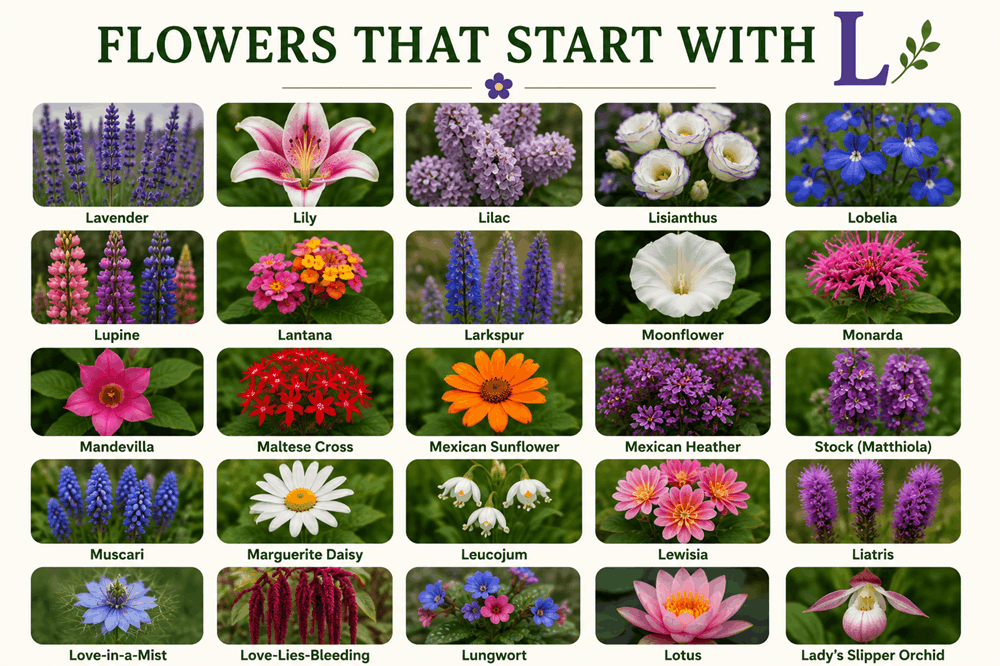
Flowers that start with L include lavender, lilies, lilacs, lisianthus, lobelia, lupines, lantana, and many other beautiful plants. Some are fragrant shrubs or climbing vines, while others grow as annuals, bulbs, perennials, tropical plants, or wildflowers. This guide introduces 25 flowers beginning with L, along with their appearance, growing habits, symbolism, and practical uses in gardens and floral arrangements.
1. Lavender
Lavender is one of the most recognizable flowers beginning with L. It produces slender purple, violet, blue, pink, or white flower spikes above aromatic gray-green foliage.
Most lavender varieties prefer full sun, dry air, and sharply drained soil. Excess moisture around the roots is one of the most common reasons lavender plants fail.
The flowers attract bees and other pollinators and can be harvested for fresh bouquets, dried arrangements, sachets, and decorative wreaths.
Lavender commonly symbolizes calm, devotion, purity, serenity, and grace.
2. Lily
True lilies belong to the Lilium genus and produce large, often fragrant flowers on tall stems. Their blooms may be white, yellow, orange, pink, red, purple, or patterned with spots and contrasting markings.
Popular types include Asiatic lilies, Oriental lilies, tiger lilies, Easter lilies, and trumpet lilies.
Lilies grow from bulbs and usually prefer plenty of sunlight with rich, well-drained soil. Some varieties have little fragrance, while Oriental and trumpet lilies can perfume an entire garden.
True lilies are extremely toxic to cats. Even a small amount of pollen, petals, leaves, or vase water can cause life-threatening kidney failure.
3. Lilac
Lilacs are flowering shrubs known for clusters of intensely fragrant spring blossoms. Purple and lavender are the classic colors, but varieties also bloom in white, pink, blue-purple, and deep magenta.
Lilacs generally perform best in full sun and climates with a cold winter period. Mature shrubs can become quite large, so they need enough space for air circulation and natural growth.
Their flowering period is relatively short, but the fragrance makes it memorable.
Lilacs often symbolize first love, renewal, youth, and nostalgic affection.
4. Lisianthus
Lisianthus produces elegant, rose-like flowers on slender upright stems. Its blooms may be white, cream, blush, pink, lavender, purple, green, or bicolored.
The plant is especially popular with florists because the flowers have a delicate appearance but can last surprisingly well in a vase.
Growing lisianthus from seed takes patience because the seedlings develop slowly. Once established, however, the plants can produce multiple flowering stems during warm weather.
Lisianthus commonly represents appreciation, gratitude, charisma, and lasting affection.
5. Lobelia
Lobelia includes low-growing annuals as well as taller perennial species. The familiar bedding types produce masses of tiny blue, purple, white, or pink flowers.
Trailing lobelia works beautifully in hanging baskets and window boxes, where the stems can spill over the edges.
Many annual lobelias prefer cool to mild weather and may slow their flowering during intense summer heat.
Perennial species such as cardinal flower can grow much taller and attract hummingbirds with vivid red tubular blooms.
6. Lupine
Lupines produce tall spikes packed with pea-like flowers. Colors include blue, purple, pink, yellow, red, white, and multicolored combinations.
They are especially striking when planted in groups, where their vertical flower spikes create a dramatic cottage-garden or meadow effect.
Lupines prefer good drainage and plenty of sunlight. Many perform best in climates with mild summers rather than extreme heat.
The flowers are often associated with imagination, happiness, admiration, and positive change.
7. Lantana
Lantana produces clusters of tiny tubular flowers that often change color as they age. A single cluster may contain yellow, orange, red, pink, purple, or white blooms at the same time.
The plant thrives in heat and full sun and becomes drought tolerant after establishment. In warm climates, lantana can grow into a substantial perennial shrub, while colder regions usually treat it as an annual.
Its nectar-rich flowers attract butterflies and other pollinators.
Lantana can be toxic if eaten, and some varieties spread aggressively in warm regions.
8. Larkspur
Larkspur produces tall flower spikes in blue, purple, pink, white, or lavender. Its blooms resemble those of delphinium, and the two plants are closely related.
Larkspur is usually grown as a cool-season annual and works particularly well in cottage gardens and cut-flower beds.
The plants often grow readily from seed and can create a strong vertical accent among lower flowers.
All parts of larkspur are poisonous if eaten, so they should be grown carefully around children, pets, and livestock.
9. Lemon Balm
Lemon balm is primarily grown as an aromatic herb, but it also produces small white or pale flowers that attract bees.
The leaves have a noticeable lemon fragrance when crushed. The plant grows vigorously in fertile soil and can spread through both roots and seed.
Because the flowers are modest, lemon balm is more useful in herb gardens and pollinator plantings than as a traditional ornamental focal point.
Regular trimming can prevent the plant from becoming too large or reseeding excessively.
10. Lemon Lily
Lemon lily produces bright yellow trumpet-shaped flowers on tall stems. Its appearance is similar to other daylilies, although the exact common name may refer to specific species.
The flowers add cheerful color to perennial borders and generally prefer sunny locations with consistent moisture.
Like other daylilies, lemon lilies can produce many buds even though each individual flower lasts for a relatively short period.
Daylilies are extremely dangerous to cats and should not be grown where cats may chew the plant.
11. Leopard Lily
Leopard lily is a common name used for several plants, including flowers with spotted orange or yellow petals that resemble animal markings.
Because common names vary, the exact botanical identity should always be checked before purchasing or planting one.
Some plants sold as leopard lilies grow from bulbs or rhizomes, while others are tropical foliage plants with completely different care requirements.
Confirming the botanical name also helps determine whether the plant is toxic to pets.
12. Leucanthemum
Leucanthemum includes the familiar Shasta daisy. These perennials produce white petals around bright yellow centers and bloom heavily during summer.
They prefer full sun and well-drained soil. Mature plants can form broad clumps that are easily divided every few years.
Removing faded flowers encourages additional blooming and prevents the plant from looking untidy.
Shasta daisies work well in cottage gardens, perennial borders, and simple summer bouquets.
13. Leucojum
Leucojum is commonly called summer snowflake or snowflake flower. It produces nodding white bell-shaped flowers marked with small green tips.
The plant grows from bulbs and resembles a larger version of a snowdrop. Depending on the species, flowering can occur in spring or early summer.
Leucojum prefers moist, well-drained soil and can perform well beside streams, ponds, and damp woodland edges.
Once established, the bulbs may multiply and create natural-looking colonies.
14. Lewisia
Lewisia is a compact perennial with brightly colored flowers in pink, orange, yellow, salmon, white, and striped combinations.
The plant forms fleshy leaves and grows naturally in rocky environments. It is particularly well suited to rock gardens, raised beds, and containers.
Excellent drainage is essential. Water sitting around the crown can quickly lead to rot, especially during winter.
Lewisia provides strong color in a small space and works particularly well in alpine-style gardens.
15. Liatris
Liatris, commonly called blazing star, produces tall spikes of fuzzy purple, lavender, pink, or white flowers.
Unlike many flower spikes that open from the bottom upward, liatris generally begins flowering near the top and progresses downward.
The plant is valuable in pollinator gardens because butterflies and bees frequently visit its nectar-rich blooms.
Liatris prefers full sun and reasonably well-drained soil and becomes fairly drought tolerant after establishment.
16. Linaria
Linaria is commonly called toadflax. It produces small snapdragon-like flowers on slender upright stems.
Colors include yellow, purple, pink, orange, red, white, and bicolored combinations. Some varieties remain compact, while others create taller airy displays.
Linaria often grows easily from seed and works well in informal beds and cottage gardens.
Some species can spread aggressively, so gardeners should check local recommendations before planting unfamiliar varieties.
17. Lobularia
Lobularia is the botanical genus that includes sweet alyssum. These low-growing plants produce masses of tiny white, lavender, purple, or pink flowers.
The blooms have a sweet honey-like fragrance and are highly attractive to small beneficial insects.
Lobularia works especially well along pathways, at the edges of containers, and between taller plants.
It prefers cool to mild weather and may slow flowering during extremely hot conditions.
18. Lotus
Lotus produces large, elegant aquatic flowers that rise above the water on sturdy stems. Blooms may be white, pink, yellow, or combinations of these colors.
The leaves are equally distinctive, forming broad round surfaces that can stand above the water.
Lotus plants grow from rhizomes rooted in soil beneath ponds or large water containers. They need warmth and abundant sunlight to flower well.
The lotus has deep cultural symbolism and commonly represents purity, enlightenment, renewal, and spiritual growth.
19. Love-in-a-Mist
Love-in-a-mist produces delicate blue, white, pink, or purple flowers surrounded by finely divided, threadlike foliage.
After flowering, the plant develops decorative seed pods that are useful in fresh and dried arrangements.
It grows easily from seed and prefers full sun with well-drained soil. Because it dislikes root disturbance, direct sowing is usually easier than transplanting.
Love-in-a-mist is well suited to cottage gardens and informal cutting beds.
20. Love-Lies-Bleeding
Love-lies-bleeding is a dramatic form of amaranth with long, hanging flower tassels. Deep red and burgundy are the classic colors, although green forms also exist.
The plant can grow several feet tall and makes a striking addition to summer borders and large floral arrangements.
It thrives in warm weather and full sun. Rich soil can produce particularly vigorous growth.
The flowers retain much of their shape when dried, making them useful for long-lasting arrangements.
21. Lungwort
Lungwort is a shade-loving perennial with clusters of small flowers that may change from pink to blue as they age.
Its leaves are often spotted or marked with silver, giving the plant ornamental value even after flowering ends.
Lungwort performs well in woodland gardens, beneath deciduous shrubs, and along shaded paths.
It prefers moist, rich soil but should not remain permanently waterlogged.
22. Lychnis
Lychnis includes several colorful cottage-garden plants, some of which are now botanically classified within the genus Silene.
Flowers may be vivid magenta, red, pink, orange, or white. Rose campion is one of the best-known examples, combining bright flowers with soft silver foliage.
Many lychnis varieties prefer full sun and well-drained soil. Some reseed freely and create informal colonies.
Their intense flower colors work especially well against gray or silver leaves.
23. Lysimachia
Lysimachia includes several plants commonly called loosestrife. Their flowers are often yellow, although some species produce white or other colors.
Growth habits vary considerably. Some form low ground covers, while others produce upright stems topped with flower clusters.
Certain lysimachias spread vigorously through underground stems and may need regular control.
Always identify the exact species before planting because plants sharing the loosestrife name can behave very differently.
24. Lycoris
Lycoris produces dramatic flowers on bare stems after its foliage has disappeared. Red spider lily is one of the most recognizable forms, with narrow recurved petals and long projecting stamens.
Other varieties may be yellow, white, pink, or orange.
The bulbs often remain unnoticed for much of the year before suddenly producing flower stalks after late-summer rainfall.
Lycoris bulbs contain toxic compounds and should not be eaten.
25. Lady’s Slipper Orchid
Lady’s slipper orchids are named for the pouch-shaped lower petal that resembles a small slipper. Their flowers may be pink, purple, white, yellow, green, or patterned.
Some species grow naturally in woodland environments, while tropical types are cultivated as houseplants.
Wild lady’s slipper orchids can be difficult to transplant and may be legally protected in some areas. They should never be dug from natural habitats.
Gardeners interested in growing them should purchase nursery-propagated plants suited to their climate.
Which L Flowers Are Best for Containers?
Lavender, lantana, lobelia, Lewisia, lobularia, lisianthus, and compact lilies can all grow successfully in containers.
Lavender and Lewisia need excellent drainage, while lobelia and sweet alyssum appreciate more consistent moisture. Lantana performs best in sunny, warm locations.
Choose a container large enough for the mature root system and make sure drainage holes remain open. Waterlogged soil can damage even plants that appreciate regular watering.
Which L Flowers Attract Hummingbirds?
Lobelia, particularly red cardinal flower types, lantana, native honeysuckle-like L vines, and some lilies can attract hummingbirds.
Tubular flowers are generally the easiest for hummingbirds to feed from while hovering.
For a better hummingbird garden, combine plants that bloom at different times so nectar remains available throughout spring, summer, and fall.
Which L Flowers Attract Bees and Butterflies?
Lavender, liatris, lantana, lobularia, lupines, and love-in-a-mist can all support pollinating insects.
Lavender is particularly popular with bees, while liatris and lantana frequently attract butterflies.
Planting several flowers of the same species together makes them easier for pollinators to locate and allows insects to feed more efficiently.
Which L Flowers Work Well in Bouquets?
Lilies, lisianthus, lavender, larkspur, liatris, love-in-a-mist, love-lies-bleeding, and lilacs can all be used in floral arrangements.
Lisianthus offers a soft romantic appearance, while larkspur and liatris provide height. Lavender contributes fragrance and fine texture, and love-lies-bleeding creates dramatic trailing movement.
Lilacs are beautiful but can wilt quickly if their woody stems are not conditioned properly. Place freshly cut branches into water promptly after harvesting.
Which L Flowers Are Best for Shade?
Lungwort, lady’s slipper orchids, some lilies, and certain lobelias can perform well in partial shade.
Lungwort is particularly useful beneath trees and shrubs, where its spotted foliage continues to add interest after the flowers disappear.
Lavender, lantana, liatris, and love-in-a-mist are much better suited to bright sunny locations.
Which L Flowers Need Extra Caution?
Several flowers beginning with L can be toxic. True lilies and daylilies are particularly dangerous to cats. Lycoris bulbs, larkspur, and parts of lantana can also cause poisoning if eaten.
Some common names create additional confusion. A plant containing “lily” in its name may not be a true lily, but it may still have its own safety concerns.
Always identify the exact botanical species when pet or child safety matters rather than relying only on a common flower name.
The Bottom Line
Flowers that start with L include familiar favorites such as lavender, lilies, lilacs, lisianthus, lobelia, lupines, and lantana. The group also contains distinctive plants such as lotus, liatris, Lycoris, Lewisia, love-in-a-mist, and lady’s slipper orchids.
There are L flowers for nearly every type of garden. Lavender thrives in sunny, dry soil, lungwort prefers woodland shade, lotus grows in water, and moonlike white lilies can become dramatic summer focal points.
When choosing an L flower, consider its sunlight, moisture, soil, climate, mature size, potential invasiveness, and toxicity. Matching each plant to the right conditions will create healthier growth, more reliable flowering, and a garden that remains attractive throughout the season.