Flowers That Start With P: Twenty-Five Beautiful Names, Meanings, and Growing Notes
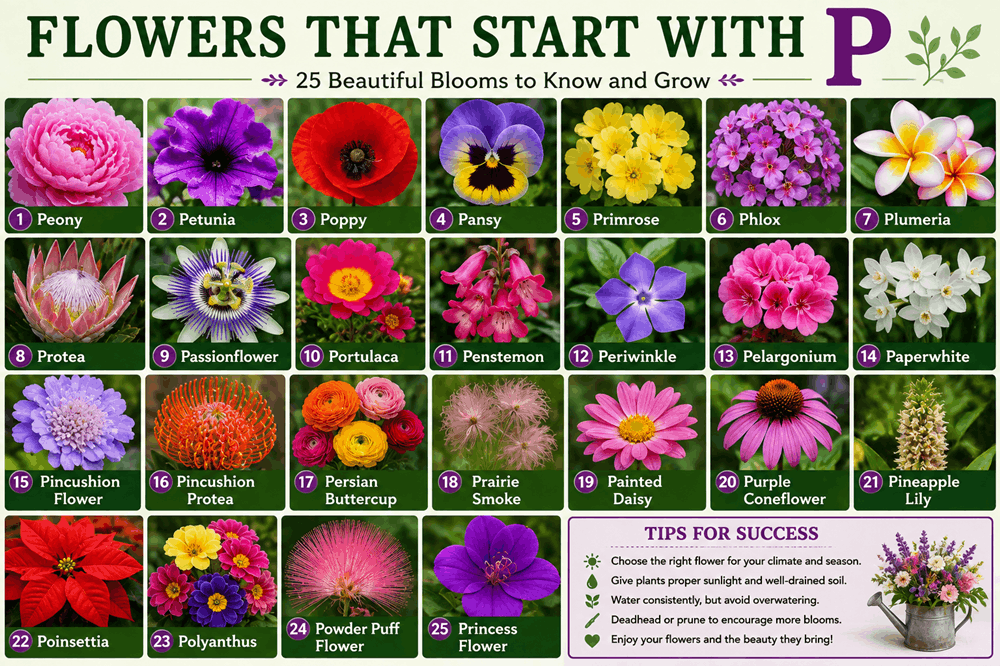
Flowers that start with P include peonies, petunias, poppies, pansies, primroses, phlox, plumeria, proteas, passionflowers, and many other distinctive blooms. Some are compact annuals suited to containers, while others are long-lived perennials, tropical trees, flowering vines, or dramatic cut flowers. This guide introduces 25 P flower names, along with their appearance, symbolism, and basic growing characteristics.
1. Peony
Peonies are famous for their large, layered flowers and rich fragrance. Their blooms may be white, cream, coral, pink, red, burgundy, or yellow, depending on the species and variety.
The botanical genus is Paeonia. The Kew Plants of the World database recognizes Paeonia as the peony genus, which includes herbaceous perennials, woody tree peonies, and intersectional hybrids.
Peonies commonly symbolize romance, prosperity, honor, happy marriage, and good fortune. Established plants can survive for decades when they are placed in suitable soil and left relatively undisturbed.
2. Petunia
Petunias are colorful warm-season flowers frequently grown in hanging baskets, containers, borders, and window boxes. Their trumpet-shaped blooms are available in purple, pink, red, white, yellow, blue, and multicolored patterns.
The botanical genus Petunia belongs to the nightshade family. The Kew profile of the Petunia genus documents its South American origins and recognized species.
Petunias bloom most heavily in bright light. Modern varieties may be compact and upright, trailing, heavily ruffled, striped, speckled, or nearly black.
3. Poppy
Poppies have delicate, tissue-like petals surrounding prominent central seed structures. Red is the most familiar color, but poppies also bloom in orange, yellow, white, pink, purple, and blue.
The name commonly refers to species in the Papaver genus, although several flowers outside that genus also use “poppy” in their common names. According to the Royal Horticultural Society’s Papaver profile, poppies may grow as annuals, biennials, or herbaceous perennials.
Red poppies are strongly associated with remembrance, while other colors may represent sleep, imagination, peace, resilience, or consolation.
4. Pansy
Pansies are compact cool-season flowers recognized by their overlapping petals and face-like markings. Their blooms come in nearly every major color, including combinations of purple, yellow, blue, orange, white, red, and black.
Pansies are usually grown as annuals or short-lived perennials, depending on the climate. They perform best during cool weather and often fade when intense summer heat arrives.
The name is connected with remembrance and thoughtfulness. In flower symbolism, pansies may communicate affection, reflection, or the idea that someone remains in your thoughts.
5. Primrose
Primroses are among the most recognizable early spring flowers. They form low rosettes of leaves and produce cheerful blooms in yellow, pink, purple, red, blue, orange, and white.
Primroses belong to the Primula genus. The RHS guide to primulas describes a broad group ranging from familiar garden primroses to moisture-loving and alpine species.
Because primroses appear early in the growing season, they often symbolize youth, renewal, optimism, and new beginnings.
6. Phlox
Phlox flowers grow in clusters and may form low carpets, compact mounds, or tall summer displays. Common colors include pink, lavender, purple, red, white, and blue.
Creeping phlox is often planted over walls, slopes, and rock gardens, while tall garden phlox adds height to perennial borders. Many varieties attract butterflies and other pollinating insects.
Phlox is associated with harmony, partnership, unity, and the joining of two lives. Its clustered flowers make that meaning especially fitting.
7. Plumeria
Plumeria produces waxy, five-petaled flowers with a strong tropical fragrance. The flowers commonly appear in white, yellow, pink, red, or multicolored combinations.
Also known as frangipani, plumeria grows as a shrub or small tree in warm climates. It is widely associated with tropical landscapes, leis, perfumes, and ceremonial flower arrangements.
Plumeria may symbolize beauty, hospitality, renewal, immortality, and spiritual devotion. Meanings vary across cultures, so the flower should not be assigned one universal interpretation.
8. Protea
Proteas are dramatic flowers with thick bracts surrounding a dense central cluster. Their unusual shape gives them an architectural quality that works well in modern bouquets and dried arrangements.
Protea flowers may be cream, pink, red, yellow, or deep burgundy. Some resemble crowns, cups, pincushions, or artichokes.
Because proteas belong to an ancient and diverse plant family, they are commonly associated with transformation, endurance, courage, and individuality.
9. Passionflower
Passionflowers are among the most structurally complex flowers beginning with P. Their blooms include rings of petals, sepals, filaments, stamens, and prominent central reproductive structures.
Many passionflowers grow on vigorous climbing vines. Their colors may include purple, blue, white, pink, red, and yellow.
The name developed from Christian symbolism assigned to different parts of the flower. Beyond its religious associations, passionflower may also represent faith, spiritual reflection, creativity, and mystery.
10. Portulaca
Portulaca is a heat-tolerant flowering plant often called moss rose. It produces low-growing succulent foliage and bright flowers in orange, pink, red, yellow, white, or mixed shades.
The blooms usually open most fully in bright sunlight. Because portulaca tolerates dry conditions, it is often used in containers, rock gardens, edging, and hot exposed spaces where more delicate annuals struggle.
The plant can represent endurance and resilience because of its ability to flower despite intense sun and limited water.
11. Penstemon
Penstemon produces upright stems covered with tubular flowers. It is commonly called beardtongue because of the hairy sterile stamen found inside many species’ flowers.
Flower colors include red, coral, pink, purple, blue, lavender, and white. The tubular blossoms are attractive to hummingbirds, bees, and other pollinators.
Different penstemon species are adapted to different environments, including dry western landscapes, meadows, woodlands, and rocky slopes.
12. Periwinkle
Periwinkle commonly refers to plants in the Vinca genus. These low-growing plants produce five-petaled flowers in blue, lavender, purple, or white.
Periwinkle can spread to form dense ground cover, especially in shaded or partly shaded areas. Its trailing stems make it useful for covering difficult spaces, although it can become invasive in some regions.
The flower traditionally symbolizes lasting friendship, faithfulness, remembrance, and enduring affection.
13. Pelargonium
Pelargoniums are often sold under the common name geranium, although true geraniums belong to a different botanical genus. Familiar examples include zonal, ivy-leaved, regal, and scented-leaf pelargoniums.
The flowers may be red, pink, salmon, orange, white, lavender, or bicolored. They are widely grown in pots, hanging baskets, window boxes, and summer garden beds.
Pelargoniums generally prefer bright light and well-drained soil. Their aromatic leaves may smell like rose, lemon, mint, apple, or spice, depending on the variety.
14. Paperwhite
Paperwhites are fragrant white narcissus flowers commonly grown indoors during winter. Several small flowers appear together on upright stems above narrow green leaves.
The bulbs can be forced into bloom in water, gravel, or potting mix, making them popular for holiday and winter displays.
Paperwhites may symbolize purity, renewal, hope, and self-reflection. Their fragrance is powerful and can be pleasant to some people but overwhelming to others.
15. Pincushion Flower
Pincushion flower is the common name for Scabiosa. The rounded flower heads contain many tiny florets surrounded by longer petals, creating the appearance of pins inserted into a cushion.
Colors include blue, lavender, purple, pink, burgundy, white, and cream. The flowers are popular in cottage gardens and cutting gardens because of their long, slender stems.
Pincushion flowers attract butterflies and tend to bloom for an extended period when spent flowers are removed regularly.
16. Pincushion Protea
Pincushion protea usually refers to flowers in the Leucospermum genus. Their long, narrow styles extend outward from the flower head, giving the bloom a vivid pincushion or firework appearance.
These flowers are commonly orange, red, yellow, or combinations of warm colors. They are frequently used in tropical and contemporary floral arrangements.
Like other members of the protea family, pincushion proteas are associated with strength, uniqueness, adaptability, and transformation.
17. Persian Buttercup
Persian buttercup is a common name for Ranunculus asiaticus. Its flowers contain layers of thin petals arranged in tight, rounded forms that resemble small roses or peonies.
They are available in white, cream, yellow, orange, salmon, pink, red, purple, and multicolored varieties. Their strong stems and elegant shape make them highly valued as cut flowers.
Persian buttercups commonly symbolize charm, attraction, and radiant beauty.
18. Prairie Smoke
Prairie smoke is a North American wildflower with nodding pink, reddish, or purple flowers. After flowering, it develops long, feathery seed tails that create a smoky appearance above the plant.
Its botanical name is Geum triflorum. The plant grows well in sunny, well-drained conditions and is often included in native gardens, prairie restorations, and pollinator plantings.
Prairie smoke offers interest beyond the flowering period because its feathery seed heads are often more noticeable than the small blooms.
19. Painted Daisy
Painted daisy is a cheerful perennial with daisy-shaped flowers in shades of red, pink, white, or rose. Its yellow centers create a strong contrast with the colorful petals.
The plant is often grown in cottage gardens and mixed borders. Its fernlike foliage adds texture even when the plant is not flowering.
Painted daisies work well as cut flowers and are attractive to pollinators. They generally prefer good drainage and a position with substantial sunlight.
20. Purple Coneflower
Purple coneflower begins with P and is one of the best-known North American native garden flowers. Its botanical name is Echinacea purpurea.
The flowers typically have pink-purple petals surrounding a raised orange-brown central cone. Modern cultivars are also available in white, yellow, orange, red, green, and deeper purple shades.
Purple coneflowers attract bees, butterflies, and other pollinators. Their seed heads can provide food for birds when left standing after the flowers fade.
21. Pineapple Lily
Pineapple lily produces a dense flower spike topped by a cluster of leafy bracts, giving it an appearance similar to a small pineapple.
Its botanical genus is Eucomis. Flowers may be green, white, cream, pink, or purple and often contain small decorative markings.
Despite its common name, pineapple lily is neither a pineapple nor a true lily. It grows from a bulb and adds a tropical appearance to containers and summer borders.
22. Poinsettia
Poinsettias are strongly associated with Christmas and winter decorating. Their showy red, pink, white, cream, or marbled structures are modified leaves called bracts rather than petals.
The plant’s actual flowers are the small yellow-green structures at the center of the bracts. Poinsettias require careful light management to develop their seasonal color again after the first year.
They are commonly associated with celebration, goodwill, hope, and holiday warmth.
23. Polyanthus
Polyanthus flowers are closely related to primroses and belong to the Primula group. Unlike many low-growing primroses, they often hold clusters of flowers on upright stems above the leaves.
They are available in red, pink, orange, yellow, purple, blue, white, and contrasting bicolored forms. Polyanthus is especially useful for adding color to containers and garden beds during cool weather.
The flowers prefer moisture-retentive soil but generally should not sit in waterlogged conditions.
24. Powder Puff Flower
Powder puff flower usually refers to species and cultivars of Calliandra. Their flowers contain masses of long stamens that create soft, rounded puffs.
Common colors include red, pink, and white. Many powder puff plants grow as tropical or subtropical shrubs and attract hummingbirds and other nectar-feeding wildlife.
The flowers can represent gentleness, joy, playfulness, and unusual beauty because of their soft, airy appearance.
25. Princess Flower
Princess flower, botanically known as Tibouchina urvilleana or a closely related accepted classification, is a tropical shrub valued for its velvety purple flowers and leaves.
The five-petaled blooms have prominent curved stamens and a deep jewel-like color. In warm climates, the plant may flower repeatedly and grow into a large shrub.
Princess flower is not frost-hardy, so gardeners in colder areas often grow it in a container that can be moved indoors before winter.
Which P Flowers Are Best for Containers?
Petunias, pansies, primroses, pelargoniums, portulaca, polyanthus, and compact pincushion flowers are all practical container choices.
The right flower depends on the season and location. Pansies and primroses prefer cooler conditions, while petunias and portulaca perform best during warm, bright weather. Pelargoniums tolerate some dryness but still need consistent care when grown in small pots.
Use containers with drainage holes and choose a potting mix suited to the plant. A container that remains continuously wet can damage roots even when the flower is described as moisture-loving.
Which P Flowers Are Good for Bouquets?
Peonies, poppies, Persian buttercups, pincushion flowers, proteas, roses sold under P-based common names, and several types of phlox can all work in arrangements.
Peonies and Persian buttercups create soft, romantic bouquets. Proteas and pincushion proteas give arrangements a dramatic tropical structure. Poppies are delicate and shorter-lived but bring movement and a natural meadow quality.
Flower availability depends on season. Peonies, for example, have a relatively concentrated natural flowering period, while florist-grown proteas and imported flowers may be available for much longer.
Which P Flowers Attract Pollinators?
Penstemon, phlox, purple coneflower, pincushion flower, prairie smoke, sun-loving poppies, and many open-centered varieties provide pollen or nectar for insects and birds.
Not every heavily doubled flower is equally useful to pollinators. Dense layers of petals may make the reproductive center difficult to reach or may replace some pollen-producing structures entirely.
For a pollinator-friendly garden, combine several flower shapes and blooming periods rather than relying on one variety. This gives different species access to food across a longer part of the year.
The Bottom Line
Flowers that start with P range from familiar favorites such as peonies, petunias, pansies, poppies, and primroses to unusual blooms such as proteas, prairie smoke, powder puff flowers, and pineapple lilies.
Some are best suited to cool spring containers, while others need summer heat, dry soil, tropical conditions, or space to climb. Their meanings are equally varied, covering romance, remembrance, renewal, resilience, transformation, friendship, and beauty.
When choosing a P flower, consider more than its name. Match its light, temperature, soil, moisture, and space requirements to the garden or container where it will grow. The right conditions will do far more for a flower than its appearance in a catalog ever can.