Flowers That Start With M: Twenty-Five Beautiful Blooms for Gardens and Bouquets
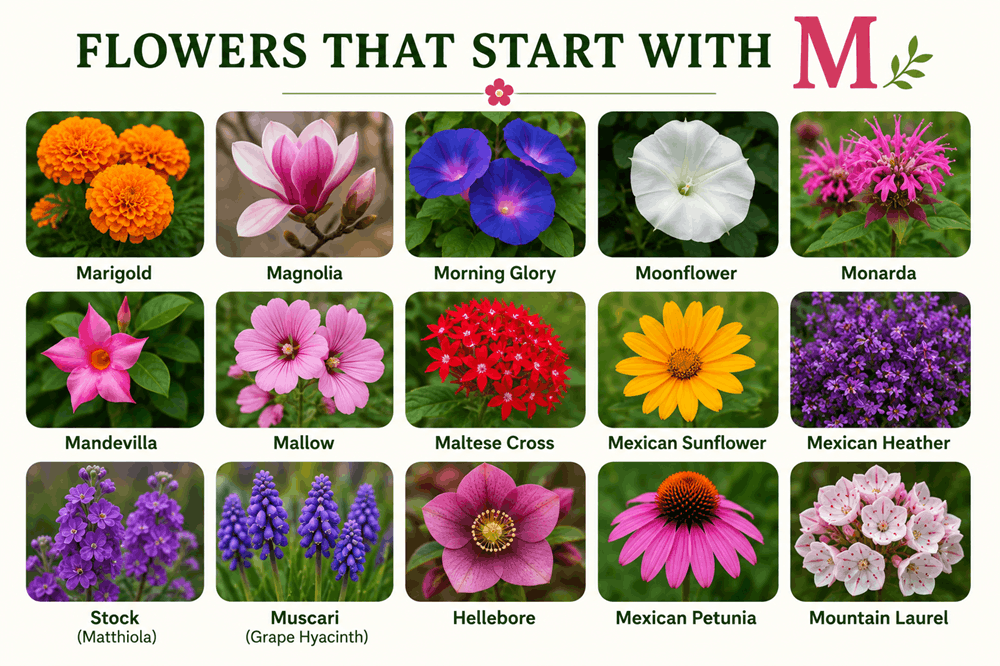
Flowers that start with M include marigolds, magnolias, morning glories, mums, moonflowers, monarda, and many other colorful plants. Some are compact annuals suited to pots, while others grow as flowering trees, vines, tropical shrubs, bulbs, or long-lived perennials. This guide introduces 25 flowers beginning with M, along with their appearance, growing habits, symbolism, and practical uses in gardens and floral arrangements.
1. Marigold
Marigolds are cheerful warm-season flowers known for their yellow, orange, gold, red, and bicolored blooms. Depending on the variety, the flowers may be small and simple or large and densely layered.
French marigolds usually stay compact, while African marigolds can grow much taller and produce larger flower heads. Both prefer full sun and soil that drains well.
Marigolds are easy to grow from seed and bloom from late spring until frost. Regular deadheading encourages continued flowering.
They are commonly associated with warmth, creativity, remembrance, and passion. Certain marigolds also hold strong cultural significance during Día de los Muertos celebrations.
2. Magnolia
Magnolias are flowering trees and shrubs with large, elegant blossoms. Flowers may be white, cream, pink, purple, yellow, or combinations of these colors.
Some magnolias bloom before their leaves emerge in spring, creating a dramatic display of flowers on bare branches. Others, including evergreen southern magnolias, bloom later and produce large fragrant white flowers.
Magnolias need enough room to reach their mature size. Some species remain relatively compact, while others eventually become substantial landscape trees.
The flower is often associated with dignity, perseverance, beauty, and strength.
3. Morning Glory
Morning glories are fast-growing vines with funnel-shaped flowers that usually open in the morning and close later in the day.
Colors include blue, purple, pink, white, red, and striped combinations. The vines can quickly cover trellises, fences, arches, and other supports during warm weather.
Morning glories prefer full sun and generally grow easily from seed. In some regions, certain species can spread aggressively, so local growing recommendations should be checked before planting.
The flowers are commonly associated with affection, renewal, and the fleeting nature of life.
4. Moonflower
Moonflower is a close relative of morning glory, but its large white flowers open in the evening instead of the morning.
The blooms may reach several inches across and release a sweet fragrance after sunset. Their pale petals remain highly visible in moonlight, making them popular in night gardens.
Moonflower vines grow quickly in warm conditions and need a sturdy support. They prefer full sun, fertile soil, and regular watering.
The seeds and other parts of the plant can be toxic if eaten, so moonflower should be grown carefully around children and pets.
5. Monarda
Monarda is commonly known as bee balm. It produces unusual flower clusters made from narrow tubular blooms arranged around the top of the stem.
Colors include red, pink, purple, lavender, and white. Scarlet varieties are especially attractive to hummingbirds, while bees and butterflies visit many other colors.
Monarda prefers sunny locations and consistent moisture. Good airflow is important because some varieties are susceptible to powdery mildew.
The plant works well in pollinator gardens, cottage borders, and naturalistic plantings.
6. Mandevilla
Mandevilla is a tropical vine with glossy foliage and large trumpet-shaped flowers. Blooms commonly appear in red, pink, white, or yellow.
The plant thrives in warm weather and grows vigorously on a trellis or other support. It is especially popular for patios, balconies, and poolside containers.
In frost-free areas, mandevilla can grow as a perennial. In colder climates, it is usually treated as an annual or moved indoors before winter.
It prefers bright light, regular feeding, and well-drained soil.
7. Mallow
Mallow refers to a broad group of plants with open, five-petaled flowers resembling small hibiscus or hollyhock blooms.
Colors commonly include pink, purple, white, lavender, and rose. Some mallows remain low, while others become large perennials or shrubs.
Many varieties tolerate ordinary garden soil and flower generously in sunny conditions. Their relaxed growth works particularly well in cottage gardens and meadow-style plantings.
8. Maltese Cross
Maltese cross produces dense clusters of vivid red or orange-red flowers on upright stems. Its bright color stands out strongly in summer borders.
The plant is an old-fashioned cottage-garden perennial that prefers full sun and well-drained soil.
Removing faded flower clusters can extend the blooming period. Mature plants may also self-seed when conditions are favorable.
Maltese cross pairs well with blue, purple, and white flowers, which provide strong contrast to its fiery blooms.
9. Mexican Sunflower
Mexican sunflower produces bright orange, red-orange, or yellow daisy-like blooms on tall, branching plants.
Although its flowers resemble sunflowers, it belongs to a different genus. The plant thrives in heat and full sun and often grows several feet tall.
Mexican sunflower is especially valuable in butterfly gardens. Its open flowers provide easy access to nectar, and blooming can continue until frost.
It grows readily from seed and generally does not need rich soil or heavy fertilization.
10. Mexican Heather
Mexican heather is a compact warm-season plant covered with small purple, lavender, pink, or white flowers.
Despite its common name, it is not a true heather. It forms a neat mound of fine-textured green foliage and works well along paths, at the front of borders, and in containers.
Mexican heather prefers warmth, plenty of sunlight, and moderate moisture. It may grow as a perennial in frost-free climates and as an annual elsewhere.
11. Mexican Petunia
Mexican petunia produces trumpet-shaped flowers in purple, pink, or white. The plant has narrow leaves and can bloom repeatedly throughout warm weather.
It tolerates heat and can grow in both moist and relatively dry soil after becoming established.
However, Mexican petunia can spread aggressively and is considered invasive in some regions. Gardeners should check local recommendations before planting it.
Sterile cultivars may be a better choice where available.
12. Michaelmas Daisy
Michaelmas daisy is a common name for several fall-blooming asters. Their flowers have narrow petals surrounding yellow centers and may be purple, lavender, pink, blue, or white.
These perennials provide valuable color late in the growing season and are especially useful for bees and butterflies when many summer flowers have finished.
They prefer sunny locations and reasonably well-drained soil. Taller varieties may benefit from being cut back early in the season to encourage bushier growth.
13. Mimosa
Mimosa flowers are known for their soft, fluffy appearance. Depending on the plant referred to by the common name, blooms may be pink, yellow, cream, or white.
The silk tree commonly called mimosa produces pink powder-puff flowers on spreading branches. Other plants called mimosa produce small yellow spherical flower heads.
Because common names can refer to different species, identify the exact plant before adding one to the landscape. Some mimosa trees can spread aggressively in warm climates.
14. Mimulus
Mimulus is commonly known as monkey flower. Its tubular or funnel-shaped flowers often have colorful spots and markings.
Blooms may be yellow, orange, red, pink, white, or purple. Some species prefer moist streamside conditions, while others are adapted to dry western environments.
Monkey flowers can attract hummingbirds and bees, especially varieties with long tubular blooms.
The plant works well in native gardens when a species suited to the local climate is selected.
15. Miltonia Orchid
Miltonia and closely related orchids are often called pansy orchids because some of their broad flowers resemble pansy faces.
Blooms may be white, pink, purple, red, yellow, or patterned with contrasting centers.
These orchids generally need bright indirect light, good airflow, and careful moisture management. They should not sit in waterlogged potting material.
Their sophisticated flowers make them attractive houseplants for growers willing to provide consistent care.
16. Muscari
Muscari is better known as grape hyacinth. It produces compact spikes of small rounded flowers, usually in deep blue, violet, white, or pale blue.
The bulbs bloom in early spring and work especially well when planted in large groups beneath trees, along pathways, or between taller spring bulbs.
Muscari prefers well-drained soil and plenty of spring sunlight. Many varieties multiply naturally over time.
Despite the common name, grape hyacinth is botanically different from true hyacinths.
17. Marguerite Daisy
Marguerite daisies produce cheerful flowers with yellow centers and white, pink, or yellow petals.
They grow as shrubby perennials in mild climates but are often treated as annuals in colder regions.
Marguerites prefer full sun and moderate temperatures. Flowering may slow during extreme heat but often improves again as conditions become cooler.
Regular deadheading encourages a longer display.
18. Marsh Marigold
Marsh marigold produces glossy yellow flowers during spring. Despite its common name, it is not a true marigold.
The plant naturally grows in wet meadows, stream edges, marshes, and other consistently damp locations.
It is useful around ponds and rain gardens where ordinary garden flowers may struggle with wet soil.
Marsh marigold should not be planted in dry areas because it needs reliable moisture to thrive.
19. Marshmallow Flower
Marshmallow, the plant from which the traditional confection took its name, produces soft pink or pale lavender flowers with darker centers.
The plant prefers moist soil and can grow several feet tall. Its flowers resemble those of other members of the mallow family.
It works well in herb gardens, naturalistic borders, and damp garden areas where it has enough room to develop.
Modern commercial marshmallows generally do not contain marshmallow root.
20. Meadow Rue
Meadow rue produces airy clouds of tiny flowers on slender stems. Depending on the species, blooms may be white, lavender, pink, yellow, or purple.
The plant has delicate foliage that resembles columbine leaves and works beautifully in woodland gardens and partly shaded borders.
Some varieties stay compact, while others grow several feet tall and add a transparent, floating effect behind shorter perennials.
Meadow rue generally prefers consistent moisture and protection from extremely hot afternoon sun.
21. Meadow Saffron
Meadow saffron produces crocus-like pink, purple, or white flowers during fall, often after its leaves have disappeared.
Despite its appearance and name, it is not the same plant as true saffron crocus. Meadow saffron contains colchicine and is highly poisonous.
It grows from underground corms and prefers well-drained soil. Its late-season flowers can provide unexpected color when many summer plants are fading.
Because of its toxicity, it should never be confused with edible saffron.
22. Madagascar Periwinkle
Madagascar periwinkle produces simple five-petaled flowers in pink, white, lavender, red, or combinations with contrasting centers.
It thrives in heat and handles dry conditions better than many bedding annuals. The plant works well in sunny containers, borders, and mass plantings.
Constantly wet soil can lead to root problems, so good drainage is important.
The plant contains biologically active compounds and should not be eaten by people or pets.
23. Matthiola
Matthiola is the botanical genus that includes stock flowers. These plants produce upright spikes of strongly fragrant blooms.
Flowers may be white, cream, pink, lavender, purple, red, or yellow. Double-flowered forms are especially popular with florists.
Stock prefers cool weather and often performs best in spring or fall. Intense summer heat can reduce flowering.
The flowers are widely used in bouquets because they add both height and fragrance.
24. Mayapple
Mayapple is a woodland perennial with large umbrella-like leaves and a single white flower that appears beneath the foliage in spring.
The bloom is easy to miss because it hangs below the leaves rather than standing above the plant.
Mayapple spreads through underground rhizomes and can form broad colonies in shaded, moist woodland conditions.
Most parts of the plant are toxic when eaten. It should not be treated as an edible woodland plant without expert knowledge.
25. Mountain Laurel
Mountain laurel is an evergreen flowering shrub with clusters of intricate cup-shaped flowers. Blooms may be white, pale pink, deep pink, or patterned with contrasting markings.
The shrub prefers acidic, well-drained soil and partial shade, making it a natural companion for azaleas and rhododendrons.
Its flowers are especially striking when examined closely because the stamens sit under tension and release when pollinators visit.
Mountain laurel is poisonous if eaten and should be kept away from livestock and pets that browse vegetation.
Which M Flowers Are Best for Containers?
Marigolds, mandevilla, Mexican heather, Madagascar periwinkle, marguerite daisies, muscari, and compact morning glories can all grow successfully in containers.
Mandevilla needs a support for climbing, while Mexican heather and Madagascar periwinkle stay relatively compact. Muscari works well in smaller spring pots and can be combined with tulips or daffodils.
Use containers with drainage holes and choose a potting mix appropriate for the plant. Even flowers that enjoy consistent moisture can develop root problems when excess water cannot escape.
Which M Flowers Attract Hummingbirds?
Monarda, mandevilla, mimulus, and some morning glories can attract hummingbirds because of their tubular flowers and accessible nectar.
Scarlet monarda is particularly effective and can become a major summer food source when planted in generous groups.
For the strongest hummingbird garden, combine several nectar plants that flower at different times rather than relying on one species.
Which M Flowers Attract Bees and Butterflies?
Mexican sunflower, Michaelmas daisies, marigolds with open centers, monarda, meadow rue, and some mallows can attract pollinating insects.
Mexican sunflower is particularly popular with butterflies, while late-blooming asters provide valuable food when many earlier flowers have finished.
Avoid broad-spectrum pesticides on plants intended for pollinators. Even products that do not immediately kill visiting insects may reduce the garden’s overall ecological value.
Which M Flowers Work Well in Bouquets?
Magnolias, marigolds, Matthiola, Michaelmas daisies, meadow rue, muscari, and some mandevilla flowers can be used in arrangements, although vase life varies significantly.
Stock provides fragrance and height, while meadow rue adds a soft, airy texture. Marigolds create strong seasonal color, and magnolia branches can become dramatic structural elements in large arrangements.
Cut stems during the cooler part of the day and place them into clean water promptly. Remove any leaves that would remain below the waterline.
Which M Flowers Are Best for Shade?
Mayapple, meadow rue, mountain laurel, and some mallows adapted to woodland conditions can tolerate partial shade.
Mountain laurel generally prefers protection from intense afternoon sunlight, while mayapple naturally grows beneath deciduous woodland canopies.
Morning glory, marigolds, Mexican sunflower, and Madagascar periwinkle are much better choices for bright sunny locations.
Which M Flowers Need Extra Caution?
Several plants beginning with M contain toxic compounds. Meadow saffron is highly poisonous, mountain laurel can poison people and animals, and most parts of mayapple should not be eaten.
Moonflower seeds can also be dangerous if swallowed, while Madagascar periwinkle contains potent compounds that make casual consumption unsafe.
Common names can create confusion, particularly with meadow saffron, marsh marigold, and Mexican petunia. Always identify the botanical plant before assuming it has the same properties as another flower with a similar name.
The Bottom Line
Flowers that start with M include familiar favorites such as marigolds, magnolias, morning glories, moonflowers, monarda, and mandevilla. The group also includes less familiar plants such as Maltese cross, meadow rue, muscari, mimulus, and mountain laurel.
There are M flowers for nearly every garden setting. Mexican sunflower thrives in summer heat, mayapple prefers woodland shade, marsh marigold enjoys wet soil, and moonflower comes alive after sunset.
When choosing an M flower, consider its sunlight, moisture needs, mature size, climate, potential invasiveness, and toxicity. Matching the right plant to the right setting will create stronger growth, more reliable flowering, and a garden that remains interesting throughout the season.