Flowers That Start With K: Twenty-Five Beautiful Blooms for Gardens and Bouquets
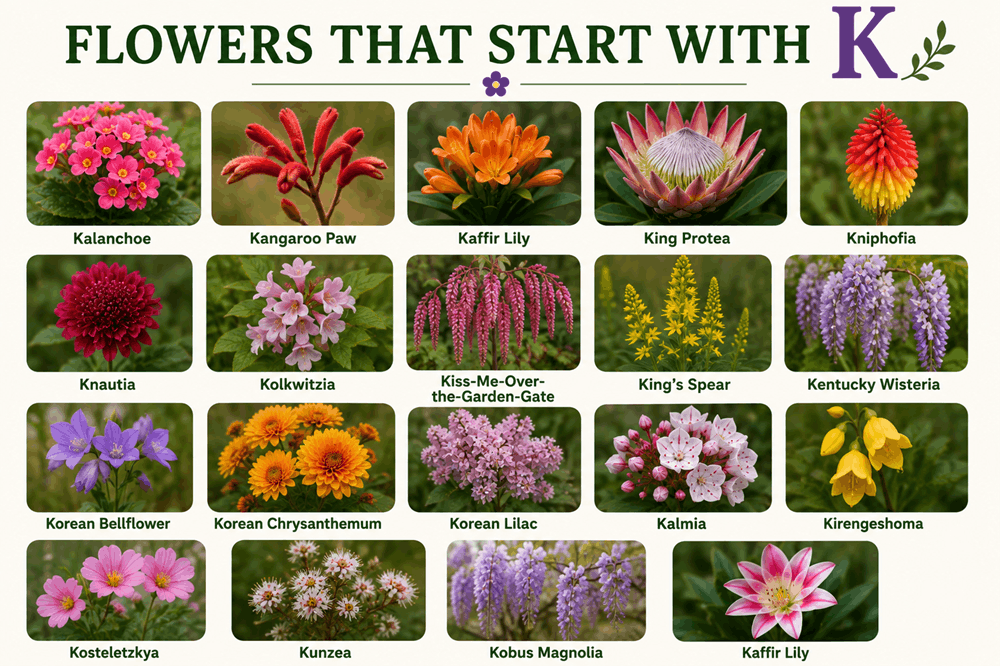
Flowers that start with K include kalanchoe, kangaroo paw, kaffir lily, kniphofia, king protea, and many other striking plants. Some are compact houseplants, while others grow as tropical shrubs, hardy perennials, bulbs, vines, or dramatic cut flowers. This guide introduces 25 flowers beginning with K, along with their appearance, growing habits, symbolism, and practical uses in gardens and floral arrangements.
1. Kalanchoe
Kalanchoe is a popular succulent houseplant that produces clusters of small flowers above thick, fleshy leaves. Common flower colors include red, pink, orange, yellow, white, and coral.
The plant prefers bright light and soil that drains quickly. Because its leaves store water, kalanchoe should be allowed to dry somewhat between waterings rather than being kept constantly wet.
Many kalanchoes bloom indoors during winter and early spring, making them useful when outdoor gardens have little color.
Kalanchoe can be toxic to cats and dogs when eaten, so it should be placed where pets cannot chew the leaves or flowers.
2. Kangaroo Paw
Kangaroo paw is an Australian plant with unusual tubular flowers covered in fine hairs. The curved blooms resemble the paws of a kangaroo, which gives the plant its common name.
Flower colors include red, orange, yellow, green, pink, and nearly black. The stems rise well above narrow grassy foliage and create a strong architectural effect.
Kangaroo paw prefers full sun and excellent drainage. Many varieties tolerate dry conditions after becoming established, although flowering improves with moderate moisture during active growth.
The flowers are popular in modern bouquets because of their unusual shape and long stems.
3. Kaffir Lily
Kaffir lily is an older common name often used for clivia, a flowering plant with broad strap-like leaves and clusters of trumpet-shaped flowers.
The blooms are usually orange or red-orange, although yellow and cream varieties are also grown.
Clivia performs well indoors in bright indirect light and does not need frequent repotting. In fact, mature plants often flower well when their roots are slightly crowded.
The plant contains toxic compounds and should be kept away from pets and children who may chew it.
4. King Protea
King protea produces enormous flower heads surrounded by thick decorative bracts. Pink and cream are the most familiar colors, although variations include deeper rose and pale white tones.
The flower can reach an impressive size and has a bold, almost sculptural appearance. It is widely used in tropical, modern, and dried floral arrangements.
King protea prefers warm, sunny conditions and very well-drained soil. Like many plants from nutrient-poor environments, it can be sensitive to excessive fertilizer.
The flower is commonly associated with transformation, courage, individuality, and resilience.
5. Kniphofia
Kniphofia is commonly known as red hot poker or torch lily. It produces tall spikes of tubular flowers that often change color from top to bottom.
Typical combinations include red fading into orange and yellow, although newer varieties may be cream, green, coral, pink, or nearly solid yellow.
Kniphofia prefers full sun and well-drained soil. Established plants can tolerate some drought, although consistent moisture during flowering produces stronger growth.
The tubular flowers are attractive to hummingbirds and other nectar-feeding pollinators.
6. Knautia
Knautia produces rounded pincushion-like flowers on slender branching stems. The most familiar varieties bloom in deep crimson, burgundy, pink, or purple.
The plant has a loose, airy growth habit and fits naturally into cottage gardens, meadow plantings, and informal borders.
Knautia prefers sunny locations and soil that drains well. Removing faded flowers encourages continued blooming and reduces unwanted self-seeding.
Its open flower heads are attractive to bees, butterflies, and other pollinating insects.
7. Kolkwitzia
Kolkwitzia is commonly known as beauty bush. It is a deciduous shrub that produces masses of small pink, bell-shaped flowers during late spring or early summer.
Mature shrubs develop long arching branches that can become covered in blooms. The flowers often have pale yellow or darker pink markings in the throat.
Beauty bush prefers full sun or light shade and ordinary well-drained garden soil.
Give it enough space to develop naturally because excessive pruning can reduce its graceful shape.
8. Kiss-Me-Over-the-Garden-Gate
Kiss-me-over-the-garden-gate is an old-fashioned annual with long hanging clusters of pink or rose-colored flowers.
The plant can grow several feet tall and creates a dramatic cottage-garden effect when planted near fences or at the back of borders.
It prefers full sun, rich soil, and consistent moisture during active growth. Once established, it may reseed naturally.
The unusual common name makes it especially memorable, while the cascading flower clusters provide movement in large garden beds.
9. King’s Spear
King’s spear produces tall spikes of bright yellow star-shaped flowers above narrow grassy foliage.
It is a perennial suited to sunny borders, Mediterranean-style gardens, and areas with dry summers.
The plant prefers well-drained soil and performs poorly in locations where its roots remain wet for long periods.
Its upright yellow flower spikes combine well with lavender, salvia, catmint, and ornamental grasses.
10. Kiwi Vine Flowers
Kiwi vines produce small cream or white flowers before developing fruit. Although the blooms are not usually grown for ornamental display, they are essential for fruit production.
Many kiwi varieties have separate male and female plants. A male vine may therefore be needed nearby to provide pollen for female vines.
The flowers attract bees and other pollinating insects.
Kiwi vines grow vigorously and require strong support, regular pruning, and enough space to spread.
11. Kobus Magnolia
Kobus magnolia is a flowering tree that produces white, star-like blossoms in early spring, often before the leaves fully emerge.
The flowers create a striking display against bare branches and may have a light fragrance.
Kobus magnolia prefers full sun or partial shade and well-drained soil. Young trees can take several years before producing a substantial flower display.
Once mature, the tree provides reliable spring interest and can become an attractive specimen in larger landscapes.
12. Korean Spice Viburnum
Korean spice viburnum produces rounded clusters of pink buds that open into white or pale pink flowers.
The blooms are especially valued for their strong, sweet fragrance, which can perfume a garden during spring.
This deciduous shrub prefers full sun or partial shade and reasonably fertile, well-drained soil.
After flowering, some varieties develop ornamental fruit and colorful fall foliage, giving the plant several seasons of interest.
13. Korean Bellflower
Korean bellflower produces star-shaped or bell-shaped flowers in shades of blue, violet, purple, or white.
The perennial works well in mixed borders and cottage gardens and often flowers for an extended period when faded blooms are removed.
It prefers sunny or lightly shaded conditions and soil that remains moderately moist without becoming waterlogged.
The plant may slowly spread into a broader clump over time.
14. Korean Chrysanthemum
Korean chrysanthemums are hardy garden mums that produce masses of daisy-like flowers during fall.
Colors include yellow, bronze, orange, pink, purple, red, and white. Their late flowering season makes them valuable when many summer perennials have already finished.
They prefer full sun and well-drained soil. Cutting young growth back earlier in the season can encourage bushier plants with more flowering stems.
The flowers attract late-season pollinators and can also be used in autumn bouquets.
15. Korean Lilac
Korean lilac is a compact flowering shrub known for fragrant clusters of pale lavender, purple, or pink flowers.
Compared with many traditional lilacs, Korean lilacs generally remain smaller and fit more easily into modest gardens.
They prefer full sun and well-drained soil. Good airflow helps reduce problems with mildew and other leaf diseases.
The fragrant spring flowers are attractive to butterflies and work well near patios and pathways.
16. Kalmia
Kalmia is better known as mountain laurel. It produces clusters of intricate cup-shaped flowers in white, pale pink, rose, or patterned combinations.
The buds have a distinctive geometric appearance before opening. Once in bloom, the flowers contain stamens that release when visiting insects disturb them.
Kalmia prefers acidic, well-drained soil and partial shade. It grows well alongside rhododendrons, azaleas, and other acid-loving shrubs.
All parts of mountain laurel are toxic when eaten.
17. Kirengeshoma
Kirengeshoma is a shade-loving perennial with unusual waxy yellow flowers that hang from arching stems.
The plant develops large maple-like leaves and works particularly well in woodland gardens or shaded borders.
It prefers rich, moist soil and protection from intense afternoon sunlight. In suitable conditions, mature plants can form impressive clumps several feet across.
Its late-season yellow flowers add color to shady areas when many spring woodland plants are no longer blooming.
18. Kosteletzkya
Kosteletzkya includes flowering plants related to hibiscus and mallow. Some species are known as seashore mallow.
The flowers are typically pink or rose-colored with open petals surrounding a prominent central structure.
Seashore mallow naturally grows in wet coastal environments and can tolerate conditions that would be too damp for many ordinary garden flowers.
It is especially useful in wetland gardens, pond edges, and landscapes designed with native moisture-loving plants.
19. Kunzea
Kunzea is a group of Australian and New Zealand shrubs that produce clusters of small flowers, often in white, pink, or red.
Many species have fine evergreen foliage and tolerate relatively dry conditions once established.
The flowers attract bees and other insects and can create a soft, airy effect across the shrub.
Kunzea generally prefers full sun and well-drained soil, although exact requirements vary by species.
20. Kalmia Latifolia
Kalmia latifolia is the botanical name of mountain laurel, but it deserves special mention because its flowers are unlike most common flowering shrubs.
The blooms resemble tiny parasols or shallow bowls with symmetrical markings inside. Colors range from pure white to soft pink and deep rose.
This evergreen shrub grows best in acidic soil with reliable drainage and partial shade.
Its dense foliage makes it attractive even outside the flowering season, but its toxicity requires caution in areas used by livestock or pets.
21. Kalanchoe Blossfeldiana
Kalanchoe blossfeldiana is one of the most commonly sold flowering kalanchoes. It forms compact plants covered with clusters of brightly colored flowers.
Single and double-flowered varieties are available in red, orange, pink, yellow, white, and salmon shades.
The plant responds to shorter day lengths, which is why it often begins flowering during winter.
After blooming, remove faded flowers and continue providing bright light. With proper care and another period of long nights, the plant may bloom again.
22. Keli Flower
Keli flower is a regional common name sometimes used for canna. Cannas produce large tropical-looking flowers in red, orange, yellow, pink, or mixed colors.
The plants also have dramatic foliage that may be green, bronze, burgundy, or striped.
Cannas thrive in warmth, sunshine, fertile soil, and consistent moisture. They grow from thick underground rhizomes and can reach several feet tall.
In cold climates, the rhizomes may need to be lifted and stored over winter.
23. Knapweed
Knapweed produces thistle-like flowers in pink, purple, blue, or occasionally white. Some species can be attractive to bees, butterflies, and other pollinators.
However, several knapweed species are highly invasive and can spread aggressively through grasslands, roadsides, and disturbed areas.
Gardeners should identify the exact species and check local recommendations before planting one.
Where invasive knapweeds are a concern, native alternatives are a much better choice.
24. Korean Forsythia
Korean forsythia produces bright yellow flowers on bare branches in early spring. The blooms often appear before the leaves, making the shrub highly visible after winter.
It prefers full sun for the strongest flowering, although it can tolerate some partial shade.
Forsythias flower on older stems, so heavy pruning at the wrong time can remove the following year’s blooms.
If pruning is necessary, it is usually best done shortly after flowering.
25. Kentucky Wisteria
Kentucky wisteria is a native North American climbing vine that produces hanging clusters of lavender, blue-purple, or violet flowers.
The vines need strong support and can grow over pergolas, fences, and large trellises.
Compared with some Asian wisterias, native Kentucky wisteria can be a more manageable choice for North American gardens, although it is still vigorous and requires pruning.
The fragrant flower clusters attract pollinators and create a dramatic display in late spring or early summer.
Which K Flowers Are Best for Containers?
Kalanchoe, kangaroo paw, kaffir lily, compact Korean lilacs, and smaller kniphofia varieties can all work well in containers.
Kalanchoe and clivia are especially suited to indoor growing, while kangaroo paw performs better in a bright outdoor location with excellent drainage.
Use pots with drainage holes and avoid choosing containers that remain constantly wet. Succulent K flowers are particularly vulnerable to root rot when overwatered.
Which K Flowers Attract Hummingbirds?
Kangaroo paw and kniphofia are two of the strongest K flowers for attracting hummingbirds. Their tubular blossoms contain nectar that hummingbirds can reach easily while hovering.
Some Kentucky wisteria flowers may also attract visiting pollinators, although bees are generally more frequent visitors.
For a stronger hummingbird garden, combine these plants with other nectar-rich flowers that bloom before and after them.
Which K Flowers Attract Bees and Butterflies?
Knautia, kniphofia, Korean chrysanthemums, Korean lilacs, kunzea, and some native K flowers can attract bees and butterflies.
Knautia is particularly useful because its open flower heads provide easy access to nectar and pollen.
Late-flowering Korean chrysanthemums can also provide food during fall when fewer flowers remain available.
Which K Flowers Work Well in Bouquets?
Kangaroo paw, king protea, kniphofia, Knautia, Korean chrysanthemums, and lilac-type flowering branches can all work in floral arrangements.
King protea makes an impressive focal flower, while kangaroo paw adds unusual texture. Knautia creates a softer meadow-like appearance, and chrysanthemums contribute fullness and good vase life.
Choose healthy stems, recut them before arranging, and remove any foliage that will sit below the waterline.
Which K Flowers Are Best for Shade?
Kirengeshoma and kalmia are among the better K flowers for partial shade.
Kirengeshoma is especially useful in woodland gardens where the soil remains consistently moist. Kalmia prefers bright shade or filtered sunlight along with acidic soil.
Kangaroo paw, kniphofia, Knautia, and most flowering kalanchoes generally need much brighter conditions.
Which K Flowers Need Extra Caution?
Kalanchoe and kalmia can be toxic when eaten, while several plants known by regional K common names may have different safety profiles depending on the exact species.
Knapweed also requires caution for a different reason: some species are invasive and should not be deliberately introduced into gardens.
Common names are not always reliable botanical identifiers. When pet safety, invasiveness, or growing requirements matter, confirm the plant’s scientific name before purchasing it.
The Bottom Line
Flowers that start with K include familiar choices such as kalanchoe, kangaroo paw, kniphofia, king protea, and Knautia, along with less familiar plants such as kirengeshoma, kunzea, Kosteletzkya, and Kentucky wisteria.
The group offers plants for many different settings. Kalanchoe grows well indoors, kangaroo paw thrives in sunny dry gardens, kirengeshoma prefers woodland shade, and king protea provides a dramatic focal flower for warm climates and arrangements.
When choosing a K flower, consider its sunlight, soil, moisture, mature size, climate, toxicity, and potential to spread. Matching the plant to the right conditions will produce healthier growth, stronger flowering, and a more successful garden than choosing a variety based only on its unusual name.