Flowers That Start With T: Twenty-Five Beautiful Blooms for Gardens and Bouquets
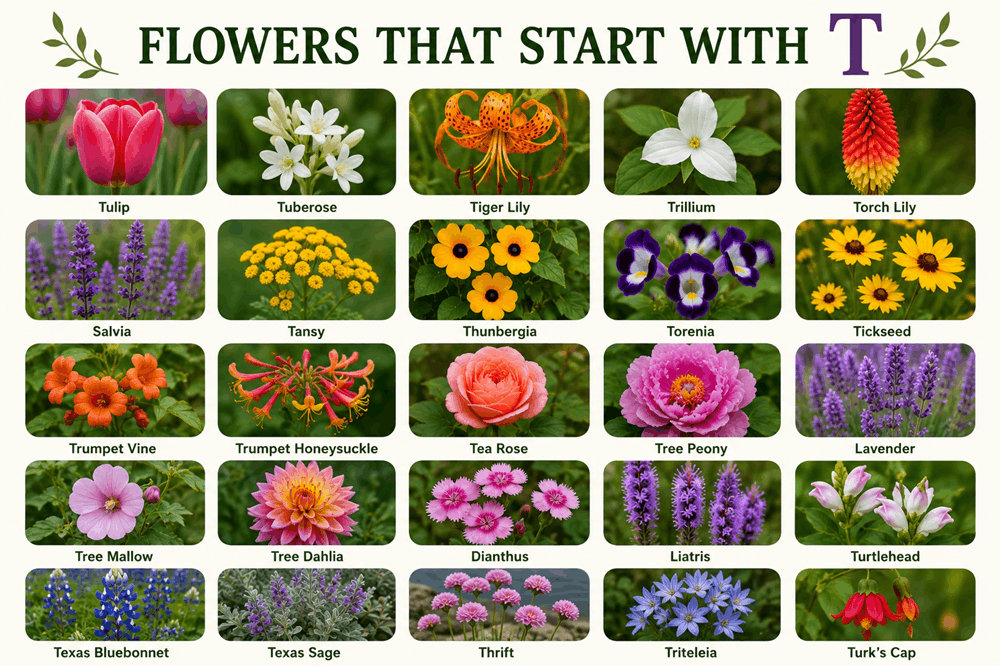
Flowers that start with T include tulips, tansy, trillium, tiger lilies, torch lilies, tuberose, and many other distinctive blooms. Some grow from bulbs, while others are annuals, perennials, shrubs, vines, or tropical plants. This guide introduces 25 flowers beginning with T, along with their appearance, growing habits, symbolism, and practical uses in gardens, containers, pollinator plantings, and floral arrangements.
1. Tulip
Tulips are among the most recognizable flowers beginning with T. Their cup-shaped blooms appear in almost every color, including white, cream, yellow, orange, pink, red, purple, burgundy, and near-black.
There are also striped, fringed, double, parrot, and lily-flowered varieties, giving tulips an enormous range of shapes and textures.
Tulip bulbs are usually planted in fall for spring flowering. They prefer well-drained soil and plenty of sunlight during their growing season.
Tulips commonly symbolize love, elegance, renewal, and spring. Red tulips are strongly associated with romantic love, while yellow tulips often suggest cheerfulness and warmth.
2. Tuberose
Tuberose produces tall spikes of creamy white flowers with an exceptionally strong fragrance.
The scent is sweet, rich, warm, and floral, which is why tuberose has long been valued in perfumery. A few stems can fragrance an entire room.
Tuberose grows from underground structures and prefers warm weather, full sun, and fertile soil with good drainage.
In colder climates, it is often grown in containers or lifted before winter. Its elegant white flowers also make it popular in wedding arrangements and evening gardens.
3. Tiger Lily
Tiger lilies produce dramatic orange flowers covered with dark spots. Their petals curve backward, exposing long stamens in the center.
The plants grow from bulbs and can reach several feet tall. They perform best in full sun or light shade with well-drained soil.
Tiger lilies are striking in summer borders and naturalized plantings.
Like other true lilies, tiger lilies are extremely toxic to cats. Even small amounts of leaves, petals, pollen, or vase water can cause life-threatening kidney failure.
4. Trillium
Trillium is a woodland wildflower recognized by its distinctive three leaves and three-petaled flowers.
Depending on the species, blooms may be white, red, burgundy, pink, yellow, or greenish.
Trilliums prefer rich woodland soil, spring moisture, and summer shade beneath deciduous trees.
They grow slowly and should never be dug from wild populations. Nursery-propagated plants are the best choice for home woodland gardens.
5. Tansy
Tansy produces clusters of small, button-like yellow flowers above ferny aromatic foliage.
The plant has a distinctive herbal scent and a long history of use in traditional gardens.
Tansy prefers full sun and tolerates a range of ordinary soils. It can spread aggressively through both seed and underground growth, so it may need careful control.
In some regions it is considered invasive. Gardeners should check local recommendations before planting it.
6. Torch Lily
Torch lily is another name for Kniphofia, commonly known as red hot poker.
The plant produces tall spikes of tubular flowers that often change from red at the top to orange and yellow lower down.
Modern varieties may also appear in coral, cream, green, pink, or pale yellow.
Torch lilies prefer full sun and well-drained soil. Their tubular flowers are highly attractive to hummingbirds and add strong vertical structure to sunny borders.
7. Thunbergia
Thunbergia is a group of flowering vines and shrubs, including the popular black-eyed Susan vine.
The flowers may be yellow, orange, white, pink, purple, or blue, depending on the species.
Black-eyed Susan vine typically has warm yellow or orange flowers with dark centers and grows rapidly over trellises and fences.
Thunbergia prefers warmth, bright light, and regular moisture. In colder climates, it is often grown as an annual.
8. Torenia
Torenia, commonly called wishbone flower, produces small trumpet-shaped blooms in purple, blue, pink, white, and yellow combinations.
It is especially useful in partly shaded gardens where many sun-loving annual flowers struggle.
Torenia works well in hanging baskets, window boxes, containers, and shaded border edges.
The plant appreciates regular moisture and protection from intense afternoon sun in hot climates.
9. Tickseed
Tickseed is the common name for Coreopsis, a group of long-blooming flowers with daisy-like blooms.
Yellow and gold are the classic colors, although modern varieties may also include red, pink, orange, cream, or bicolored flowers.
Most coreopsis plants prefer full sun and well-drained soil. Many tolerate heat, drought, and relatively poor growing conditions once established.
Deadheading or trimming after the first bloom can encourage a second flush of flowers.
10. Trumpet Vine
Trumpet vine produces large tubular flowers in orange, red, or yellow shades.
The vine grows vigorously and can quickly cover fences, pergolas, poles, and other strong structures.
Its nectar-rich flowers are especially attractive to hummingbirds.
However, trumpet vine can spread aggressively through underground shoots and seed. It needs regular pruning and should be planted only where its vigorous growth can be controlled.
11. Trumpet Honeysuckle
Trumpet honeysuckle is a climbing vine with tubular red, coral, orange, or yellow flowers.
Unlike some invasive honeysuckles, native trumpet honeysuckle can be an excellent wildlife plant when grown within its native range.
The flowers are particularly attractive to hummingbirds and other pollinators.
It prefers sunlight or light shade and needs a trellis, fence, or arbor for support.
12. Tea Rose
Tea roses are known for elegant flowers and often have a warm, tea-like fragrance.
Modern hybrid tea roses usually produce large individual blooms on long stems, making them especially popular as cut flowers.
Colors include red, white, yellow, pink, lavender, peach, and numerous blends.
Tea roses grow best in full sun with fertile, well-drained soil and regular moisture.
13. Tree Peony
Tree peonies are woody shrubs that produce enormous spring flowers, often larger than those of ordinary herbaceous peonies.
Blooms may be white, yellow, pink, red, purple, peach, or multicolored.
Unlike herbaceous peonies, tree peonies retain their woody stems through winter rather than dying completely to the ground.
They prefer good drainage, protection from harsh wind, and a location with plenty of light but some relief from extreme afternoon heat.
14. Tree Mallow
Tree mallow produces soft pink, purple, or white flowers resembling small hibiscus blooms.
The plant grows as a woody shrub in mild climates and can flower over an extended period.
Tree mallow prefers sunny locations and relatively well-drained soil. It may tolerate coastal conditions and light drought after establishment.
Regular pruning can help maintain a compact shape and encourage fresh flowering growth.
15. Tree Dahlia
Tree dahlia is a tall species of dahlia that can grow dramatically higher than ordinary garden varieties.
Its flowers are usually pale lavender, pink, or purple and appear near the tops of tall cane-like stems.
Tree dahlias perform best in mild climates with long growing seasons because they often flower late in the year.
They require a sheltered location and may need support because strong wind can damage their tall stems.
16. Tassel Flower
Tassel flower, commonly associated with Emilia, produces small fluffy blooms that resemble tiny paintbrushes or tassels.
Flowers are commonly red-orange, scarlet, or pink.
The plant grows easily from seed and prefers full sun and warm conditions.
Its loose, airy structure works naturally in cottage gardens and informal meadow-style plantings.
17. Toad Lily
Toad lilies produce unusual orchid-like flowers covered with spots and speckles.
Blooms may be white, lavender, pink, purple, or combinations of these shades.
They are especially valuable because they flower in late summer or fall and tolerate partial shade.
Toad lilies prefer rich soil and consistent moisture. Plant them close to paths or seating areas because their intricate flowers are best appreciated at close range.
18. Treasure Flower
Treasure flower is another common name for Gazania.
It produces brightly colored daisy-like blooms in yellow, orange, red, pink, cream, and striped combinations.
The flowers open most fully in bright sunlight and may close during cloudy weather or at night.
Treasure flowers thrive in hot, dry conditions and are excellent for rock gardens, sunny containers, coastal landscapes, and drought-tolerant plantings.
19. Turtlehead
Turtlehead produces upright stems topped with pink, white, or rose-colored flowers shaped like small turtle heads.
It prefers consistently moist soil and can tolerate partial shade, making it useful in rain gardens, pond edges, and damp perennial borders.
The flowers bloom from late summer into fall and attract pollinating insects.
Turtlehead provides a good option for gardens where moisture-loving plants are needed rather than drought-tolerant species.
20. Texas Bluebonnet
Texas bluebonnet produces upright spikes of blue pea-like flowers, often tipped with white.
The plant is strongly associated with spring landscapes in Texas and belongs to the lupine group.
Bluebonnets prefer sunny locations and well-drained soil. They are adapted to relatively lean growing conditions and generally do not need heavy fertilization.
Plants grow readily from seed when conditions are suitable.
21. Texas Sage
Texas sage is a flowering shrub with silvery foliage and purple, lavender, pink, or white flowers.
The plant often blooms after periods of summer rain or increased humidity.
It thrives in hot, sunny climates and tolerates drought extremely well after establishment.
Texas sage is especially useful in xeriscapes and desert-style gardens where water conservation is important.
22. Thrift
Thrift, also known as sea thrift, produces rounded flower clusters in pink, white, or lavender above narrow grassy foliage.
The plant tolerates windy, salty, and exposed coastal conditions surprisingly well.
It grows best in full sun and sharply drained soil and works beautifully in rock gardens, gravel beds, and along walls.
Its compact size also makes it useful for small gardens and container edges.
23. Triteleia
Triteleia produces clusters of star-shaped flowers on slender stems during late spring or early summer.
Blooms are usually blue, violet, purple, or white.
The plant grows from corm-like underground structures and prefers full sun with well-drained soil.
Triteleia works well in naturalized bulb plantings and cut-flower gardens, where its airy flower clusters provide a soft effect.
24. Twinflower
Twinflower is a low-growing woodland plant that produces pairs of small pink or pale bell-shaped flowers.
The flowers are delicate and often lightly fragrant.
Twinflower naturally grows in cool forests and prefers partial shade, acidic soil, and consistent moisture.
Its creeping growth habit makes it suitable for naturalistic woodland gardens where subtle flowers are valued.
25. Turk’s Cap
Turk’s cap produces red, pink, or occasionally white flowers whose petals remain tightly twisted rather than opening flat.
The shape resembles a traditional turban or cap, which explains the common name.
Turk’s cap grows well in warm climates and can tolerate partial shade better than many flowering shrubs.
Its nectar-rich flowers attract hummingbirds and butterflies, making it useful in wildlife gardens.
Which T Flowers Are Best for Containers?
Tulips, Torenia, treasure flower, thrift, tree mallow, and compact Thunbergia varieties can all work well in containers.
Tulips provide spring color, while Torenia is particularly useful for partly shaded summer pots. Treasure flower and thrift prefer sunny containers with excellent drainage.
Use pots with drainage holes and choose a container large enough for the mature root system. Vining plants such as Thunbergia also need a small trellis or support.
Which T Flowers Attract Hummingbirds?
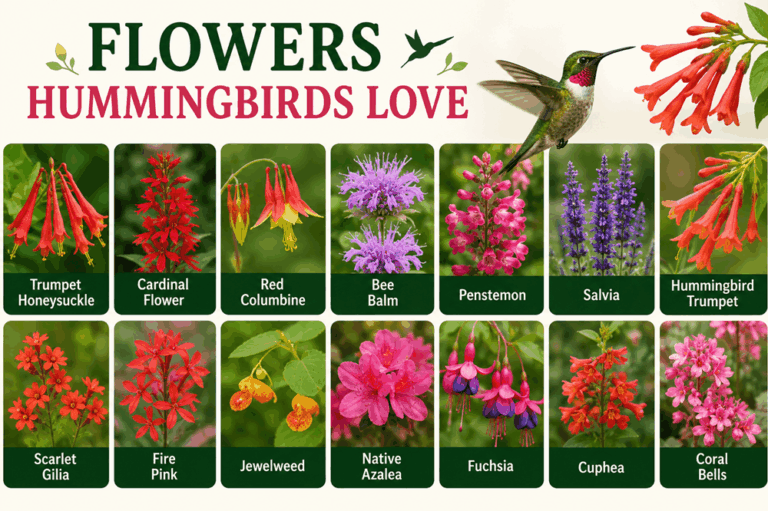
Torch lily, trumpet vine, trumpet honeysuckle, Turk’s cap, and certain Thunbergia species can attract hummingbirds.
Tubular flowers are particularly useful because hummingbirds can easily reach nectar while hovering.
For the best results, combine several hummingbird flowers with different bloom periods so nectar remains available throughout the warm season.
Which T Flowers Attract Bees and Butterflies?
Tickseed, Texas bluebonnet, turtlehead, torch lily, trillium, and some tulips can provide resources for pollinating insects.
Tickseed is especially useful during summer, while bluebonnets offer earlier seasonal nectar and pollen.
Open flower forms are generally easier for pollinators to use than densely doubled varieties.
Which T Flowers Work Well in Bouquets?
Tulips, tuberose, tiger lilies, tea roses, tree peonies, Triteleia, and toad lilies can all be used in floral arrangements.
Tulips create a clean spring look, tuberose adds fragrance, and tree peonies provide large luxurious focal flowers.
True lilies require special caution in households with cats, as even small amounts can be extremely dangerous.
Which T Flowers Are Best for Shade?
Toad lily, trillium, twinflower, Torenia, turtlehead, and Turk’s cap can all tolerate partial shade.
Trillium and twinflower are especially suited to woodland environments, while Torenia works well in shaded containers and porch planters.
Treasure flower, Texas sage, and most tulips require much brighter conditions for their best flowering.
Which T Flowers Are Best for Dry Gardens?
Texas sage, treasure flower, thrift, Jerusalem-sage-like dryland plants, and established torch lilies tolerate dry conditions well once their roots are established.
Drainage is especially important. A drought-tolerant plant can still fail if its roots remain wet for long periods.
Newly planted specimens should still be watered regularly until they develop strong root systems.
Which T Flowers Prefer Moist Soil?
Turtlehead, twinflower, and some trilliums prefer consistently moist conditions.
Turtlehead is especially suitable near ponds, rain gardens, and damp border areas.
Moist soil should still contain enough air around the roots. Permanently stagnant soil is unsuitable for many plants even if they enjoy regular moisture.
Which T Flowers Need Extra Caution?
Several T flowers require careful handling or placement. Tiger lilies and other true lilies are extremely toxic to cats, while some Thunbergia and trumpet vine species may spread aggressively.
Tansy can also become invasive in certain regions and should not be planted without checking local guidance.
Common names can cause confusion, especially names such as torch lily and tree lily that may refer to plants from very different botanical groups.
When pet safety, invasiveness, or growing requirements matter, always confirm the exact species before planting.
The Bottom Line
Flowers that start with T include familiar favorites such as tulips, tuberose, tiger lilies, trillium, torch lily, and Torenia. The group also includes distinctive plants such as Texas sage, turtlehead, tree peony, Triteleia, twinflower, and Turk’s cap.
There are T flowers for many different garden conditions. Treasure flowers thrive in hot, dry sun, toad lilies prefer partial shade, turtlehead enjoys moist soil, and trumpet honeysuckle can bring hummingbirds to a flowering trellis.
When choosing a T flower, consider its sunlight, moisture, soil, mature size, climate, toxicity, and ability to spread. Matching the plant to the right setting will produce healthier growth, stronger flowering, and a garden that remains colorful and interesting throughout the season.