Cannabis Flower Flight: What It Is and How It Works
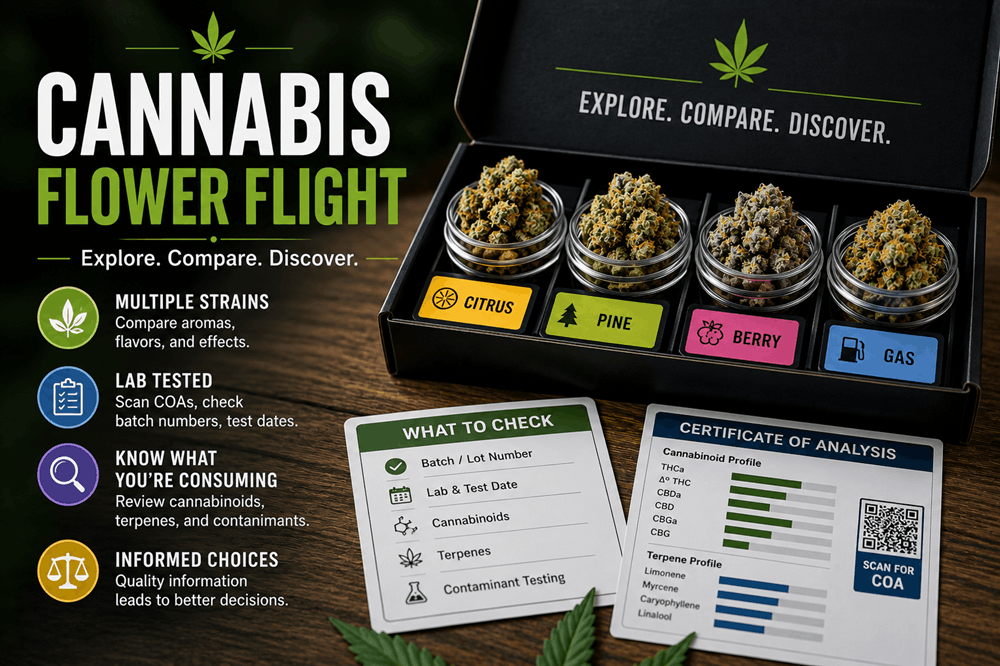
A cannabis flower flight is a sampler containing small amounts of several cannabis flower products or cultivars. The term borrows from wine, beer, and coffee flights, where multiple samples are grouped for comparison.
In cannabis retail, however, “flower flight” is a commercial description—not a regulated quality designation. It does not guarantee a particular number of samples, complete strain information, independent laboratory testing, or consistent quality.
A useful flower flight should make each sample identifiable and traceable to the laboratory results for the batch from which it came.
Important: This article is for general education only. It does not recommend purchasing or using cannabis and is not medical or legal advice.
What Is a Cannabis Flower Flight?
A cannabis flower flight typically contains several smaller flower samples sold or packaged together.
Depending on the producer or retailer, a flight might include:
- Different cultivars from one grower
- Several cannabinoid profiles
- A rotating seasonal selection
- Multiple phenotypes from the same cultivar
- Samples grouped around aroma or another theme
There is no universal standard governing how many samples must be included, how much each must weigh, or whether customers can choose them.
The words flower flight, variety pack, and sample pack also overlap. A flight usually suggests intentional comparison, while a variety pack simply indicates multiple products and a sample pack emphasizes smaller quantities. None of these terms establishes a testing or safety standard.
The Former Stay Supernatural Flower Flight
In December 2024, the former Stay Supernatural store offered a flower flight containing four one-gram THCa flower samples for $30.
The strains changed frequently and were selected by the retailer rather than the customer. The page promoted the sampler as a way to compare flavors and effects before ordering larger quantities. It also claimed that included products were tested for heavy metals, pesticides, mold, and other contaminants.
Those details describe a discontinued commercial offer. They do not define flower flights generally or provide information about products sold elsewhere.
Stay Supernatural is now an educational publication that does not sell cannabis. Its current editorial approach emphasizes laboratory results, potency, contaminants, product-quality claims, legal changes, and the difference between evidence and marketing.
What Information Should Come With Each Sample?
Every flower sample should be clearly identifiable.
Useful package or label information may include:
- Cultivar or product name
- Producer or cultivator
- Batch or lot number
- Net weight
- Packaging date
- Harvest date, when provided
- Cannabinoid results
- Laboratory name and testing date
- A QR code or link to the matching Certificate of Analysis
- Warnings required by the applicable jurisdiction
The batch or lot number is especially important. Without it, a reader may be unable to determine whether a laboratory report belongs to the flower inside the package.
A polished label or working QR code does not automatically establish product quality. The underlying report still needs to match the product and show what was—and was not—tested.
Should Every Sample Be Traceable to a COA?
Ideally, every sample should be traceable to a Certificate of Analysis, commonly called a COA, for the batch from which it came.
That does not necessarily mean every small container requires a separate PDF. Several samples may legitimately point to one report if they came from the same tested lot.
However, a flight containing different cultivars may involve multiple:
- Harvests
- Production lots
- Cultivators
- Testing dates
- Cannabinoid profiles
- Terpene profiles
A report for one cultivar cannot establish the composition or contaminant results of the other cultivars in the package.
Four Checks for a Flower Flight COA
1. Match the sample and batch
Compare the package with the COA for matching details such as:
- Product name
- Batch or lot number
- Sample identifier
- Harvest or production date
A report from another harvest or a similarly named cultivar is not an adequate substitute.
2. Confirm the laboratory and dates
A useful report should identify:
- The laboratory
- The date the sample was received
- The completion date
- The certificate number
- The analytical methods
- Relevant licensing or accreditation information
Use the laboratory’s online verification system when one is available.
3. Review the cannabinoids and units
The cannabinoid panel may report:
- THCa
- Delta-9 THC
- CBDa and CBD
- CBGa and CBG
- Other measured cannabinoids
- Total or potential THC
Results may be shown as percentages, milligrams per gram, dry-weight values, or another unit. Confirm the format before comparing samples.
4. Check which contaminant panels were performed
A potency-only report does not prove that a sample was screened for contaminants.
Depending on the jurisdiction and product, testing may include:
- Pesticides
- Heavy metals
- Microbial impurities
- Mycotoxins
- Residual solvents
- Moisture or water activity
- Foreign material
California’s licensed cannabis system provides one example of a broad testing framework. The state requires cannabis batches to be tested before retail sale and requires labels to accurately report cannabinoids and terpenes. These California rules should not be treated as nationwide standards for every cannabis or hemp product.
Readers can learn more through the California Department of Cannabis Control’s guide to cannabis testing laboratories.
Common laboratory terms
- ND: Not detected
- LOD: Limit of detection
- LOQ: Limit of quantitation
- NT: Not tested
- Pass/Fail: Whether the result met the applicable limit
“Not detected” generally means the substance was not found above the method’s detection threshold. It does not mean the same thing as “not tested.”
How THCa and Total THC Are Reported
THCa is an acidic cannabinoid naturally present in cannabis. When cannabis is heated, some THCa can convert into delta-9 THC through decarboxylation.
USDA hemp-production compliance testing accounts for this potential conversion. Laboratories must use a post-decarboxylation or similarly reliable method, report results on a dry-weight basis, and include measurement uncertainty. These USDA procedures concern hemp-production compliance, not every finished retail product or commercial COA.
The commonly used calculation is:
Total THC ≈ delta-9 THC + (THCa × 0.877)
USDA also explains that licensed hemp production uses the combined calculation of THCa multiplied by 0.877 plus delta-9 THC.
Readers can review the USDA hemp laboratory-testing guidelines for more detail.
A flower sample showing little delta-9 THC before heating should not automatically be considered non-intoxicating if it contains substantial THCa.
Why Strain Names Are Not Enough
Flower flights are often promoted as an easy way to compare strains. The names may offer some context, but they are imperfect identifiers of chemistry.
A peer-reviewed study of 89,923 commercial cannabis samples found that indica, sativa, and hybrid labels did not consistently align with measured chemical diversity. The researchers also found differing levels of consistency among products sharing strain names.
Readers can review the full PLOS ONE study on commercial cannabis chemistry and labeling.
A more useful comparison considers:
- The matching COA
- Cannabinoid concentrations
- Measured terpenes
- Producer and cultivator
- Harvest and packaging dates
- Product storage
- Whether samples were handled consistently
An “indica” label should not be treated as a guarantee of sedation, while “sativa” should not be treated as a promise of energy or creativity.
Can Aroma Identify the Terpenes?
Aroma can help someone describe what they smell, but it cannot confirm a laboratory terpene profile.
A sensory description such as citrus, pine, fruit, earth, fuel, spice, or cream is different from a measured laboratory result. Neither one automatically proves how a person will respond.
It helps to distinguish:
- Sensory observation: what someone reports smelling
- Laboratory measurement: what an analytical method detected
- Effect claim: what a seller predicts someone will experience
A citrus aroma does not prove that limonene is the dominant terpene. A measured terpene concentration also does not guarantee a particular emotional or medical effect.
Does Higher THCa Mean Better Flower?
No. A larger THCa percentage does not automatically mean that a sample is fresher, cleaner, safer, or higher quality.
Potency is only one part of product evaluation. Other considerations include:
- Whether the COA matches the batch
- Which contaminants were tested
- Product age
- Storage conditions
- Moisture condition
- Label accuracy
- Individual sensitivity to THC
Stay Supernatural’s current editorial standards specifically emphasize looking beyond the percentage on a product label and examining batch numbers, testing dates, detection limits, cannabinoid profiles, and contaminant screening.
Ranking a flower flight solely from highest to lowest THCa can therefore create a misleading picture of quality.
Can Effects Be Compared Reliably?
Personal impressions may help someone describe an experience, but they do not create controlled scientific evidence.
Effects may differ with:
- Potency
- Amount used
- Consumption method
- Tolerance
- Medications or other substances
- Expectations
- Mood and setting
- Individual response
Even two people using flower from the same batch may report different experiences.
A flower flight cannot prove that one cultivar is universally uplifting, sedating, creative, calming, or medically beneficial.
Safety Considerations
Small containers can still hold flower capable of producing substantial intoxication when heated. Small packaging should not be mistaken for low potency or low risk.
Basic precautions include:
- Do not drive or operate machinery while impaired.
- Avoid combining cannabis with alcohol or other impairing substances.
- Keep all samples away from children and pets.
- Do not assume different samples are safe to combine.
- Check that each product is clearly labeled.
- Be cautious when batch testing cannot be verified.
The CDC states that cannabis can slow reaction time and decision-making, impair coordination, and distort perception. Using cannabis and alcohol together can increase impairment.
More information is available in the CDC’s guidance on cannabis and driving.
Are Cannabis Flower Flights Legal?
A sampler has no special legal status. The legality of a flower flight depends on the composition of every included sample and the federal, state, tribal, and local rules applying where it is produced, sold, shipped, possessed, or used.
The former Stay Supernatural page claimed that its flight was Farm Bill compliant and could be shipped through USPS regardless of the buyer’s location. That broad statement did not account for different state, tribal, or local restrictions.
As of July 2026, the federal hemp definition currently in effect uses a limit of no more than 0.3% delta-9 THC by dry weight. An amendment enacted on November 12, 2025, is scheduled to take effect 365 days later, on November 12, 2026. It changes the definition to use total tetrahydrocannabinols and expressly includes THCa.
Unless Congress delays, repeals, or otherwise changes the amendment, it will take effect on the scheduled date.
A label saying “hemp-derived,” “Farm Bill compliant,” or “federally legal” does not establish that every sample is lawful in every jurisdiction.
Readers can review the current provision and scheduled amendment in 7 U.S.C. § 1639o.
Frequently Asked Questions
What is a cannabis flower flight?
It is a sampler containing small amounts of several cannabis flower products or cultivars. There is no universal standard governing the number or size of the samples.
How many samples are usually included?
The number varies by seller. The former Stay Supernatural flight included four one-gram samples, while other packages may include more or fewer.
Can several samples share one COA?
Yes, when they came from the same tested batch and the report clearly applies to all of them. Samples from different cultivars, lots, or harvests should remain independently traceable.
Are all included cultivars normally disclosed?
Not always. Some packages contain rotating or mystery selections. A useful flight should identify every sample and provide enough information to connect it to its batch record.
Does higher THCa mean stronger effects?
Not predictably. Potency, amount, consumption method, tolerance, other compounds, and individual response all matter.
Is a cannabis flower flight federally legal?
The sampler format itself has no special federal status. Every included sample must be evaluated under the laws applying to the product and jurisdiction.
The Bottom Line
A cannabis flower flight is a multi-sample product format, not a regulated quality designation.
The most useful flight is one in which every sample is clearly identified, traceable to a matching batch and COA, and accompanied by understandable cannabinoid and contaminant information.
Strain names, aromas, category labels, and THCa percentages can provide limited context. None can independently establish quality, safety, legality, or a predictable experience.
The former Stay Supernatural Flower Flight was a rotating four-sample commercial pack. Its strongest modern replacement is an educational guide that helps readers evaluate labels, laboratory reports, and marketing claims more carefully.