Cannabis Climate Control: Temperature, Humidity, VPD, Airflow, and HVAC Explained
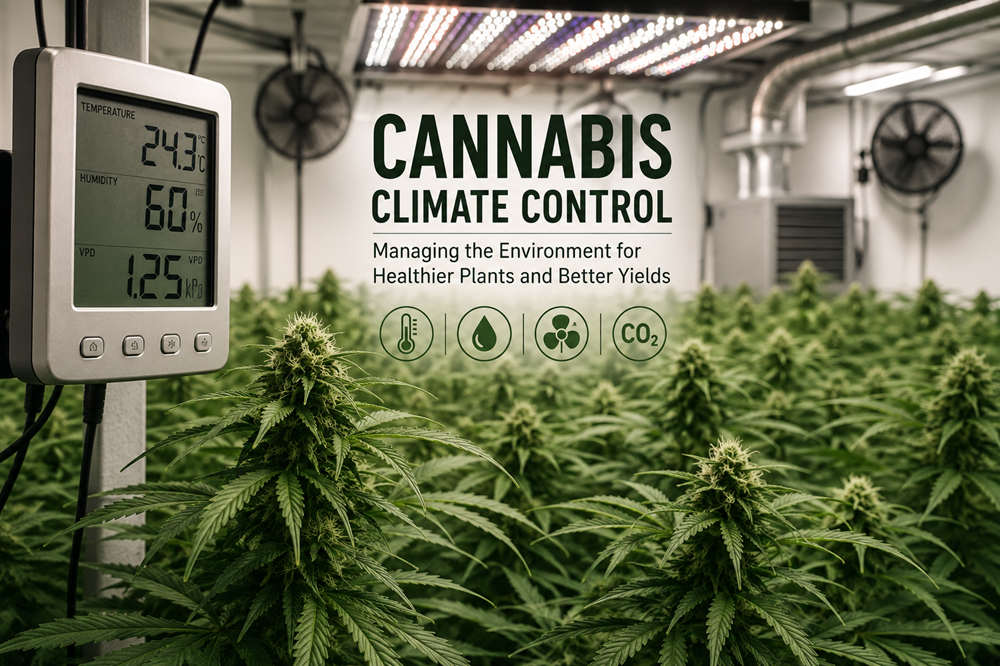
Cannabis climate control involves managing the conditions surrounding a crop, including temperature, moisture, airflow, lighting, carbon dioxide, and the heat and water vapor produced during cultivation.
These conditions are closely connected. Lighting affects leaf temperature and plant water use. Irrigation adds moisture to the growing space. Dehumidification may add heat, while cooling equipment may remove both heat and water vapor. Effective climate control therefore depends on coordinating the crop, the cultivation room, and its mechanical systems.
What Is Cannabis Climate Control?
Cannabis climate control is the process of maintaining environmental conditions that support plant development while reducing excessive stress, condensation, uneven growth, and conditions favorable to crop disease.
The environment immediately surrounding the leaves and flowers is especially important. Conditions within a dense canopy may differ from readings taken on a wall, near a doorway, or directly beneath an air-supply vent. A room can appear stable at the controller while containing warmer, cooler, wetter, or poorly ventilated areas around the plants.
A cultivation climate-control system may include:
- Heating and cooling equipment
- Dehumidification
- Air-circulation fans
- Fresh-air ventilation
- Environmental sensors
- Lighting controls
- Carbon dioxide equipment
- Automated controllers and alarms
No single device controls the entire growing environment. The performance of each component depends on room design, plant density, irrigation practices, equipment capacity, and the way the different systems are programmed to operate.
How the Cultivation Method Changes Climate-Control Needs
The degree of environmental control available depends largely on whether cannabis is grown indoors, in a greenhouse, or outdoors.
Indoor cultivation
Indoor facilities depend on mechanical systems because the crop is separated from natural sunlight, rainfall, and wind. Electric lighting creates heat, while plant transpiration and irrigation introduce water vapor into an enclosed space.
Indoor production offers substantial control over environmental conditions, but that control depends on properly designed cooling, moisture removal, airflow, lighting, and automation. Problems can develop quickly when one of these systems is unable to meet the changing demands of the crop.
Greenhouse and mixed-light cultivation
Greenhouses combine natural conditions with mechanical or passive controls. Sunlight can reduce reliance on electric lighting, but solar radiation may rapidly increase air and canopy temperatures. Outdoor humidity, clouds, wind, and seasonal weather also influence the interior environment.
Climate-control tools may include vents, circulation fans, shade curtains, heating, evaporative cooling, supplemental lighting, and mechanical dehumidification. The equipment must respond to changing outdoor conditions rather than maintaining a completely isolated room.
Outdoor cultivation
Outdoor growers have little direct control over air temperature and atmospheric humidity. Environmental management depends more on site selection, seasonal timing, plant spacing, wind exposure, irrigation, cultivar characteristics, and preparation for severe weather.
Outdoor production may require less mechanical equipment, but it remains vulnerable to prolonged rain, high nighttime humidity, heat, frost, smoke, and other conditions that cannot be fully corrected after they occur.
The Main Environmental Variables
Air temperature and leaf temperature
Air temperature describes the growing space, but plants respond directly to the temperature of their tissues. Leaves may be warmer or cooler than the nearby air depending on light intensity, transpiration, air movement, water availability, and the temperature of surrounding surfaces.
Strong light can warm the canopy even when the room thermostat appears normal. Transpiration may cool leaves, while limited water uptake can reduce that cooling effect. For this reason, room temperature alone does not always describe the conditions experienced by the plant.
Temperature also changes the relationship between air and moisture. As air cools, its saturation vapor pressure decreases. Relative humidity can therefore rise during a temperature drop even when no additional water vapor enters the room.
Relative humidity and dew point
Relative humidity expresses the amount of water vapor in the air relative to the saturation level at the current temperature. Because saturation changes with temperature, the same quantity of moisture can produce different relative humidity readings as a room warms or cools.
Dew point is the temperature at which the air reaches saturation and condensation can begin. A leaf, pipe, wall, duct, or other surface can fall below the dew point even when the room’s average humidity reading appears acceptable. Moisture may then collect on that surface.
Water vapor in a cultivation room comes from plant transpiration, wet growing media, runoff, standing water, exposed reservoirs, and irrigation. As plants develop more leaf area, they may release substantially more moisture than they did early in the crop cycle.
Vapor pressure deficit
Vapor pressure deficit, or VPD, is the difference between saturation vapor pressure and the actual vapor pressure of the surrounding air. In plant production, the most informative calculation considers the moisture conditions at the leaf surface and in the nearby air.
A low VPD represents relatively weak atmospheric drying demand. A high VPD represents stronger demand for water to move from the plant into the air. Either extreme may become stressful when it exceeds the plant’s ability to regulate water uptake and transpiration.
Leaf temperature matters because it influences saturation vapor pressure at the leaf surface. Calculating VPD from room temperature alone may be misleading when the canopy is noticeably warmer or cooler than the air.
VPD should be treated as a management indicator rather than a fixed recipe. Plant genetics, canopy structure, root-zone moisture, light intensity, airflow, plant age, and irrigation strategy all influence how a crop responds under the same calculated VPD.
A 2025 controlled-environment study compared one CBD-dominant cannabis genotype grown at canopy-relative-humidity ranges of 37–58% and 78–98%. Plants exposed to the higher range produced less biomass and showed delayed flowering and lower measured cannabinoid concentrations.
The experiment demonstrates the potential consequences of extremely humid canopy conditions, but it does not establish a universal humidity target. It involved one genotype, ten plants per treatment, and two broad environmental ranges.
Air circulation and ventilation
Air circulation moves conditioned air within a room and through the crop. It helps limit stagnant zones, temperature layering, and localized moisture accumulation.
The objective is broad and reasonably uniform movement rather than a narrow stream directed at a few plants. Air speed that is too high can increase localized water loss, move branches excessively, or produce different conditions for plants closest to a fan.
Ventilation serves a different purpose by exchanging indoor air with outdoor air. It may remove heat, moisture, odors, or accumulated gases when outside conditions are suitable. In enclosed rooms, unnecessary ventilation can increase heating or cooling loads and remove supplemented carbon dioxide.
Lighting
Lighting affects climate beyond the heat released by the fixture. Light can warm plant surfaces, drive photosynthesis, and increase water use. Higher plant activity may produce a larger moisture load for the environmental system to manage.
Lighting schedules also create predictable transitions. When fixtures turn on or off, the room’s heat load changes faster than plant and growing-media moisture release. Controllers should account for those transitions instead of treating the room as though its load were constant throughout the day.
Carbon dioxide
Some enclosed facilities supplement carbon dioxide to support photosynthesis under appropriate lighting and crop conditions. Supplementation must be coordinated with ventilation so that the gas is not immediately removed from the room.
Carbon dioxide enrichment also creates an occupational safety concern. OSHA lists a permissible exposure limit of 5,000 parts per million as an eight-hour time-weighted average. This is a workplace exposure limit, not a recommended cultivation concentration.
Facilities using carbon dioxide may require gas monitors, alarms, emergency ventilation, equipment inspection, documented response procedures, and worker training. Fire, building, occupational, and cannabis regulations can vary by jurisdiction, so facility requirements should be confirmed locally.
How Climate Priorities Change During Plant Development
Propagation and young plants
Cuttings and seedlings have small or developing root systems. They may be less able to replace water lost through their leaves, particularly under intense light or strong moving air.
Climate management at this stage focuses on avoiding rapid moisture loss while roots become established. Propagation domes and enclosures can slow drying, but they can also produce condensation and limited air exchange. Conditions should be adjusted as the plants develop functioning roots.
Vegetative development
As plants expand, greater leaf area increases transpiration and changes the room’s moisture load. Environmental equipment that was adequate soon after planting may become less effective as the canopy fills the space.
Plant growth also changes air pathways. Larger leaves and closely spaced branches can obstruct circulation that previously moved freely through the room. Fan placement and plant spacing may need to be reassessed as the canopy develops.
Flowering
Flowering plants often form a denser canopy with less open space around leaves and inflorescences. These structures can create localized conditions that differ from measurements taken above or beside the crop.
Environmental management during flowering therefore depends on maintaining access for conditioned air throughout the canopy. Lowering the room’s average humidity will not eliminate every humid pocket when air cannot reach the plant interior.
Lights-off periods
The transition into darkness is a common period of environmental instability. When lights turn off, the room loses a major heat source and may cool quickly. As temperature falls, relative humidity can rise even without an immediate increase in the amount of water vapor.
Plants and wet growing media may continue releasing moisture during this temperature change. An irrigation event late in the light period can add to the load by leaving saturated media, runoff, or wet surfaces as the room cools.
Control systems should anticipate this scheduled transition. Waiting until humidity has already exceeded a limit may allow condensation or a prolonged period of unfavorable canopy conditions before the equipment catches up.
Equipment Used to Control the Environment
HVAC systems
Heating, ventilation, and air-conditioning equipment manages sensible heat, meaning heat that changes air temperature. Sources can include lights, pumps, fans, people, exterior weather, and heat released by other equipment.
Cultivation also creates a latent load associated with water vapor. Conventional comfort-cooling equipment may lower air temperature without providing enough moisture removal for a plant-filled room, particularly when the cooling demand is low but transpiration continues.
The HVAC guidance for controlled-environment agriculture emphasizes evaluating both sensible and latent loads. Equipment selection should account for lighting, irrigation volume, plant development, outdoor conditions, room construction, and differences between daytime and nighttime operation.
Dehumidification
Many refrigerant-based dehumidifiers cool air below its dew point so that water condenses and can be collected. The processed air may then be reheated before returning to the cultivation space.
Standalone refrigerant units commonly release compressor and reheat energy into the room. This heat can increase the load on the cooling system. Other dedicated or integrated systems manage moisture differently, so equipment should be compared by moisture-removal capacity, heat output, efficiency, operating range, and compatibility with the facility’s HVAC design.
Capacity should be based on the amount of water entering and leaving the cultivation environment. Irrigation records, runoff, drainage, plant uptake estimates, and collected condensate can help operators understand the room’s actual moisture balance.
Fans and air distribution
Fans distribute air that has already been heated, cooled, or dehumidified. Their effectiveness depends on fan orientation, crop height, aisle arrangement, shelving, ducts, walls, and other obstructions.
Equipment layout should be evaluated with mature plants in place, not only in an empty room. A circulation pattern that appears effective before planting may change substantially once the canopy reaches full size.
Environmental controllers
Environmental controllers receive data from sensors and direct connected equipment. Basic systems operate from temperature and humidity setpoints, while more advanced platforms coordinate lighting, irrigation, fans, vents, HVAC, dehumidification, and carbon dioxide equipment.
Coordination prevents separate devices from responding in ways that waste energy or destabilize the room. For example, dehumidification may add heat while cooling removes it, ventilation may exhaust supplemented carbon dioxide, and irrigation may add moisture shortly before a scheduled temperature reduction.
A well-programmed controller can sequence equipment, respond to scheduled lighting and irrigation events, and record how the room behaves under changing loads.
Monitoring, Sensors, and Commissioning
Reliable climate control depends on representative measurements. One sensor cannot describe every part of a large room, vertical rack, greenhouse, or dense canopy.
Temperature and humidity sensors are generally most useful near the active canopy without being placed in direct light, water spray, a concentrated supply-air stream, or against an exterior wall. Multiple measurement points may be needed to identify differences between aisles, elevations, room edges, and central growing areas.
Depending on the facility, a monitoring system may track:
- Air temperature and relative humidity
- Leaf or canopy temperature
- Carbon dioxide concentration
- Growing-media moisture or weight
- Irrigation and runoff volume
- Lighting status
- Equipment runtime
- Power consumption
- Collected condensate
- Vent, door, curtain, or damper positions
Sensors should be compared with calibrated reference instruments on a documented schedule. Drift can cause two devices in the same location to report different values, leading a controller to maintain the wrong conditions while appearing to function normally.
Historical trends can reveal problems that isolated readings miss. Data may show recurring humidity increases after irrigation, slow recovery after lighting transitions, excessive compressor cycling, or gradual loss of control as plant biomass increases.
Monitoring should begin with commissioning. Sensors, alarms, equipment stages, and programmed sequences should be tested under representative operating conditions to verify that they perform as intended.
The controls guidance for cultivation facilities recommends functional performance testing and coordination among climate, lighting, and irrigation systems. Testing should be repeated after major equipment replacements, room reconfiguration, software updates, or substantial control changes.
Alarms should identify equipment failures, prolonged environmental deviations, carbon dioxide hazards, water leaks, power loss, and sensor communication problems. Each alarm also needs a defined response so staff know what action to take when it is triggered.
Common Cannabis Climate-Control Problems
Treating temperature and humidity as independent settings
Cooling, heating, and moisture removal affect one another. Controls that respond to each variable independently can create unstable conditions or cause equipment to work against itself.
Measuring only one part of the room
A single sensor may conceal substantial differences between canopy levels, aisles, corners, perimeter walls, and supply-air locations.
Using early-stage equipment loads for final sizing
Young plants release less moisture and obstruct less airflow than mature plants. Equipment should be evaluated for anticipated peak crop loads rather than the easiest part of the growth cycle.
Undersizing climate equipment
Insufficient cooling or moisture-removal capacity can leave the room unable to recover from lighting, irrigation, or weather-related loads.
Oversizing equipment
Excessive capacity can cause short cycling, uneven control, unnecessary wear, and poor performance at partial load. Maximum capacity is only one consideration; equipment must also operate effectively when demand is lower.
Ignoring water outside the crop
Leaks, standing runoff, wet floors, uncovered reservoirs, and poorly draining equipment add moisture without benefiting the plants. Correcting these sources can reduce the environmental load placed on dehumidification equipment.
Applying one climate recipe to every cultivar
Environmental targets should be evaluated against plant response, room data, production methods, and facility limitations. A setting used successfully in one operation may not produce the same result with different genetics, lighting, irrigation, or canopy architecture.
Energy Efficiency and Environmental Impact
Efficient climate control begins with matching equipment to the facility’s actual heat and moisture loads. It also requires preventing independent systems from making opposing corrections.
Useful efficiency measures include:
- Coordinating lighting, irrigation, HVAC, and dehumidification schedules
- Using equipment capable of adjusting to partial loads
- Maintaining filters, coils, drains, fans, ducts, and sensors
- Reducing unintended air leakage
- Repairing irrigation and condensate leaks promptly
- Recovering useful heat where practical
- Submetering major systems
- Comparing resource use across rooms and crop cycles
Energy data can also help identify maintenance problems. A system that begins running longer to maintain the same conditions may have dirty coils, blocked filters, failed components, refrigerant problems, inaccurate sensors, or an environmental load that has changed.
Cannabis climate-control efficiency is also becoming part of state environmental policy. The New York Office of Cannabis Management sustainability program, for example, addresses energy metering, lighting efficiency, HVAC refrigerants, emissions planning, and resource benchmarking for regulated cultivation.
Requirements vary by jurisdiction, so growers should not assume that another state’s standards apply to their facility. The New York program is useful as an example of how energy use, equipment selection, emissions, and data reporting can be incorporated into cannabis regulation.
Final Takeaway
Cannabis climate control is not a matter of following one temperature, humidity, or VPD chart. It requires understanding how plant development, irrigation, lighting, airflow, room construction, and mechanical equipment influence the environment together.
Representative sensors, calibrated instruments, commissioning, historical data, preventive maintenance, and direct observation of the crop allow operators to make adjustments based on actual conditions rather than assumptions. A coordinated system is more likely to maintain uniform conditions, identify failures early, and use resources efficiently as the crop changes.