Cannabis Search Engine Marketing: Building Visibility When Ads Are Restricted
Cannabis businesses operate in one of the most restricted digital marketing environments. Customers regularly use search engines to find licensed dispensaries, research products, understand local laws, and learn about cannabinoids, yet many conventional paid advertising opportunities remain unavailable.
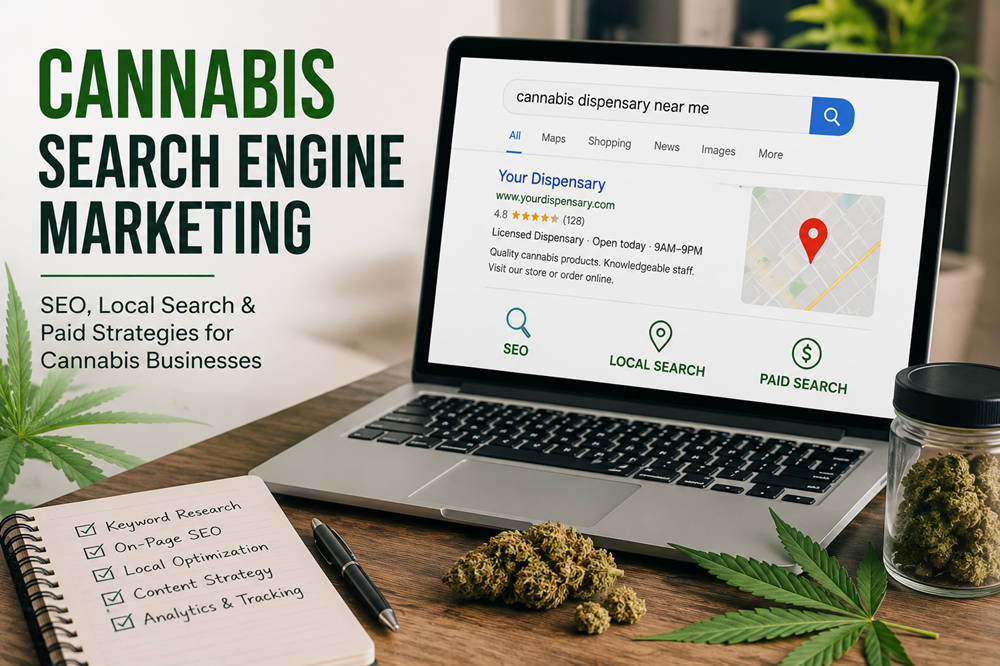
That makes cannabis search engine marketing broader than buying advertisements. A strong strategy combines cannabis SEO, local search visibility, technically accessible websites, accurate business information, useful content, and careful compliance review.
What Is Cannabis Search Engine Marketing?
Cannabis search engine marketing is the process of helping a cannabis-related business appear when people search for relevant information, products, locations, or professional services.
It includes several distinct activities:
- Organic SEO improves unpaid visibility for educational, commercial, and location-based pages.
- Local SEO helps physical businesses appear when people search within a particular city, neighborhood, or service area.
- Paid search places advertisements in search results when the advertiser, product, location, and landing page satisfy platform policies.
- Conversion optimization makes it easier for eligible visitors to find directions, view a menu, contact a business, or complete another useful action.
These channels serve different needs. Someone researching cannabis testing may need an educational guide, while a person searching for a licensed dispensary nearby needs accurate store information. Treating both searches as the same marketing opportunity usually produces weak pages and poorly qualified traffic.
Why Cannabis Search Marketing Is Different
A cannabis company may be licensed under state or provincial law while remaining restricted by an advertising platform. Rules may also differ among adult-use cannabis, medical cannabis, hemp-derived products, CBD products, and companies that provide services to the industry.
Search campaigns may be affected by:
- Geographic restrictions on sales and delivery
- Minimum-age requirements
- Limits on advertising near or to minors
- Rules governing discounts and promotional language
- Required license details, warnings, or disclosures
- Restrictions on therapeutic and disease-related claims
Organic search is not an exemption from these requirements. A page can violate state advertising rules or consumer-protection standards even when no money was paid to promote it.
Geography also matters more than raw traffic volume. A dispensary gains little from attracting visitors who live outside its licensed market. The goal is to reach people the business can legally and practically serve.
Can Cannabis Businesses Use Google Ads?
In most situations, plant-touching cannabis businesses cannot use Google Ads to promote marijuana products or dispensaries. Google’s current recreational drugs policy prohibits ads for marijuana, cannabis shops, products that facilitate recreational drug use, and instructional material about producing, buying, or using recreational drugs.
There is a narrow exception for certain topical, hemp-derived CBD products containing no more than 0.3% THC. Eligible non-pharmaceutical advertisers must obtain the required third-party and Google certifications. In the United States, location targeting is currently limited to California, Colorado, and Puerto Rico, and some advertising formats remain unavailable.
This exception generally concerns topical products such as creams, lotions, sprays, and similar external-use formats. It should not be interpreted as broad approval for ingestible CBD, THC products, dispensaries, or recreational cannabis brands.
Google is also running a limited Canadian cannabis advertising pilot on Search. The pilot began August 25, 2025, and is scheduled to continue through December 31, 2026. Participation is limited to qualifying federally licensed and provincially or territorially authorized entities, so it does not create general advertising access for every Canadian cannabis company.
Ancillary businesses may have more flexibility when promoting services such as accounting, security, software, legal support, packaging, or cultivation technology. Approval still depends on the wording, imagery, keywords, service offered, and content of the landing page.
Businesses should not hide cannabis references, substitute misleading terminology, or show reviewers a different landing page from the one customers see. Attempts to evade review can lead to disapproved ads or account restrictions.
Building a Compliance-First Search Program
Compliance should shape a campaign before keywords are selected or pages are written. The first step is to define exactly what the company may promote, where it may operate, and which customers it may serve.
A basic review process should confirm:
- The business holds the required licenses for the market discussed.
- The product or service may legally be promoted in that jurisdiction.
- Delivery and service-area statements match actual operating boundaries.
- Age and eligibility requirements are clearly presented where necessary.
- Prices, availability, discounts, and store information are current.
- Required warnings and disclosures are visible.
- Claims about effects, safety, or health are appropriately supported.
Businesses operating in several jurisdictions may need qualified legal review before publishing location-specific promotions or product claims. A sentence that is acceptable in one market may require different wording or disclosures in another.
Health claims need especially careful treatment. The Federal Trade Commission’s Health Products Compliance Guidance explains that objective advertising claims must be truthful, not misleading, and adequately substantiated. Claims about pain, anxiety, sleep, inflammation, disease, or other health outcomes should not be based only on customer testimonials or common assumptions about cannabis.
Each important page should have a designated owner and review date. Legal information, store details, product availability, advertising policies, and scientific evidence can all change, making periodic review essential.
Cannabis Keyword Research and Search Intent
Effective keyword research begins by identifying what the searcher wants to accomplish. Each meaningful intention should lead to a page designed for that specific task.
Local Searches
Queries such as “licensed dispensary in Denver,” “dispensary open near me,” or “cannabis delivery in Portland” suggest that the user wants to locate a business.
These searches should lead to a genuine location or service-area page with store hours, directions, purchasing requirements, accessibility details, pickup or delivery information, and access to the appropriate menu.
Product and Category Searches
Some customers search for a product format, cannabinoid, terpene profile, strain, brand, or potency range. When local rules permit, these queries can be addressed through detailed category and product pages.
Descriptions should reflect the actual product rather than repeat identical text across an entire menu. Useful differences may include ingredients, cannabinoid content, format, package size, testing information, and availability by location.
Educational Searches
Educational searches may concern cannabis laws, cannabinoids, testing, cultivation, storage, responsible use, or plant health. These queries are best addressed through focused resources that answer one central question clearly.
An article about certificates of analysis, for example, should explain how laboratory results are organized and interpreted. It does not also need to target dispensary directions, delivery terms, and product prices.
Business-to-Business Searches
Ancillary companies should target the operational problems they solve. Relevant searches may involve compliance software, inventory management, packaging, insurance, payment systems, legal services, facility security, or cultivation equipment.
These visitors generally need service pages, technical resources, demonstrations, case studies, or implementation details rather than consumer-oriented cannabis articles.
Assigning Keywords to Pages
Group related terms by intention and assign each group to one useful page. This reduces internal competition and prevents the creation of thin pages for minor variations of the same phrase.
A city-specific page should exist only when the company has a real location, licensed delivery area, event, or substantial local information. Replacing the city name in otherwise identical text does not create meaningful local value.
Local SEO for Dispensaries
Local SEO helps customers find and evaluate a physical store. Accurate information is more important than promotional language because visitors commonly want to confirm where the business is, when it is open, and whether it can serve them.
Follow Google’s Business Profile guidelines when creating or maintaining a listing. Use the business name shown on real-world signage, select relevant categories, provide a legitimate address or service area, and avoid duplicate profiles for the same location.
Each store should also have a dedicated page containing:
- Its complete address and phone number
- Regular and holiday operating hours
- Driving and public-transit directions
- Parking and accessibility information
- Medical or adult-use eligibility details
- Pickup and delivery availability
- Nearby landmarks
- A link to the correct location menu
Business Profile posts require special care. Google allows regulated businesses to publish posts, but those posts must not include content about the regulated products themselves. A dispensary may use posts for updated hours, temporary closures, hiring information, community notices, or other general business announcements, but it should not use them to promote individual cannabis products.
Customer reviews must come from genuine experiences. Do not offer discounts, loyalty points, free products, contest entries, payments, or other incentives in exchange for any Google review, even when customers are asked to provide an honest opinion. Businesses may invite customers to leave feedback, but the request should remain neutral.
Developers may add LocalBusiness structured data to location pages so search engines can interpret details such as addresses, phone numbers, coordinates, and opening hours. The markup must match information visible to users.
Structured data can improve how Google understands a page, but it does not guarantee a rich result, knowledge panel, or higher ranking.
Creating Useful Cannabis Content
Cannabis content should answer real customer questions rather than fill the website with minor keyword variations. Quality is more valuable than publishing frequency when every article says essentially the same thing.
Useful topics may include:
- How cannabis products are tested
- How to read a certificate of analysis
- What cannabinoids and terpenes are
- How to store cannabis responsibly
- How medical and adult-use programs differ
- What identification a dispensary customer may need
- How local purchasing or delivery rules work
- How environmental conditions affect cannabis plants
Google’s guidance on helpful, reliable, people-first content encourages publishers to create material for readers rather than primarily to manipulate rankings. Cannabis websites can support that goal through clear sourcing, original explanations, transparent authorship, and visible review dates.
Scientific and regulatory statements should link to primary sources whenever possible. Articles should distinguish established evidence from anecdotal reports, traditional use, and marketing claims.
Strain names and product labels should not be presented as guarantees that every person will experience a particular effect. Individual responses can differ, and marketing language should not replace evidence.
Internal links should help readers continue a related task. A terpene guide might link to an explanation of laboratory reports, while a state-law article might direct eligible readers to a relevant licensed location. Links should not force every informational visitor onto an unrelated sales page.
Technical SEO for Cannabis Websites
Technical SEO ensures that search engines and visitors can access the information created for them. Cannabis websites should maintain secure connections, mobile-friendly layouts, logical navigation, descriptive page titles, crawlable links, consistent URLs, and accurate XML sitemaps.
Several technical issues are especially common in this industry.
Third-Party Menus
Dispensary menus often depend on embedded platforms or JavaScript. Important category names, location information, and descriptive text should not exist only inside an application that search engines may struggle to interpret.
Create crawlable location and category pages around the menu so visitors and search engines can understand the store even when live inventory changes frequently.
Age-Verification Screens
Age-verification tools should satisfy applicable requirements without unnecessarily making all public information inaccessible to search engines. Store details, educational resources, and other lawful public content should remain crawlable where regulations permit.
Duplicate Inventory URLs
Menus may generate numerous URLs from filters, sorting options, tracking parameters, categories, and store selections. Canonical tags and appropriate indexation rules can keep these variations from competing with primary location and product pages.
Unavailable Products
Inventory changes quickly. A temporarily unavailable item does not always require immediate deletion, especially when it may return. Pages for permanently discontinued products can be redirected to a relevant category or alternative when that destination genuinely helps the visitor.
Avoid redirecting every removed product to the homepage. That makes it harder for customers to continue their search and gives search engines little contextual information.
Turning Search Visitors Into Customers
A visitor should be able to complete the purpose of the search without navigating through unnecessary promotional screens.
A dispensary location page should make it easy to determine:
- Whether the store serves medical patients, adult-use customers, or both
- Whether the location is currently open
- Which identification or documents are required
- Whether pickup or delivery is available
- Where the store is located
- How to view current inventory
Delivery pages should clearly state eligible areas, minimum orders, fees, identification requirements, and service times. They should not imply that delivery is available beyond licensed boundaries.
Educational articles require a softer next step. A reader may benefit from another guide, a testing explanation, a store-information page, or a location finder rather than an immediate product offer.
Pop-ups, promotional banners, and age checks should not repeatedly obstruct the same visitor. Mobile users in particular need enough visible space to read store information, warnings, and navigation controls.
Measuring Search Marketing Performance
Traffic and rankings show whether pages are visible, but they do not reveal whether the business is reaching eligible customers.
Useful performance measures include:
- Calls from location pages
- Requests for directions
- Clicks to store-specific menus
- Pickup or delivery actions
- Qualified business-to-business inquiries
- Organic visits from permitted service areas
- Conversions that begin on educational pages
Separate branded searches from non-branded searches. Branded queries show whether people who already know the business can find it. Non-branded queries indicate whether the website reaches people looking for a product category, nearby location, answer, or professional service.
Performance should also be reviewed by store or market. Sitewide totals can hide weak location pages, incorrect hours, incomplete listings, or regional indexation problems.
Google Search Console provides data on impressions, clicks, queries, pages, and countries. Analytics tools can then show what visitors do after arriving, such as opening a menu, requesting directions, or submitting an inquiry.
Reports should exclude or separately identify traffic from areas the business cannot serve. High visitor numbers are not meaningful when they come from ineligible markets.
A Sustainable Approach to Cannabis Search
Long-term search visibility does not come from hiding restricted products, producing hundreds of nearly identical pages, or making stronger claims than the evidence supports.
It comes from maintaining accurate locations, understanding customer intent, publishing reliable information, keeping important pages technically accessible, and measuring actions that matter to the business.
Paid search may remain limited, but cannabis companies can still build meaningful visibility through organic SEO and local search. The strongest programs treat compliance as part of the marketing process, not as an obstacle to address after a campaign has already been created.