Is THCP Stronger Than THCA? Potency, Effects, and Key Differences
Yes. THCP has much stronger CB1 receptor activity and greater psychoactive potential than raw, unheated THCA. The comparison becomes more complicated when THCA is heated, because heat can convert THCA into delta-9 THC, the cannabinoid responsible for most of the familiar intoxicating effects of cannabis.
THCP is also frequently described as being “33 times stronger than THC.” That number comes from laboratory receptor-binding research. It does not mean THCP has been proven to make people 33 times higher, nor does it provide a reliable formula for comparing doses.
Is THCP Stronger Than THCA?
In their original chemical forms, THCP and THCA behave very differently.
THCP is a THC-related cannabinoid with strong activity at the CB1 receptor, one of the main receptors involved in cannabis intoxication. THCA, or tetrahydrocannabinolic acid, interacts much more weakly with CB1 and is generally not considered intoxicating in the same way as delta-9 THC.
| Feature | THCP | THCA |
|---|---|---|
| CB1 receptor activity | High | Relatively weak |
| Psychoactive potential in original form | High based on pharmacology | Generally low |
| Needs heat to become THC-like | No | Yes, heat converts THCA toward THC |
| Relationship to THC | Structural homolog of THC | Acidic precursor to THC |
| Human dose-response research | Very limited | Limited in its raw form |
So if someone asks whether THCP or raw THCA is stronger from an intoxicating standpoint, THCP is the clearer answer. If the THCA is smoked, vaped, or otherwise heated, however, some of it becomes THC and the comparison changes.
Why THCP and THCA Behave So Differently
The difference becomes easier to understand by looking at their chemistry and cannabinoid-receptor activity.
THCP Has an Unusually Long Side Chain
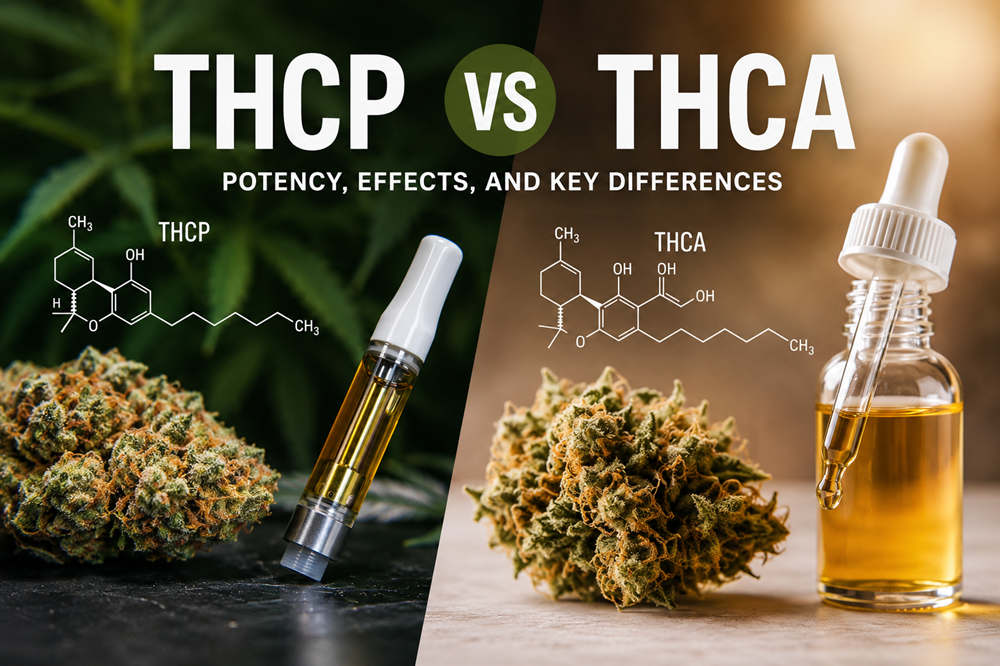
Researchers first reported the isolation and characterization of delta-9 THCP from Cannabis sativa in 2019. Like delta-9 THC, THCP has a molecular structure capable of interacting with cannabinoid receptors, but its alkyl side chain contains seven carbon atoms rather than THC’s five.
In the original THCP study published in Scientific Reports, researchers proposed that this longer chain allows THCP to interact extensively with a hydrophobic region of the CB1 receptor.
The researchers measured a CB1 binding affinity, expressed as a Ki value, of 1.2 nanomolar for THCP. They compared this with a previously reported value of about 40 nanomolar for delta-9 THC. Because lower Ki values indicate stronger receptor affinity, that comparison produced the widely repeated figure of approximately 33-fold higher CB1 affinity.
THCA Has Much Weaker CB1 Activity
THCA is the acidic precursor from which delta-9 THC can form. Its additional carboxyl group substantially changes how the molecule behaves.
A study examining THCA at human cannabinoid receptors found that THCA-A had much weaker CB1 binding than THC. The researchers also highlighted an important experimental problem: THCA can degrade or convert into THC, meaning even small amounts of THC contamination can make THCA appear more active at CB1 than it actually is.
This weak direct activity helps explain why consuming unchanged THCA is different from consuming THC or a strongly CB1-active cannabinoid such as THCP.
Is THCP Really 33 Times Stronger Than THC?
The phrase “33 times stronger” needs qualification.
The original THCP research showed approximately 33-fold greater CB1 binding affinity in the comparison used by the authors. Binding affinity describes how strongly a compound associates with a receptor. It does not directly measure how intoxicated a person becomes.
That means the research does not establish that:
- 1 milligram of THCP equals 33 milligrams of THC;
- THCP produces exactly 33 times more intoxication;
- its effects last 33 times longer; or
- everyone responds to THCP in the same way.
There is also a difference between affinity and functional potency. Affinity concerns receptor binding, while functional assays examine how effectively a compound activates signaling after binding.
A 2024 study of hemp-derived and semisynthetic cannabinoids found that THCP was among the THC homologs showing greater potential for CB1 activation than delta-9 THC on measures of potency, efficacy, or both. That supports the view that THCP is pharmacologically potent, but it still does not establish an exact human intoxication ratio.
A 2026 analysis further showed that reported CB1 functional potency can change depending on factors such as the assay type, readout, and biological system used. Receptor-affinity measurements were more consistent, while potency estimates were more dependent on experimental conditions.
For readers, the practical takeaway is straightforward: THCP appears substantially more active at CB1 than ordinary THC in laboratory research, but “33 times stronger” should not be used as a human dosing or intoxication formula.
What Happens When THCA Is Heated?
THCA does not necessarily remain THCA once substantial heat is applied.
Through a chemical process called decarboxylation, THCA loses a carboxyl group and is converted into delta-9 THC. This transformation is one reason cannabis chemistry distinguishes between THCA and “total THC.”
The conversion also matters analytically. 2025 research from the National Institute of Standards and Technology examined THCA decarboxylation during cannabinoid analysis and described total THC as incorporating both delta-9 THC and decarboxylated THCA.
For consumers, this chemistry explains an apparent contradiction: a product can contain large amounts of THCA even though THCA itself has little classic intoxicating activity, yet become intoxicating when it is heated because THC is formed.
THCP vs. Heated THCA: Which Is Stronger?
Once THCA has been substantially decarboxylated, comparing THCP with THCA is no longer quite accurate. The psychoactive comparison increasingly becomes THCP versus the delta-9 THC produced from THCA.
Laboratory evidence suggests THCP can bind to and activate CB1 more strongly than delta-9 THC. What researchers do not yet have is a well-established human dose-response relationship showing exactly how a given amount of THCP compares with a given amount of THC.
Variables such as route of administration, absorption, metabolism, tolerance, product composition, and individual response can all influence the eventual experience. Those uncertainties make precise statements such as “2 mg of THCP equals X mg of THC” difficult to justify from current research.
What Do We Know About THCP Safety?
THCP deserves additional caution precisely because its human evidence base is small relative to its strong laboratory activity.
The available research establishes that THCP can interact powerfully with CB1 receptors, but controlled human studies have not yet characterized its dose-response curve, typical duration, adverse-effect frequency, or safe dose range with the confidence available for better-studied substances.
There is also limited clinical evidence of serious reactions. A 2025 case report described an adult who developed prolonged psychotic symptoms and severe self-harm after consuming a product reported to contain 8 mg of delta-9 THCP. The person had previously used conventional THC products without psychotic symptoms.
That report should not be treated as proof that THCP normally causes psychosis or that a particular dose will have the same effect in another person. A single case cannot establish incidence or causation with the strength of a controlled trial. It does illustrate why experience with conventional THC does not necessarily predict how someone will respond to a less-studied, highly active cannabinoid.
Another practical limitation is that pharmacology studies generally evaluate defined cannabinoid compounds under controlled laboratory conditions. Commercial cannabinoid products can introduce additional variables, including cannabinoid concentration, formulation, accompanying cannabinoids, and dose accuracy. Laboratory potency figures therefore should not be treated as guarantees of how a particular retail product will feel.
The Bottom Line
THCP has much stronger CB1 receptor activity and greater psychoactive potential than raw THCA. Unheated THCA interacts only weakly with CB1 and generally does not produce the classic THC high.
Heat changes the comparison because THCA can decarboxylate into delta-9 THC. A smoked or vaped THCA-rich product can therefore become intoxicating largely because THC is formed, not because unchanged THCA suddenly behaves like THCP.
THCP also appears more pharmacologically potent than delta-9 THC in laboratory research. However, the popular claim that THCP is “33 times stronger” refers to a receptor-affinity comparison and should not be interpreted as evidence that it produces exactly 33 times the high.
The most accurate answer is therefore: THCP is clearly stronger than raw THCA from a CB1 and psychoactive perspective, but science has not established a simple human potency multiplier for THCP versus THC.