THCA vs. CBD: Effects, Benefits, Drug Tests, and Legal Differences
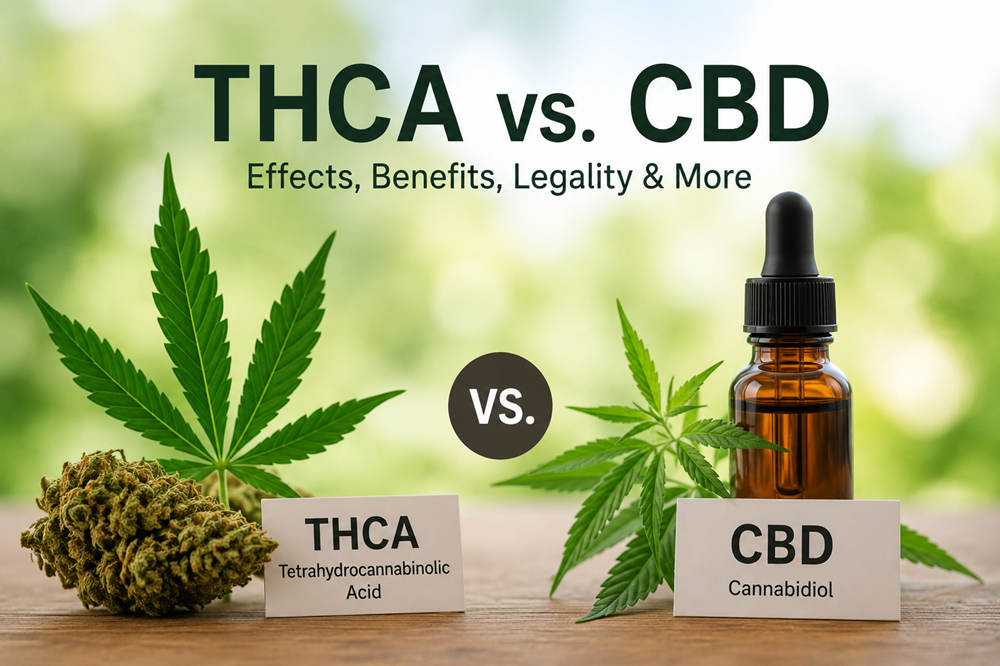
THCA and CBD are both naturally occurring cannabis cannabinoids, but they are not interchangeable. CBD does not normally cause a high. THCA itself is generally considered non-intoxicating, but when it is heated through smoking, vaping, dabbing, or cooking, much of it can convert into intoxicating delta-9 THC.
That distinction influences how THCA and CBD products affect users, what researchers know about their potential benefits, their drug-testing risks, and how they are regulated. CBD also has substantially more human clinical research behind it, while evidence for THCA remains much more preliminary.
THCA vs. CBD at a Glance
| Feature | THCA | CBD |
|---|---|---|
| Full name | Tetrahydrocannabinolic acid | Cannabidiol |
| Occurs naturally in cannabis? | Yes | Yes |
| Intoxicating in its original form? | Generally no | No |
| Effect of heating | Can convert into delta-9 THC | Does not normally convert into THC through heating |
| Common products | Flower, concentrates, extracts, some tinctures | Oils, gummies, capsules, flower, topicals, extracts |
| Human research | Limited | Much more extensive |
| Drug-test concern | Significant, especially when heated | Possible if the product contains THC |
What Is THCA?
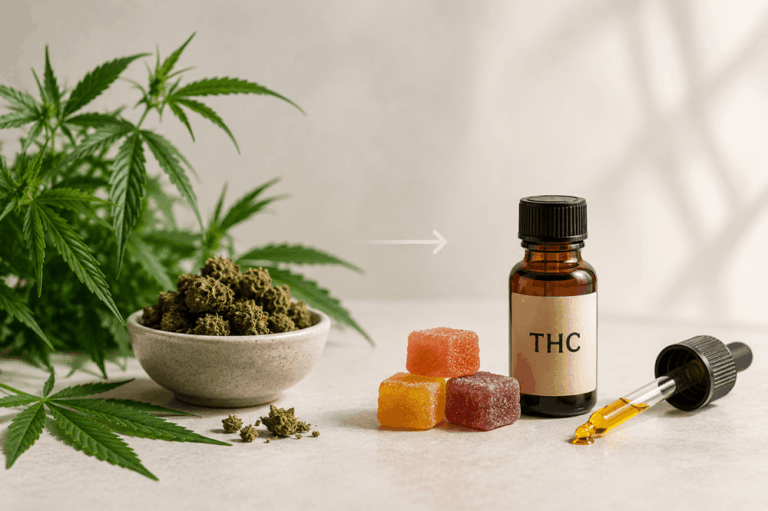
THCA, short for tetrahydrocannabinolic acid, is an acidic cannabinoid produced naturally by the cannabis plant. It is a chemical precursor to delta-9 THC, meaning that its molecular structure can change into THC under the right conditions.
That process is known as decarboxylation. Heat removes part of the THCA molecule and forms delta-9 THC. This is why freshly harvested cannabis can contain a high concentration of THCA while containing considerably less delta-9 THC before it is heated.
The distinction also matters when cannabis is tested. The USDA’s hemp testing guidelines require methods that account for the potential conversion of THCA into THC when calculating total THC.
THCA itself is generally regarded as non-intoxicating because it does not interact with cannabinoid receptors in the same way as delta-9 THC. The important practical question, therefore, is not only how much THCA a product contains but also how it will be consumed.
What Is CBD?
CBD, or cannabidiol, is another major cannabinoid found in cannabis. The CDC describes CBD as non-impairing, meaning CBD itself does not cause the characteristic high associated with THC.
CBD is not the direct acidic counterpart to THCA. Cannabis plants initially produce much of their cannabidiol-related content as CBDA, or cannabidiolic acid. Heating CBDA can convert it into CBD, just as heating THCA can convert it into THC.
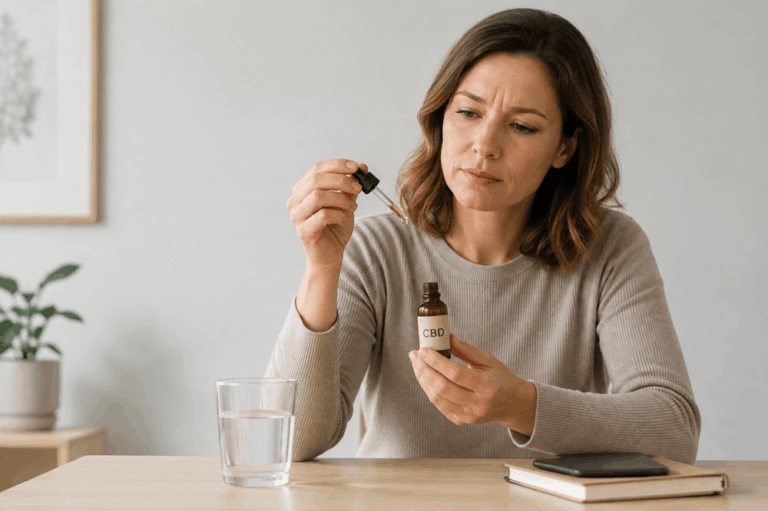
Commercial CBD comes in many forms, including oils, gummies, capsules, creams and flower. Some products contain mostly isolated CBD, while others retain additional cannabinoids and plant compounds. This difference becomes particularly important for people who need to minimize THC exposure.
THCA vs. CBD Effects: Will Either Get You High?
CBD does not normally produce THC-like intoxication. A properly manufactured CBD product containing negligible THC therefore should not produce the euphoria, altered perception, or substantial impairment associated with marijuana.
THCA requires more context. Consuming THCA without substantial heating is different from smoking or vaping a THCA-rich product. The CDC notes that heating THCA converts it into THC, which can produce mind-altering effects.
This is especially important with THCA flower. Although a package may emphasize its THCA percentage rather than its delta-9 THC percentage, smoking that flower creates THC during use. Someone trying to avoid intoxication should therefore not treat smokable THCA flower as equivalent to a low-THC CBD product.
Individual effects can still vary. Cannabinoid concentration, dose, route of administration, tolerance, other substances used at the same time, and individual sensitivity can all influence the experience.
Potential Benefits and What Research Actually Shows
CBD has stronger human evidence
CBD is the better studied of the two cannabinoids in people. The clearest medical evidence involves purified prescription cannabidiol rather than ordinary retail CBD products.
Epidiolex is an FDA-approved prescription cannabidiol medicine used for seizures associated with Lennox-Gastaut syndrome, Dravet syndrome, and tuberous sclerosis complex in patients one year of age and older. Its current indications and safety information are available through the DailyMed Epidiolex label.
That approval does not mean over-the-counter CBD oils or gummies have been proven to treat epilepsy or other medical conditions. Prescription cannabidiol has controlled manufacturing, standardized dosing, clinical evidence, and medical supervision that consumer CBD products do not necessarily have.
Researchers have also studied CBD in areas such as anxiety, pain, sleep, and substance-use disorders. Results vary by condition, dose, formulation, and study design, so broad claims that CBD reliably treats these problems go beyond the available evidence.
Evidence for THCA is much earlier
THCA has shown biological activity in laboratory and animal research, which has led to interest in areas such as inflammation, nausea, and neurological conditions. Human clinical evidence, however, remains limited.
Laboratory findings cannot establish that THCA is an effective treatment in people. There is currently no THCA medicine with an FDA approval comparable to prescription cannabidiol, so claims that THCA has established therapeutic benefits should be treated cautiously.
For both cannabinoids, the useful question is not how many potential benefits appear in marketing material but how strong the evidence is for a particular use.
Side Effects and Safety
The safety profile of a THCA product depends heavily on whether it results in THC exposure. Once THCA is converted into delta-9 THC, users can experience impairment, altered judgment, slowed reaction time, anxiety, dizziness, or other THC-related effects. Driving or operating machinery while impaired is unsafe.
CBD avoids typical THC intoxication but is not free of risk. The FDA identifies potential CBD concerns that include liver effects, medication interactions, and changes in alertness. Prescription cannabidiol labeling also includes warnings about hepatic injury and somnolence or sedation.
Drug interactions deserve particular attention because CBD can alter how the body processes certain medications. People who take prescription drugs, especially medicines with narrow dosing ranges or known liver interactions, should discuss CBD use with a qualified healthcare professional.
Product quality can create additional risk with either cannabinoid. The cannabinoid concentration on a label may not always perfectly reflect the contents, and poorly controlled products can contain unwanted THC or contaminants. Pregnancy and breastfeeding also warrant particular caution with cannabis-derived products.
Will THCA or CBD Show Up on a Drug Test?
THCA products should not be considered drug-test safe, particularly when they are smoked, vaped, or otherwise heated. Once THCA becomes delta-9 THC and is processed by the body, THC metabolites can be produced and detected by commonly used testing methods.
Pure CBD is different because workplace marijuana tests are not generally designed to detect CBD itself. The risk comes from THC that may be present in a CBD product.
A SAMHSA advisory on CBD warns that products marketed as CBD can contain delta-9 THC, including products consumers may believe to be THC-free. SAMHSA’s federal workplace guidance also distinguishes THC testing from CBD itself.
Full-spectrum CBD products intentionally retain additional cannabis compounds and may contain some THC. Manufacturing or labeling problems can create additional uncertainty. Anyone whose employment, athletic participation, legal status, or other obligations depend on a negative drug test should not assume that a retail cannabinoid product is risk-free.
Is THCA or CBD Legal?
Legal status is more complicated than whether a package says “hemp.” Federal hemp law, FDA rules, and state laws can apply to the same product, and the federal framework for hemp-derived cannabinoids is undergoing a significant change in 2026.
Federal hemp law and THCA
Public Law 119-37, enacted November 12, 2025, contains changes to the federal definition of hemp that are scheduled to take effect 365 days after enactment. The new definition uses a limit of no more than 0.3% total tetrahydrocannabinols, including THCA, on a dry-weight basis.
The enacted law also creates new exclusions for certain hemp-derived cannabinoid products. For final hemp-derived cannabinoid products, one provision addresses products containing more than 0.4 milligrams combined per container of total tetrahydrocannabinols, including THCA, plus other cannabinoids determined or marketed to have similar THC-like effects. The full statutory language is available in Public Law 119-37.
Current legislative note, August 10, 2026: The Senate passed an amended version of H.R. 6500 on August 8, 2026. That Senate language would temporarily limit the application of most Section 781 hemp changes until December 11, 2026. However, the Senate amendment has not yet completed the legislative process and is not itself enacted law. Because this situation is moving quickly, readers should verify the current federal status before relying on a legal conclusion.
CBD has an additional FDA issue
Qualifying as hemp under federal agricultural or controlled-substance law does not automatically make every CBD product lawful for every use. The 2018 Farm Bill preserved FDA authority over cannabis-derived products.
The FDA’s current CBD guidance states that CBD cannot currently be marketed as a dietary supplement under the existing federal framework and generally cannot be added to conventional food introduced into interstate commerce. Other product categories can be subject to different requirements.
States may impose restrictions that differ from federal rules for THCA, CBD, hemp-derived cannabinoids, age limits, product formats, testing, and retail sales. Anyone buying or carrying these products should therefore check current state law as well as federal rules.
THCA Flower vs. CBD Flower
THCA flower and CBD flower can be difficult to distinguish by appearance alone. Both come from Cannabis sativa plants, and either may have visible trichomes, strong aromas, and terpene profiles commonly associated with cannabis.
The meaningful difference is their cannabinoid composition. CBD-dominant flower generally contains much more CBD or CBDA and relatively little potential THC. THCA flower contains substantially more THCA and is intended to deliver much greater THC exposure when smoked.
For that reason, appearance, strain names, or the word “hemp” on a package do not tell a consumer how intoxicating a flower may become. Its cannabinoid analysis is much more informative.
How to Read THCA and CBD Product Labels
A useful product label should be supported by a recent, batch-specific certificate of analysis, often abbreviated as COA. The laboratory report can help show whether the cannabinoid profile matches the claims made on the package.
- THCA: Shows the amount of acidic THC precursor present before additional heating.
- Delta-9 THC: Shows THC already present in the tested sample.
- Total THC: Accounts for potential THC associated with THCA as well as existing THC.
- CBD and CBDA: Show the main cannabidiol-related cannabinoids.
- Contaminant results: Depending on the product and laboratory, a COA may include testing for pesticides, heavy metals, microbes, or residual solvents.
CBD packaging may also describe products as isolate, broad-spectrum, or full-spectrum. Isolate is intended to contain primarily CBD, while broader extracts retain additional cannabis compounds. Because terminology and manufacturing practices can vary, the actual laboratory results are more useful than relying on those marketing terms alone.
Frequently Asked Questions About THCA and CBD
Can CBD and THCA be used together?
A product can contain both CBD and THCA, but combining cannabinoids does not guarantee a particular result. Their effects can vary with concentration, dose, route of administration, other cannabinoids present, and whether the THCA is heated.
Does CBD cancel out THC produced from THCA?
No. CBD should not be treated as a reliable way to cancel THC intoxication. Cannabinoid interactions depend on dose and route of administration. In controlled research involving oral THC and high-dose CBD, CBD slowed THC metabolism and increased THC exposure and some drug effects rather than simply reducing them.
Are CBD products automatically THC-free?
No. Full-spectrum products can intentionally contain THC, while manufacturing or labeling problems can introduce unexpected amounts. Consumers who need to minimize THC exposure should check a recent laboratory report rather than relying solely on a “CBD,” “hemp,” or “THC-free” statement.
The Bottom Line on THCA vs. CBD
CBD and THCA start as different cannabinoids and have different practical implications. CBD itself does not normally cause a high, while THCA can become intoxicating delta-9 THC when sufficient heat is applied. CBD also has a considerably stronger human research base, although that evidence does not validate every health claim made for consumer CBD products.
The most reliable way to evaluate either product is to consider its complete cannabinoid profile, how it will be consumed, medication and drug-testing concerns, and current federal and state law. With major federal hemp provisions still developing in 2026, legal claims on cannabinoid packaging should never substitute for up-to-date rules.