Flowers That Start With O: Twenty-Five Beautiful Blooms for Gardens and Bouquets
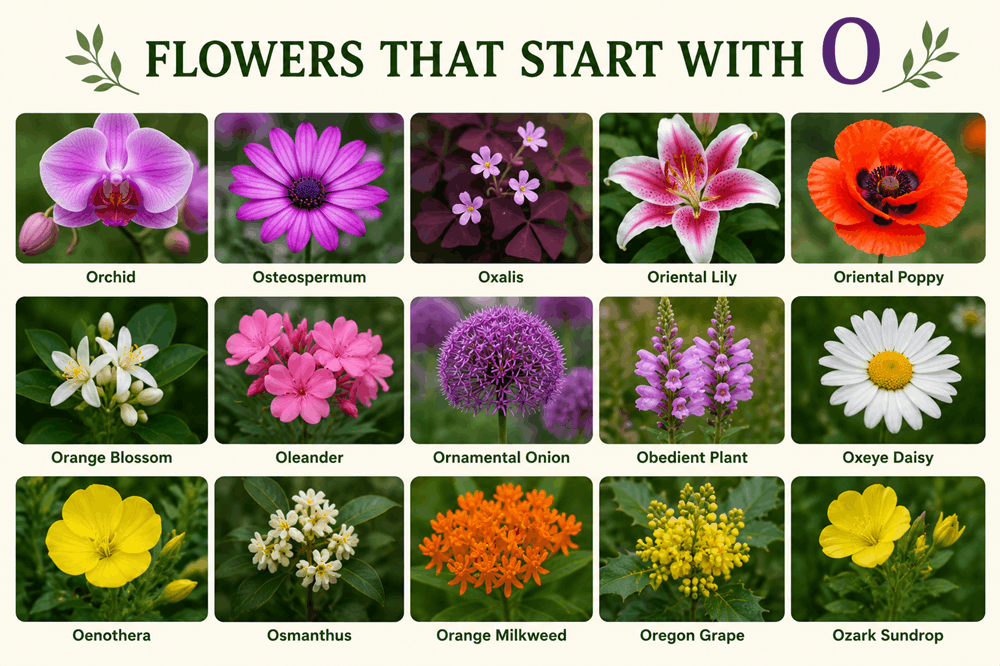
Flowers that start with O include orchids, oleanders, osteospermums, oxalis, Oriental lilies, ornamental onions, orange blossoms, and many other attractive plants. Some are tropical houseplants, while others grow as bulbs, perennials, shrubs, herbs, or wildflowers. This guide introduces 25 flowers beginning with O, along with their appearance, growing habits, symbolism, and practical uses in gardens, containers, pollinator plantings, and floral arrangements.
1. Orchid
Orchids are among the most diverse flowering plants in the world. Their flowers range from tiny, delicate blooms to large, dramatic blossoms with highly unusual shapes.
Colors include white, yellow, pink, purple, orange, red, green, and countless patterned combinations.
Popular household orchids include Phalaenopsis, Dendrobium, Cattleya, and Oncidium. Their care requirements vary, but many prefer bright indirect light, good airflow, and a loose growing medium that drains quickly.
Orchids commonly symbolize beauty, refinement, love, strength, and luxury.
2. Osteospermum
Osteospermum is commonly called African daisy. It produces colorful daisy-like flowers with distinctive central disks.
Blooms may be white, purple, pink, yellow, orange, lavender, or bicolored. Some varieties have spoon-shaped petals or dark blue-purple centers.
Osteospermum prefers full sun and well-drained soil. It flowers best during mild weather and may slow down during extreme heat.
In cooler climates, it is usually grown as an annual, while mild regions may treat it as a short-lived perennial.
3. Oxalis
Oxalis includes many plants with clover-like foliage and small five-petaled flowers.
Flowers may be white, pink, yellow, lavender, or purple. Some varieties are grown mainly for their colorful leaves, which can be deep purple, green, silver-marked, or patterned.
Oxalis grows well in containers, rock gardens, and indoor pots depending on the species.
Many varieties naturally enter dormancy for part of the year, causing the foliage to disappear before fresh growth returns later.
4. Oriental Lily
Oriental lilies produce large, dramatic flowers with a strong fragrance. Popular colors include white, pink, crimson, and combinations with contrasting spots or stripes.
They grow from bulbs and generally flower during summer.
Oriental lilies prefer full sun or light shade and rich, well-drained soil. Their strong perfume makes them popular in bouquets and fragrance gardens.
True lilies are extremely toxic to cats. Even small amounts of pollen, leaves, petals, or vase water can cause life-threatening kidney failure.
5. Oriental Poppy
Oriental poppies produce enormous papery flowers on tall stems during late spring or early summer.
The classic color is vivid red-orange with dark centers, but cultivated varieties also appear in pink, salmon, white, burgundy, and purple-toned shades.
Oriental poppies prefer full sun and well-drained soil. Their foliage may die back after flowering, particularly during hot summer weather.
Plant them among later-emerging perennials that can fill the space once the poppies become dormant.
6. Orange Blossom
Orange blossom refers to the fragrant white flowers produced by orange trees.
Despite the fruit’s bright color, the flowers themselves are usually white and intensely scented. They appear before developing into oranges later in the season.
Orange blossoms have long been associated with weddings and traditionally symbolize purity, good fortune, fertility, and happiness.
The flowers are also important in perfumery, where orange blossom and neroli materials contribute fresh, sweet, citrus-floral scents.
7. Oleander
Oleander is an evergreen flowering shrub with clusters of pink, red, white, peach, yellow, or salmon-colored flowers.
It thrives in hot climates and tolerates drought once established, making it common in Mediterranean-style landscapes and warm roadside plantings.
Oleander prefers full sun and well-drained soil and can flower for a long period in warm weather.
Every part of oleander is highly poisonous if eaten. The plant should be handled carefully and kept away from children, pets, and livestock.
8. Ornamental Onion
Ornamental onions, commonly known as alliums, produce spherical flower heads made from dozens or hundreds of tiny blooms.
Purple and lavender are the most familiar colors, although varieties may also bloom in white, pink, yellow, or burgundy.
Most ornamental onions grow from bulbs planted in fall and flower in late spring or early summer.
They prefer full sun and well-drained soil and are highly attractive to bees and other pollinating insects.
9. Obedient Plant
Obedient plant produces upright spikes of tubular flowers in pink, lavender, purple, or white.
Its unusual common name comes from the way individual flowers can sometimes be gently repositioned along the stem and remain temporarily in place.
The plant prefers full sun or light shade and moderately moist soil.
It can spread strongly through underground stems, so it is best planted where a gradually expanding patch will not become a problem.
10. Oxeye Daisy
Oxeye daisy produces classic white petals surrounding a bright yellow central disk.
The flowers resemble smaller Shasta daisies and create a cheerful wildflower appearance.
Oxeye daisies tolerate ordinary soil and full sun and may spread vigorously through seed.
In some areas, the plant is considered invasive or a troublesome pasture weed. Check local guidance before deliberately introducing it into a garden.
11. Oenothera
Oenothera is the botanical genus that includes evening primroses and sundrops.
Many species produce yellow, pink, white, or pale flowers that open during the evening or remain open through part of the day.
The flowers can attract moths and other nighttime pollinators.
Most evening primroses prefer sunny locations and well-drained soil, although exact requirements differ between species.
12. Oncidium Orchid
Oncidium orchids are often called dancing lady orchids because their small flowers can resemble figures wearing flowing skirts.
Yellow with brown or burgundy markings is the classic color combination, although varieties may also appear in pink, red, white, or orange.
Oncidiums generally prefer bright filtered light, good airflow, and an orchid-growing medium that drains quickly.
Mature plants can produce long branching sprays covered with dozens of flowers, creating an impressive indoor display.
13. Osmanthus
Osmanthus is an evergreen shrub or small tree that produces tiny but strongly fragrant flowers.
The blooms may be white, cream, or pale yellow and can be surprisingly powerful despite their small size.
Some varieties have a fragrance compared with apricot, peach, tea, or jasmine.
Osmanthus grows well in mild climates and is useful as a hedge, screening plant, or fragrant specimen near patios and entrances.
14. Orlaya
Orlaya produces delicate white flower clusters with an airy appearance similar to Queen Anne’s lace.
Each flower head contains larger outer petals surrounding smaller central blooms, creating a lace-like effect.
The plant is commonly grown as an annual and prefers full sun with well-drained soil.
Orlaya is especially popular in cottage gardens and cut-flower arrangements because it adds softness without overwhelming larger focal blooms.
15. Ornamental Oregano
Ornamental oregano is grown primarily for its decorative flowers and bracts rather than culinary use.
The plant may produce cascading clusters in pink, purple, green, cream, or silvery shades.
Many varieties have aromatic foliage and perform well in sunny, dry locations.
Ornamental oregano is particularly effective in containers, rock gardens, and hanging baskets where the flowering stems can spill over an edge.
16. Oswego Tea
Oswego tea is another common name for bee balm, or Monarda.
The plant produces dramatic clusters of tubular flowers in red, pink, purple, lavender, or white.
Its aromatic foliage and nectar-rich blooms make it valuable in pollinator gardens. Bees, butterflies, and hummingbirds frequently visit the flowers.
Oswego tea prefers sun or light shade and moderately moist soil. Good airflow helps reduce powdery mildew.
17. Oxlip
Oxlip is a primrose relative with clusters of pale yellow nodding flowers held above crinkled green leaves.
It prefers cool woodland conditions, partial shade, and moist, rich soil.
Oxlip works naturally in woodland gardens, shaded lawns, and informal spring plantings.
The soft yellow flowers appear early in the growing season and combine well with bluebells, violets, and other spring woodland flowers.
18. Oregon Grape
Oregon grape is an evergreen shrub with bright yellow flower clusters that appear in late winter or spring.
The flowers are followed by blue-purple berries and are surrounded by glossy, holly-like foliage.
Oregon grape tolerates partial shade and works well in woodland-style gardens and native landscapes.
Its early flowers can provide a valuable food source for pollinating insects when relatively few other plants are blooming.
19. Orange Milkweed
Orange milkweed, commonly called butterfly weed, produces bright clusters of orange flowers during summer.
The plant is strongly associated with butterfly gardens because milkweeds serve as host plants for monarch caterpillars.
Orange milkweed prefers full sun and well-drained soil and becomes highly drought tolerant once established.
It develops a deep root system and does not appreciate frequent transplanting.
20. Orange Coneflower
Orange coneflower produces golden-yellow to orange daisy-like flowers with dark central cones.
It belongs to the Rudbeckia group and creates strong summer color in perennial borders and naturalistic gardens.
The plant prefers full sun and tolerates ordinary garden soil once established.
Its open flowers attract bees and butterflies, while seed heads may provide food for birds later in the season.
21. Orange Hawkweed
Orange hawkweed produces vivid orange-red flowers resembling small dandelions.
The color is striking, but the plant can spread aggressively through both seed and underground runners.
In several regions, orange hawkweed is considered invasive and should not be deliberately planted.
Gardeners who like its bright color can choose non-invasive alternatives such as orange coneflowers, blanket flowers, or butterfly weed.
22. Orange Jasmine
Orange jasmine, sometimes called mock orange jasmine, is a tropical or subtropical shrub with small white fragrant flowers.
Despite its name, the flowers are not orange. The name refers to its association with citrus-like fragrance and orange-family relatives.
The plant develops glossy evergreen foliage and may produce small decorative fruits after flowering.
Orange jasmine prefers warmth, bright light, and well-drained soil and can be grown as a hedge or container specimen.
23. Oyster Plant
Oyster plant is commonly grown for its sword-shaped green and purple foliage, but it also produces small white flowers tucked between boat-shaped purple bracts.
The flowers are subtle compared with the colorful leaves, making this plant more of a foliage feature than a floral focal point.
Oyster plant prefers warm conditions and bright indirect light or partial sun.
It can grow outdoors in frost-free climates or indoors as a container plant in colder regions.
24. Olympic Mullein
Olympic mullein produces tall branching flower spikes covered with numerous bright yellow blooms.
The plant can become several feet tall and creates a dramatic vertical accent in sunny, dry gardens.
Its woolly gray-green foliage forms a substantial rosette before the flowering stems appear.
Olympic mullein prefers full sun and excellent drainage and works particularly well in gravel gardens and naturalistic landscapes.
25. Ozark Sundrop
Ozark sundrop is a low-growing evening primrose relative with large bright yellow flowers.
The blooms can appear disproportionately large compared with the compact plant, creating a bold display near ground level.
Ozark sundrop prefers full sun and well-drained soil and is well suited to rock gardens, slopes, border edges, and dry landscapes.
Its sprawling growth habit allows the flowers to spill naturally over stones and retaining walls.
Which O Flowers Are Best for Containers?
Orchids, osteospermum, oxalis, ornamental oregano, orange jasmine, and compact ornamental onions can all grow successfully in containers.
Orchids need specialized growing media rather than ordinary potting soil, while ornamental oregano and osteospermum prefer excellent drainage and plenty of sunlight.
Oxalis works particularly well in small indoor or patio pots because its foliage can be as attractive as its flowers.
Which O Flowers Attract Hummingbirds?
Oswego tea, orange milkweed, some Oenothera species, and nectar-rich tubular flowers can help attract hummingbirds or other pollinators depending on the region.
Bee balm is especially useful because its tubular flowers provide accessible nectar and can bloom heavily during summer.
A successful hummingbird garden should contain several flowering plants with overlapping bloom periods rather than relying on one species alone.
Which O Flowers Attract Bees and Butterflies?
Ornamental onions, orange milkweed, orange coneflowers, Oenothera, Oswego tea, and Oregon grape can all provide resources for pollinating insects.
Orange milkweed is especially important in butterfly gardens because it serves both as a nectar source and as a host plant for monarch caterpillars.
Ornamental onions can attract large numbers of bees when their spherical flower heads are fully open.
Which O Flowers Work Well in Bouquets?
Orchids, Oriental lilies, Oriental poppies, ornamental onions, Orlaya, and ornamental oregano can all contribute to floral arrangements.
Orchids provide an elegant, sculptural look, while Orlaya adds light filler. Ornamental onions create strong geometric shapes, and Oriental lilies provide large fragrant focal flowers.
Oriental poppies are beautiful but delicate as cut flowers and require careful handling.
Never bring true lilies into a home with cats because even pollen or vase water can be dangerous.
Which O Flowers Are Best for Shade?
Oxlip, Oregon grape, oxalis, and some orchids are among the better O flowers for partial shade.
Oxlip works particularly well in woodland gardens with cool, moist soil, while Oregon grape can tolerate shade beneath trees and shrubs.
Osteospermum, ornamental onion, orange milkweed, and Ozark sundrop generally flower better in bright sunlight.
Which O Flowers Are Best for Dry Gardens?
Oleander, ornamental oregano, orange milkweed, Olympic mullein, osteospermum, and Ozark sundrop can tolerate dry conditions once established.
Most still need regular watering while young. Drought tolerance improves after plants have developed mature root systems.
Excellent drainage is especially important because a drought-tolerant plant can still fail when its roots remain waterlogged.
Which O Flowers Prefer Moist Soil?
Oxlip, some Oenothera species, and certain woodland oxalis varieties appreciate more consistent moisture.
Oxlip is especially suitable for cool, damp woodland conditions.
Moist soil does not always mean permanently saturated ground, so match the exact species to the site rather than assuming all members of a plant group have identical needs.
Which O Flowers Are Fragrant?
Several flowers beginning with O are known for strong fragrance.
Orange blossom is one of the most famous, with a sweet citrus-floral scent used widely in perfumery. Osmanthus produces tiny flowers with an apricot-like perfume, while Oriental lilies can fill a garden or room with fragrance.
Orange jasmine is another aromatic choice for warm climates, and some orchids have surprisingly strong scents.
If fragrance is important, plant these flowers near patios, entrances, pathways, or open windows where their scent can be appreciated.
Which O Flowers Need Extra Caution?
Oleander is highly toxic, while Oriental lilies are extremely dangerous to cats.
Orange hawkweed presents a different problem because it can become invasive in some regions. Oxeye daisy may also spread aggressively and is considered undesirable in certain areas.
Common names can create confusion as well. Orange jasmine does not have orange flowers, and ornamental onion includes many different Allium species.
When toxicity, invasiveness, or pet safety matters, identify the exact botanical species before adding it to the garden.
The Bottom Line
Flowers that start with O include familiar choices such as orchids, osteospermum, oxalis, Oriental lilies, orange blossoms, oleander, and ornamental onions. The group also contains less familiar plants such as Orlaya, oxlip, Olympic mullein, Ozark sundrop, and ornamental oregano.
There are O flowers for many different garden settings. Osteospermum and orange milkweed thrive in sunny beds, oxlip prefers woodland shade, orchids make beautiful indoor plants, and ornamental onions bring bold architectural shape to spring and early-summer borders.
When choosing an O flower, consider sunlight, soil, moisture, mature size, climate, toxicity, and whether the plant can spread aggressively. Matching each flower to the right environment will produce healthier growth, stronger blooming, and a garden with greater color, fragrance, and variety throughout the season.