The Grass Withers and the Flowers Fade: Meaning, Context, and Lasting Hope
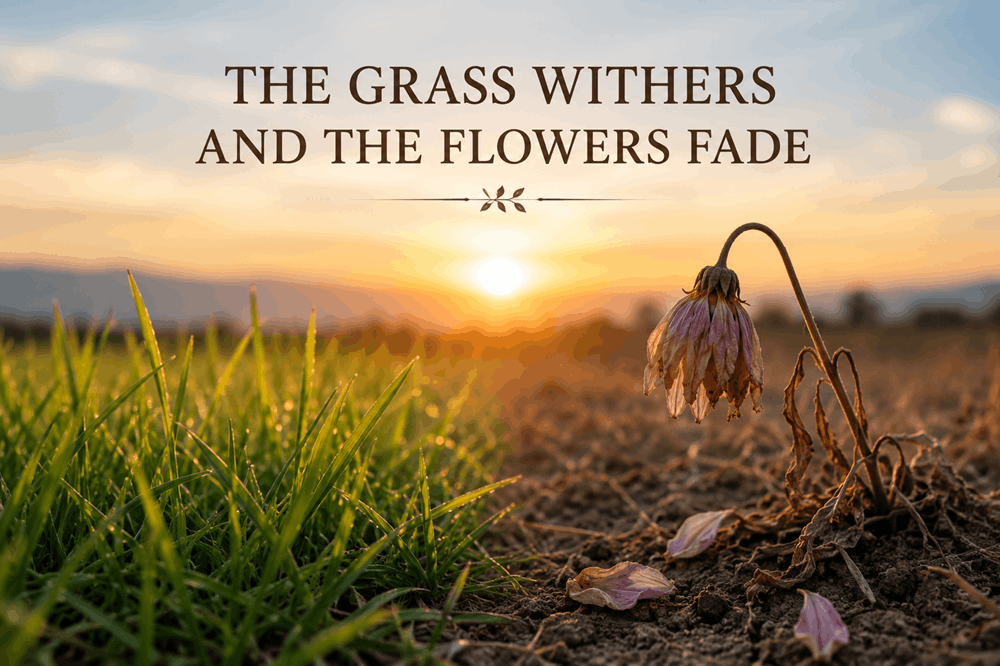
“The grass withers and the flowers fade” is a biblical phrase from Isaiah 40 that uses something familiar in nature to describe a much larger truth: human life, beauty, strength, success, and circumstances are temporary, but God’s word endures. The image is simple because everyone understands it. Green grass eventually dries, beautiful flowers eventually lose their petals, and seasons move on. The passage turns that ordinary observation into a reminder about what remains dependable when everything else changes.
Where Does “The Grass Withers and the Flowers Fade” Come From?
The phrase comes from Isaiah 40:8. Different Bible translations use slightly different wording, but the central message remains the same: grass withers, flowers fade, and the word of God stands forever.
The verse belongs to a larger passage that contrasts human frailty with the permanence and faithfulness of God.
That context matters because Isaiah is not simply making a poetic observation about plants. Grass and flowers become pictures of human existence. They can look strong, beautiful, and full of life for a season, but none of them remain unchanged forever.
God’s word is presented as the opposite. It does not depend on a season, appearance, political situation, human strength, or temporary circumstance.
What Does the Grass Represent?
Grass represents the temporary nature of human life.
Grass can cover an entire landscape and appear strong and permanent. Yet intense heat or a change of season can quickly turn green fields brown.
Human life can feel similar.
You can become accustomed to a particular season of life and assume it will continue indefinitely. Work feels secure. Relationships seem stable. Children are young. Parents are healthy. Your body feels strong. A familiar home seems permanent.
Then circumstances change.
The grass image is a reminder that change is not unusual. It is built into human existence.
This does not mean life is meaningless. Grass can still be beautiful even though it does not stay green forever. Instead, the comparison encourages humility about the things people often treat as permanent.
What Do the Fading Flowers Represent?
Flowers add another layer to the image because they represent beauty, achievement, recognition, youth, and the things people admire.
A flower can be spectacular at full bloom. Its color attracts attention, and its fragrance fills the air. Yet that moment does not last indefinitely.
The same is true of many things people spend enormous amounts of energy pursuing.
Appearance changes. Popularity changes. Careers rise and fall. possessions wear out. Trends disappear. Awards eventually gather dust. Even memories that once seemed unforgettable can become less vivid with time.
The fading flower does not say these things have no value. It simply puts their value into perspective.
Something can be beautiful without being permanent.
The Verse Is Really About Permanence
The strongest contrast in the passage is not between good things and bad things. It is between temporary things and something lasting.
Grass is temporary.
Flowers are temporary.
Human strength is temporary.
Human praise is temporary.
God’s word, according to the passage, is not.
That contrast changes how the verse should be understood. It is not primarily a gloomy statement about death or decline. It is meant to point beyond temporary circumstances toward something dependable.
When everything around you seems capable of changing, the verse asks you to consider what you are building your confidence upon.
Why Does Isaiah Use Flowers and Grass?
The imagery works because it requires almost no explanation.
People living in the ancient world understood how quickly vegetation could change under harsh conditions. A landscape that looked green and alive could become dry surprisingly quickly.
The same picture still makes sense today.
You can buy a bouquet at its peak, place it in a vase, and watch it gradually change over the following days. Petals soften. Leaves droop. Colors fade. Eventually, the flowers that once looked perfect have to be removed.
That cycle makes flowers powerful symbols of impermanence.
Isaiah takes something visible and uses it to explain something invisible: the difference between what lasts for a season and what can be trusted beyond the season.
“The Grass Withers and the Flowers Fade” Is Not Anti-Beauty
It is easy to misunderstand the verse as saying beauty does not matter because it eventually disappears.
That is not the point.
A flower does not become worthless simply because it fades. Its temporary nature can actually make you appreciate it more closely.
You notice spring blossoms because they do not remain all year. You value time with someone because you know the moment cannot be repeated exactly. You appreciate childhood because children grow. You treasure certain seasons precisely because they pass.
The biblical image can therefore encourage appreciation rather than detachment.
You can enjoy temporary gifts without expecting them to provide permanent security.
A Reminder About Human Pride
The passage also challenges human pride.
People naturally want to believe that their accomplishments will make them permanent in some way. A successful career, wealth, reputation, physical beauty, influence, or social position can begin to feel like proof of lasting importance.
But every generation eventually discovers that these things change.
Someone who once dominated public attention can become almost forgotten. A company considered unstoppable can disappear. Buildings can be demolished. Technologies become obsolete. Fashion changes. Physical strength declines.
The image of grass and flowers places human greatness inside a larger perspective.
You can accomplish meaningful things while still recognizing that you are not permanent.
The Phrase Can Be Comforting During Change
At first, a verse about withering and fading may not sound comforting. Yet its message can become especially meaningful during uncertain seasons.
When something good disappears, you may feel as though everything dependable has disappeared with it.
The passage says otherwise.
A job can change without everything being lost. A relationship can end without your entire future ending. A season of health can change without meaning disappearing from life. A home can be left behind without every source of security being left behind with it.
The verse acknowledges that temporary things really do fade. It does not pretend otherwise.
Its comfort comes from insisting that temporary things are not the only things that exist.
What the Verse Means During Grief
The image can take on deeper meaning during grief because loss makes impermanence impossible to ignore.
Ordinary life often allows you to forget how quickly circumstances can change. Grief interrupts that illusion.
Someone who was present is suddenly absent. A familiar routine changes. Places, songs, objects, and photographs carry a different emotional weight.
In that setting, “the grass withers and the flowers fade” can sound painfully accurate.
But the verse does not end with fading.
Its movement is toward permanence and hope. The temporary character of human life is placed beside the enduring character of God.
For a believer, that distinction can provide a foundation when emotions and circumstances feel unstable.
The New Testament Repeats the Image
The same image appears again in the New Testament in 1 Peter 1. Peter uses grass and flowers to describe human life and glory before emphasizing the enduring word of the Lord.
This repetition shows that the imagery was not limited to one historical situation in Isaiah.
Early Christians also understood it as a broader description of human life.
Generations change, circumstances change, and human achievements pass, but the truth they trusted was understood as enduring beyond them.
What Does “The Word of God Stands Forever” Mean?
This part of the passage provides the answer to the fading imagery.
To say that God’s word stands forever means that it is not made unreliable by changing circumstances.
Human promises can fail because human beings change, forget, become unable to act, or die. Human opinions can shift with culture and circumstance.
The biblical claim is that God is not limited in the same way.
Therefore, what God declares is portrayed as more dependable than the temporary things people usually use for security.
The verse invites trust in what lasts rather than absolute dependence on what obviously cannot.
How the Verse Changes the Way You Look at Success
Success is not condemned by the image of fading flowers. What changes is the amount of weight you place on it.
A promotion can be celebrated without becoming your entire identity.
Recognition can be enjoyed without requiring constant praise.
Money can provide comfort without becoming the measure of your worth.
Beauty can be appreciated without pretending aging will never happen.
Achievement can matter without being treated as eternal.
The verse encourages you to hold temporary successes with gratitude rather than desperation.
How the Verse Changes the Way You Look at Difficult Seasons
The temporary nature of life applies to painful circumstances too.
If beautiful flowers fade, storms also pass.
A difficult season can feel permanent when you are inside it. Anxiety, financial pressure, conflict, disappointment, loneliness, or uncertainty can make the future seem identical to the present.
Yet human circumstances are constantly changing.
The verse does not promise that every problem will disappear immediately. It does remind you that your present situation is not the ultimate measure of reality.
That perspective can create room for patience.
Why This Verse Appears on Memorials and Artwork
The phrase is often used in memorial pieces, Christian artwork, journals, wall decor, tattoos, and floral designs because its imagery is both beautiful and serious.
Flowers naturally symbolize life, beauty, memory, and mortality. Pairing them with the words from Isaiah makes the symbolism even stronger.
A fading flower can represent someone whose earthly life has ended, while the remainder of the passage points toward something enduring.
This makes the verse appropriate for situations involving remembrance without reducing it to a purely sad message.
Flowers Fade, but Their Beauty Still Matters
There is another practical lesson hidden in the imagery: temporary things can still have genuine value.
A bouquet does not need to last forever to be worth giving.
A sunset does not need to remain in the sky to be worth watching.
A conversation does not need to last hours to change someone’s day.
A season of life does not need to be permanent to become meaningful.
Recognizing impermanence does not require becoming emotionally detached. It can encourage the opposite: paying closer attention while something is still present.
A Simple Way to Apply the Verse
You can apply the message by asking two questions about the things occupying your attention.
First: Is this temporary?
Second: Am I treating it as though it were permanent?
Those questions can apply to both successes and struggles.
If something good is temporary, enjoy it without making it your entire foundation. If something painful is temporary, resist allowing it to define your entire future.
Then consider what the passage presents as enduring: God and his word.
The practical lesson is not to stop caring about life. It is to care about life while keeping temporary circumstances in proper proportion.
The Bottom Line
“The grass withers and the flowers fade” comes from Isaiah 40 and uses familiar images from nature to describe the temporary nature of human life, beauty, strength, success, and circumstances.
Grass can appear strong and then dry. Flowers can look perfect and then lose their petals. Human life contains the same pattern of growth, beauty, change, and loss.
But the passage does not end by telling you that everything fades. Its central contrast is that while human life and glory are temporary, God’s word stands forever.
That is why the verse can speak equally well to success, uncertainty, aging, grief, and change. It encourages you to appreciate beautiful things without expecting them to last forever, endure difficult seasons without assuming they define the future, and place your deepest confidence in something the passage describes as more permanent than either.