Flowers That Start With E: Twenty-Five Beautiful Blooms for Every Garden Style
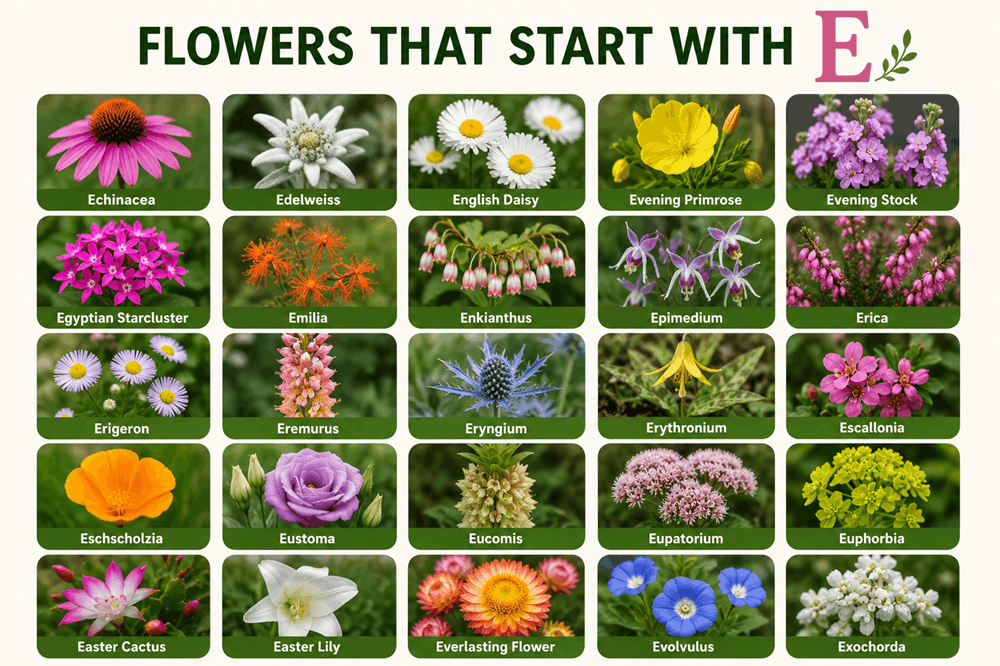
Flowers that start with E include echinacea, edelweiss, English daisies, evening primrose, eryngium, eustoma, and many other distinctive blooms. Some are familiar cottage-garden favorites, while others are unusual alpine plants, flowering shrubs, tropical annuals, or dramatic cut flowers. This guide introduces 25 flowers beginning with E, along with their appearance, growing habits, symbolism, and practical uses in gardens and bouquets.
1. Echinacea
Echinacea is better known as coneflower, a tough perennial recognized by its raised central cone and surrounding petals. Purple and pink are the classic colors, although modern varieties also bloom in white, yellow, orange, red, and green.
Echinacea thrives in sunny locations with well-drained soil and becomes reasonably drought tolerant after establishment. The flowers attract bees and butterflies, while mature seed heads can provide food for birds later in the year.
Its strong stems and long flowering season make echinacea useful in prairie gardens, cottage borders, pollinator plantings, and cut-flower beds.
2. Edelweiss
Edelweiss is a small alpine flower famous for its white, star-shaped appearance. What looks like petals is actually a group of woolly bracts surrounding tiny yellow flowers.
The plant naturally grows in mountainous environments and prefers cool conditions, bright light, and sharply drained soil. It does not enjoy the hot, humid summers found in many lowland regions.
Edelweiss commonly symbolizes courage, devotion, purity, and enduring love. Its association with high mountain landscapes has helped make it one of the most recognizable alpine flowers.
3. English Daisy
English daisies produce cheerful flowers with yellow centers surrounded by white, pink, or red petals. Many cultivated forms have fuller, almost pom-pom-like blooms.
They prefer cool weather and often flower in spring or fall. In mild climates, they may continue through winter.
English daisies work well in containers, border edges, and informal lawns. Their compact size makes them especially useful when taller flowers would overwhelm a small space.
4. Evening Primrose
Evening primrose is known for flowers that often open near sunset. Yellow is the most familiar color, although some species bloom in white, pink, or pale shades.
The flowers can attract moths and other evening pollinators. Many evening primroses tolerate sunny, dry conditions once established.
Some species spread readily through seed, so gardeners who prefer a controlled planting may want to remove developing seed capsules before they mature.
5. Evening-Scented Stock
Evening-scented stock produces modest flowers that become much more noticeable after sunset because of their strong fragrance.
The blooms are usually pale pink, lavender, purple, or white. During the day, they may look partially closed, but in the evening they release a sweet scent that works well near patios, porches, and windows.
This plant prefers cool to mild conditions and well-drained soil. It is often grown as an annual.
6. Egyptian Starcluster
Egyptian starcluster, commonly known as pentas, produces rounded clusters of small star-shaped flowers. Colors include red, pink, purple, lavender, and white.
The plant thrives in warm weather and is particularly attractive to butterflies and hummingbirds. In tropical climates it may grow as a perennial shrub, while colder regions usually treat it as an annual.
Pentas performs best with plenty of sunlight and regular moisture without soggy soil.
7. Emilia
Emilia is a delicate warm-season flower with small tassel-like blooms, usually in orange-red, scarlet, or pink shades. It is sometimes called tassel flower.
The plant has a loose, airy growth habit that works well in cottage gardens and informal meadow-style plantings.
Emilia grows easily from seed and prefers full sun. It may reseed where growing conditions suit it.
8. Enkianthus
Enkianthus is a flowering shrub that produces clusters of small bell-shaped blooms in spring. The flowers are usually cream, pale pink, or white, often marked with red or rose-colored veins.
The shrub is also valued for its fall foliage, which may turn brilliant shades of orange, red, and yellow.
Enkianthus prefers acidic, well-drained soil and generally performs best in partial shade or gentle sunlight. It works well in woodland-style gardens and alongside rhododendrons and azaleas.
9. Epimedium
Epimedium is a shade-loving perennial with delicate flowers that may be yellow, pink, white, orange, red, or purple. Many varieties have unusual spurs that give the flowers an airy, almost fairy-like appearance.
The plant is especially useful as ground cover beneath trees and shrubs where grass may struggle. Once established, many epimediums tolerate dry shade surprisingly well.
New foliage can emerge bronze or red before becoming green, giving the plant interest even after flowering ends.
10. Erica
Erica is a large group of plants commonly called heath. These small evergreen shrubs produce masses of tiny bell-shaped or tubular flowers.
Blooms may be pink, purple, white, red, or lavender. Different species flower during different seasons, making it possible to create color during periods when relatively few other shrubs are blooming.
Most ericas prefer acidic, well-drained soil and bright conditions. They are useful in rock gardens, heather gardens, containers, and coastal landscapes.
11. Erigeron
Erigeron, commonly called fleabane, produces small daisy-like flowers with numerous narrow petals surrounding yellow centers.
Colors commonly include white, pale pink, lavender, and purple. Some varieties change from white to pink as the flowers age, creating several colors on one plant.
Erigeron works beautifully along walls, steps, paths, and cottage-garden borders. Many varieties tolerate dry soil once established and bloom for a long period.
12. Eremurus
Eremurus is commonly called foxtail lily or desert candle. It produces spectacular vertical flower spikes that can rise several feet above the ground.
The flowers may be yellow, white, peach, orange, pink, or pale salmon. Hundreds of tiny blossoms open gradually along each tall stem.
Eremurus needs excellent drainage and plenty of sunlight. Its roots are unusual and fragile, so they should be planted carefully and left relatively undisturbed.
13. Eryngium
Eryngium, commonly called sea holly, has unusual spiky flower heads surrounded by pointed bracts. Blue and steel-blue varieties are the most recognizable, although silver, green, and purple forms also exist.
The plant prefers sunny, dry conditions and well-drained soil. Once established, many varieties tolerate drought very well.
Eryngium is popular in fresh and dried arrangements because its strong shape and metallic coloring remain distinctive even after drying.
14. Erythronium
Erythronium is a spring woodland flower commonly known as trout lily or dog’s-tooth violet. Its nodding flowers often have petals that curve backward.
Blooms may be yellow, white, cream, or pink. Several species also have beautifully mottled leaves.
Erythronium grows best in cool woodland conditions with moisture during spring and shade during summer. It naturally becomes dormant after its growing season ends.
15. Escallonia
Escallonia is an evergreen or semi-evergreen flowering shrub that produces clusters of small tubular flowers. Common colors include pink, red, crimson, and white.
It is especially useful as a hedge or screening shrub in mild climates. Many varieties tolerate wind and coastal exposure.
Escallonia flowers attract pollinating insects and generally perform best in sunny, well-drained locations.
16. Eschscholzia
Eschscholzia is the botanical genus that includes the California poppy. Its silky cup-shaped flowers are best known in bright orange, although yellow, cream, red, pink, and white varieties are also grown.
California poppies prefer sunny, dry conditions and soil with excellent drainage. Rich fertilizer is usually unnecessary and can lead to more foliage with fewer flowers.
The plants grow readily from seed and are excellent for wildflower gardens, dry borders, and informal landscapes.
17. Eustoma
Eustoma is commonly known as lisianthus. It produces elegant flowers resembling roses, with soft layers of petals on slender stems.
Colors include white, cream, pink, lavender, purple, green, blue-violet, and bicolored combinations.
Eustoma is highly valued by florists because of its refined appearance and good vase life. Growing it from seed requires patience because seedlings develop slowly, but mature plants can produce an impressive number of stems.
18. Eucomis
Eucomis is commonly called pineapple lily because its flower spike is topped with a cluster of leafy bracts resembling the crown of a pineapple.
Flowers may be white, cream, pale green, pink, or purple. The plant grows from a bulb and develops broad, tropical-looking foliage.
Eucomis performs well in sunny borders and large containers. In colder climates, the bulbs may need winter protection.
19. Eupatorium
Eupatorium is a name traditionally applied to several tall flowering perennials with clusters of small fluffy blooms. Some plants once classified in this group are now placed in related genera.
Garden forms may produce pink, purple, white, or mauve flowers and are useful in naturalistic plantings.
Tall varieties can provide late-season food for butterflies and other pollinators. Give them enough space because mature plants can become substantial.
20. Euphorbia
Euphorbia includes a huge range of plants, from compact garden perennials to poinsettias and succulent species. Their true flowers are often tiny, while colorful surrounding bracts provide most of the visual display.
Garden euphorbias may produce chartreuse, lime-green, yellow, red, or orange coloring.
Many species tolerate dry conditions and poor soil. However, euphorbias produce a milky sap that can irritate skin and eyes, so gloves should be worn when cutting or pruning them.
21. Easter Cactus
Easter cactus is a houseplant known for bright flowers that often appear during spring. The blooms may be red, orange, pink, purple, or white.
Unlike desert cacti, Easter cactus naturally grows in environments where it receives filtered light and more consistent moisture. It prefers a loose, well-drained potting mixture and should not be allowed to remain waterlogged.
A period of cooler temperatures and longer nights can encourage bud formation before flowering.
22. Easter Lily
Easter lilies produce large, fragrant white trumpet-shaped flowers. They are commonly sold as potted plants during spring celebrations.
The bulbs can sometimes be planted outdoors after indoor flowering when the local climate is suitable. The plant prefers bright light and well-drained soil.
Easter lilies are extremely poisonous to cats. Even tiny amounts of petals, leaves, pollen, or contaminated vase water can cause life-threatening kidney failure. Cat households should avoid them completely.
23. Everlasting Flower
Everlasting flower commonly refers to strawflower and similar plants whose papery blooms retain their color and shape after drying.
Strawflowers are available in yellow, orange, pink, red, purple, cream, and white. Their stiff petals feel dry even while the flowers are fresh.
They prefer sunny, warm conditions and well-drained soil. For dried arrangements, cut the flowers before they open completely and hang the stems upside down in a dry location.
24. Evolvulus
Evolvulus is a low-growing warm-season plant known for clear blue funnel-shaped flowers. It is sometimes called blue daze.
The flowers open best in bright sunlight and may close during cloudy weather or at night. The silver-green foliage provides additional contrast.
Evolvulus works well in hanging baskets, containers, border edges, and sunny ground-cover plantings. It prefers good drainage and warm temperatures.
25. Exochorda
Exochorda is a flowering shrub commonly called pearl bush. Its round white buds resemble strings of pearls before opening into clusters of five-petaled white flowers.
The shrub usually blooms heavily in spring and can become a striking landscape feature when covered in flowers.
Exochorda prefers a sunny or lightly shaded position with well-drained soil. Give it enough room to develop its naturally arching branches rather than pruning it into a rigid shape.
Which E Flowers Are Best for Containers?
English daisies, evening-scented stock, Egyptian starcluster, erigeron, Easter cactus, evolvulus, eustoma, and compact euphorbias can all work well in containers.
Warm-weather plants such as evolvulus and pentas prefer plenty of sunlight, while Easter cactus does better with bright indirect light. English daisies generally prefer cooler conditions.
Use pots with drainage holes and choose a container large enough for the plant’s root system. Container soil dries more quickly than garden soil, so check moisture regularly during warm weather.
Which E Flowers Attract Pollinators?
Echinacea, evening primrose, Egyptian starcluster, erigeron, eryngium, escallonia, eupatorium, and California poppies can all contribute to a pollinator-friendly garden.
Pentas is particularly attractive to butterflies and may also receive hummingbird visits. Evening primrose provides food for night-active moths, while echinacea supports numerous bees and butterflies during the day.
Plant several flowers of the same species together when possible. Larger groups are easier for pollinators to notice and allow them to feed more efficiently.
Which E Flowers Work Well in Bouquets?
Eustoma, eryngium, echinacea, eremurus, everlasting flowers, and some erigerons all work well in floral arrangements.
Eustoma provides soft, rose-like blooms, while eryngium adds strong texture and unusual blue coloring. Eremurus creates dramatic height, and everlasting flowers are excellent when an arrangement needs to be dried and preserved.
Cut stems during the cooler part of the morning and place them into clean water promptly. Remove leaves below the waterline to reduce bacterial growth.
Which E Flowers Are Good for Dry Gardens?
Eryngium, California poppy, some euphorbias, erigeron, and certain heaths can tolerate relatively dry conditions after establishment.
Drainage is particularly important. A drought-tolerant plant can still fail when its roots remain wet for long periods.
For a low-water garden, combine plants with similar moisture needs rather than planting drought-tolerant flowers beside species that require frequent irrigation.
Which E Flowers Need Extra Caution?
Several plants beginning with E require careful handling. Euphorbia produces irritating milky sap, while Easter lilies are extremely dangerous to cats.
Other ornamental plants may cause digestive irritation or other problems when eaten. Garden plants should never be considered edible unless the exact species has been positively identified and is known to be suitable for food use.
When pets or young children have access to the garden, check the specific plant before adding it rather than relying only on a common name.
The Bottom Line
Flowers that start with E include familiar favorites such as echinacea, English daisies, evening primrose, eryngium, and eustoma, along with less common plants such as edelweiss, enkianthus, eremurus, erythronium, and exochorda.
The group offers something for almost every garden. Echinacea thrives in sunny pollinator beds, epimedium handles shade, eryngium tolerates dry conditions, Easter cactus grows indoors, and eustoma produces elegant flowers for bouquets.
Choose each plant according to its climate, soil, sunlight, moisture needs, mature size, and potential toxicity. Matching an E flower to the right location will produce healthier plants and stronger flowering than choosing a bloom simply because its name or color catches your attention.