What Is Hemp-Derived THC? Effects, Types, Safety, and Legal Differences Clearly Explained
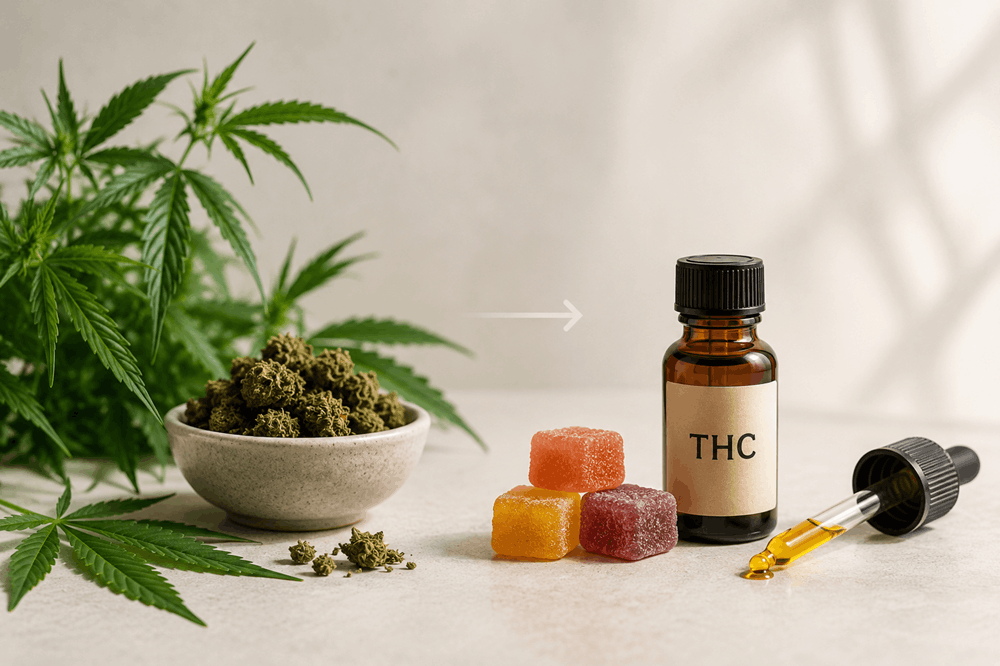
Hemp-derived THC is an intoxicating cannabinoid obtained from hemp rather than marijuana. It may be extracted directly from hemp or produced by converting another hemp cannabinoid, commonly CBD. The phrase describes the source and manufacturing pathway, not a completely different type of intoxication. Hemp-derived THC can still make you high, impair driving, cause side effects, and lead to a positive drug test.
What Does Hemp-Derived THC Mean?
Hemp-derived THC generally refers to tetrahydrocannabinol that originates from a plant or extract classified as hemp. Hemp and marijuana both belong to the cannabis plant family, but federal law has historically separated them according to their THC concentration.
Under the federal definition in effect on August 6, 2026, hemp includes Cannabis sativa plants and their derivatives containing no more than 0.3 percent delta-9 THC on a dry-weight basis. Cannabis material exceeding that limit does not qualify as hemp under that definition.
The word “derived” can describe several different processes. THC may occur naturally in the plant, be separated and concentrated from an extract, or be created by chemically converting another hemp-derived cannabinoid. These products may all be marketed as hemp-derived even though their manufacturing methods and final chemical compositions are not identical.
This is why the term alone does not tell you:
- Which form of THC is present
- How many milligrams the product contains
- Whether the product is intoxicating
- Whether the THC occurred naturally or was produced through conversion
- Whether the product is legal in a particular state
- Whether it was tested for solvents, reaction by-products, pesticides, or heavy metals
Is Hemp-Derived THC the Same as Marijuana-Derived THC?
When the product contains delta-9 THC, the active molecule is not made non-intoxicating simply because it came from hemp. “Hemp-derived” identifies the legal or agricultural source. It does not create a special version of delta-9 THC that cannot produce a high.
A five-milligram serving of properly identified hemp-derived delta-9 THC may produce effects similar to a five-milligram serving of marijuana-derived delta-9 THC. The actual experience can still vary because of the formulation, route of use, food intake, individual sensitivity, tolerance, metabolism, and accuracy of the label.
The important difference has generally been how the source material and finished product fit within federal and state legal definitions. Marijuana-derived THC is commonly sold through licensed state cannabis systems. Hemp-derived THC has also appeared in gummies, drinks, tinctures, and other products sold outside dispensaries.
That retail distinction should not be confused with a safety distinction. A product sold in a convenience store, online shop, wellness store, or liquor retailer may still contain an intoxicating dose of THC.
Common Types of Hemp-Derived THC
The term may be used for several related cannabinoids. Consumers should identify the exact compound rather than treating all hemp-derived THC products as interchangeable.
Hemp-Derived Delta-9 THC
Delta-9 THC is the cannabinoid most strongly associated with the traditional cannabis high. It can affect perception, mood, memory, coordination, judgment, and reaction time.
Some manufacturers have sold delta-9 gummies and beverages under the federal hemp definition by keeping the concentration below 0.3 percent of the product’s dry weight. Because the calculation is based on a percentage rather than an automatically fixed serving limit, a sufficiently heavy gummy could contain several milligrams of delta-9 THC while remaining below that percentage.
For example, 0.3 percent of a four-gram gummy is 12 milligrams. That calculation helps explain how a product can contain an intoxicating amount of delta-9 THC while being marketed as hemp-derived under the law currently in effect.
Delta-8 THC
Delta-8 THC occurs naturally in cannabis, but usually in very small amounts. Commercial products often contain concentrations far beyond what would ordinarily be obtained from raw hemp. Manufacturers commonly produce those concentrations by chemically converting hemp-derived CBD into delta-8 THC.
Delta-8 is psychoactive and intoxicating. Although some people describe its effects as milder than delta-9 THC, that description does not guarantee a weak or predictable experience. The FDA has received adverse-event reports involving symptoms such as vomiting, hallucinations, anxiety, dizziness, confusion, tremors, and loss of consciousness.
The FDA has also warned that the chemical conversion process may produce unwanted reaction by-products or leave contaminants when manufacturing is poorly controlled. A cannabinoid panel alone may not identify every substance created during conversion.
Delta-10 THC
Delta-10 THC is another THC isomer marketed in hemp-derived vapes, gummies, and other products. It is generally present naturally only in limited quantities, so concentrated commercial material may involve conversion and refinement.
Research on delta-10 is much more limited than research on delta-9 THC. Product descriptions sometimes make confident claims about energy, creativity, relaxation, or strain-like effects, but those marketing categories are not a substitute for controlled human evidence.
THCA Products
THCA, or tetrahydrocannabinolic acid, is the acidic precursor to delta-9 THC. Raw cannabis flower can contain substantial THCA without containing the same measured amount of active delta-9 THC before heating.
When THCA is heated through smoking, vaping, or cooking, part of it converts into delta-9 THC. A product marketed as THCA hemp flower may therefore produce effects similar to traditional high-THC cannabis after use.
Calling a flower product “hemp” does not mean it will remain non-intoxicating when smoked. Consumers should examine total potential THC rather than looking only at the pre-use delta-9 THC line on a laboratory report.
How Can Hemp-Derived THC Be Intoxicating?
The federal hemp definition focused on the concentration of delta-9 THC in the plant or derivative, not on whether every finished product could produce intoxication. That distinction allowed products containing other intoxicating cannabinoids or meaningful milligram amounts of delta-9 THC to enter the market.
Delta-8 products illustrate the problem clearly. A hemp plant may contain only a trace amount of delta-8, but CBD obtained from hemp can be converted into concentrated delta-8 material. The finished product can then be intoxicating even though its starting material came from legally defined hemp.
The same general issue applies to product weight. A low percentage of THC can still represent an active dose when the product is heavy enough. Percentage and milligrams answer different questions:
- Percentage shows how much of the product’s weight is THC.
- Milligrams show the amount of THC in a serving or package.
A consumer trying to estimate effects should look at milligrams per serving and per container, not only the percentage printed on a certificate of analysis.
Does Hemp-Derived THC Get You High?
Yes. Hemp-derived delta-9, delta-8, and similar intoxicating cannabinoids can produce a high. Possible effects include relaxation, altered sensory perception, changes in time perception, laughter, increased appetite, sleepiness, impaired short-term memory, and reduced coordination.
Unwanted effects may include anxiety, panic, paranoia, nausea, vomiting, confusion, dizziness, rapid heartbeat, extreme sedation, or difficulty walking steadily. The likelihood and intensity of these effects can increase with larger servings, low tolerance, delayed edible effects, or use with alcohol and other drugs.
Edibles deserve particular caution because their effects may be delayed. Someone who feels nothing shortly after eating a gummy may take another serving and later experience a much stronger combined effect. The CDC notes that edible and high-concentration products can have delayed or unpredictable effects and may increase the risk of poisoning or consuming too much.
Is Hemp-Derived THC Legal?
Its legal status is complicated and is changing. Federal law, state law, product type, cannabinoid, concentration, manufacturing method, and intended use can all affect whether a particular product may be produced, shipped, possessed, or sold.
As of August 6, 2026, the current federal hemp definition still uses the limit of no more than 0.3 percent delta-9 THC on a dry-weight basis. However, Congress enacted Public Law 119-37 on November 12, 2025, with major hemp-definition changes scheduled to become effective 365 days later, on November 12, 2026.
Unless the law is changed or delayed before that date, the new definition will use a total-THC standard that includes THCA. It will also exclude certain cannabinoids manufactured outside the plant and final hemp-derived cannabinoid products containing more than 0.4 milligrams combined total THC and similar-effect cannabinoids per container.
This means an article or product description that simply says hemp-derived THC is “federally legal” can be incomplete or misleading. Even before the scheduled federal change, individual states have imposed their own restrictions, age limits, licensing systems, serving caps, testing rules, or bans.
Federal hemp classification also does not override the FDA’s authority over foods, drugs, dietary supplements, cosmetics, and other regulated products. A cannabis ingredient qualifying as hemp under agricultural law does not automatically make every food, supplement, or therapeutic claim lawful.
Because the rules are changing, consumers and businesses should check current state and federal requirements rather than relying on an old package, blog post, or retailer’s legal disclaimer.
Is Hemp-Derived THC Safer Than Marijuana?
It is not automatically safer. Safety depends on dose, cannabinoid, route of administration, manufacturing quality, contaminants, individual health, and the use of alcohol or medication.
A regulated state cannabis product may have stronger THC but also be subject to specific testing, packaging, tracking, and age-control requirements. A hemp-derived product may contain a lower labeled amount yet come from a market with inconsistent oversight. The word “hemp” does not establish purity, potency, or manufacturing quality.
Converted cannabinoid products require particular scrutiny. Manufacturing delta-8 or related cannabinoids may involve acids, solvents, heat, catalysts, and purification steps. Poor processing can leave residual chemicals or produce unidentified compounds. The FDA has specifically warned about potentially harmful chemicals and by-products associated with some delta-8 manufacturing methods.
How to Read a Hemp-Derived THC Label
Start with the number of milligrams per serving. Do not assume the largest number on the front of the package represents one dose. It may describe the total cannabinoid content in the entire container.
Check the following details:
- The exact cannabinoid, such as delta-9 THC or delta-8 THC
- THC milligrams per piece, serving, and container
- The number of servings in the package
- The recommended serving size
- Whether the product contains CBD or other cannabinoids
- The batch or lot number
- The laboratory that performed the testing
- The date the sample was tested
- Results for solvents, pesticides, heavy metals, and microorganisms
The certificate of analysis should match the batch number on the package. A generic report from a different batch does not prove that the product in hand has the same potency or contaminant profile.
For converted cannabinoids, a basic potency report may be insufficient. Consumers should look for broader testing capable of identifying residual solvents and unexpected compounds rather than assuming a high delta-8 percentage demonstrates quality.
Can Hemp-Derived THC Cause a Positive Drug Test?
Yes. Drug tests generally do not excuse THC exposure because the product was sold as hemp-derived. Delta-9 products can produce the same metabolites associated with cannabis use, and delta-8 use may also trigger a positive cannabinoid result.
The risk depends on the product, amount, frequency of use, individual metabolism, testing method, and time since use. A product labeled legal, hemp-derived, or low-THC should not be treated as drug-test safe.
SAMHSA has warned that commercial hemp and CBD products may contain THC and that product content is not federally certified for consumers in a way that guarantees avoidance of a positive workplace test.
Can You Drive After Using Hemp-Derived THC?
No one should drive or operate dangerous equipment while impaired by hemp-derived THC. The source of the cannabinoid does not restore reaction time, judgment, memory, balance, or coordination.
The CDC states that cannabis can impair skills needed for driving, including coordination, judgment, memory, reaction, and the ability to maintain lane position. Alcohol and cannabis used together may cause greater impairment than either substance alone.
There is also no dependable waiting period that guarantees every person is safe to drive. Duration depends on the dose, route, tolerance, product, and individual metabolism. Edibles may continue affecting a person long after the initial high appears to decline.
Who Should Be Especially Cautious?
Hemp-derived THC products should be kept away from children and pets. Gummies, chocolates, cookies, and drinks can resemble ordinary food, creating a serious risk of accidental ingestion. FDA reports involving delta-8 have included many unintended pediatric exposures and cases requiring medical evaluation.
Pregnant and breastfeeding people should avoid assuming hemp-derived THC is safer than other cannabis. THC can pass through the body to a developing baby, and public-health agencies advise against cannabis use during pregnancy.
Extra caution is also appropriate for people with heart conditions, a history of severe anxiety or psychosis, a low cannabis tolerance, or those taking sedating medication. Anyone using prescription drugs should ask a qualified healthcare professional about possible interactions rather than relying on a retailer.
The Bottom Line
Hemp-derived THC is THC obtained from hemp or produced from hemp-derived starting material. It can include delta-9 THC, delta-8 THC, and other intoxicating cannabinoids marketed through the hemp industry.
The word “hemp-derived” does not mean non-intoxicating, medically approved, contaminant-free, or safe for driving. Hemp-derived delta-9 can act like delta-9 THC from marijuana because the source does not remove the molecule’s psychoactive properties. Converted cannabinoids may introduce additional manufacturing and testing concerns.
Legal status is also changing. As of August 6, 2026, the federal 0.3-percent delta-9 dry-weight definition remains in effect, but stricter federal provisions are scheduled to begin on November 12, 2026, unless Congress changes the law beforehand. Consumers should examine milligrams, ingredients, batch testing, state rules, and the exact cannabinoid rather than relying on the word “hemp.”