How to Decarb Cannabis: A Practical Guide to Heat, Timing, and Safety
Decarboxylation uses controlled heat to change cannabinoid acids such as THCA and CBDA into THC and CBD. It is commonly performed before cannabis flower is added to butter, cooking oil, or a preparation that will not receive enough heat on its own.
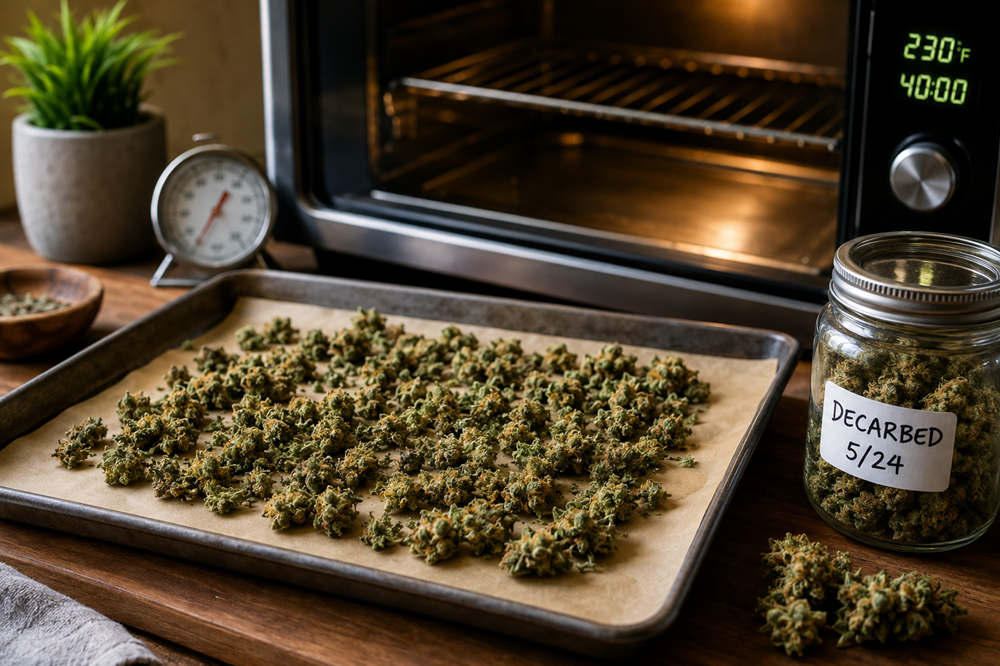
For THC-dominant flower, a common household starting point is about 230°F (110°C) for 35 to 45 minutes. This is a practical guideline rather than a universal scientific endpoint. The flower’s moisture, cannabinoid composition, batch size, and actual oven temperature can all affect the result.
Adults should only possess and prepare cannabis where local law permits it. Homemade cannabis products should also be treated cautiously because their potency cannot be confirmed without laboratory testing.
What Decarboxylation Does
Cannabis flower naturally contains many cannabinoids in acidic forms. Much of the potential THC in freshly harvested or properly stored flower is present as tetrahydrocannabinolic acid, or THCA. CBD-dominant flower may similarly contain a substantial amount of cannabidiolic acid, or CBDA.
When these compounds receive sufficient heat, they release carbon dioxide and change into their neutral forms. THCA becomes THC, while CBDA becomes CBD. This chemical reaction is known as decarboxylation.
The process does not create more cannabinoids. It changes the molecular form of compounds already present in the plant. Some conversion occurs slowly during drying, aging, and storage, but controlled heating accelerates it.
Smoking and vaporizing apply heat immediately, so cannabis used for inhalation does not generally require a separate oven step. Decarboxylation is mainly relevant when flower will be used in an infused ingredient or another preparation that involves limited heating.
Decarboxylation should not be confused with infusion. Decarboxylation changes the cannabinoids, while infusion transfers them from the plant material into a carrier such as butter or oil.
What You Need
The standard oven method requires only a few basic items:
- Legally obtained cannabis flower
- A rimmed baking sheet or shallow oven-safe dish
- Parchment paper
- An oven thermometer
- Clean hands or kitchen scissors
- A spoon or spatula
- An airtight, clearly labeled container
An independent oven thermometer is useful because the temperature displayed on a household oven may not match the temperature around the baking tray. Ovens also cycle above and below their selected setting as the heating element switches on and off.
Use a clean work area and keep ordinary food away from the preparation space. This reduces the chance that someone will accidentally mistake the cannabis for an herb, seasoning, or tea ingredient.
How to Decarb Cannabis in an Oven
1. Preheat the Oven
Set the oven to approximately 230°F (110°C). Place the oven thermometer near the center and allow the temperature to stabilize before adding the cannabis.
Moderate, steady heat is preferable to a higher setting intended to finish the process more quickly. Excessive heat leaves less room for error and can scorch the flower or contribute to the breakdown of cannabinoids and aromatic compounds.
2. Break the Flower Into Coarse Pieces
Use clean hands or kitchen scissors to separate the flower into small, roughly even pieces. The goal is to expose the material to heat without reducing it to powder.
Very fine cannabis can heat too quickly, burn around the edges, and pass through a strainer during a later infusion. Coarse pieces are easier to spread, stir, and handle.
3. Spread It Across the Tray
Line the baking sheet or oven-safe dish with parchment paper. Arrange the cannabis in a loose, single layer.
Avoid creating a deep pile. Overlapping material may trap moisture and heat unevenly, especially in a large batch. Divide the cannabis between two trays or process it in separate batches when necessary.
4. Heat for 35 to 45 Minutes
Place the tray near the center of the oven and heat the cannabis for approximately 35 to 45 minutes.
After about 20 minutes, gently stir or redistribute the pieces. This exposes different surfaces and helps compensate for hot and cool areas within the oven.
Dry, well-cured flower may be ready toward the shorter end of the range. Material that contains more moisture may take longer to dry and toast evenly. Avoid extending the time automatically, since prolonged heating is not always beneficial.
The same timing should not be assumed to produce identical results with every cultivar or cannabinoid profile. In particular, CBD-rich flower may follow a different conversion pattern from THC-dominant flower.
5. Remove the Tray
Take the cannabis out when it appears dry and lightly toasted. It may shift from bright green toward olive green or light brown and develop a stronger roasted herbal aroma.
The flower should not be blackened or smoking. A burned smell, dark edges, or visible smoke indicates that the material has become too hot.
6. Let It Cool
Leave the cannabis on the tray until it reaches room temperature. It will often become more brittle as it cools.
Do not place warm cannabis directly into a sealed container. Trapped warmth can produce condensation and introduce unwanted moisture.
How to Judge the Result
Decarbed cannabis often becomes drier, more brittle, and slightly darker, but these changes are only general observations. The starting color and texture depend on the cultivar, age, curing process, and storage conditions.
Use a measured heating time and a verified oven temperature rather than relying entirely on appearance or smell. Flower can look toasted without having reached a particular cannabinoid conversion level, while naturally dark flower may appear finished earlier than it actually is.
There is no dependable visual test for exact potency or complete decarboxylation. Confirming the remaining amounts of THCA, CBDA, THC, and CBD requires laboratory analysis.
Common Decarboxylation Problems
Heating at Too High a Temperature
Increasing the temperature may shorten the heating period, but it also increases the risk of scorching the flower. A moderate setting provides a wider margin between useful heating and excessive degradation.
Grinding the Cannabis Too Finely
Powdered cannabis has more surface area exposed to heat and may toast unevenly. It can also create a gritty infused product if small particles pass through the strainer.
Overcrowding the Tray
A thick or tightly packed layer prevents the pieces from receiving similar amounts of heat. Spread the material loosely and avoid processing an unnecessarily large batch at once.
Using Damp Flower
Flower that contains substantial moisture may steam before it begins to toast. It may require more time than dry flower, but raising the oven temperature sharply is not the best solution.
Assuming the Oven Display Is Accurate
An oven set to 230°F may run hotter or cooler than expected. Check the thermometer during the process and make small adjustments when the temperature remains consistently outside the intended range.
Expecting Exact Potency
A laboratory label on the starting flower can provide useful information, but it cannot establish the precise strength of a homemade infused product. Decarboxylation losses, infusion efficiency, mixing, and serving size introduce additional uncertainty.
Are There Other Decarboxylation Methods?
Temperature-controlled appliances and sous vide systems are sometimes used to provide steadier heating or contain more of the aroma. Their correct settings depend on the device, packaging, batch size, and material being processed. Follow the equipment manufacturer’s safety instructions rather than applying household oven timing automatically.
Microwaving is not a reliable substitute for controlled oven heating. Microwave energy can heat cannabis rapidly and unevenly, producing overheated areas while leaving other parts less affected.
How to Store Decarbed Cannabis
Transfer the completely cooled cannabis to a clean, airtight container. Mark the container clearly with its contents and the preparation date.
Store it in a cool, dark, and dry location away from direct sunlight, radiators, ovens, and other sources of heat. Limiting exposure to heat, light, air, and moisture helps slow changes in quality during storage.
Do not reuse an ordinary spice, tea, or food container unless it has been thoroughly cleaned and relabeled. Cannabis stored in familiar kitchen packaging can easily be mistaken for a normal ingredient.
Keep the container locked away from children, teenagers, visitors, and pets. The same precautions apply to infused butter, oil, baked goods, and any utensils or equipment that retain cannabis residue.
Potency and Edible Safety
Homemade cannabis preparations can be difficult to dose consistently. Even when the starting cannabinoid percentage is known, the final strength depends on the degree of conversion, losses during heating, infusion efficiency, and how evenly the infused ingredient is distributed.
Two portions from the same batch may not contain exactly the same amount of THC. This is particularly likely when the mixture has not been stirred thoroughly or when plant material remains unevenly distributed.
Ingested THC acts more slowly than inhaled cannabis. According to Health Canada’s lower-risk guidance, effects may take 30 minutes to two hours to become noticeable and up to four hours to reach their full intensity. Consuming another serving during that interval increases the risk of taking too much.
A person using a homemade preparation should therefore begin cautiously, avoid adding another serving while effects are still developing, and never assume that a homemade portion has a precisely measured strength.
Cannabis should not be used before driving, cycling in traffic, operating equipment, or completing another activity that requires unimpaired judgment and coordination. Combining it with alcohol or other intoxicating substances may increase impairment and other risks.
Public-health authorities advise avoiding cannabis during pregnancy and breastfeeding. Anyone taking prescription medication or managing a serious physical or mental health condition should speak with a qualified healthcare professional before using cannabis.
After a suspected accidental ingestion or possible poisoning, contact a local poison center for guidance. Call emergency services when someone is unconscious, having trouble breathing, or experiencing another immediately life-threatening condition.
Legal Considerations
Cannabis laws differ between countries, states, provinces, territories, counties, and cities. The rules may separately address possession, home cultivation, processing, edible preparation, storage, transportation, and sharing with another adult.
In the United States, state cannabis policies can differ considerably and continue to change. Legal purchase or possession does not automatically make every form of home processing lawful, so check the current regulations that apply where the cannabis will be prepared and used.
Landlords, hotels, college residences, and other properties may also restrict cannabis possession, odor, or preparation even where local law permits adult use.
Final Thoughts
Decarbing cannabis in a household oven depends on controlled heat rather than speed. A practical starting method is to break the flower into coarse pieces, spread it in a single layer, and heat it at about 230°F (110°C) for 35 to 45 minutes while checking the actual oven temperature.
The finished material may look dry and lightly toasted, but its cannabinoid content cannot be determined by appearance. Store it securely, label it clearly, and treat any homemade preparation as having uncertain potency.