Male vs. Female Cannabis Plants: How to Tell the Difference
Male and female cannabis plants perform different reproductive functions. Male plants produce pollen, while female plants receive pollen and form seeds after fertilization. Female plants also produce the dense, trichome-covered flowers commonly cultivated for their cannabinoid and terpene content.
The differences are difficult to see during early vegetative growth. They become much clearer when reproductive structures begin appearing at the nodes, where branches meet the main stem.
Male vs. Female Cannabis at a Glance
| Feature | Male Cannabis Plant | Female Cannabis Plant |
|---|---|---|
| Reproductive function | Produces and releases pollen | Receives pollen and supports seed development |
| Early flower structure | Small, rounded pollen sacs | Pointed bracts with protruding stigmas |
| Mature flower form | Loose clusters of hanging flowers | Dense clusters of bracts and flowers |
| Role in seed formation | Supplies pollen but does not bear seeds | Bears seeds after fertilization |
| Typical flower cannabinoid concentration | Relatively low | Substantially higher in most cultivars |
| Common production role | Breeding, pollen production and genetic diversity | Flower, resin, cannabinoid or seed production |
The flower structures provide the most dependable visual evidence. Plant height, leaf width and overall shape vary too much among cultivars and growing conditions to identify sex reliably.
How Cannabis Plant Sex Works
Cannabis sativa is predominantly dioecious, meaning male and female flowers usually grow on separate plants. Most dioecious cannabis plants have an XX/XY sex-chromosome system. XX plants generally develop female flowers, while XY plants generally develop male flowers.
Chromosomes provide the genetic foundation for plant sex, but visible flower expression also involves developmental and hormonal regulation. This helps explain why cannabis can sometimes produce reproductive structures that do not match the plant’s usual sexual form.
Some cultivars are monoecious rather than dioecious. A monoecious plant naturally carries separate male and female flowers on the same individual. These cultivars are commonly associated with certain fiber and grain production systems where seed formation is part of the intended crop cycle.
How to Identify a Female Cannabis Plant
A female cannabis plant develops pistillate flowers. The first signs normally appear at the nodes as the plant approaches flowering.
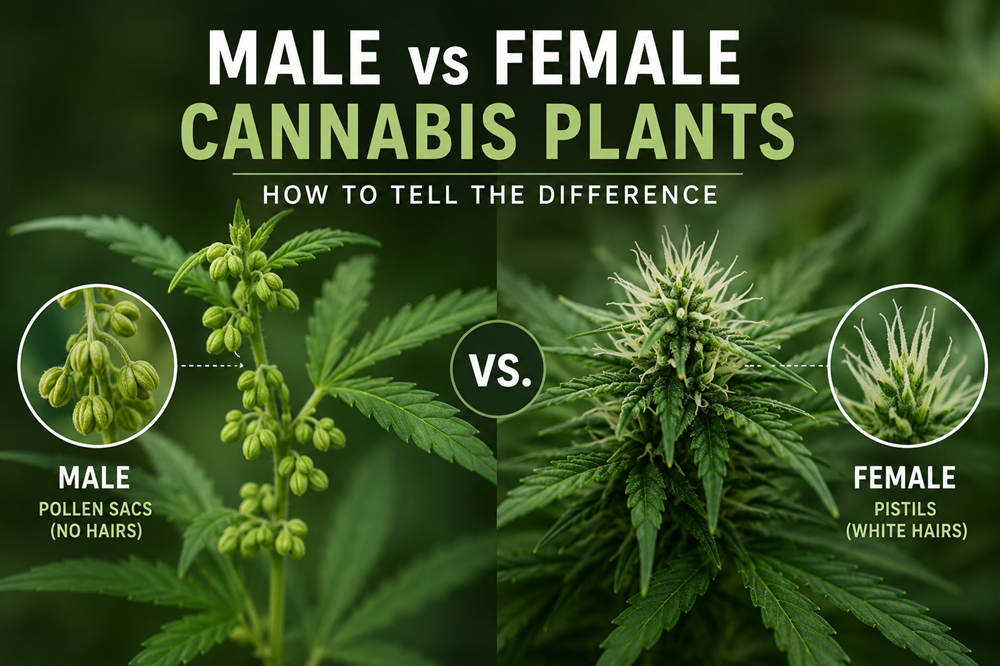
An early female flower has a small, pointed bract from which one or two fine stigmas emerge. The stigmas are often pale when young and are designed to capture airborne pollen. Their shape and position are more useful for identification than their color.
Several nodes should be examined before reaching a conclusion. Reproductive structures do not always become visible across the entire plant at the same time, and very young branch growth can be mistaken for a flower.
What Mature Female Flowers Look Like
As flowering continues, female flowers develop into compact inflorescences made up of many closely arranged bracts. Stigmas extend from between the bracts and may darken as the flowers mature.
The bracts and nearby floral leaves carry large numbers of glandular trichomes. These tiny secretory structures create the resin in which cannabinoids and terpenes are produced and stored. They give mature female flowers their frosted or sparkling appearance.
How to Identify a Male Cannabis Plant
A male cannabis plant develops staminate flowers that produce pollen. Its earliest reproductive structures also appear at the nodes, but they look different from the pointed, stigma-bearing structures of a female plant.
Male pre-flowers resemble small round or oval sacs. They may initially appear alone, then multiply and move slightly away from the stem on short stalks. They do not have protruding stigmas.
As the plant matures, the flowers form loose, branching clusters. Individual flowers hang downward before opening and exposing pollen-producing anthers. This open arrangement allows pollen to disperse easily through the air.
Male plants frequently begin flowering earlier than female plants in the same population. Early pollen release increases the chance that pollen will be available when female flowers become receptive.
What Happens During Cannabis Pollination?
Cannabis is primarily wind-pollinated. Pollen released from a male flower can travel through the air and land on the stigma of a female flower.
After compatible pollen reaches the stigma, it germinates and produces a pollen tube that grows toward an ovule. Fertilization allows an embryo to develop. The ovule then becomes a seed, while surrounding floral tissue forms the small dry fruit that encloses it.
Pollination is essential when the objective is to create seeds. It allows genetic material from two parent plants to combine, producing offspring with a new mixture of inherited characteristics.
It has a different consequence in crops intended to produce unfertilized flower. Research examining fertilization and cannabis flower chemistry found that pollination generally reduced the concentrations of many phytocannabinoids, although the response varied among compounds and parental combinations.
Pollination is therefore useful or undesirable depending on the production goal. It is necessary for conventional breeding and seed crops but usually avoided when the priority is resin-rich, seedless flower.
Do Male Cannabis Plants Produce THC or CBD?
Male cannabis plants can contain cannabinoids, including THC- and CBD-related compounds. The statement that male plants contain no cannabinoids is inaccurate.
The major difference is quantity. Female inflorescences normally contain many more glandular trichomes, making them a much richer source of cannabinoids and aromatic terpenes. A comparative analysis of male and female cannabis flowers found substantially greater cannabinoid accumulation in female flowers.
Being female does not automatically make a plant high in THC or CBD. Its chemical profile is also determined by cultivar genetics, maturity, plant health and environmental conditions. A female cultivar bred to remain low in THC will not become THC-rich simply because it produces female flowers.
Why Female Cannabis Plants Are Usually Grown for Flower
Female plants are preferred for flower production because their inflorescences provide the greatest concentration of resin-producing tissue. When they remain unfertilized, the flowers continue developing bracts and glandular trichomes rather than shifting their reproductive effort toward mature seeds.
This makes unfertilized female flower the principal material used for cannabinoid-rich cannabis products. The same female plant can serve a different purpose when pollinated, becoming a source of seeds rather than seedless flower.
The desired outcome determines how the plant is managed. Flower production prioritizes unfertilized females, while seed production depends on successful pollen transfer.
What Are Male Cannabis Plants Used For?
Male plants are essential to conventional breeding. Breeders collect or control pollen from selected males and use it to fertilize chosen female plants. The resulting seeds may combine traits related to growth pattern, flowering time, disease response, fiber characteristics or chemical composition.
Male plants also help preserve genetic diversity in naturally reproducing cannabis populations. Removing them entirely prevents ordinary sexual reproduction unless another pollen source is introduced.
Some fiber cultivars may benefit from male stems because they can produce relatively fine fibers. Their practical value depends on the variety, harvest schedule and intended textile or industrial product.
A male plant is therefore not biologically inferior to a female plant. It is simply unsuitable for a crop whose main objective is unfertilized female flower.
Monoecious, Intersex and Hermaphroditic Cannabis
These terms are often used interchangeably in casual cannabis discussions, but they do not describe exactly the same thing.
A monoecious cannabis plant produces separate male and female flowers on the same plant as part of a predictable cultivar characteristic. This trait has been intentionally developed in some agricultural varieties.
An intersex plant displays reproductive structures that differ from its expected sexual form. For example, a plant with mostly female flowers may develop a few pollen-producing anthers or complete male flowers. If they release viable pollen, nearby female flowers can become fertilized.
Botanically, a hermaphroditic or bisexual flower contains both male and female reproductive organs within one flower. The word “hermaphrodite” is often used more broadly in cannabis culture for any plant carrying both types of reproductive structures, even when the structures occur in separate flowers.
Intersex expression may be influenced by genetics, development, hormones or environmental conditions. Stress is one possible factor, but it should not be treated as the explanation for every case.
Can You Identify Plant Sex From Seeds?
The appearance of an ordinary cannabis seed does not reveal whether it will produce a male or female plant. Seed size, shape, color, stripes and shell markings are not dependable sex indicators.
Feminized seeds are different because they are produced through breeding methods intended to greatly increase the probability of female offspring. The term describes the breeding process, not a visible feature of the seed coat. A feminized seed cannot be distinguished reliably from a regular seed by looking at it.
Laboratory testing can identify sex-linked DNA before a seedling forms visible flowers. A 2025 study of genetic markers for cannabis seedlings reported highly accurate identification across the tested hemp cultivars. However, the reliability of any commercial test still depends on its markers, procedures and compatibility with the cultivar being examined.
Can Leaves or Plant Shape Reveal the Sex?
Male and female cannabis plants both produce the familiar palmate leaves made up of multiple leaflets. Leaf width, leaflet number and color are affected by genetics, age, nutrition, light and other growing conditions.
Male plants may sometimes appear taller or less densely branched within a particular population, but these are tendencies rather than reliable diagnostic features. A tall plant is not necessarily male, just as a short or bushy plant is not necessarily female.
Visual identification becomes dependable only after reproductive structures appear. Before then, a validated genetic test is more reliable than conclusions based on leaves or overall growth habit.
The Main Difference Between Male and Female Cannabis
The fundamental difference is reproductive function. Male cannabis plants produce and release pollen. Female cannabis plants receive pollen and bear seeds after fertilization.
Their structures reflect those roles. Male plants form loose flower clusters suited to pollen dispersal, while female plants form compact inflorescences with stigmas, bracts and abundant glandular trichomes.
Female plants are generally chosen for cannabinoid-rich flower, while male plants remain important for breeding, pollen production and genetic diversity. Identifying them accurately requires examining their flowers rather than relying on seeds, leaves or general plant shape.