What to Send When Someone Dies Instead of Flowers: Thoughtful Alternatives That Comfort
If you are wondering what to send when someone dies instead of flowers, the best alternatives are usually things that offer comfort, reduce everyday stress, or honor the person who died. A meal delivery, memorial donation, handwritten sympathy letter, practical care package, comforting food, remembrance gift, or offer of specific help can often feel more personal than a traditional bouquet.
The right choice depends less on how impressive the gift looks and more on what the grieving person may actually need.
1. Send a Meal or Food Delivery
Food is one of the most practical things you can send after a death.
Grief can make ordinary tasks such as shopping, cooking, and deciding what to eat feel unexpectedly difficult. At the same time, the person’s home may be filled with visiting relatives or friends. A ready-to-eat meal removes one small responsibility during an exhausting period.
Good choices include:
- A restaurant delivery gift card
- A homemade casserole or soup
- A prepared family meal
- A breakfast basket
- Fresh bread and simple snacks
- Freezer-friendly meals
If you are sending food directly, choose something that does not require immediate preparation.
It is also helpful to consider allergies, dietary restrictions, and religious practices before ordering.
2. Make a Donation in the Person’s Memory
A memorial donation can be especially meaningful when the person who died cared deeply about a particular cause.
You might contribute to an animal shelter, hospital, conservation organization, scholarship fund, religious organization, local charity, or disease-related nonprofit.
Sometimes the family specifically requests donations instead of flowers in an obituary or funeral notice. In that case, following their request is usually one of the most respectful choices you can make.
Even a modest donation can carry emotional significance when it supports something the person valued during life.
3. Write a Personal Sympathy Letter
A thoughtful letter costs very little but can become one of the most meaningful things someone receives after a loss.
Instead of trying to find perfect words, focus on something genuine.
You might share a memory of the person who died, describe something you admired about them, or simply tell the grieving person that you are thinking about them.
Specific memories can be particularly comforting because they remind the family that their loved one’s life mattered beyond their immediate circle.
A sentence such as, “I will always remember how she made everyone feel welcome at family gatherings,” may mean more than a long generic message about sympathy.
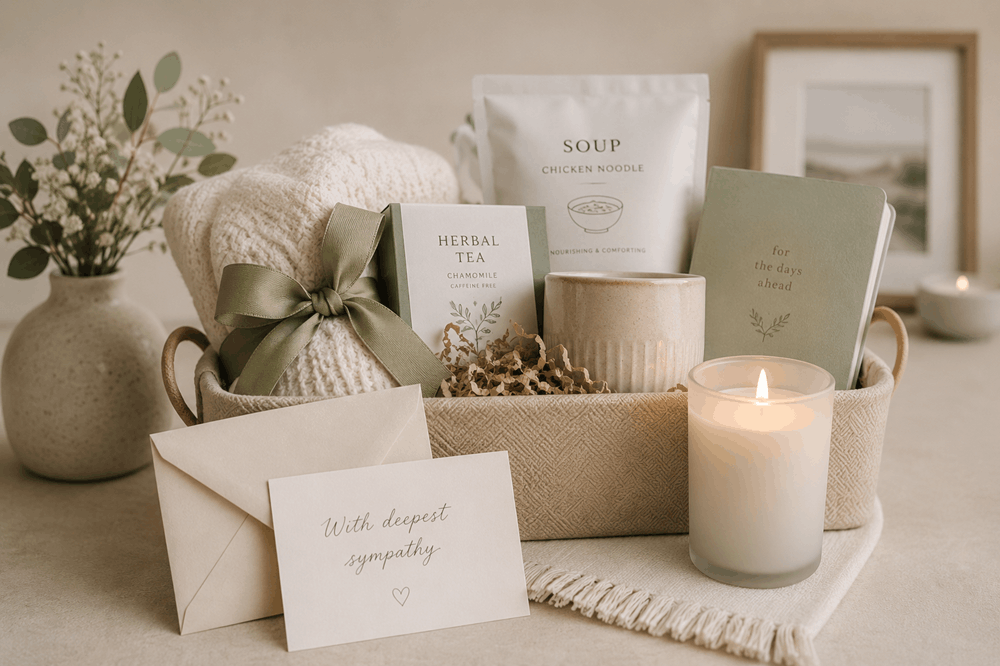
4. Send a Practical Care Package
Grief affects the body as well as the emotions. People may sleep poorly, forget meals, feel exhausted, or struggle to concentrate.
A simple care package can provide small comforts without demanding anything from the recipient.
Possible items include:
- Tea or coffee
- Crackers and easy snacks
- Chocolate
- A soft blanket
- Unscented lotion
- Tissues
- A reusable water bottle
- A comforting candle
- A sleep mask
- A journal
Keep the package simple rather than filling it with inspirational messages. Someone in early grief may appreciate comfort more than encouragement.
5. Give a Grocery or Restaurant Gift Card
If you do not know what food the family likes, a gift card may be more useful than choosing a meal yourself.
Grocery cards can help with ordinary household expenses, while restaurant or delivery-service cards give the recipient the freedom to order food when they actually need it.
This kind of gift is particularly useful several days or weeks after the funeral, when the initial wave of meals and visitors may have stopped.
Grief does not end when the funeral ends, and practical support later can be especially appreciated.
6. Create a Memory Book or Photo Gift
If you knew the person who died well, photographs and shared memories can become meaningful remembrance gifts.
You could create a small photo album, printed collection of memories, framed photograph, or simple digital folder containing pictures the family may not already have.
The most valuable photographs are not always professional portraits.
A candid image from a birthday dinner, vacation, workplace gathering, or ordinary afternoon may capture a side of the person that the family treasures.
If the death is very recent, you may want to wait before giving a larger memorial gift. Some people appreciate these keepsakes immediately, while others find them easier to receive after some time has passed.
7. Send a Memorial Candle
A candle can serve as a quiet remembrance object without taking up much space.
Some people light a candle on birthdays, anniversaries, holidays, or evenings when they are particularly missing someone.
If you choose one, simplicity usually works best. Avoid overly elaborate grief quotations unless you know they match the recipient’s beliefs and personality.
A plain candle accompanied by a short note can be enough.
8. Give a Living Plant or Tree
If you want something with the natural feeling of flowers but greater longevity, consider a plant, shrub, or tree.
A small indoor plant can remain as a quiet reminder for years. If the recipient has a garden, a flowering shrub or tree may become a living memorial.
However, think carefully before sending something that requires significant care. A grieving person may not want another responsibility.
Low-maintenance plants are usually better than delicate varieties.
If you want to arrange for a memorial tree to be planted elsewhere, some organizations allow trees to be planted in memory of a loved one.
9. Offer Specific Practical Help
Sometimes the most valuable thing you can give is not an object at all.
People often say, “Let me know if you need anything,” but someone who is grieving may not have the energy to decide what to ask for.
A specific offer is easier to accept.
For example, you could offer to:
- Walk the dog
- Pick up groceries
- Drive children to school or activities
- Mow the lawn
- Take trash bins out
- Bring dinner on a particular evening
- Help clean after visiting relatives leave
- Run errands
Practical assistance can be especially useful for someone who has lost a spouse, parent, or household member who previously handled certain daily responsibilities.
10. Send Something for the Children
When a household includes children, small gestures directed toward them can also help the family.
A coloring book, simple craft activity, comforting stuffed animal, puzzle, or age-appropriate book may give children something familiar and calming to focus on.
This can also provide parents or caregivers with a little breathing room during a difficult week.
Avoid gifts that are excessively loud, complicated, or require adult setup.
11. Give a Meaningful Book
A book can be comforting, but choosing one requires sensitivity.
Some people appreciate books about grief, spirituality, remembrance, or coping. Others do not want to read anything related to grief immediately after a death.
If you know the person well, you might instead send a novel, poetry collection, devotional, or familiar favorite that offers quiet companionship.
The important thing is not to send a book that suggests there is a correct way or timetable for grieving.
12. Send a Comforting Basket for the Household
A household basket is different from a decorative gift basket because its purpose is practical.
You might include coffee, tea, bottled drinks, individually wrapped snacks, fruit, breakfast foods, paper plates, napkins, or easy pantry items.
This can be particularly helpful when relatives and friends are coming in and out of the house.
Small necessities may not feel emotionally significant when you purchase them, but they can remove several minor burdens from the family.
13. Pay for a Helpful Service
Depending on your relationship with the family, paying for a service can be an unusually thoughtful alternative to flowers.
Possibilities include:
- House cleaning
- Lawn care
- Grocery delivery
- Pet care
- Snow removal
- Childcare
- Meal delivery
This is most appropriate when you know the recipient well enough to understand what would genuinely help.
A service should reduce stress, not create awkwardness or make the person feel that their home is being judged.
14. Give a Small Personalized Memorial Gift
Personalized gifts can work well when they are understated.
A simple engraved ornament, memorial stone, framed quote, small piece of jewelry, or keepsake bearing the person’s name or initials may become meaningful over time.
However, personalized memorial products are extremely individual. Some people cherish them, while others prefer not to display obvious grief-related items.
This option is usually safest when you know the recipient closely.
15. Remember Them Several Weeks Later
One of the most thoughtful alternatives to sending flowers immediately is doing something later.
Support is often abundant during the first few days after a death. Then the funeral ends, visitors leave, messages slow down, and the grieving person returns to a life that suddenly feels different.
Sending a meal, card, gift certificate, or short message three or four weeks later can carry enormous meaning.
You can also make a note of the person’s birthday, the anniversary of the death, or an important holiday and reach out again.
Long-term remembrance communicates something simple but powerful: the person who died has not been forgotten.
What Should You Send to a Funeral Instead of Flowers?
If you are sending something directly to a funeral or memorial service, your choices are somewhat different from what you might send to someone’s home.
Good alternatives include a memorial donation, sympathy card, guest-book contribution, framed photograph requested by the family, or food for a reception if you have arranged it with the organizers.
Avoid sending large or complicated objects to the funeral location unless you know they are wanted. The family may already be managing flowers, photographs, personal possessions, and numerous other items.
What Can You Send to Someone’s Home After a Death?
For someone’s home, practicality usually matters most.
Meals, grocery cards, snacks, comfort packages, cleaning help, and handwritten notes are all useful options.
If you are unsure, food or a gift card combined with a sincere note is difficult to get wrong.
What Should You Avoid Sending?
Most sympathy gifts are well intentioned, but a few types can accidentally create discomfort.
Be cautious with:
- Strongly religious gifts when you do not know the person’s beliefs
- Alcohol unless you know it is appropriate
- Large items that require storage
- Pets or living animals
- Plants requiring complicated care
- Overly cheerful motivational gifts
- Anything that pressures the person to “move on”
Grief is deeply individual. A gift should acknowledge the loss rather than try to fix it.
How Much Should You Spend?
There is no required amount.
A handwritten card and homemade meal can be more meaningful than an expensive memorial gift.
Your relationship with the grieving person should guide the gesture. A coworker might send a card or contribute to a group meal, while a close friend or relative may offer more substantial practical support.
The sincerity and usefulness of the gesture matter more than its price.
What Should You Write With the Gift?
Keep the message simple.
You do not need to explain death, search for a lesson, or find a perfect quotation.
A short message such as, “Thinking of you and your family. I hope this makes the next few days a little easier,” is enough.
If you knew the person who died, adding one genuine memory makes the note more personal.
Bottom Line
When deciding what to send when someone dies instead of flowers, think about comfort rather than ceremony. Meals, grocery cards, memorial donations, handwritten letters, simple care packages, remembrance gifts, and practical help can all provide meaningful support.
The best gesture is often one that makes life slightly easier while allowing grief to be what it is. You do not need to say something profound or send something expensive. Showing up thoughtfully, remembering the person who died, and continuing to care after the first difficult days have passed can mean far more than any traditional sympathy gift.