Can You Bring Flowers on a Plane? A Simple Guide for Travelers
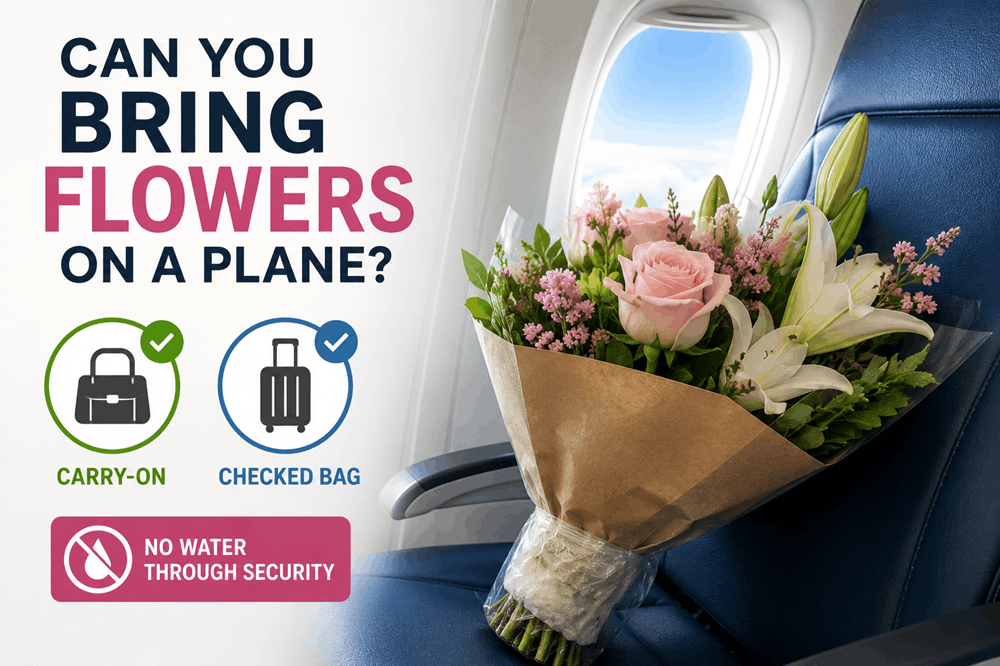
Yes, you can usually bring flowers on a plane. In the United States, the TSA allows fresh flowers in both carry-on and checked baggage, but fresh flowers must pass through the security checkpoint without water. The biggest complications arise with international flights, agricultural inspections, and trips involving places such as Hawaii, where certain flowers and plant materials may be restricted.
Can You Take Fresh Flowers Through Airport Security?
For flights departing from U.S. airports, fresh flowers are generally permitted through TSA security. TSA specifically lists flowers as allowed in both carry-on and checked baggage. However, the flowers need to go through the checkpoint without water.
This means you can carry a bouquet through security, but placing the stems in a vase or container full of water before screening can cause problems.
A much easier approach is to keep the bouquet wrapped and protect the cut ends with slightly damp paper towels. Cover the damp stems with a plastic bag or other leak-resistant wrapping so moisture does not get onto your luggage or other passengers’ belongings.
Once you are beyond security, you can decide whether the flowers need additional hydration before boarding.
Can Flowers Go in Your Carry-On?
Yes. Fresh flowers are permitted in carry-on baggage under TSA rules.
In many situations, carrying the flowers with you is preferable to putting them in checked luggage. A bouquet is delicate, and baggage handling can easily crush petals, snap stems, or flatten an arrangement.
Carry-on transport also gives you more control over temperature and positioning.
You still need to consider the airline’s normal baggage limitations. A very large bouquet could be awkward to store safely, particularly on a full flight where overhead-bin space is limited.
If possible, keep the bouquet compact enough to hold comfortably without blocking an aisle or interfering with another passenger’s space.
Can You Put Flowers in Checked Luggage?
TSA also permits flowers in checked baggage.
That does not necessarily make checked luggage the best option.
Suitcases are stacked, moved, dropped, and exposed to changing temperatures. Delicate flowers can arrive badly damaged even when the airline has technically allowed them.
If you need to check flowers, protect them carefully. A rigid box is generally safer than placing an uncovered bouquet between clothes.
Secure the flowers so they cannot move around inside the container, protect flower heads from pressure, and keep moisture away from clothing and other items.
Can You Bring Flowers on a Domestic Flight?
For an ordinary domestic U.S. flight, taking a cut bouquet is generally straightforward from the TSA security perspective. Fresh flowers are permitted in carry-on and checked baggage as long as you comply with screening requirements.
However, security rules and agricultural rules are two different things.
TSA primarily determines whether an item can pass through airport security. Agricultural authorities are concerned with whether plant material can carry insects, diseases, or invasive species into another area.
That distinction becomes particularly important when traveling between areas with special agricultural protections.
Can You Bring Flowers on an International Flight?
You may be able to bring flowers on an international flight, but international travel is considerably more complicated.
Every country can establish its own rules for bringing plants, flowers, seeds, fruit, soil, and other agricultural products across its borders.
If you are entering the United States from another country, plants, plant parts, and cut flowers are subject to USDA agricultural requirements. Some flowers may be admissible, while others can be restricted or prohibited depending on the species, origin, pests associated with the plant, and other factors.
Do not assume that a bouquet purchased legally at your departure airport is automatically permitted into the destination country.
Do You Have to Declare Flowers at U.S. Customs?
Yes. Travelers entering the United States are required to declare agricultural products, including plants and plant materials. Cut flowers can therefore need to be presented for agricultural inspection when you arrive.
Declaring flowers does not automatically mean they will be confiscated.
An agricultural specialist may inspect them and determine whether they are admissible. The important point is to declare them rather than attempting to carry plant material through customs unnoticed.
U.S. Customs and Border Protection specifically reminds travelers that flowers and plants must be declared because they can potentially carry agricultural pests.
Why Are International Flower Rules So Strict?
A flower may look completely harmless while carrying tiny insects, eggs, fungi, bacteria, or other organisms that are difficult for an ordinary traveler to notice.
Introducing a foreign agricultural pest into a new environment can damage crops and native ecosystems, which is why countries regulate plant material at their borders.
The restrictions are therefore based less on the bouquet itself than on what could potentially travel with it.
Fresh flowers, leaves, stems, roots, seeds, fruits, and soil can all present different agricultural risks.
Can You Bring Flowers From Hawaii to the Mainland?
Travel from Hawaii to the continental United States has special agricultural rules even though it is domestic travel.
USDA restricts the movement of various agricultural products from Hawaii to the U.S. mainland, Alaska, and Guam because plant material can carry pests that are not established elsewhere in the country.
Many fresh flowers and leis can be taken from Hawaii, but there are exceptions. USDA guidance, for example, identifies restrictions involving certain plants and citrus-related flowers and leaves.
Your baggage may also be subject to agricultural inspection before departure.
If you plan to bring home a lei or tropical bouquet, buying it from a vendor familiar with agricultural travel requirements can make the process easier.
Can You Bring a Lei on a Plane?
Usually, yes, but the answer depends on where the lei comes from and where you are taking it.
Within ordinary unrestricted routes, wearing or carrying a flower lei generally presents little difficulty.
When traveling from Hawaii to the mainland, however, the plant materials used in the lei matter. USDA allows many fresh flowers, leis, and foliage while restricting certain species and plant families.
A lei containing one prohibited plant can create a problem even if all of the other flowers are acceptable.
Can You Bring Roses on a Plane?
Yes. A bouquet of cut roses can generally pass through a U.S. airport security checkpoint without water under TSA’s flower policy.
Wrap the stems carefully and use a protective flower sleeve around the blooms.
For international travel, the fact that the flowers are roses does not eliminate agricultural requirements. You still need to check the destination country’s plant-import rules and declare agricultural material where required.
Can You Bring a Wedding Bouquet on a Plane?
You can generally carry a wedding bouquet on a U.S. flight, and keeping it with you is usually safer than checking it.
Remove any container of standing water before going through security. Keep the stems lightly hydrated with damp wrapping and protect the flowers with a sleeve or box.
Wedding bouquets can be unusually wide or delicate, so transportation logistics matter as much as security rules.
If you are flying to a destination wedding, traveling with loose flowers and having the final bouquet assembled after arrival can sometimes be easier than transporting a finished arrangement.
Can You Bring Flowers in a Vase on a Plane?
The flowers themselves are allowed through U.S. airport security, but a vase filled with water is a different matter.
TSA specifically says fresh flowers should pass through the checkpoint without water.
An empty vase can be much easier to transport. Wrap it securely to prevent breaking and carry the flowers separately without standing water.
Once you reach your destination, trim the stems again and arrange the flowers in fresh water.
How Do You Keep Flowers Fresh While Flying?
Air travel can leave flowers without a normal vase for several hours, so preparing them properly can make a substantial difference.
Before leaving for the airport, start with well-hydrated flowers. Place the stems in clean water for several hours before traveling if possible.
Shortly before departure:
- Trim a small amount from the bottom of the stems.
- Remove leaves that are already damaged.
- Wrap the stem ends with slightly damp paper towels.
- Cover the damp section with plastic to prevent leaks.
- Place a protective sleeve around the bouquet.
- Keep delicate flower heads from being crushed.
- Avoid leaving the bouquet inside a hot vehicle.
After arriving, trim the stems again and place the flowers into a clean vase with fresh water.
Should You Use a Flower Box for Flying?
A flower box can be extremely useful, particularly for expensive or delicate arrangements.
The box should be large enough that petals do not press firmly against the sides but small enough that the bouquet cannot slide around constantly.
For roses, peonies, ranunculus, dahlias, and other easily bruised flowers, preventing physical pressure is especially important.
Just remember that a box does not exempt the flowers from airline baggage restrictions or agricultural inspection.
What About Dried Flowers?
Dried flowers are easier to transport physically because you do not need to keep their stems hydrated.
They can still be fragile, however, so place them inside a rigid container or protective sleeve.
International travelers should not automatically assume that dried plant material is exempt from agricultural requirements. Customs rules can cover a wide range of plants and plant products, so plant-based souvenirs should be checked against destination regulations.
What About Potted Flowers?
A potted flowering plant is significantly more complicated than a cut bouquet.
Roots, growing media, soil, and live plants for propagation may be subject to additional agricultural regulations, especially during international travel.
USDA treats plants, plant parts, cut flowers, and seeds as agricultural materials that can be subject to entry restrictions.
If you simply want to give someone flowers after arriving, buying a plant at your destination is usually much easier than attempting to transport a rooted one across an agricultural border.
Can Airport Security Refuse Your Flowers?
Yes. Although TSA lists fresh flowers as permitted, its guidance also states that the final decision about whether an item can pass through a checkpoint rests with the TSA officer.
That does not mean ordinary bouquets are routinely rejected. It simply means unusual packaging, prohibited items hidden within an arrangement, or another security concern can result in additional screening or refusal.
Keep the bouquet straightforward and easy to inspect.
Carry-On or Checked Baggage: Which Is Better?
For most fresh bouquets, carry-on transportation is the better choice when practical.
You can protect the flowers from crushing, notice immediately if the wrapping shifts, and avoid the rough handling associated with checked luggage.
Checked baggage may make sense for well-protected dried flowers or arrangements packed inside a sturdy container, but fresh delicate flowers are more vulnerable.
Whatever method you choose, check your airline’s baggage dimensions before arriving at the airport.
A Simple Checklist Before Flying With Flowers
Before heading to the airport with a bouquet, check a few things:
- Confirm that your airline can accommodate the bouquet.
- Remove standing water before TSA screening.
- Protect stems with damp, leak-resistant wrapping.
- Use a flower sleeve or sturdy box.
- Keep the arrangement compact enough to manage comfortably.
- Check agricultural restrictions for Hawaii, territories, and international destinations.
- Declare flowers when entering a country that requires agricultural declarations.
- Keep the bouquet easily accessible if an inspector needs to examine it.
The Bottom Line
Yes, you can bring flowers on a plane in many situations. For U.S. airport security, TSA allows fresh flowers in both carry-on and checked baggage, but they should go through the checkpoint without water.
Domestic mainland travel is usually the simplest. International trips and travel involving agricultural quarantine areas such as Hawaii require more attention because flowers and other plant materials may need inspection or may be restricted. Travelers entering the United States must declare agricultural products, and admissibility ultimately depends on the type of plant material and where it came from.
For the flowers themselves, keep them hydrated before the trip, wrap the stems with slightly damp material rather than transporting them in standing water, and protect the blooms from crushing. When possible, carry a valuable bouquet with you rather than checking it. With a little preparation and a quick check of the destination’s agricultural rules, flowers can travel surprisingly well by air.