Flowers That Start With F: Twenty-Five Beautiful Blooms for Gardens and Bouquets
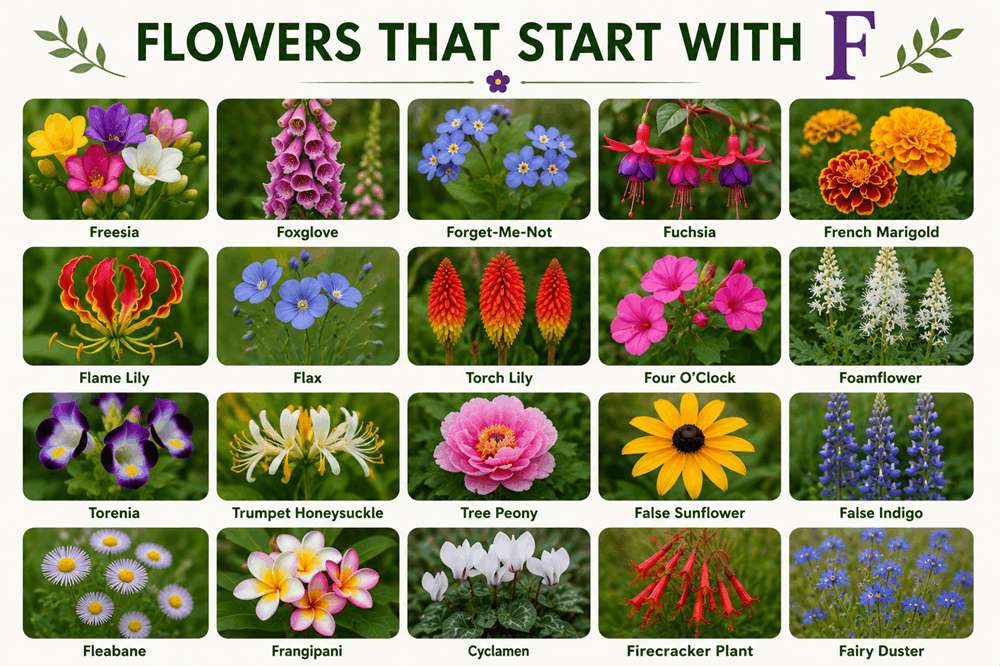
Flowers that start with F include freesias, foxgloves, forget-me-nots, fuchsias, French marigolds, flame lilies, and many other colorful plants. Some are fragrant bulbs or cut flowers, while others grow as annuals, perennials, shrubs, vines, or woodland plants. This guide introduces 25 flowers beginning with F, along with their appearance, growing habits, symbolism, and practical uses in gardens, containers, pollinator plantings, and bouquets.
1. Freesia
Freesia is one of the best-known flowers beginning with F. Its graceful, funnel-shaped flowers grow along slender arching stems and are prized for their sweet fragrance.
Colors include white, cream, yellow, orange, pink, red, lavender, and purple. Many varieties have bicolored or contrasting centers.
Freesias grow from corms and prefer bright light, mild temperatures, and well-drained soil. They perform especially well in climates with cool winters and relatively mild spring weather.
As cut flowers, freesias are popular in wedding bouquets and fragrant arrangements. They are often associated with friendship, trust, innocence, and thoughtfulness.
2. Foxglove
Foxgloves produce tall flower spikes lined with tubular, bell-shaped blooms. Their flowers may be pink, purple, white, yellow, peach, or rose, often with spotted throats.
These plants are classic additions to cottage gardens and woodland edges. Many varieties prefer partial shade, although they can tolerate more sunlight in cooler climates.
Foxgloves attract bees, which often climb deep inside the tubular flowers to reach nectar.
All parts of foxglove are highly toxic if eaten. The plant contains potent cardiac compounds, so it should be grown carefully around children, pets, and livestock.
3. Forget-Me-Not
Forget-me-nots produce clusters of small blue flowers with bright yellow or white centers. Pink and white forms are also available.
They prefer cool conditions and often grow well in partial shade with consistently moist soil.
Forget-me-nots can reseed freely and may spread into soft colonies around woodland edges, streams, and shaded borders.
The flowers are strongly associated with remembrance, enduring affection, loyalty, and memories of loved ones.
4. Fuchsia
Fuchsias produce distinctive hanging flowers with long stamens and layered petals. Their blooms may combine pink, red, purple, white, orange, or coral.
Many varieties grow beautifully in hanging baskets, where the flowers can dangle freely beneath the foliage.
Fuchsias generally prefer bright shade or morning sunlight with protection from intense afternoon heat. They appreciate consistent moisture but dislike waterlogged soil.
Hummingbirds are strongly attracted to their nectar-rich flowers, making fuchsias excellent for shaded wildlife gardens.
5. French Marigold
French marigolds are compact annuals with bright yellow, orange, red, bronze, and bicolored flowers.
The plants are easy to grow from seed and bloom from late spring until frost when given enough sunlight.
French marigolds stay shorter than many African marigolds, making them useful for border edges, containers, vegetable gardens, and mass plantings.
Regular deadheading encourages continued flowering throughout summer.
6. Flame Lily
Flame lily produces dramatic flowers with narrow, curling petals in red, orange, yellow, and combinations of those colors.
The petals sweep backward, giving each flower the appearance of flames moving upward.
The plant grows as a climbing perennial in warm climates and requires support for its slender stems.
Flame lily is striking but highly toxic. Every part of the plant, especially the underground tubers, should be kept away from children and pets.
7. Flax Flower
Flax produces delicate open flowers on slender stems. Blue is the classic color, although some varieties bloom in white, pink, red, or yellow.
The flowers often last only a short time individually, but plants continue opening new blooms over an extended period.
Flax prefers full sun and well-drained soil and works beautifully in meadow gardens, cottage borders, and naturalistic plantings.
Blue flax is particularly valued for its soft sky-blue color and fine-textured growth.
8. Fleabane
Fleabane, or Erigeron, produces small daisy-like flowers with numerous narrow petals surrounding yellow centers.
Colors range from white and pale pink to lavender and purple. Some varieties change color as the blooms age.
Fleabane grows well in sunny, well-drained locations and can flower for a remarkably long period.
It is especially attractive spilling over walls, steps, stone paths, and cottage-garden borders.
9. Four O’Clock
Four o’clock flowers typically begin opening late in the afternoon and remain open into the evening.
Blooms may be pink, yellow, white, red, magenta, or striped, and a single plant can sometimes produce several colors.
The flowers often release a noticeable fragrance after sunset and can attract moths and other evening pollinators.
Four o’clocks prefer full sun or light shade and warm weather. In mild climates, they may return from underground tubers each year.
10. Foamflower
Foamflower produces airy spikes of tiny white or pale pink flowers above attractive foliage.
It is a woodland perennial that performs well in partial shade and rich, moist soil.
The flowers create a soft, foamy appearance when several plants bloom together, which explains the common name.
Foamflower works particularly well beneath deciduous trees, along shaded paths, and in woodland-style ground-cover plantings.
11. Fairy Primrose
Fairy primrose produces delicate clusters of pink, purple, lavender, or white flowers above softly textured foliage.
The plant prefers cool temperatures and bright indirect light. It is often grown in containers or protected garden areas.
Fairy primrose can provide color during cooler seasons when many warm-weather annuals are dormant.
Its dainty flower clusters work well in small pots and windowsill displays.
12. False Indigo
False indigo, commonly known as Baptisia, produces tall spikes of pea-like flowers above blue-green foliage.
Blue-purple is the classic color, but modern varieties may also bloom in white, yellow, pink, chocolate, or combinations of several shades.
False indigo prefers full sun and well-drained soil. Once established, its deep root system makes it highly drought tolerant.
Mature plants can become large and shrub-like, making them valuable as structural perennials in sunny borders.
13. False Sunflower
False sunflower, or Heliopsis, produces bright yellow or golden daisy-like blooms through summer.
The plant resembles a smaller branching sunflower and works particularly well in cottage gardens and perennial borders.
It prefers full sun and ordinary garden soil and can bloom for an extended period with regular deadheading.
The flowers attract bees, butterflies, and other beneficial insects.
14. Feverfew
Feverfew produces small white daisy-like flowers with yellow centers above aromatic foliage.
The plant has a traditional cottage-garden appearance and can flower generously during summer.
It prefers full sun or light shade and well-drained soil. Feverfew may reseed readily where conditions suit it.
Although the plant has a history of herbal use, garden plants should never be consumed casually without appropriate knowledge and guidance.
15. Firecracker Plant
Firecracker plant produces masses of narrow tubular flowers, commonly in bright red or coral.
The arching stems can create a cascading fountain of color, making the plant especially effective in large containers and hanging situations.
It thrives in warm climates with bright light and well-drained soil.
The tubular flowers are highly attractive to hummingbirds, which can visit repeatedly while the plant remains in bloom.
16. Firebush
Firebush is a warm-climate shrub with clusters of red-orange tubular flowers.
The plant can bloom for much of the warm season and is particularly valuable in butterfly and hummingbird gardens.
It prefers full sun or light shade and tolerates heat very well once established.
In tropical and subtropical areas, firebush can become a substantial shrub. In cooler regions, it may be grown as a seasonal container plant.
17. Flannel Flower
Flannel flower is an Australian native known for soft white star-shaped blooms surrounded by fuzzy bracts.
The flowers have an unusual velvety texture that gives the plant its common name.
Flannel flowers prefer excellent drainage and bright light. They are adapted to relatively lean soils and may react poorly to excessive fertilizer.
Their delicate white-and-green appearance makes them attractive in modern bouquets and native-style gardens.
18. Flowering Maple
Flowering maple, or Abutilon, is not a true maple but gets its name from the maple-like shape of its leaves.
The plant produces hanging bell-shaped flowers in yellow, orange, red, pink, white, or bicolored combinations.
Flowering maple prefers bright light and warm temperatures and can bloom for long periods under favorable conditions.
In cold climates, it is commonly grown in containers and moved indoors before frost.
19. Florist’s Cyclamen
Florist’s cyclamen produces elegant upswept flowers above heart-shaped leaves, often patterned with silver.
Flowers may be white, pink, red, purple, magenta, or bicolored.
Unlike many tropical houseplants, cyclamen prefers cool conditions and bright indirect light.
After flowering, the plant may enter dormancy and lose its foliage. This resting phase is normal.
Cyclamen is toxic to pets if eaten, particularly the underground tuber.
20. Frangipani
Frangipani, also called plumeria, produces fragrant tropical flowers with thick petals and smooth rounded shapes.
Colors include white, yellow, pink, red, peach, and combinations with contrasting centers.
Frangipani thrives in warmth, full sun, and well-drained soil. The plant develops into a small tree or large shrub in frost-free climates.
Its strongly scented flowers are often associated with tropical gardens, leis, perfume, and warm-weather landscapes.
21. Fringe Flower
Fringe flower produces clusters of narrow ribbon-like petals that create a soft, feathery appearance.
Depending on the variety, flowers may be white, pink, or deep magenta. Some cultivated forms also have burgundy-purple foliage.
The shrub prefers full sun or partial shade and soil that drains well.
Fringe flower works well as a foundation shrub, informal hedge, or colorful foliage plant in mild climates.
22. Fritillaria
Fritillaria is a group of spring bulbs with distinctive hanging or bell-shaped flowers.
Some species produce checkered purple blooms, while others develop tall crowns of orange, yellow, or red flowers.
Fritillarias prefer well-drained soil and generally flower best in locations with bright spring light.
Crown imperial is one of the largest types, while snake’s head fritillary is known for its delicate checkered pattern.
23. Fairy Duster
Fairy duster produces fluffy pink, red, or pale flowers made up largely of long projecting stamens.
The plant is adapted to hot, dry climates and is especially useful in desert and xeriscape gardens.
It prefers full sun and soil with excellent drainage and becomes drought tolerant once established.
The flowers attract hummingbirds and other pollinators while adding a soft, unusual texture to dry landscapes.
24. Fairy Lily
Fairy lily is a common name used for certain rain lilies, which produce delicate trumpet-shaped flowers after periods of rain.
Blooms may be pink, white, yellow, or lavender depending on the species.
The plants grow from small bulbs and form clumps of narrow grassy leaves.
Fairy lilies prefer sunny or lightly shaded locations with well-drained soil and look especially attractive when planted in groups.
25. Forest Lily
Forest lily is a common name used for certain shade-loving bulbous plants, particularly in regions with mild climates.
Depending on the species, the flowers may appear in pink, white, orange, red, or pale shades.
These plants generally perform best in woodland-like environments with filtered light, rich soil, and consistent moisture.
Because “forest lily” can refer to more than one plant, checking the botanical name is important when purchasing one for a specific garden or when pet safety matters.
Which F Flowers Are Best for Containers?
Fuchsias, freesias, French marigolds, flowering maple, fairy primrose, florist’s cyclamen, and compact firecracker plants all perform well in containers.
Fuchsias are particularly suited to hanging baskets, while freesias grow beautifully in spring pots. French marigolds are easy choices for sunny summer containers.
Use containers with drainage holes and match the potting mix to the plant. A moisture-loving fuchsia has very different needs from a drought-tolerant fairy duster.
Which F Flowers Attract Hummingbirds?
Fuchsia, firecracker plant, firebush, fairy duster, and some flowering maple varieties are excellent hummingbird flowers.
Their tubular or nectar-rich blooms allow hummingbirds to feed while hovering.
For a stronger hummingbird garden, combine several flowers with different blooming periods so nectar remains available for more of the season.
Which F Flowers Attract Bees and Butterflies?
False sunflower, false indigo, flax, fleabane, feverfew, French marigolds, and forget-me-nots can all attract pollinating insects.
Open daisy-like flowers such as false sunflower are particularly easy for bees and butterflies to use.
A pollinator garden works best when flowers are planted in noticeable groups and pesticide use is kept to a minimum.
Which F Flowers Work Well in Bouquets?
Freesias, foxgloves, forget-me-nots, flannel flowers, fritillarias, flax, and frangipani can all contribute to floral arrangements.
Freesias add fragrance, foxgloves provide height, and flannel flowers create a soft white-and-green texture.
Fritillarias are particularly useful when a bouquet needs an unusual shape, while forget-me-nots add delicate blue coloring.
Flowers with hollow or delicate stems should be handled gently and placed in clean water soon after cutting.
Which F Flowers Are Best for Shade?
Fuchsias, foamflower, forget-me-nots, foxgloves, and forest lilies are among the better choices for partial shade.
Foamflower is especially useful beneath deciduous trees, while fuchsias are ideal for shaded hanging baskets and patios.
French marigolds, false sunflower, fairy duster, and many flax varieties generally flower better in stronger sunlight.
Which F Flowers Are Best for Dry Gardens?
Fairy duster, false indigo, flax, fleabane, and some fringe flowers can tolerate relatively dry conditions once established.
Excellent drainage is especially important for drought-tolerant plants. Constantly wet soil can damage roots even when the plant handles summer heat well.
Newly planted specimens still need regular watering until they develop strong root systems.
Which F Flowers Prefer Moist Soil?
Fuchsias, foamflowers, forget-me-nots, and some forest lilies appreciate consistent moisture.
Foamflower and forget-me-not are especially suitable for woodland-style areas where the soil remains cool and damp.
Moist soil should not automatically mean standing water. Most of these flowers still need oxygen around their roots and benefit from good drainage.
Which F Flowers Are Fragrant?
Several flowers beginning with F are especially valued for scent.
Freesia has a fresh, sweet fragrance and is widely used by florists. Frangipani has a rich tropical perfume, while four o’clocks often release fragrance during the evening.
Some flowering maples and fringe flowers have lighter scents, while foxglove and false sunflower are grown more for appearance than fragrance.
If fragrance is important, place strongly scented plants near patios, doorways, seating areas, and frequently used garden paths.
Which F Flowers Bloom for a Long Time?
French marigolds, fuchsias, firebush, firecracker plants, fleabane, and false sunflower can all flower for extended periods under suitable conditions.
French marigolds may continue until frost, while firebush can flower for much of the year in tropical climates.
Regular deadheading, proper sunlight, consistent watering, and occasional trimming can help extend the flowering period of many long-blooming plants.
Which F Flowers Need Extra Caution?
Foxglove and flame lily are among the most important F flowers to treat cautiously because both contain powerful toxic compounds.
Florist’s cyclamen is also toxic to pets if eaten, particularly the tuber.
Some common flower names can refer to more than one species. Forest lily and fairy lily are examples, so confirming the botanical name is important when toxicity, climate suitability, or growing requirements matter.
The Bottom Line
Flowers that start with F include familiar favorites such as freesia, foxglove, forget-me-not, fuchsia, French marigold, and frangipani. The group also includes distinctive plants such as flame lily, flannel flower, foamflower, fritillaria, fairy duster, and flowering maple.
There are F flowers for nearly every type of garden. Fairy duster thrives in hot, dry landscapes, foamflower prefers woodland shade, fuchsia brightens partially shaded containers, and French marigolds provide dependable summer color in full sun.
When choosing an F flower, consider sunlight, soil, moisture, mature size, climate, toxicity, and growth habit. Matching each plant to the right environment will produce healthier growth, stronger flowering, and a garden with more color, fragrance, and seasonal variety.