How Many Flowers Are in a Bouquet? A Practical Stem Count Guide
Most bouquets contain somewhere between 10 and 30 flower stems, but there is no single standard number. A small hand-tied bouquet may use 6 to 12 stems, an average gift bouquet often contains 12 to 24, and a large luxury arrangement may include 30 to 50 stems or more. The final number depends on flower size, bouquet style, greenery, budget, and how full you want the arrangement to look.
How Many Flowers Are Usually in a Bouquet?
A typical bouquet usually contains around 12 to 24 stems. That range creates enough fullness for a noticeable arrangement without making it difficult to hold or place in an ordinary vase.
However, counting stems does not always tell you how large a bouquet will appear. Twelve hydrangea stems can create an enormous arrangement, while twelve delicate sweet pea stems may still look relatively small.
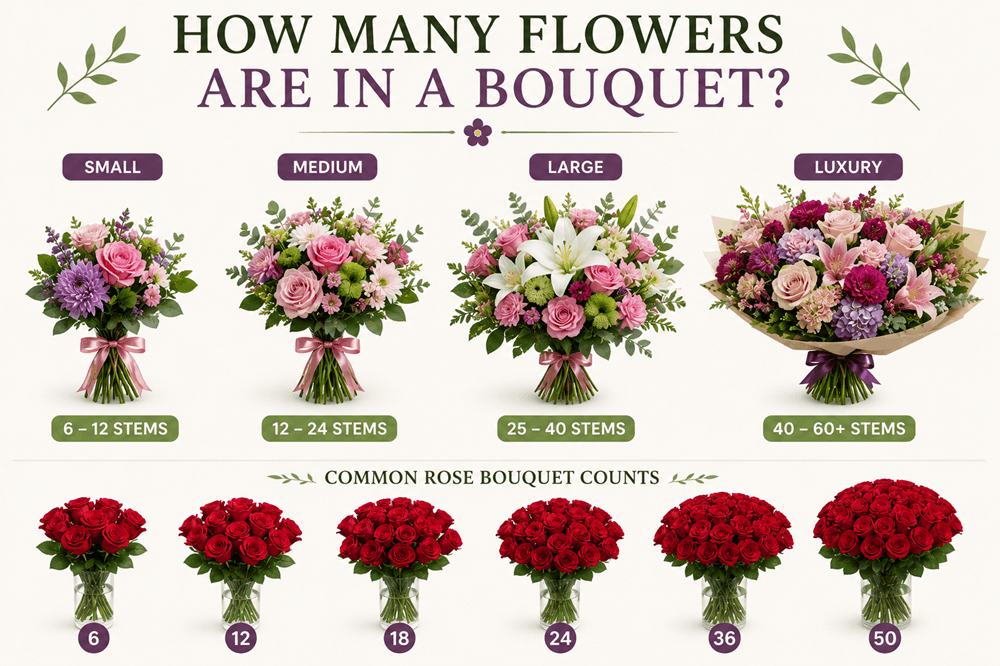
A useful general guide is:
- Small bouquet: 6 to 12 stems
- Medium bouquet: 12 to 24 stems
- Large bouquet: 25 to 40 stems
- Luxury bouquet: 40 to 60 stems or more
These numbers normally include the main flowers but may or may not include greenery and filler stems, depending on how a florist describes the arrangement.
Does One Stem Always Mean One Flower?
No. This is one reason bouquet sizes can be confusing.
A rose stem normally carries one main rose. A hydrangea stem carries one enormous flower cluster. A spray rose stem may contain several smaller roses, while an alstroemeria stem can hold numerous individual flowers and buds.
One stem of baby’s breath can also branch into dozens of tiny flowers.
Because of this, a 15-stem bouquet can look very different depending on which flowers are used.
Florists generally think about visual volume, proportion, and focal flowers rather than simply trying to reach a particular number.
How Many Roses Are in a Typical Bouquet?
Rose bouquets are easier to count because most standard florist roses produce one primary flower per stem.
Common rose bouquet sizes include:
- 6 roses
- 12 roses
- 18 roses
- 24 roses
- 36 roses
- 50 roses
A dozen roses remains one of the most familiar arrangements. It creates a medium-sized bouquet that works well for birthdays, anniversaries, romantic gifts, and congratulations.
For a fuller luxury arrangement, 18 to 24 roses usually creates a stronger visual impact.
Large bouquets of 36 or 50 roses can be dramatic, but they also require a substantial vase and plenty of space.
How Many Flowers Are in a Small Bouquet?
A small bouquet often contains 6 to 12 main flower stems.
This size works well for casual gifts, small tables, thank-you flowers, children’s bouquets, or simple hand-tied arrangements.
A small mixed bouquet might contain:
- 3 roses
- 3 carnations
- 2 chrysanthemums
- 2 filler stems
- A few pieces of greenery
That creates around 10 flower stems while still looking balanced.
If you use larger flowers such as hydrangeas, lilies, or sunflowers, you may need even fewer stems.
How Many Flowers Are in a Medium Bouquet?
A medium bouquet generally contains around 12 to 24 flower stems.
This is one of the most practical sizes for birthdays, anniversaries, Mother’s Day, congratulations, and general gift giving.
A mixed bouquet in this range might contain:
- 6 roses
- 5 carnations
- 4 lisianthus stems
- 3 alstroemeria stems
- 2 filler flower stems
- Greenery
Even though the bouquet contains around 20 flower stems, branching flowers such as lisianthus and alstroemeria can make it appear much fuller.
How Many Flowers Are in a Large Bouquet?
A large bouquet often contains between 25 and 40 flower stems.
This size works well when the bouquet needs to make a strong impression, such as for a milestone birthday, anniversary, engagement, graduation, or major celebration.
Large bouquets may combine several focal flowers with smaller supporting blooms.
For example, a 30-stem arrangement could include:
- 10 roses
- 6 ranunculus
- 5 lisianthus stems
- 4 carnations
- 5 filler flower stems
- Additional greenery
A bouquet this size can become heavy, particularly if it contains thick-stemmed flowers or large amounts of foliage.
How Many Flowers Are in a Luxury Bouquet?
Luxury bouquets often contain 40 to 60 stems or more, but premium design is not determined by stem count alone.
A florist may create a luxurious arrangement with only 20 premium flowers if those flowers are unusually large, expensive, or carefully arranged.
Garden roses, peonies, orchids, hydrangeas, calla lilies, proteas, and premium ranunculus can create a high-end appearance without requiring an enormous number of stems.
On the other hand, a dramatic bouquet of 50 roses relies heavily on repetition and scale.
Luxury usually comes from a combination of flower quality, freshness, color coordination, design, and presentation rather than simply adding more stems.
How Many Flowers Are in a Bridal Bouquet?
A bridal bouquet commonly contains around 20 to 40 flower stems, although the number varies dramatically with bouquet style.
A compact round bridal bouquet might use 20 to 25 stems, while a large garden-style arrangement may require 30 to 50 or more.
The type of flower matters significantly.
A bridal bouquet made primarily from roses or ranunculus may need many individual stems. A bouquet featuring hydrangeas, peonies, or king protea can achieve substantial volume with far fewer flowers.
Greenery and trailing foliage can also make a bouquet look larger without dramatically increasing the number of flowers.
How Many Flowers Are in a Bridesmaid Bouquet?
Bridesmaid bouquets are usually smaller than the bridal bouquet.
A typical bridesmaid bouquet may contain around 10 to 20 flower stems.
Using the same flowers as the bridal bouquet in a smaller quantity creates visual consistency while keeping the bride’s arrangement more prominent.
For example, if the bridal bouquet contains 30 mixed stems, a bridesmaid bouquet might use 15 to 18 stems in similar colors.
How Many Flowers Are Needed for a Hand-Tied Bouquet?
A simple hand-tied bouquet usually needs around 12 to 20 stems.
For beginners, 15 stems is a useful starting point because it provides enough material to create a rounded arrangement without becoming difficult to handle.
You might use:
- 5 focal flowers
- 5 secondary flowers
- 3 filler flowers
- 2 to 4 greenery stems
Rotate the bouquet gradually as you add each stem so the flowers remain evenly distributed.
Once the bouquet feels balanced, secure the stems with floral tape, twine, or ribbon.
How Many Flowers Should Be in a Birthday Bouquet?
A birthday bouquet generally works well with 12 to 24 stems.
A smaller casual birthday arrangement may contain around 10 flowers, while a milestone birthday bouquet might contain 24, 30, or more.
There is no need to match the flower count to the recipient’s age unless you specifically want to create that kind of personalized gift.
Color and flower choice often matter more than number. A dozen flowers in the recipient’s favorite colors can feel more thoughtful than a huge arrangement chosen without considering their preferences.
How Many Flowers Should You Give for an Anniversary?
Anniversary bouquets often contain 12 to 24 flowers, especially when roses are used.
Twelve roses remain a traditional romantic choice, while 24 creates a fuller, more dramatic arrangement.
You can also make the bouquet more personal by matching the number of flowers to years together.
For example, a tenth anniversary bouquet could contain 10 roses or 10 focal flowers surrounded by smaller filler flowers and greenery.
The symbolism is optional. A beautifully designed bouquet does not need a numerical meaning to feel romantic.
How Many Flowers Should You Give Someone?
For most everyday occasions, 10 to 20 stems is enough to create an attractive gift bouquet.
A small bouquet is suitable for:
- Thank-you gifts
- Casual birthdays
- Housewarming gifts
- Get-well wishes
- Congratulations
- Thinking-of-you flowers
A larger bouquet may be appropriate for romantic occasions, major milestones, formal celebrations, or when several people are contributing to the gift.
How Many Flowers Do You Need for a Vase?
The number depends on the width and height of the vase.
A narrow bud vase may need only one to three stems. A medium household vase often holds 10 to 20 stems comfortably. A large statement vase may require 25 flowers or more.
The opening is particularly important.
If the vase opening is very wide, a small number of flowers may spread apart and look sparse. A narrower neck naturally gathers the stems and can make a smaller bouquet appear fuller.
As a rough guide:
- Bud vase: 1 to 3 stems
- Small vase: 5 to 10 stems
- Medium vase: 10 to 20 stems
- Large vase: 20 to 40 stems
Large Flowers Require Fewer Stems
The size of each bloom may have more influence on bouquet fullness than the actual stem count.
Hydrangeas are a good example. Three to five large hydrangea stems can fill a medium vase by themselves.
Peonies also create substantial volume. A bouquet containing 10 large open peonies may appear as full as an arrangement containing twice as many smaller flowers.
Other large focal flowers include:
- Sunflowers
- King protea
- Dinner-plate dahlias
- Large chrysanthemums
- Oriental lilies
When using large flowers, begin with fewer stems and add more only if the bouquet genuinely needs additional volume.
Small Flowers Require More Stems
Flowers with narrow stems and small blooms usually need to be grouped in larger quantities.
Examples include:
- Sweet peas
- Freesia
- Waxflower
- Lavender
- Statice
- Small spray roses
- Baby’s breath
However, branching stems can complicate the calculation. One spray rose stem might carry five or more blooms, so 10 stems can still create considerable fullness.
Should Greenery Count as Part of the Bouquet?
When planning a bouquet yourself, it is usually easiest to count flower stems and greenery separately.
For example, you might plan a bouquet with 18 flower stems plus 6 greenery stems.
Common foliage includes eucalyptus, ruscus, salal, fern, olive branches, and pittosporum.
Greenery can dramatically increase the visual size of an arrangement without adding more flowers.
For a modern, flower-heavy style, use very little greenery. For a loose garden-style bouquet, foliage may make up a substantial portion of the arrangement.
What Is a Good Flower-to-Greenery Ratio?
There is no strict rule, but around 70 to 80 percent flowers and 20 to 30 percent greenery creates a balanced traditional bouquet.
A contemporary arrangement may contain almost no greenery, while a wild garden bouquet may use closer to equal amounts of flowers and foliage.
The important thing is that greenery supports the flowers rather than making the bouquet look unintentionally sparse.
How to Make a Bouquet Look Fuller With Fewer Flowers
You do not necessarily need dozens of expensive flowers to create a full-looking bouquet.
Start with a few large focal flowers. Add branching secondary flowers and then use filler blooms to occupy smaller spaces.
Greenery can extend the outline and give the arrangement more volume.
Useful flowers for increasing fullness include:
- Hydrangeas
- Chrysanthemums
- Carnations
- Lisianthus
- Alstroemeria
- Spray roses
- Baby’s breath
Keeping the stems at slightly different heights also creates dimension and prevents the bouquet from looking compressed.
Odd or Even Number of Flowers?
In casual floral design, odd numbers are often useful because they can create a natural-looking arrangement. Three, five, seven, or nine focal flowers are easy to distribute without creating obvious symmetry.
However, there is no universal requirement that a bouquet must contain an odd number of flowers.
Traditional rose bouquets frequently contain 12 or 24 stems, both even numbers.
Cultural meanings can also vary. In some places, certain flower numbers have strong associations with romance, mourning, or celebration.
If the bouquet is intended for someone from a culture with specific flower-count traditions, it may be worth considering those customs.
How to Calculate Flowers for Your Own Bouquet
A simple approach is to decide on the bouquet size first.
For a medium hand-tied bouquet, begin with approximately:
- 5 to 7 focal flowers
- 5 to 7 secondary flowers
- 3 to 5 filler stems
- 3 to 6 greenery stems
This produces roughly 13 to 19 flower stems plus foliage.
Adjust the number depending on bloom size. If your focal flowers are enormous hydrangeas, you may need only three. If they are small roses, you may need seven or more.
Build the arrangement gradually instead of buying an exact number and assuming every stem must be used.
The Bottom Line
Most bouquets contain around 10 to 30 flower stems, with 12 to 24 being a common range for an everyday gift bouquet. Small arrangements may contain only 6 to 12 stems, while large or luxury bouquets can contain 30, 40, 50, or more.
The number alone does not determine the size of a bouquet. Hydrangeas, peonies, lilies, and sunflowers create far more volume per stem than delicate flowers such as sweet peas or lavender. Branching flowers such as spray roses, lisianthus, and alstroemeria can also make a relatively low stem count appear much fuller.
If you are making your own bouquet, start with about 15 to 20 flower stems for a medium arrangement and add greenery separately. Focus on proportion, color, flower size, and balance rather than trying to reach a particular number. A well-designed bouquet with fewer beautiful stems will usually look better than an overcrowded arrangement built around stem count alone.