Flowers That Start With I: Twenty-Five Beautiful Blooms for Gardens and Bouquets
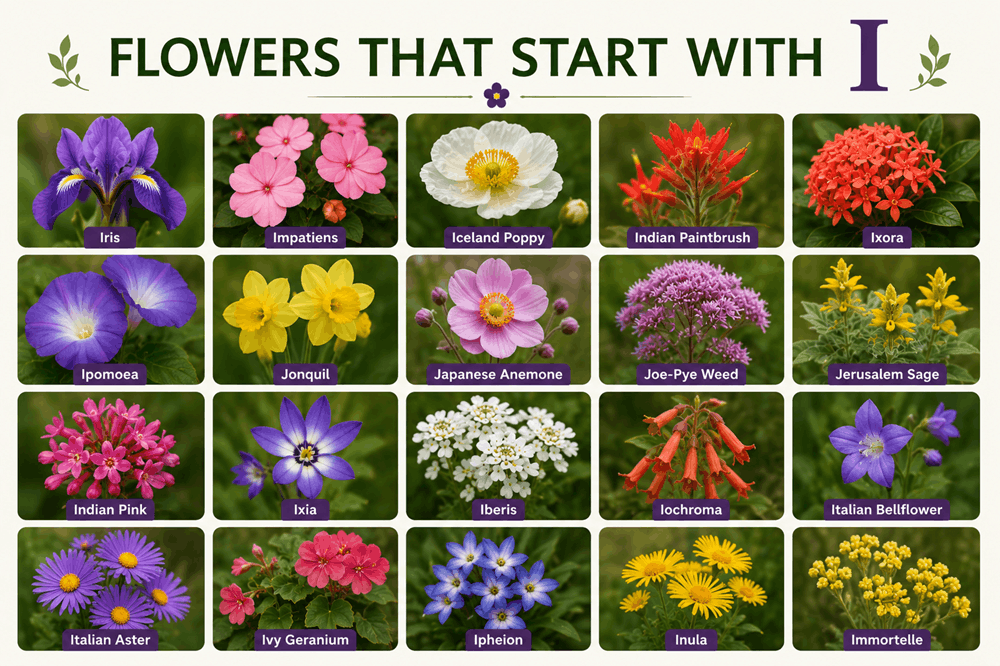
Flowers that start with I include irises, impatiens, ixora, Iceland poppies, Indian paintbrush, and several lesser-known but beautiful garden plants. Some grow as bulbs or rhizomes, while others are annuals, perennials, shrubs, tropical flowers, or woodland plants. This guide introduces 25 flowers beginning with I, along with their appearance, growing habits, symbolism, and practical uses in gardens, containers, pollinator plantings, and floral arrangements.
1. Iris
Iris is one of the most recognizable flowers beginning with I. Its blooms have distinctive upright petals known as standards and lower petals called falls.
Irises come in an enormous range of colors, including purple, blue, white, yellow, pink, peach, orange, burgundy, and multicolored combinations.
Different types have different growing needs. Bearded irises prefer sunny locations and excellent drainage, while Japanese and Siberian irises generally tolerate more moisture.
Irises commonly symbolize wisdom, faith, courage, hope, and admiration. Their strong shape also makes them popular in cut-flower arrangements.
2. Impatiens
Impatiens are among the most useful flowers for shaded gardens. Their soft, colorful blooms can cover plants from late spring until frost.
Flowers may be white, pink, red, coral, orange, lavender, or purple. Some varieties have single flowers, while others produce double blooms resembling miniature roses.
Traditional impatiens prefer partial shade and consistent moisture. They are excellent for shaded beds, porch containers, hanging baskets, and window boxes.
Too much intense sunlight can cause leaves to scorch, particularly in hot climates.
3. New Guinea Impatiens
New Guinea impatiens produce larger flowers and thicker foliage than traditional bedding impatiens.
They are available in vivid shades of red, orange, pink, lavender, purple, and white. Their leaves may be deep green, bronze, or variegated.
These plants generally tolerate more sunlight than standard impatiens, although they still appreciate protection from extreme afternoon heat.
They work beautifully in containers and partly shaded flower beds where continuous summer color is needed.
4. Iceland Poppy
Iceland poppies produce delicate, papery flowers on slender stems. Their blooms appear in white, yellow, orange, peach, pink, and red.
The flowers move easily in the breeze and have a light, translucent appearance that makes them especially attractive in cottage gardens.
Iceland poppies prefer cool conditions and often perform best in spring or fall. They may struggle during hot, humid summers.
Their flowers are popular in natural-looking bouquets, although the stems need careful handling because they can be delicate.
5. Indian Paintbrush
Indian paintbrush is a striking wildflower known for colorful bracts that surround its smaller true flowers.
Red and orange are the most familiar colors, although some species appear pink, yellow, cream, or purple.
These plants are unusual because many are partially parasitic. Their roots connect with neighboring plants and obtain some water and nutrients from them.
Indian paintbrush is best suited to native or naturalistic landscapes rather than ordinary garden beds where intensive cultivation is expected.
6. Ixora
Ixora is a tropical shrub that produces dense clusters of small star-shaped flowers.
Colors include red, orange, pink, yellow, and white. The flowers can appear repeatedly throughout warm weather in suitable climates.
Ixora prefers warmth, bright light, acidic soil, and consistent moisture without waterlogged roots.
In frost-free climates, it can be used as a flowering hedge or foundation shrub. In colder regions, compact varieties may be grown in containers and protected during winter.
7. Ipomoea
Ipomoea is the botanical group that includes morning glories and moonflowers. These fast-growing vines produce funnel-shaped flowers in blue, purple, pink, white, red, or multicolored forms.
Morning glory flowers generally open early in the day, while moonflowers open toward evening.
Most varieties prefer full sun and a trellis, fence, or arbor for climbing.
Some Ipomoea species reseed heavily or spread aggressively, so local growing recommendations should be checked before planting.
8. Ixia
Ixia, sometimes called African corn lily, produces colorful star-shaped flowers on thin upright stems.
Blooms may be white, yellow, orange, pink, red, purple, or greenish, often with contrasting dark centers.
Ixia grows from corms and prefers full sun with excellent drainage. It performs particularly well in climates with mild winters and relatively dry summers.
The slender stems make Ixia useful in light, airy floral arrangements.
9. Iberis
Iberis is better known as candytuft. It forms low mounds covered with clusters of small white, pink, or pale lavender flowers.
Evergreen candytuft is particularly popular in rock gardens, along walls, beside paths, and at the front of sunny borders.
The plant prefers full sun and well-drained soil. Once established, it tolerates moderate dryness.
A light trim after flowering helps maintain a compact shape and can encourage additional growth.
10. Incarvillea
Incarvillea is sometimes called hardy gloxinia because its large trumpet-shaped flowers resemble those of tropical gloxinia.
Blooms are usually pink, rose, magenta, or white with yellow throats.
The plant prefers rich but well-drained soil and plenty of sunlight. It grows from thick underground roots and may be slow to emerge in spring.
Incarvillea works well in perennial borders and cottage-style gardens where its bright flowers can stand above lower plants.
11. Indigo
Indigo plants produce clusters of small pea-like flowers in pink, purple, violet, or white, depending on the species.
Some species are historically important because their leaves were used to produce natural indigo dye.
These plants generally prefer warm conditions and plenty of sunlight. Growth habit varies from small perennial plants to woody shrubs.
In a garden, indigo flowers create a loose, natural appearance and may attract pollinating insects.
12. Indian Blanket
Indian blanket is a colorful wildflower closely related to blanket flower. Its daisy-like blooms usually combine red or burgundy centers with bright yellow petal tips.
The plant thrives in full sun and tolerates heat, drought, and relatively poor soil.
It is especially well suited to prairie gardens, wildflower meadows, and low-maintenance landscapes.
The flowers attract bees and butterflies and can bloom for an extended period under favorable conditions.
13. Indian Hawthorn
Indian hawthorn is an evergreen flowering shrub with clusters of small pink or white flowers.
The blooms usually appear heavily in spring and may be followed by dark blue or purple-black berries.
The shrub prefers full sun or partial shade and soil with good drainage. Once established, it can tolerate some drought.
Indian hawthorn works well as a low hedge, foundation planting, or compact ornamental shrub in mild climates.
14. Indian Pink
Indian pink is a woodland perennial with striking red tubular flowers that open to reveal yellow interiors.
The bold red-and-yellow combination makes the flowers highly visible to hummingbirds.
Indian pink grows well in partial shade and prefers rich, moist soil with good drainage.
It is an excellent native-style choice for woodland gardens and shady hummingbird plantings.
15. Indian Mallow
Indian mallow produces small cup-shaped flowers, usually in yellow, orange, or pale shades, above soft foliage.
Depending on the species, the plant may grow as an annual, perennial, or small shrub.
Many forms prefer warm conditions and sunny locations. Their mallow-like flowers resemble smaller versions of hibiscus or hollyhock blooms.
The exact common name can refer to several related plants, so checking the botanical species is helpful when choosing one for the garden.
16. Italian Aster
Italian aster produces daisy-like flowers with purple, lavender, or blue-violet petals surrounding yellow centers.
The plant flowers later in the season and can extend garden color into late summer and fall.
It prefers full sun and well-drained soil and works well in cottage gardens, perennial borders, and pollinator plantings.
The flowers attract bees and butterflies at a time when many earlier perennials have finished blooming.
17. Italian Bellflower
Italian bellflower produces delicate blue, lavender, or violet flowers with a star-like or bell-shaped form.
It is often grown as a trailing plant in hanging baskets, window boxes, and containers.
The plant prefers bright indirect light or gentle outdoor sun and consistent moisture without soggy soil.
Its cascading stems can become covered with flowers, creating a soft waterfall effect over the edge of a pot.
18. Italian Jasmine
Italian jasmine is a flowering shrub or climbing plant with clusters of yellow flowers.
Unlike the classic white jasmine used heavily in perfumery, yellow jasmine species may have a lighter or different fragrance.
The plant prefers bright sunlight and well-drained soil and performs best in relatively mild climates.
Its yellow flowers add warm color to walls, fences, and informal shrub borders.
19. Ipheion
Ipheion, commonly called spring starflower, produces small star-shaped flowers in pale blue, lavender, white, or violet.
The bulbs bloom during spring and create their strongest visual effect when planted in groups.
Ipheion prefers full sun or light shade and well-drained soil. It can naturalize over time in lawns, rock gardens, and beneath deciduous shrubs.
The foliage has an onion-like scent when crushed.
20. Isotoma
Isotoma produces small star-shaped flowers, usually in blue, lavender, purple, pink, or white.
Many varieties stay low and spreading, making them suitable for containers, hanging baskets, and border edges.
The plant prefers bright light and soil that remains moderately moist without becoming waterlogged.
Some Isotoma species contain irritating sap, so washing hands after handling damaged stems is sensible.
21. Iochroma
Iochroma is a tropical or subtropical flowering shrub with clusters of long tubular flowers.
Colors may include deep purple, blue-violet, red, pink, yellow, or white.
The flowers hang in clusters and are especially attractive to hummingbirds.
Iochroma prefers warm conditions, bright light, and regular moisture. In colder climates, it can be grown in a large container and moved into winter protection.
22. Ironweed
Ironweed is a tall native perennial with clusters of intense purple flowers in late summer.
Its upright stems and vivid coloring make it particularly useful in meadow gardens and naturalistic borders.
Ironweed prefers full sun and can tolerate moist soil better than many drought-oriented prairie plants.
The flowers attract butterflies, bees, and other beneficial insects during the later part of the growing season.
23. Ivy Geranium
Ivy geranium is a trailing pelargonium with glossy ivy-like leaves and clusters of colorful flowers.
Blooms may be red, pink, lavender, white, coral, or bicolored.
Its trailing stems make it especially effective in hanging baskets, balcony boxes, and elevated containers.
Ivy geranium prefers bright light and soil with good drainage. In extremely hot climates, some afternoon protection can help preserve the flowers and foliage.
24. Immortelle
Immortelle is a common name associated with everlasting flowers whose papery blooms maintain their color after drying.
Depending on the exact species, flowers may be yellow, gold, orange, pink, or white.
These plants are valued for dried bouquets because the petals retain their shape and texture for months.
Most everlasting-type flowers prefer sunny, warm conditions and good drainage.
The name “immortelle” reflects their long-lasting appearance after harvest.
25. Inula
Inula includes several herbaceous perennials with bright yellow daisy-like flowers.
Some species produce narrow ray petals surrounding prominent golden centers, creating a loose, almost shaggy appearance.
Inula generally prefers sunny conditions and can work well in naturalistic borders and wildflower-style plantings.
Many species attract pollinating insects and provide useful yellow color during summer.
Which I Flowers Are Best for Containers?
Impatiens, New Guinea impatiens, Italian bellflower, Isotoma, ivy geranium, and compact Ixora varieties all perform well in containers.
Impatiens are ideal for shaded pots, while Ixora needs warmer and brighter conditions. Ivy geranium works especially well in hanging baskets because its stems naturally trail over the sides.
Every container should have drainage holes. Container plants may need more frequent watering than plants growing directly in the ground, particularly during summer.
Which I Flowers Attract Hummingbirds?
Indian pink and Iochroma are two particularly strong I flowers for hummingbirds because both produce tubular blooms containing accessible nectar.
Ixora may also attract nectar-feeding wildlife in warm climates.
A hummingbird garden works best when several flowering plants bloom at different points in the season, providing a continuous food source.
Which I Flowers Attract Bees and Butterflies?
Ironweed, Indian blanket, Italian asters, indigo, and some iris varieties can attract bees, butterflies, and other pollinating insects.
Ironweed is especially useful late in the season, when many spring and early-summer flowers have finished blooming.
Choose open flower forms and avoid unnecessary broad-spectrum insecticides if supporting pollinators is a priority.
Which I Flowers Work Well in Bouquets?
Irises, Iceland poppies, Ixia, Italian asters, immortelle, and some indigo flowers can all work in floral arrangements.
Irises provide strong sculptural form, while Iceland poppies create movement and delicacy. Ixia adds small star-shaped flowers along slender stems.
Immortelle is especially useful for bouquets intended to be dried and displayed long after the fresh arrangement has faded.
Which I Flowers Are Best for Shade?
Impatiens, New Guinea impatiens, Indian pink, and some woodland-adapted irises perform well in partial shade.
Traditional impatiens are among the best choices for brightening spaces beneath trees, covered porches, and east-facing garden beds.
Indian blanket, Ixia, Iberis, and many asters require much stronger sunlight for reliable flowering.
Which I Flowers Are Best for Dry Gardens?
Indian blanket, Iberis, some indigo species, and certain Mediterranean or alpine I flowers can tolerate dry conditions once established.
Excellent drainage is especially important. A plant adapted to dry soil can still fail quickly if its roots remain constantly wet.
Newly planted drought-tolerant flowers still need regular watering until their root systems become established.
Which I Flowers Prefer Moist Soil?
Japanese-style irises, ironweed, Indian pink, and impatiens generally appreciate more consistent moisture than dry-garden plants.
Impatiens can wilt quickly when container soil dries out completely, while moisture-loving irises may thrive beside ponds or rain gardens.
Even moisture-loving plants usually need drainage and oxygen around the roots, so permanently stagnant soil is not suitable for every species.
Which I Flowers Need Extra Caution?
Several I flowers require careful identification. Some Ipomoea species contain toxic seeds, while Isotoma sap may irritate skin.
Iris rhizomes and other plant parts can also cause digestive upset if eaten by pets.
Common names such as Indian mallow, immortelle, and indigo may refer to several different plants, so confirming the botanical name is important when toxicity, invasiveness, or growing conditions matter.
The Bottom Line
Flowers that start with I include familiar favorites such as iris, impatiens, Iceland poppies, Ixora, Indian paintbrush, and Ixia. The group also includes less familiar plants such as Incarvillea, Ipheion, Isotoma, Iochroma, and ironweed.
There are I flowers for many different garden conditions. Impatiens thrive in partial shade, Indian blanket handles sunny dry landscapes, ironweed provides late-summer color, and Indian pink brings hummingbirds into woodland gardens.
When choosing an I flower, consider its sunlight, moisture, soil, mature size, climate, toxicity, and growth habit. Matching each plant to the right environment will produce healthier growth, stronger flowering, and a more attractive garden throughout the season.