Flowers That Start With J: Twenty-Five Beautiful Blooms for Gardens and Bouquets
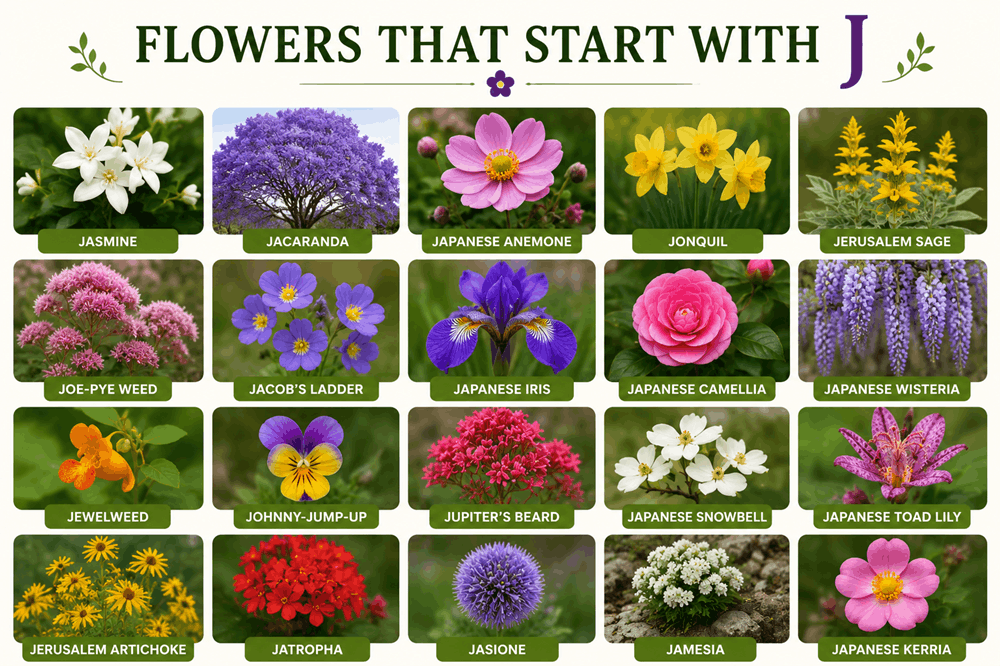
Flowers that start with J include jasmine, jacaranda, Japanese anemone, jonquil, Jerusalem sage, and many other distinctive plants. Some are fragrant vines or flowering trees, while others grow as bulbs, perennials, shrubs, tropical ornamentals, or wildflowers. This guide introduces 25 flowers beginning with J, along with their appearance, growing habits, symbolism, and practical uses in gardens, containers, pollinator plantings, and floral arrangements.
1. Jasmine
Jasmine is one of the best-known flowers beginning with J. Many varieties produce small white or pale yellow flowers with an intensely sweet fragrance.
Some jasmines grow as climbing vines, while others develop into shrubs. Their growing requirements vary, but most prefer bright light, warm conditions, and soil with good drainage.
Common jasmine is often trained over trellises, fences, and arches where its fragrance can be enjoyed near patios and entrances.
Jasmine commonly symbolizes love, beauty, purity, sensuality, and affection. Its flowers are also widely associated with perfumery because of their rich scent.
2. Jacaranda
Jacaranda trees produce spectacular clusters of lavender-blue or violet trumpet-shaped flowers. When mature trees bloom heavily, their branches can appear almost completely covered in purple.
Jacarandas prefer warm climates, full sun, and well-drained soil. They can eventually become large trees and require enough space for both their roots and spreading canopy.
Fallen flowers can create a colorful carpet beneath the tree, although they may become slippery on walkways.
Jacaranda is commonly associated with wisdom, renewal, beauty, and good fortune.
3. Japanese Anemone
Japanese anemones produce elegant flowers on tall, branching stems during late summer and fall.
Blooms are usually white, pale pink, rose, or deeper pink, with prominent yellow centers. Their long stems allow the flowers to move gently in the wind.
Japanese anemones grow well in partial shade or gentle sun and prefer soil that remains moderately moist.
Established plants can spread through underground roots, so give them enough room to form a natural colony.
4. Jonquil
Jonquils are a type of narcissus known for fragrant yellow or white spring flowers. Their narrow leaves and clusters of blooms distinguish them from some other daffodil types.
The bulbs are planted in fall and flower during late winter or spring, depending on the climate.
Jonquils prefer sunny or lightly shaded locations with soil that drains well. After flowering, allow the leaves to remain until they turn yellow naturally.
Like other narcissus bulbs, jonquils are toxic when eaten and should be kept away from pets that dig or chew plants.
5. Jerusalem Sage
Jerusalem sage produces bright yellow flowers arranged in tiers around upright stems. Its soft gray-green leaves add color and texture even when the plant is not blooming.
Despite its common name, Jerusalem sage is not a true sage. It belongs to a different botanical group.
The plant thrives in full sun and well-drained soil and handles dry conditions well once established.
It is especially useful in Mediterranean-style landscapes, gravel gardens, and drought-tolerant borders.
6. Joe-Pye Weed
Joe-Pye weed is a tall native perennial with large clusters of dusty pink, mauve, or purple flowers.
It blooms during late summer and is highly attractive to butterflies, bees, and other pollinating insects.
Many varieties prefer moist soil and full sun, although some tolerate light shade. Mature plants can become very tall, so they work best toward the back of borders or in naturalistic plantings.
Compact cultivars are available for smaller gardens.
7. Jacob’s Ladder
Jacob’s ladder produces clusters of delicate blue, lavender, purple, or white flowers above fern-like foliage.
The leaves are arranged in a ladder-like pattern, which explains the common name.
The plant prefers cool conditions, partial shade, and soil that remains evenly moist without becoming waterlogged.
Jacob’s ladder works especially well in woodland gardens, shaded borders, and areas beneath deciduous trees.
8. Japanese Iris
Japanese iris produces enormous, elegant flowers in blue, purple, lavender, white, pink, and patterned combinations.
The blooms are often flatter and broader than those of traditional bearded irises.
Japanese irises prefer consistently moist, acidic soil during their growing season and perform especially well beside ponds, streams, and rain gardens.
They need plenty of sunlight for strong flowering but appreciate reliable moisture around their roots.
9. Japanese Camellia
Japanese camellia is an evergreen shrub with glossy leaves and beautifully layered flowers.
The blooms may be red, pink, white, cream, or variegated and can resemble roses or peonies depending on the variety.
Camellias prefer acidic, well-drained soil and protection from harsh afternoon sunlight. They can flower from winter into spring when relatively few other shrubs are blooming.
The flowers are often associated with admiration, devotion, elegance, and lasting affection.
10. Japanese Wisteria
Japanese wisteria produces long hanging clusters of fragrant flowers in purple, lavender, pink, or white.
The vine can become extremely vigorous and heavy, so it requires a strong pergola, arbor, or other permanent support.
Wisteria flowers best with plenty of sunlight. Regular pruning helps control growth and can encourage stronger flowering.
Japanese wisteria can become invasive in some regions. Native or less aggressive alternatives may be more appropriate depending on location.
11. Japanese Honeysuckle
Japanese honeysuckle produces fragrant tubular flowers that begin white and often turn yellow as they age.
The scent can be especially strong during warm evenings, and the flowers attract pollinating insects.
However, this vine spreads aggressively and is considered invasive across many areas. It can smother shrubs, trees, and native vegetation.
Gardeners are generally better served by choosing locally native honeysuckle species that provide similar flowers and wildlife value without the same invasive behavior.
12. Japanese Primrose
Japanese primrose produces tiers of pink, magenta, white, or purple flowers on upright stems.
It prefers moist, humus-rich soil and partial shade, making it an excellent choice beside streams, ponds, and damp woodland edges.
Plants may reseed and form attractive colonies where the soil remains consistently moist.
Japanese primrose brings bright spring color to locations where many drought-tolerant garden flowers would struggle.
13. Jewelweed
Jewelweed produces hanging orange or yellow-orange flowers with curved nectar spurs.
The plant commonly grows in damp, partly shaded locations such as stream banks, woodland edges, and low wet areas.
Hummingbirds can visit the tubular flowers, while bees also act as pollinators.
Jewelweed is an annual that can reseed generously, so it is most appropriate in informal native plantings rather than tightly controlled borders.
14. Johnny-Jump-Up
Johnny-jump-up is a small viola with cheerful flowers commonly combining purple, yellow, and white.
The plant prefers cool weather and can bloom during spring and fall, sometimes continuing through mild winters.
Johnny-jump-ups grow well in containers, border edges, cottage gardens, and between taller plants.
They frequently reseed themselves, appearing unexpectedly in nearby garden spaces, which helps explain their playful common name.
15. Jupiter’s Beard
Jupiter’s beard, commonly known as red valerian, produces clusters of small red, rose-pink, or white flowers.
The plant thrives in sunny, dry conditions and is often seen growing around walls, rocks, and other well-drained areas.
Its flowers attract butterflies and other pollinating insects and can continue for a long period when faded stems are removed.
Jupiter’s beard may reseed aggressively in some climates, so local invasive-plant guidance should be checked before planting.
16. Jerusalem Artichoke Flower
Jerusalem artichoke is better known for its edible underground tubers, but the plant also produces cheerful yellow sunflower-like blooms.
It can grow very tall and works best in large gardens where its vigorous spreading habit can be managed.
The plant prefers full sun and tolerates a range of ordinary soils.
Because underground tubers can remain behind and produce new growth, Jerusalem artichokes can be difficult to remove once established.
17. Japanese Toad Lily
Japanese toad lily produces unusual spotted flowers in white, purple, lavender, or pink.
The intricate blooms often resemble miniature orchids and appear during late summer or fall.
Toad lilies are especially valuable for shaded gardens because they flower at a time when many woodland plants have already finished.
They prefer rich soil, partial shade, and consistent moisture. Plant them near paths where the small detailed flowers can be appreciated up close.
18. Japanese Snowbell
Japanese snowbell is a small flowering tree with elegant white bell-shaped flowers hanging beneath its branches.
The flowers appear during late spring or early summer and may have a light fragrance.
The tree prefers well-drained, slightly acidic soil and performs well in full sun or partial shade.
Its graceful branching habit and downward-facing flowers make it a beautiful choice for patios, woodland edges, and small ornamental landscapes.
19. Japanese Pieris
Japanese pieris is an evergreen shrub that produces drooping clusters of small white or pale pink bell-shaped flowers.
Flower buds often develop long before they open, providing winter interest. New foliage may emerge bright red, bronze, or pink before becoming green.
Japanese pieris prefers acidic soil, good drainage, and partial shade.
All parts of the plant are toxic when eaten, so it should be planted carefully around pets and livestock.
20. Japanese Kerria
Japanese kerria is a deciduous shrub known for bright yellow flowers that appear along slender green stems.
Single-flowered forms resemble small yellow roses, while double varieties produce fuller pom-pom-like blooms.
Kerria performs well in partial shade and can brighten areas where many flowering shrubs produce fewer blooms.
The plant can spread through suckers, so occasional pruning may be needed to keep it within its intended space.
21. Justicia
Justicia is a diverse group of tropical and subtropical flowering plants. Depending on the species, flowers may be pink, red, orange, purple, white, or yellow.
Some varieties produce colorful bracts surrounding smaller true flowers, while others develop tubular blooms attractive to hummingbirds.
Many justicias prefer warmth, partial sun, and consistent moisture.
They can be grown as landscape shrubs in frost-free climates or as containers and houseplants in colder regions.
22. Jaborosa
Jaborosa includes South American flowering plants with unusual star-shaped or trumpet-like blooms.
Flowers are often white or pale green and may release fragrance during the evening to attract nighttime pollinators.
Several species grow from underground structures and prefer warm conditions with good drainage.
Jaborosa is much less common in home gardens than jasmine or jonquils, making it an interesting choice for collectors of unusual plants.
23. Jatropha
Jatropha includes tropical shrubs and small trees with clusters of bright red, coral, or pink flowers.
Some ornamental forms flower for long periods in warm climates and attract butterflies and hummingbirds.
Jatropha prefers full sun or bright light and soil that drains well. Established plants can tolerate moderate dryness.
Many Jatropha species contain toxic compounds, particularly in their seeds and sap, so they should be handled cautiously around children and pets.
24. Jasione
Jasione produces small rounded flower heads, usually in blue or blue-purple shades.
The individual flowers cluster tightly together, creating a button-like appearance above slender stems.
Jasione generally prefers sunny locations with poor, sandy, or rocky soil and good drainage.
Its blue coloring and compact growth make it useful in rock gardens, gravel gardens, and naturalistic plantings.
25. Jamesia
Jamesia is a flowering shrub known for clusters of small white flowers with prominent centers.
It is sometimes called cliffbush because it naturally grows in rocky mountain environments.
The plant prefers well-drained soil and is best suited to cooler climates where its natural alpine or mountain conditions can be approximated.
Jamesia is uncommon in ordinary garden centers but can be an interesting addition to native, rock, or specialized mountain gardens.
Which J Flowers Are Best for Containers?
Jasmine, Johnny-jump-ups, Japanese primrose, compact Justicia varieties, and smaller jonquils can all grow well in containers.
Jasmine usually needs a trellis or small support, while Johnny-jump-ups work well around the edge of pots. Jonquils can be planted in fall containers for spring color.
Use pots with drainage holes and choose a potting mixture suited to the plant. Acid-loving plants such as Japanese pieris require different soil conditions from drought-tolerant species such as Jerusalem sage.
Which J Flowers Attract Hummingbirds?
Jewelweed, certain Justicia species, and some jasmine-like tubular flowers can attract hummingbirds.
Jewelweed is particularly valuable in native gardens where it naturally grows, while red tubular justicias can provide nectar for extended periods in warm climates.
Hummingbird gardens work best when several nectar-rich flowers bloom at overlapping times rather than relying on a single species.
Which J Flowers Attract Bees and Butterflies?
Joe-Pye weed, Jupiter’s beard, Jerusalem artichoke flowers, jacaranda, and jasmine can all attract pollinating insects.
Joe-Pye weed is especially valuable for butterflies in late summer, while Jerusalem artichoke flowers provide a sunflower-like food source later in the growing season.
Avoid unnecessary pesticide use on flowers intended to support pollinators.
Which J Flowers Work Well in Bouquets?
Jasmine, Japanese anemones, jonquils, Japanese irises, camellias, and flowering branches from Japanese snowbell can all contribute to floral arrangements.
Jasmine adds fragrance and trailing movement, while Japanese iris creates dramatic focal flowers. Jonquils provide cheerful spring color.
Narcissus-type flowers such as jonquils release sap after cutting. Conditioning them separately in water before combining them with other flowers can help prevent damage to more sensitive stems.
Which J Flowers Are Best for Shade?
Japanese anemone, Jacob’s ladder, Japanese primrose, Japanese toad lily, Japanese kerria, and Japanese pieris can all perform well in partial shade.
Japanese toad lily is particularly useful because it flowers late in the season, bringing color to shaded areas after many spring woodland plants have disappeared.
Jerusalem sage and Jerusalem artichoke are much better suited to full sunlight.
Which J Flowers Prefer Moist Soil?
Japanese iris, Japanese primrose, jewelweed, and Joe-Pye weed are excellent choices for gardens with consistently moist soil.
Japanese iris can thrive beside ponds and streams, while jewelweed naturally appears in damp woodland environments.
Moisture requirements still vary. Soil that is consistently damp is different from permanently flooded ground, so choose each plant according to the exact conditions available.
Which J Flowers Are Best for Dry Gardens?
Jerusalem sage, Jasione, Jatropha, and established Jerusalem artichokes can tolerate relatively dry conditions once their roots are established.
Jerusalem sage is particularly well suited to sunny Mediterranean-style landscapes where summer rainfall is limited.
Good drainage remains important. Many drought-tolerant plants suffer more from excessive winter moisture than from summer dryness.
Which J Flowers Need Extra Caution?
Several J flowers require careful handling or placement. Japanese pieris is toxic when eaten, while Jatropha can contain poisonous sap and seeds.
Japanese honeysuckle creates a different concern because it is invasive in many areas and can damage native habitats.
Jonquil and other narcissus bulbs are also toxic when consumed. Always identify the exact plant before adding unfamiliar species to a garden shared with pets or young children.
The Bottom Line
Flowers that start with J include familiar favorites such as jasmine, jacaranda, Japanese anemone, jonquil, Jerusalem sage, and Joe-Pye weed. The group also includes less familiar plants such as Jasione, Jaborosa, Jamesia, and Japanese toad lily.
There are J flowers for many different garden conditions. Jerusalem sage thrives in hot, dry sun, Japanese primrose prefers moist shade, Japanese iris grows beautifully near water, and jasmine can cover a sunny trellis with fragrant flowers.
When choosing a J flower, consider sunlight, moisture, climate, mature size, toxicity, and whether the plant can become invasive. Matching each flower to the right conditions will produce healthier growth, stronger blooming, and a garden that stays interesting through more of the year.