Flowers That Start With G: Twenty-Five Beautiful Blooms for Gardens and Bouquets
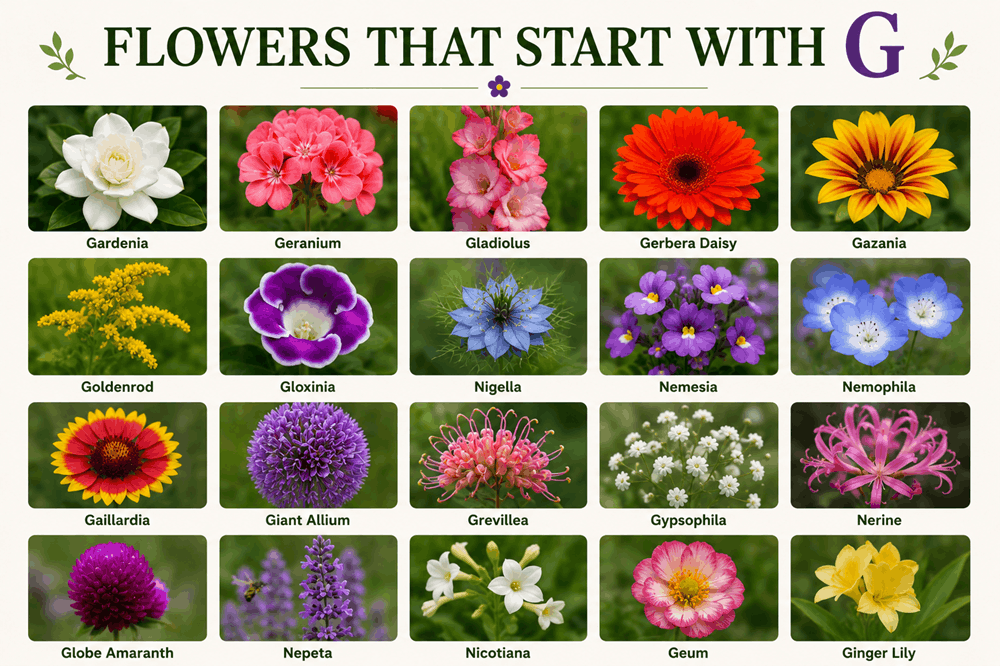
Flowers that start with G include gardenias, geraniums, gladiolus, gazanias, gerberas, goldenrod, and many other colorful plants. Some grow as compact annuals or houseplants, while others develop into perennials, bulbs, shrubs, vines, or tall cut flowers. This guide introduces 25 flowers beginning with G, along with their appearance, growing habits, symbolism, and practical uses in gardens, containers, pollinator plantings, and floral arrangements.
1. Gardenia
Gardenias are famous for creamy white flowers and an intense fragrance. Their waxy blooms contrast beautifully with glossy dark-green leaves, giving the plant a refined appearance even when it is not flowering.
Gardenias prefer warm conditions, acidic soil, consistent moisture, and bright light without extreme afternoon heat. They can be demanding because sudden changes in temperature, water, or soil conditions may cause buds to drop.
In warm climates, gardenias grow as evergreen shrubs. In colder regions, they are often kept in containers and moved indoors before frost.
Gardenias commonly symbolize purity, admiration, love, and refinement.
2. Geranium
Geranium is a name used for both true hardy geraniums and the pelargoniums commonly sold as annual bedding plants.
Garden-center geraniums usually produce rounded clusters of red, pink, salmon, white, purple, or orange flowers above aromatic foliage.
They perform well in sunny containers, window boxes, and summer flower beds. Good drainage is important, and allowing the soil to dry slightly between waterings can help prevent root problems.
Hardy geraniums have a softer growth habit and are generally grown as perennials in borders and woodland edges.
3. Gladiolus
Gladiolus produces tall flower spikes lined with large, funnel-shaped blooms. Colors include white, pink, red, orange, yellow, purple, green, and numerous multicolored combinations.
These flowers grow from underground corms and are generally planted in spring for summer flowering.
Gladiolus prefers full sun, well-drained soil, and consistent moisture while actively growing. Tall varieties may need support in windy locations.
Their long stems make gladiolus especially useful in large bouquets and dramatic table arrangements.
4. Gerbera Daisy
Gerbera daisies produce large, cheerful flowers with broad petals surrounding a prominent central disk.
They are available in red, orange, yellow, pink, white, cream, salmon, and many bicolored forms.
Gerberas are widely used as cut flowers because of their bold colors and clean shape. In the garden, they prefer bright light and soil that drains well.
These flowers are commonly associated with happiness, innocence, cheerfulness, and positive energy.
5. Gazania
Gazania produces vivid daisy-like flowers that often feature contrasting stripes, rings, or dark markings near the center.
Colors include yellow, orange, red, pink, cream, white, and multicolored patterns. The blooms open most fully in bright sunlight and may partially close during cloudy weather or at night.
Gazanias thrive in heat, dry soil, and full sun. They are excellent choices for rock gardens, coastal landscapes, containers, and drought-tolerant borders.
Too much moisture or rich fertilizer can result in weaker growth and fewer flowers.
6. Goldenrod
Goldenrod produces arching clusters of tiny yellow flowers during late summer and fall.
It is an important late-season plant for bees, butterflies, and other pollinating insects. Its bright color also works well in naturalistic arrangements and meadow-style gardens.
Goldenrod is sometimes blamed for seasonal allergies, but ragweed is generally the more significant source of airborne pollen during the same period.
Different goldenrod species vary in height and spreading behavior, so choose one appropriate for the size of the garden.
7. Gloxinia
Gloxinia is a flowering houseplant with large, velvety, trumpet-shaped blooms. Colors include red, pink, purple, white, and bicolored forms.
The plant prefers bright indirect light, warmth, and moderate humidity. Water the soil carefully without soaking the crown or leaves.
After flowering, gloxinia may enter dormancy. The foliage can die back while the underground tuber rests before beginning another growth cycle.
The luxurious texture of the flowers makes gloxinia especially attractive as an indoor decorative plant.
8. Gaillardia
Gaillardia is commonly called blanket flower. It produces warm-toned daisy-like blooms in red, yellow, orange, burgundy, and combinations of these shades.
The plant thrives in sunny, dry conditions and tolerates poor soil better than many heavily cultivated flowers.
Blanket flower works well in prairie gardens, xeriscapes, pollinator plantings, and low-maintenance borders.
Removing faded blooms can encourage further flowering, although leaving a few seed heads can provide food for birds.
9. Gentian
Gentians are known for intensely blue trumpet-shaped or star-shaped flowers. Some species also bloom in purple, white, or yellow.
Many gentians prefer cool climates and are naturally found in alpine meadows, mountains, and open grasslands.
Growing requirements differ by species, but many need excellent drainage, moderate moisture, and protection from extreme heat.
The deep blue color of gentian makes it especially valuable in gardens because true blue flowers are relatively uncommon.
10. Geum
Geum produces cheerful cup-shaped flowers on slender stems above textured foliage. Colors include yellow, orange, red, peach, pink, and cream.
The plants generally bloom in spring and early summer and work well in cottage gardens and mixed perennial borders.
Geum prefers full sun or light shade and soil that remains moderately moist without becoming waterlogged.
Regular removal of faded flowers can extend the blooming period.
11. Globe Amaranth
Globe amaranth produces round, clover-like flower heads in purple, pink, magenta, red, orange, or white.
The flowers have a papery texture and retain their color well after drying, making them excellent for wreaths and preserved arrangements.
Globe amaranth thrives in heat and full sun and tolerates dry conditions once established.
It is easy to grow from seed and can provide color from summer until frost.
12. Globe Thistle
Globe thistle produces spherical blue or purple flower heads with a spiky texture.
The plant has silver-green foliage and a strong architectural appearance that fits well in dry gardens and modern landscapes.
Globe thistle prefers full sun and well-drained soil. Once established, it is relatively drought tolerant.
The flowers attract bees and also retain their shape when dried for arrangements.
13. Glory of the Snow
Glory of the snow is a small spring bulb that produces star-shaped flowers in blue, pink, or white.
It blooms extremely early, sometimes while patches of snow are still present.
The bulbs look best when planted in groups beneath deciduous trees, in lawns, or along paths where they can naturalize.
After flowering, allow the narrow foliage to remain until it turns yellow naturally.
14. Goat’s Beard
Goat’s beard produces large, feathery plumes of creamy white flowers above fern-like foliage.
The plant can resemble an oversized astilbe and works particularly well in woodland gardens and moist, partly shaded borders.
Goat’s beard prefers rich soil and consistent moisture. Mature plants can become several feet tall and wide, so they need adequate space.
The airy white flowers can brighten shady sections of a garden during early summer.
15. Gomphrena
Gomphrena is another name for globe amaranth, although many gardeners know the plant primarily by its botanical name.
Its rounded flower heads may be purple, pink, white, red, orange, or lavender.
Gomphrena performs extremely well in hot summers and keeps flowering even when some cool-season annuals have stopped.
The stiff papery flowers are excellent for cutting and drying because they preserve their shape for months.
16. Grevillea
Grevillea is a group of Australian shrubs and trees with unusual flowers made from clusters of long, curved styles.
Colors include red, orange, pink, yellow, cream, and combinations of these shades.
Many grevilleas attract nectar-feeding birds and pollinating insects. They prefer full sun and excellent drainage.
Like several Australian plants adapted to nutrient-poor soil, some grevilleas are sensitive to high levels of phosphorus fertilizer.
17. Gypsophila
Gypsophila is better known as baby’s breath. It produces clouds of tiny white or pale pink flowers on fine branching stems.
The airy flowers are widely used as filler in wedding bouquets, romantic arrangements, and dried floral displays.
Gypsophila prefers sunny, well-drained conditions. Perennial varieties can develop into large, rounded plants once established.
Although common in bouquets, baby’s breath can cause digestive upset in pets when eaten.
18. Golden Marguerite
Golden marguerite produces bright yellow daisy-like flowers above finely divided aromatic foliage.
This perennial blooms heavily during summer and works well in sunny borders and cottage gardens.
It prefers full sun and soil with good drainage. Once established, it can tolerate moderate dryness.
Cutting back faded stems may encourage a second flush of flowers and keep the plant compact.
19. Giant Allium
Giant alliums produce enormous spherical flower heads composed of many small purple, violet, or lavender blooms.
The flowers rise on tall, strong stems above strap-like foliage and can create a striking architectural effect.
The bulbs are planted in fall and usually bloom in late spring or early summer.
Giant alliums prefer full sun and well-drained soil. Their flowers are attractive to bees and other pollinators.
20. Ginger Lily
Ginger lily produces fragrant tropical flowers in white, cream, yellow, orange, or peach, depending on the species.
The plant grows from underground rhizomes and develops lush upright foliage similar to ornamental ginger.
Ginger lilies prefer warmth, rich soil, and consistent moisture during active growth. Some varieties tolerate partial shade.
The flowers can be intensely fragrant, especially during warm evenings.
21. Golden Trumpet
Golden trumpet is a common name used for several yellow trumpet-flowered tropical plants, including certain Allamanda species.
The flowers are large, bright yellow, and funnel-shaped, making them highly visible in warm-climate gardens.
Allamanda can grow as a climbing shrub or vigorous vine and prefers full sun, warmth, and regular moisture.
Its milky sap can be irritating, and the plant should not be eaten.
22. Ground Orchid
Ground orchids grow in soil rather than living primarily as epiphytes on trees. One commonly cultivated type produces clusters of pink, purple, yellow, or white orchid flowers on upright stems.
They prefer warm conditions and bright but filtered light, although exact needs vary by species.
Ground orchids work particularly well in tropical and subtropical borders where the soil drains freely.
In cooler climates, they can sometimes be grown in containers and protected indoors during winter.
23. Green Rose
Green rose is an unusual rose mutation in which the normal flower structures are replaced largely by green, leaf-like parts.
The result looks more like a cluster of layered green sepals than a traditional rose.
Green roses are grown mainly for novelty and texture rather than fragrance or classic petal form.
They can add unusual contrast to floral arrangements, especially alongside white, blush, or burgundy flowers.
24. Guernsey Lily
Guernsey lily is a common name for certain nerine flowers. The plant produces clusters of bright pink, red, or rose-colored blooms on bare stems in fall.
The narrow petals often curve backward and sparkle slightly in bright light.
Guernsey lilies prefer sunny, well-drained locations and generally flower best when left undisturbed.
Their late-season bloom makes them useful for extending color into autumn.
25. Greater Masterwort
Greater masterwort produces unusual star-like flower heads surrounded by pointed bracts. Colors include white, pale pink, dusty rose, green, and burgundy.
The plant has a soft, old-fashioned appearance and works beautifully in cottage gardens and naturalistic borders.
It prefers moist, fertile soil and performs well in partial shade or gentle sunlight.
Greater masterwort is also valued as a cut flower because its delicate shape adds texture without overwhelming larger blooms.
Which G Flowers Are Best for Containers?
Geraniums, gazanias, gloxinia, globe amaranth, gardenias, and compact gerbera daisies all work well in containers.
Gazanias prefer hot, sunny conditions, while gloxinia is better suited to indoor bright light. Gardenias need consistent moisture and acidic potting soil but dislike waterlogged roots.
Use containers with drainage holes and choose a pot size appropriate for the mature plant.
Which G Flowers Attract Hummingbirds?
Grevillea, ginger lily, and some tubular geranium or tropical G flowers may attract hummingbirds where the flowers provide accessible nectar.
In warm climates, grevilleas can be especially valuable because many species produce nectar-rich flowers over long periods.
Combining several hummingbird-friendly plants with different blooming seasons creates a more dependable feeding area.
Which G Flowers Attract Bees and Butterflies?
Goldenrod, globe thistle, gaillardia, giant allium, geum, and gerbera-type flowers can attract bees, butterflies, and other beneficial insects.
Goldenrod is especially important late in the season, while giant alliums provide abundant spring or early-summer nectar.
Flowers with open centers are generally easier for pollinators to use than heavily doubled varieties.
Which G Flowers Work Well in Bouquets?
Gladiolus, gerbera daisies, gardenias, gypsophila, globe amaranth, greater masterwort, and giant alliums can all be used in floral arrangements.
Gladiolus adds height, while gerberas provide bright focal flowers. Gypsophila creates soft filler, and greater masterwort contributes delicate texture.
Globe amaranth is especially useful when the flowers will later be dried and preserved.
Which G Flowers Are Best for Shade?
Goat’s beard, greater masterwort, some ground orchids, and certain gardenias can perform well with partial shade.
Goat’s beard is especially effective in woodland-style gardens with rich, moist soil.
Gazanias, globe thistle, gaillardia, and most gladiolus generally need much stronger sunlight for the best flowering.
Which G Flowers Are Best for Dry Gardens?
Gazanias, globe thistle, gaillardia, and some grevilleas are among the strongest G choices for dry, sunny landscapes.
All of these plants still need water while becoming established. Drought tolerance usually improves after the root system has developed.
Excellent drainage is especially important. A drought-tolerant plant can still fail if its roots remain wet for long periods.
Which G Flowers Need Extra Caution?
Some flowers beginning with G require careful handling. Golden trumpet plants can contain irritating sap, while baby’s breath may cause digestive upset in pets.
Common names can also be confusing. Ground orchid, ginger lily, and golden trumpet may refer to different species depending on region.
When toxicity, pet safety, or growing requirements are important, confirm the botanical identity rather than relying only on the common name.
The Bottom Line
Flowers that start with G include familiar favorites such as gardenias, geraniums, gladiolus, gerbera daisies, gazanias, and goldenrod. The group also includes unusual flowers such as grevillea, globe thistle, ginger lily, greater masterwort, and glory of the snow.
There are G flowers for many different garden conditions. Gazanias thrive in hot, dry sun, goat’s beard prefers moist woodland shade, gloxinia grows beautifully indoors, and gladiolus creates dramatic summer flower spikes.
When choosing a G flower, consider its sunlight, moisture, soil, climate, mature size, toxicity, and potential to spread. Matching the right plant to the right setting will produce healthier growth, more reliable flowers, and a garden that remains colorful and interesting across the seasons.