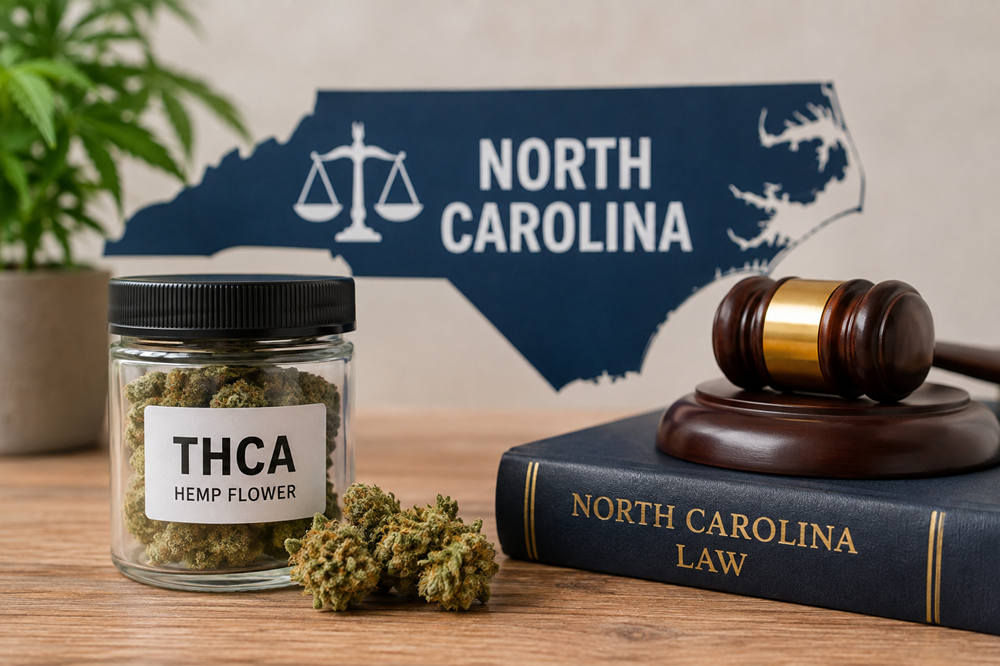
Is THCA Legal in North Carolina? NC Laws Explained for 2026
THCA products can currently qualify as legal hemp under North Carolina’s controlled-substance laws when they contain no more than 0.3% delta-9 THC on a dry-weight basis. North Carolina law uses that delta-9 THC threshold when defining hemp and when exempting qualifying tetrahydrocannabinols from Schedule VI.
That does not make every product labeled “THCA hemp” automatically legal. Actual cannabinoid content matters, and separate federal rules can apply depending on how a product is manufactured, marketed, or sold.
The biggest change is still ahead: on November 12, 2026, a new federal hemp definition is scheduled to take effect that counts THCA toward a 0.3% total-tetrahydrocannabinols limit. That change could remove many high-THCA products from the federal definition of hemp.
Is THCA Legal in North Carolina Right Now?
North Carolina’s current hemp law focuses on delta-9 THC rather than THCA itself.
Under G.S. 90-87, hemp includes Cannabis sativa L. and its derivatives, extracts, cannabinoids, isomers, acids, salts, and salts of isomers when the plant or product contains no more than 0.3% delta-9 THC on a dry-weight basis.
The state’s controlled-substance schedule reinforces that distinction. G.S. 90-94 lists tetrahydrocannabinols as Schedule VI substances but makes an exception for tetrahydrocannabinols found in products containing no more than 0.3% delta-9 THC on a dry-weight basis.
These provisions are why a product containing substantial THCA can potentially fall within North Carolina’s hemp framework even when its THCA concentration is much higher than 0.3%.
The current federal statutory definition of hemp likewise uses a 0.3% delta-9 THC dry-weight threshold through November 11, 2026. However, hemp status does not override every other law that may apply to foods, dietary supplements, drugs, labeling, or other regulated products.
Why THCA Can Become Intoxicating
THCA, or tetrahydrocannabinolic acid, is a naturally occurring cannabinoid found in cannabis. It is chemically different from delta-9 THC, but the two are closely connected.
When THCA is heated, it can undergo decarboxylation and convert into delta-9 THC. Smoking, vaping, or cooking cannabis can accelerate that process.
This chemical conversion helps explain why high-THCA flower can produce intoxicating effects even if the amount of delta-9 THC measured before use is comparatively low.
It also explains an important legal distinction: although North Carolina’s current statutory hemp definition uses delta-9 THC, federal hemp-production testing already considers the THC that could result from THCA conversion.
Federal Hemp Law Changes on November 12, 2026
The present legal framework is scheduled to change substantially on November 12, 2026.
Congress enacted Public Law 119-37 on November 12, 2025. Section 781 takes effect 365 days later and replaces the current federal hemp definition with one based on total tetrahydrocannabinols, including THCA.
Under the new definition, hemp may contain no more than 0.3% total tetrahydrocannabinols on a dry-weight basis. Because THCA will expressly count toward that threshold, a product will not remain federally defined as hemp merely because its pre-existing delta-9 THC concentration is below 0.3%.
This change is particularly significant for high-THCA flower. Flower containing a large percentage of THCA would generally exceed a federal 0.3% total-tetrahydrocannabinols threshold once THCA is included in the measurement and therefore would not qualify under the new federal hemp definition.
There Is Also a Separate 0.4 mg Finished-Product Rule
The same federal law creates an additional restriction for final hemp-derived cannabinoid products. It excludes certain finished products containing more than 0.4 milligrams combined per container of total tetrahydrocannabinols, including THCA, plus other cannabinoids that the Secretary of Health and Human Services determines have, or are marketed as having, effects similar to tetrahydrocannabinol.
This 0.4 mg provision should not be confused with the 0.3% total-tetrahydrocannabinols definition. They are separate parts of the new federal framework.
The law also excludes certain synthetic or manufactured cannabinoids and places restrictions on intermediate hemp-derived cannabinoid products.
None of these November changes should be described as current law in August 2026. Unless Congress amends or delays Section 781, however, they are scheduled to take effect on November 12.
North Carolina House Bill 328 Could Change State Law Too
North Carolina lawmakers are separately considering House Bill 328, or the “Regulate Hemp-Derived Consumables” bill.
HB 328 has not become law as of August 10, 2026. The Senate adopted the conference report on July 2, but the measure subsequently returned to the House. Its latest listed action is a July 30 referral to the House Committee on Rules, Calendar, and Operations.
The pending conference text would move North Carolina away from its current delta-9-only standard. It defines total THC using delta-9 THC plus 87.7% of the THCA concentration, together with other specified tetrahydrocannabinols such as delta-7, delta-8, and delta-10 THC.
The proposal would also define a prohibited finished hemp-derived consumable product as certain products intended for ingestion or inhalation containing more than 0.4 mg of total THC per container or containing a synthetic or chemically converted cannabinoid.
That proposed North Carolina rule is similar to, but not identical to, the new federal 0.4 mg provision. The federal provision also refers to other cannabinoids determined to have or be marketed as having THC-like effects.
The conference text also contains proposed restrictions involving the sale, delivery, and possession of hemp-derived consumable products by people under 21. Because HB 328 remains pending, those provisions should not be treated as requirements created by HB 328 today.
Why Hemp Farming Rules Already Count THCA
The law becomes easier to understand when hemp production and finished retail products are treated as separate issues.
The USDA hemp-testing rules require production samples to be analyzed using methods that consider the potential conversion of THCA into delta-9 THC.
For licensed hemp production, USDA describes total available THC using the calculation:
Total THC = delta-9 THC + (THCA × 0.877)
The 0.877 conversion factor accounts for the difference in molecular weight as THCA loses carbon dioxide during decarboxylation.
This means a grower cannot rely solely on a low measured delta-9 THC concentration when a crop contains substantial THCA. Production testing must account for the THC that the THCA can potentially produce.
That rule concerns hemp-production compliance. It should not be confused with the wording of North Carolina’s current controlled-substance statutes governing the definition of hemp.
Can You Buy, Possess, or Order THCA in North Carolina?
A THCA product that genuinely meets North Carolina’s current hemp definition can fall outside the state’s definition of marijuana and the Schedule VI exception for qualifying hemp products.
What matters is the product’s actual composition, not simply what a retailer writes on the package. Terms such as “hemp,” “Farm Bill compliant,” or “legal THCA” are not legal guarantees.
This same principle applies when ordering THCA online. Shipping a product from another state does not change its cannabinoid content or automatically establish compliance with North Carolina and federal law.
Interstate purchases will deserve particular attention after November 12, 2026, because products with more than 0.3% total tetrahydrocannabinols will no longer fit the new federal definition of hemp even when their delta-9 THC concentration alone is below 0.3%.
Flower also presents practical complications because hemp and marijuana can be difficult to distinguish visually or by smell. A package, receipt, or certificate of analysis may provide useful information, but none should be treated as an absolute guarantee about how a particular situation will be handled.
Can You Drive After Using THCA?
Whether a product qualifies as hemp is separate from whether someone may legally drive after using it.
Under North Carolina’s impaired-driving law, a person commits impaired driving by operating a vehicle on a highway, street, or public vehicular area while under the influence of an impairing substance.
The statute also states that being legally entitled to use a drug is not a defense to an impaired-driving charge.
Because heating THCA can produce intoxicating delta-9 THC, a person should not drive or operate dangerous equipment while impaired after using a THCA product.
How to Read a THCA Certificate of Analysis
A certificate of analysis, or COA, can help show whether the laboratory results match what a product label claims. It is useful evidence about composition, but it is not a legal guarantee.
When reviewing a THCA product, look for:
- Delta-9 THC concentration: This is particularly important under North Carolina’s current 0.3% delta-9 dry-weight standard.
- THCA concentration: This shows the amount of acidic THC precursor in the sample.
- Total THC: This is useful for understanding potential THC exposure and will become especially important as the federal framework changes.
- A matching batch or lot number: The laboratory report should correspond to the product being sold.
- The test date and laboratory: A batch-specific report is more useful than an undated or generic potency sheet.
Be cautious when a label says only “less than 0.3% THC” without explaining whether that figure refers to delta-9 THC, total THC, or another measurement.
What Could Change Next?
Three developments matter most for North Carolina THCA law during the remainder of 2026.
1. The Federal Definition Changes November 12
Unless Congress changes the law, the federal definition of hemp will begin counting THCA as part of the 0.3% total-tetrahydrocannabinols threshold.
2. North Carolina Could Act on HB 328
The General Assembly could adopt the pending conference report, modify the proposal, or take no further action. Until a bill is enacted, its proposed standards are not current law.
3. Congress Could Amend the New Federal Rules
Legislation has been introduced in Congress seeking to repeal or delay the changes enacted in Section 781. A proposed bill, however, does not change the effective date of existing law unless it is enacted.
The Bottom Line: Is THCA Legal in NC?
As of August 10, 2026, a THCA product can qualify as hemp under North Carolina’s controlled-substance laws if it contains no more than 0.3% delta-9 THC on a dry-weight basis. The state’s current statutes use delta-9 THC rather than THCA or total THC for that threshold.
The answer is set to change at the federal level on November 12, 2026. Federal hemp will then be limited to 0.3% total tetrahydrocannabinols, expressly including THCA, and additional restrictions will apply to finished hemp-derived cannabinoid products.
North Carolina’s HB 328 could create a similar total-THC approach under state law, but it remains pending as of this article’s update date.
Because both federal and state rules are in transition, consumers and businesses should check the current statutes and product-specific laboratory results rather than relying on an old article or a package claim that simply says “legal hemp.”