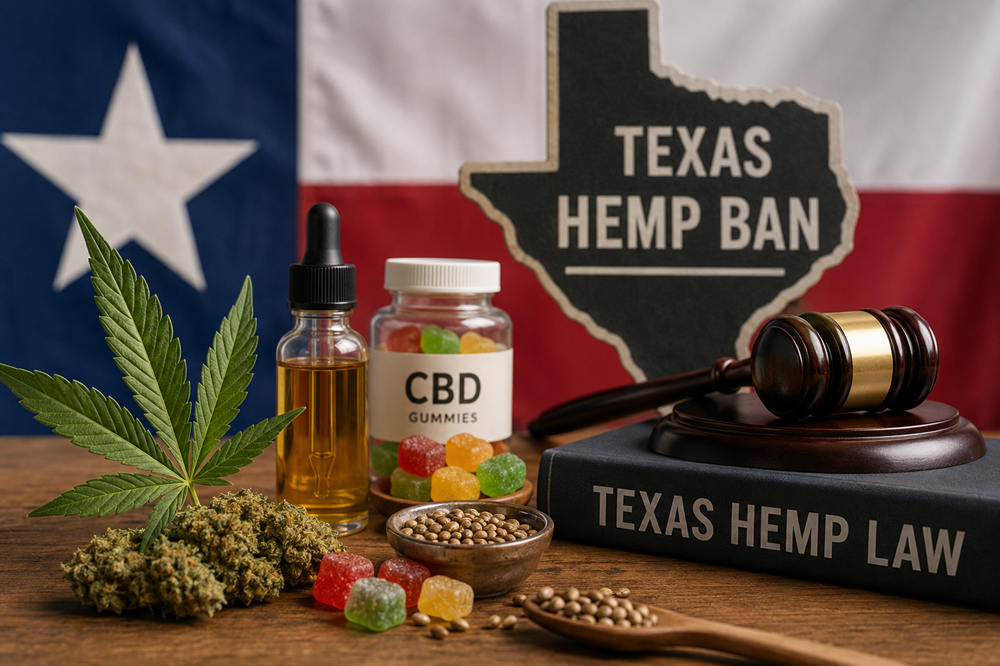
Texas Hemp Ban Explained: What Is Actually Illegal in 2026?
Texas has not banned hemp across the board. As of August 2026, however, the state is enforcing rules that make many high-THCA hemp products noncompliant, while a separate change effective July 31 restored controlled-substance treatment for delta-8 THC and other covered tetrahydrocannabinols.
That distinction matters. CBD, industrial hemp, compliant hemp-derived delta-9 products, THCA flower, delta-8 products, and smokable hemp do not all have the same legal status. The widely discussed Senate Bill 3 would have gone much further, but Governor Greg Abbott vetoed that bill in 2025.
For consumers and businesses, the useful question is therefore not simply whether Texas “banned hemp.” It is which products still fit within the state’s regulated hemp system and which no longer do.
Did Texas Ban Hemp?
No. Texas still operates a Consumable Hemp Program, and lawful hemp products can still be manufactured, distributed, or sold when they satisfy the applicable state rules.
Texas Health and Safety Code Chapter 443 allows consumable hemp products within the state’s hemp framework, subject to restrictions on THC concentration and requirements covering testing, labeling, licensing, registration, and retail sales.
The recent crackdown instead affects particular cannabinoid products. Two changes are especially important: the consumable-hemp regulations that became effective March 31, 2026, and the controlled-substance scheduling change that became effective July 31, 2026.
What Changed on July 31, 2026?
The July change primarily concerns delta-8 THC and the state’s controlled-substance schedule.
The dispute dates back to 2021, when the Texas Department of State Health Services classified certain forms of delta-8 THC within the state’s controlled-substance schedule. Hemp businesses challenged the action, and an injunction limited enforcement while the case proceeded through the courts.
On May 1, 2026, the Texas Supreme Court ruled in Texas Department of State Health Services v. Sky Marketing Corp., clearing the way for the state to reinstate its scheduling action.
The distinction centers partly on how commercial delta-8 products are produced. Delta-8 occurs naturally in cannabis in trace quantities, but concentrated commercial delta-8 is commonly manufactured through conversion of other hemp-derived cannabinoids such as CBD.
DSHS now states that only trace amounts of delta-8 THC naturally produced by the hemp plant from which a consumable hemp product was manufactured are permissible under the hemp exception. The restored schedule became effective July 31, 2026.
DSHS also says consumable hemp products labeled as containing delta-8, or products shown to contain more than permissible trace amounts of covered tetrahydrocannabinols, may be detained and referred to law enforcement.
This is a significant restriction on the intoxicating hemp market, but it is not a blanket ban on hemp itself.
How Texas Currently Treats Common Hemp Products
Hemp legality cannot always be determined from the product name on a package. The cannabinoid profile, THC concentration, manufacturing method, laboratory results, and intended use can all matter.
| Product Type | Current Texas Position | Key Issue |
|---|---|---|
| CBD products | Can remain within the regulated hemp market | The finished product still must meet applicable THC, testing, labeling, registration, and age requirements. |
| Hemp-derived delta-9 THC products | Potentially compliant | The product must remain within the applicable hemp THC threshold and satisfy the other consumable-hemp rules. |
| High-THCA flower and products | Often noncompliant under the current total-THC rule | Texas includes THCA when calculating total delta-9 THC, so low measured delta-9 alone does not establish compliance. |
| Delta-8 THC products | Generally controlled beyond naturally occurring trace amounts | The restored controlled-substance schedule became effective July 31, 2026. |
| Delta-10 and other THC isomer products | Should not be assumed lawful merely because they are hemp-derived | The restored schedule addresses tetrahydrocannabinols broadly, so the chemistry and composition of the product matter. |
| Smokable hemp | Not categorically prohibited from retail sale | In-state manufacturing or processing for smoking is prohibited, and the product must still meet applicable hemp requirements. |
| Industrial hemp and ordinary hemp-seed products | Not covered by a blanket hemp ban | Industrial and non-cannabinoid hemp uses are distinct from the restrictions aimed at consumable cannabinoid products. |
The table is best understood as a general guide rather than a substitute for a product-specific legal analysis. A label describing something as “hemp-derived” does not determine whether the finished product complies with Texas law.
Why THCA Has Become a Major Issue in Texas
THCA is affected by a different part of the Texas regulatory framework than the July 31 delta-8 scheduling change.
The consumable-hemp rules effective March 31, 2026 include THCA when determining total delta-9 THC. DSHS has stated that it is currently enforcing this requirement.
When laboratory testing leaves THCA intact, the rules calculate potential total delta-9 THC using the conversion:
Total delta-9 THC = (0.877 × THCA) + delta-9 THC
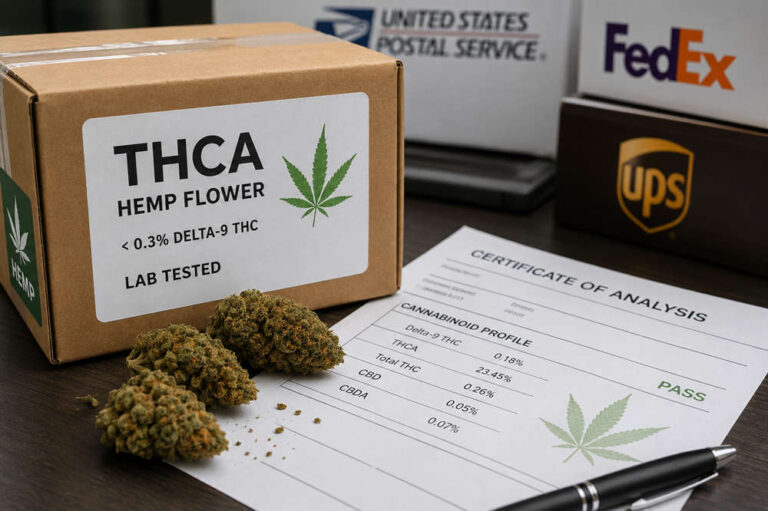
This matters because THCA can convert into delta-9 THC when heated. A flower product might show less than 0.3% delta-9 THC on one line of its certificate of analysis while containing a much larger percentage of THCA.
Under the current Texas calculation, that THCA cannot simply be ignored.
For example, a product marketed as “THCA hemp” should not be assumed compliant merely because its measured delta-9 THC concentration is below 0.3%. If its calculated total delta-9 THC exceeds the applicable threshold, it can fall outside the state’s consumable-hemp standard.
The March 2026 rules have faced an industry legal challenge, but that does not mean businesses can presently disregard them. DSHS told the Texas Senate in July 2026 that it is enforcing the March rules, including the inclusion of THCA in total delta-9 THC, age restrictions, labeling requirements, and updated fees.
What Happened to Senate Bill 3?
Much of the “Texas hemp ban” terminology originated with Senate Bill 3 during the 2025 legislative session.
The Texas Legislature passed SB 3 as a much broader attempt to restrict intoxicating consumable-hemp products. Had it become law, the Texas hemp market would have changed far more dramatically through legislation.
That did not happen.
Governor Greg Abbott vetoed Senate Bill 3 in June 2025. His veto statement argued that the legislation faced significant constitutional issues and called instead for a tightly regulated hemp market.
Texas later pursued additional restrictions through agency rulemaking and executive action. Governor Abbott’s Executive Order GA-56 directed agencies to strengthen measures involving age verification, testing, labeling, enforcement, and other aspects of the consumable-hemp market.
SB 3 therefore should not be described as the law that banned hemp in Texas. It never took effect. The restrictions in force in 2026 come through other legal and regulatory mechanisms.
Rules That Apply to Hemp Products That Remain Legal
A cannabinoid product avoiding controlled-substance classification does not automatically mean it can be sold freely. Texas imposes substantial requirements on the regulated consumable-hemp market.
Buyers Must Be 21 or Older
Texas prohibits consumable-hemp licensees and registered retailers from selling consumable hemp products to people under 21. Sellers must verify age using valid government-issued identification before completing the sale.
The age rule applies to the regulated consumable-hemp category broadly rather than only to products marketed as intoxicating.
Products Are Subject to Testing and Labeling Rules
Texas rules establish requirements covering cannabinoid testing, certificates of analysis, packaging, labeling, batch identification, and related compliance information.
A batch-specific certificate of analysis can help show what cannabinoids a laboratory detected, but a COA is not a permanent declaration of legality. Consumers and retailers should make sure the report actually corresponds to the product and batch in question.
Labels such as “Farm Bill compliant,” “legal THC,” or “hemp-derived” also do not override Texas testing standards.
Retailers and Manufacturers Face Higher Fees
Texas has substantially increased the cost of participating in the consumable-hemp market.
DSHS currently lists the Consumable Hemp Product license at $10,000 annually per location, plus the applicable Texas Online fee. The Retail Hemp Registration is $5,000 annually per location, plus the applicable online fee.
The licensing category depends on the activity. Businesses manufacturing, processing, or distributing covered consumable hemp products generally operate under different requirements from retailers selling finished products directly to consumers.
Is Smokable Hemp Banned in Texas?
Not completely, but Texas makes an important distinction between manufacturing and retail distribution.
Texas prohibits the processing or manufacturing of a consumable hemp product for smoking within the state. The Texas Supreme Court upheld that statutory manufacturing restriction in 2022.
At the same time, DSHS states that a lower-court injunction continues to permit distribution and retail sale of qualifying consumable hemp products for smoking.
That does not mean every package of hemp flower is automatically legal to sell. A smokable hemp product must still satisfy the state’s other applicable requirements, including the current THC calculation. High-THCA flower can therefore fail the consumable-hemp standard even though Texas does not categorically prohibit all retail sales of smokable hemp.
What the Changes Mean for Consumers
Consumers should be especially cautious about relying on older assumptions about Texas hemp law.
A product being widely available in stores in 2024 or 2025 does not establish that the same product complies with the rules in force in August 2026. Delta-8 is the clearest example because the injunction that had limited enforcement of the state’s earlier scheduling position is no longer controlling the market in the same way.
THCA presents a different issue. The relevant question is not simply whether a package lists less than 0.3% delta-9 THC. The state’s current testing method also accounts for THCA when determining total delta-9 THC.
Consumers can review a current, batch-specific COA for useful information about cannabinoid concentrations, but laboratory paperwork should not be confused with individualized legal advice. Possession questions can also involve facts that go beyond how a product was advertised at retail.
What the Rules Mean for Texas Hemp Businesses
For retailers and other businesses, inventory compliance has become more important than product marketing terminology.
Delta-8 products present a particularly clear enforcement concern after July 31. DSHS says products labeled as containing delta-8 or shown to contain more than permissible trace amounts of covered tetrahydrocannabinols may be detained and referred to law enforcement.
For products remaining within the consumable-hemp system, businesses must separately address testing, batch documentation, labeling, age verification, registration or licensing, and other regulatory obligations.
THCA-heavy inventory requires additional attention because the total-delta-9 calculation can produce a different compliance result from simply reading the measured delta-9 THC concentration on a COA.
The practical result is a Texas hemp market in which product composition matters at least as much as the name printed on the package.
A Federal Hemp Change Is Scheduled for November 2026
Texas businesses and consumers also face a significant federal change later this year.
Public Law 119-37, enacted November 12, 2025, contains a new federal hemp definition scheduled to become effective 365 days after enactment, on November 12, 2026.
The new definition measures hemp using total tetrahydrocannabinols, expressly including THCA, with a 0.3% dry-weight threshold. It also excludes certain intermediate and final hemp-derived cannabinoid products from the federal definition.
Among those exclusions are final hemp-derived cannabinoid products containing cannabinoids manufactured outside the plant and products containing more than 0.4 milligrams combined total per container of total tetrahydrocannabinols, including THCA, plus other cannabinoids determined to have similar effects.
If Section 781 takes effect as currently written, it could substantially narrow the range of cannabinoid products that qualify federally as hemp.
That federal change has not taken effect as of this August 2026 update. Because Congress can amend federal law before November 12, the status should be checked again close to the effective date rather than treated as a completed ban.
The Bottom Line on the Texas Hemp Ban
Texas has not prohibited hemp as a whole. Instead, the state has created a much narrower environment for intoxicating and high-THC hemp products.
The March 31, 2026 consumable-hemp rules are currently being enforced and include THCA in the calculation of total delta-9 THC. That makes many high-THCA products difficult or impossible to fit within the state’s current hemp threshold.
A separate change effective July 31, 2026 restored the state’s controlled-substance scheduling position on delta-8 THC, with DSHS recognizing only naturally occurring trace quantities within the hemp exception.
Meanwhile, the broad SB 3 hemp prohibition debated in 2025 never became law because Governor Abbott vetoed it.
For a product sold in Texas today, the most useful questions are what cannabinoids it contains, in what concentrations, how those cannabinoids were produced, whether the batch passes current Texas testing rules, and whether the business selling it complies with the state’s licensing and retail requirements.
Another major change is scheduled at the federal level for November 12, 2026, so the legal landscape is likely to remain unsettled.
This article is for general educational purposes and is not legal advice. Cannabis and hemp laws can change quickly, and the legal treatment of a particular product can depend on its composition, laboratory results, manufacturing method, jurisdiction, and surrounding circumstances. Current official Texas and federal sources should be checked before relying on an older legality claim.