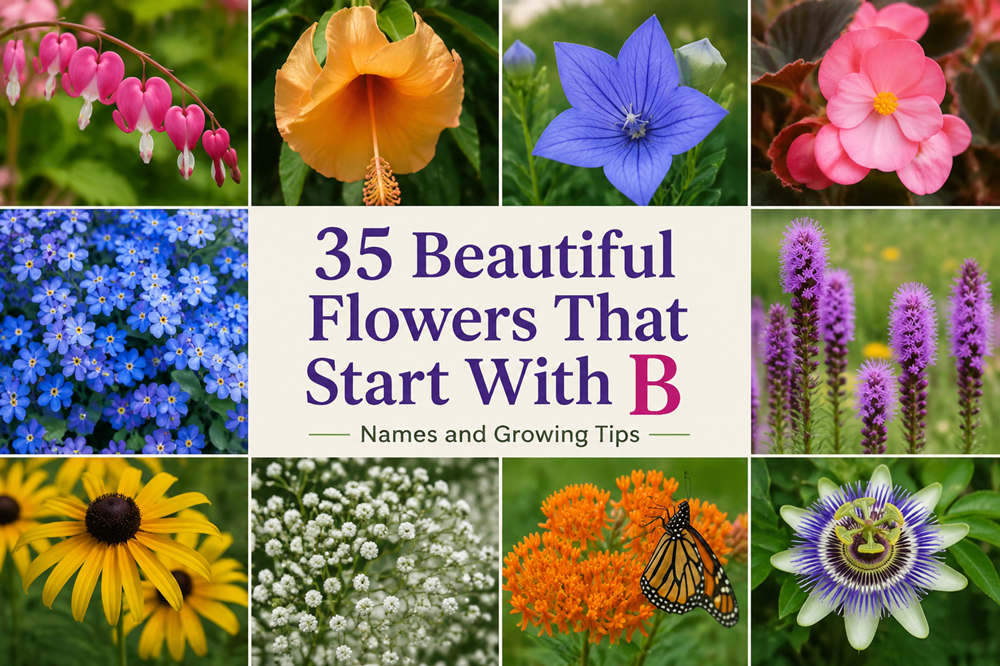
35 Beautiful Flowers That Start With B: Names and Growing Tips
From delicate blue wildflowers to dramatic tropical blooms, flowers that start with B cover an impressive range of colors, shapes, and growing habits. Familiar favorites such as begonias and black-eyed Susans share the letter with lesser-known choices including boronia, brunnera, and blue lace flower.
Below are 35 flowers beginning with B, with their scientific names, typical bloom periods, distinguishing features, and useful growing details.
Quick List of Flowers That Start With B
| Flower | Scientific Name | Typical Colors | Plant Type | Typical Bloom Period |
|---|---|---|---|---|
| Baby Blue Eyes | Nemophila menziesii | Blue, white | Annual | Spring |
| Baby’s Breath | Gypsophila paniculata | White, pink | Perennial | Late spring to summer |
| Bachelor’s Button | Centaurea cyanus | Blue, pink, white, purple | Annual | Late spring to summer |
| Balloon Flower | Platycodon grandiflorus | Blue, violet, pink, white | Perennial | Summer |
| Balsam | Impatiens balsamina | Pink, red, purple, white | Annual | Summer to fall |
| Baptisia | Baptisia spp. | Blue, purple, yellow, white | Perennial | Late spring to early summer |
| Basket Flower | Plectocephalus americanus | Pink, lavender | Annual | Summer |
| Basket-of-Gold | Aurinia saxatilis | Yellow | Perennial | Spring |
| Bee Balm | Monarda spp. | Red, pink, purple, white | Perennial | Summer |
| Begonia | Begonia spp. | Pink, red, orange, yellow, white | Annual or tender perennial | Summer to fall |
| Bellflower | Campanula spp. | Blue, purple, pink, white | Mostly perennial | Late spring to summer |
| Bells of Ireland | Moluccella laevis | Green, white | Annual | Summer |
| Bergenia | Bergenia spp. | Pink, red, white | Perennial | Spring |
| Bird of Paradise | Strelitzia reginae | Orange, blue | Tropical perennial | Variable in warm climates |
| Bird’s-Foot Violet | Viola pedata | Violet, blue | Perennial | Spring |
| Black-Eyed Susan | Rudbeckia spp. | Yellow, orange | Annual, biennial, or perennial | Summer to fall |
| Blanket Flower | Gaillardia spp. | Red, yellow, orange | Annual or perennial | Late spring to fall |
| Blazing Star | Liatris spp. | Purple, pink, white | Perennial | Summer |
| Bleeding Heart | Lamprocapnos spectabilis | Pink, white | Perennial | Spring |
| Blue Daisy | Felicia amelloides | Blue-violet | Tender perennial | Spring through fall in mild climates |
| Blue Flax | Linum lewisii | Blue | Perennial | Late spring to summer |
| Blue Lace Flower | Trachymene coerulea | Blue, lavender | Perennial in its native range; often annual or biennial in cultivation | Summer |
| Blue Star | Amsonia spp. | Pale blue | Perennial | Spring to early summer |
| Bluebell | Hyacinthoides spp. | Blue, violet, white | Bulbous perennial | Spring |
| Blue-Eyed Grass | Sisyrinchium spp. | Blue, violet | Perennial | Spring to early summer |
| Borage | Borago officinalis | Blue, occasionally pink | Annual | Late spring to fall |
| Boronia | Boronia spp. | Pink, purple, white | Shrub | Late winter to spring |
| Bougainvillea | Bougainvillea spp. | Pink, purple, red, orange, white | Woody vine or shrub | Seasonal flushes in warm climates |
| Bouvardia | Bouvardia spp. | Pink, red, white, orange | Shrub or perennial | Summer to fall |
| Browallia | Browallia speciosa | Blue, violet, white | Tender perennial, often grown as an annual | Summer to fall |
| Brunnera | Brunnera macrophylla | Blue | Perennial | Spring |
| Brugmansia | Brugmansia spp. | White, yellow, pink, orange | Tropical shrub or small tree | Summer to fall |
| Buttercup | Ranunculus spp. | Yellow, white, pink, orange | Annual or perennial | Spring to summer |
| Butterfly Bush | Buddleja spp. | Purple, pink, white, blue-violet | Shrub | Summer to fall |
| Butterfly Weed | Asclepias tuberosa | Orange, yellow | Perennial | Late spring to summer |
Bloom times vary with species, cultivar, climate, and growing conditions. Plants that are perennial in warm climates may also be grown as annuals where winters are colder.
35 Flowers That Start With B
1. Baby Blue Eyes
Nemophila menziesii is a low-growing annual wildflower with soft blue, cup-shaped blooms that often fade toward white at the center. Native to western North America, it is especially striking when planted in groups, where the small flowers can create a carpet of blue. It favors the cooler part of the growing season and is a natural fit for borders, containers, and informal wildflower plantings.
2. Baby’s Breath
Gypsophila paniculata produces clouds of tiny white or pale pink flowers on finely branched stems. Its light, airy appearance has made it a familiar addition to bouquets, but mature plants can also create a soft haze of color in sunny borders. Perennial baby’s breath can spread aggressively and is considered invasive in some regions of North America, so local guidance should be checked before planting it outdoors.
3. Bachelor’s Button
Also called cornflower, Centaurea cyanus is best known for brilliant blue flower heads, though garden varieties also come in pink, burgundy, purple, and white. This annual has a relaxed wildflower character and readily fits cottage gardens and cutting patches. Because “bachelor’s button” has been applied to more than one plant, the scientific name is helpful when choosing seeds.
4. Balloon Flower
The unopened buds of Platycodon grandiflorus swell like miniature balloons before opening into broad, star-shaped flowers. Blue-violet is the traditional color, with pink and white cultivars also available. This perennial is valued for its unusual buds as much as its flowers and develops fleshy roots that make established plants better left undisturbed.
5. Balsam
Impatiens balsamina is an upright annual with flowers tucked closely along its fleshy stems. The blooms can be single or densely petaled and appear in shades of pink, red, purple, and white. Unlike the low bedding impatiens commonly used in shady landscapes, garden balsam has a taller, old-fashioned form that feels at home in cottage-style plantings.
6. Baptisia
Baptisia, often called false indigo, forms substantial clumps topped by spikes of pea-shaped flowers. Blue-purple Baptisia australis is particularly familiar, although the genus also includes white and yellow-flowering species and many garden hybrids. After the flowers fade, inflated seedpods continue the display. Deep roots help established plants tolerate periods of dryness and make them difficult to relocate later.
7. Basket Flower
American basket flower, Plectocephalus americanus, is a tall annual wildflower bearing large lavender-pink flower heads with fringed petals. It was formerly widely known as Centaurea americana. The common name refers to the overlapping bracts underneath each bloom, which form an intricate woven pattern resembling the surface of a basket.
8. Basket-of-Gold
Aurinia saxatilis forms low mats or mounds that become covered with vivid yellow flowers in spring. The combination of compact growth and bright color makes basket-of-gold particularly suited to rock gardens, walls, slopes, and sunny border edges. Sharp drainage is important, especially where winters or summers bring prolonged wet conditions.
9. Bee Balm
Bee balm belongs to the genus Monarda, a group of aromatic North American plants in the mint family. Their distinctive flower heads may be red, pink, purple, or white and attract a range of visiting pollinators, including bees, butterflies, and hummingbirds. The aromatic leaves add another sensory feature beyond the unusual flowers.
10. Begonia
Begonias are among the most diverse flowers beginning with B. Some are grown chiefly for showy blooms, others for patterned foliage, and many provide both. Depending on the group, the flowers may be white, yellow, orange, salmon, pink, or red. Fibrous, tuberous, cane, and rhizomatous begonias differ considerably in size and care, so the exact type matters when choosing one for a garden or container.
11. Bellflower
The genus Campanula contains hundreds of plants ranging from tiny rock-garden species to tall border perennials. Many produce the bell-shaped flowers behind the common name, while others open into broader stars. Blue and violet are especially characteristic, although white and pink selections are also common. Their varied habits make bellflowers far more diverse than the single common name suggests.
12. Bells of Ireland
Bells of Ireland, Moluccella laevis, is grown primarily for its tall green spikes rather than colorful petals. The conspicuous bell-like structures are pale green calyces surrounding much smaller flowers. Their architectural form makes them unusual among annuals, and the stems remain attractive in both fresh and dried arrangements.
13. Bergenia
Bergenia pairs clusters of spring flowers with thick, leathery leaves that can remain attractive long after blooming finishes. Flowers usually range from pink to reddish-purple, with white forms also available. In colder weather, the broad foliage of some varieties develops bronze or red tones, giving the plant value during seasons when relatively few flowers are present.
14. Bird of Paradise
Strelitzia reginae produces dramatic orange and blue flowers whose shape resembles the head and crest of an exotic bird. Large paddle-shaped leaves reinforce the tropical effect. Native to South Africa, bird of paradise thrives outdoors in suitably warm climates but is commonly kept in containers or grown indoors where freezing temperatures would otherwise damage it.
15. Bird’s-Foot Violet
Viola pedata differs noticeably from many woodland violets. Its leaves are deeply divided into narrow segments that inspired the name bird’s-foot violet, while the flowers appear in shades of violet, lilac, and blue. The species is associated with relatively open, well-drained habitats rather than the moist, deeply shaded situations commonly associated with other violets.
16. Black-Eyed Susan
Black-eyed Susans are recognizable by golden-yellow rays surrounding dark, raised centers. The common name applies to multiple Rudbeckia species, including the widely grown Rudbeckia hirta. Their bold summer color and informal daisy shape make them characteristic plants for sunny borders, meadow-style landscapes, and native or naturalistic gardens.
17. Blanket Flower
Gaillardia species and hybrids produce warm-toned daisy flowers combining red, orange, and yellow. Many display rings or bands of contrasting color, giving the flower heads an especially vivid appearance. These sun-loving plants are often comfortable in conditions that are too hot or dry for more moisture-dependent ornamentals, provided the soil drains freely.
18. Blazing Star
Blazing star, or Liatris, sends up narrow flower spikes densely packed with purple, lavender, pink, or white florets. Many species have the unusual habit of beginning to open near the top of the spike before progressing downward. Their upright form provides a strong vertical accent among grasses, rounded perennials, and meadow plants.
19. Bleeding Heart
Lamprocapnos spectabilis is instantly recognizable when its arching stems carry rows of dangling heart-shaped flowers. Traditional plants combine rosy pink outer petals with white inner portions, while all-white selections are also available. The display is strongest in spring, and the foliage can retreat later in the season, particularly when conditions become hot or dry.
20. Blue Daisy
Felicia amelloides combines cool blue-violet ray petals with bright yellow centers. This South African plant grows as a small perennial or subshrub in mild climates but is often treated seasonally where winters are cold. Its familiar daisy shape allows the unusual blue coloring to become the main visual attraction.
21. Blue Flax
Linum lewisii bears clear blue flowers above slender stems and narrow foliage. Each bloom is delicate and relatively short-lived, but plants continue producing new flowers during their flowering period. Native to western North America, blue flax is well matched to sunny naturalistic gardens where its light texture can mingle easily with grasses and other wildflowers.
22. Blue Lace Flower
Blue lace flower, Trachymene coerulea, produces rounded clusters of many tiny blue to lavender flowers, creating a finely textured, lace-like effect. The species is perennial in its native western and southwestern Australia, while horticultural references also describe it as an annual or biennial in cultivation. Its long, slender stems make the flowers especially graceful in cutting gardens.
23. Blue Star
Blue star refers to plants in the genus Amsonia, which develop clusters of small, pale blue, star-shaped blooms. The flowering display is subtle rather than oversized, but mature clumps can be striking. Several species also have handsome narrow foliage that remains attractive after flowering, and some develop yellow or golden tones later in the year.
24. Bluebell
Bluebells are bulbous spring flowers associated strongly with woodland settings. The English bluebell, Hyacinthoides non-scripta, carries nodding blue-violet flowers along arching stems, sometimes accompanied by white forms. Because the bulbs flower before a dense tree canopy fully develops, they can create broad sweeps of spring color beneath deciduous trees.
25. Blue-Eyed Grass
Despite its name and narrow blade-like leaves, blue-eyed grass is not a true grass. Sisyrinchium belongs to the iris family. Small blue or violet flowers, often centered with yellow, appear just above compact clumps of foliage. The combination gives the plant a neat, understated character suited to meadow edges and naturalistic plantings.
26. Borage
Borago officinalis has bright blue, five-pointed flowers that look almost star-shaped, set against noticeably coarse and bristly foliage. The annual tends to grow with a loose, informal habit and can self-seed readily when conditions suit it. Its distinctive flowers also make it easy to recognize among herbs and cottage-garden plants.
27. Boronia
Boronia is a genus of Australian shrubs valued for small flowers that may be pink, purple, red-toned, or white. Several species are also notably fragrant. Boronias can be more demanding than many common border plants, particularly when climate, drainage, or root conditions are unsuitable, but their refined flowers and scent give them an appeal quite different from larger, showier shrubs.
28. Bougainvillea
Bougainvillea creates brilliant displays of pink, purple, red, orange, or white, but the colorful structures are actually modified leaves called bracts. The true flowers are small and sit inside them. This vigorous tropical and subtropical plant can climb, scramble, or form a shrub-like mass, and established specimens are well adapted to strong sunlight and relatively dry conditions.
29. Bouvardia
Bouvardia produces clusters of slender tubular flowers in shades including white, pink, coral, red, and orange. The flowers have a clean, geometric quality quite unlike the broad daisies or bells found elsewhere on this list. Several species come from Mexico and Central America, and cultivated forms are particularly familiar as cut flowers.
30. Browallia
Browallia speciosa, sometimes called bush violet, is admired for blue-violet flowers with pale centers. Naturally a tender perennial, it is frequently grown as an annual where winters are cold. Its compact leafy habit suits containers and bedding displays, especially when gardeners want blue or violet color without relying on tall flowering spikes.
31. Brunnera
Brunnera macrophylla produces small blue spring flowers reminiscent of forget-me-nots, followed by a much longer season of bold heart-shaped foliage. Many popular cultivars have silvered or patterned leaves that brighten shady areas even after the blooms disappear. For that reason, brunnera is often selected as much for its foliage as for its flowers.
32. Brugmansia
Brugmansia, commonly called angel’s trumpet, bears enormous hanging trumpet-shaped flowers in white, yellow, peach, orange, or pink. Many varieties become strongly fragrant, especially toward evening. These woody tropical plants can become substantial shrubs or small trees and are frequently grown in large containers where winters require indoor protection.
Safety note: All parts of Brugmansia are highly poisonous if eaten, and the sap can irritate skin. Gloves are advisable when handling or pruning the plant, and it should be positioned carefully around children and pets.
33. Buttercup
Buttercup is a broad common name for plants in the large genus Ranunculus. Familiar wild species often carry simple, glossy yellow flowers, while cultivated ranunculus can produce densely layered blooms in shades of pink, red, orange, yellow, and white. The enormous difference between meadow buttercups and florist-style varieties shows how diverse a single botanical genus can be.
34. Butterfly Bush
Butterfly bush refers to shrubs in the genus Buddleja, known for elongated clusters of many small, nectar-rich flowers. Purple and violet are common, with pink and white cultivars also available. Some forms, especially Buddleja davidii, can spread invasively in certain regions. Gardeners in affected areas should check local regulations and favor approved non-invasive or low-fertility selections where appropriate.
35. Butterfly Weed
Asclepias tuberosa brings vivid orange to yellow flower clusters to sunny summer plantings. This North American native belongs to the milkweed genus and serves as a host plant for monarch caterpillars as well as providing nectar for a range of adult pollinators. Its strong color is especially effective among grasses and softer-toned prairie flowers.
Flowers That Start With B by Color
For gardeners choosing plants primarily by color, several groups stand out among these B flowers.
Blue and Purple Flowers That Start With B
- Baby Blue Eyes
- Bachelor’s Button
- Balloon Flower
- Baptisia
- Bellflower
- Bird’s-Foot Violet
- Blazing Star
- Blue Daisy
- Blue Flax
- Blue Lace Flower
- Blue Star
- Bluebell
- Blue-Eyed Grass
- Borage
- Browallia
- Brunnera
Pink and Red Flowers That Start With B
- Baby’s Breath
- Balsam
- Bee Balm
- Begonia
- Bergenia
- Bleeding Heart
- Boronia
- Bougainvillea
- Bouvardia
- Brugmansia
Yellow and Orange Flowers That Start With B
- Basket-of-Gold
- Bird of Paradise
- Black-Eyed Susan
- Blanket Flower
- Buttercup
- Butterfly Weed
Best B Flowers for Different Garden Conditions
For Pollinator Gardens
Bee balm, blazing star, butterfly weed, borage, black-eyed Susan, and blanket flower can all contribute nectar, pollen, or other wildlife value. A mixture that flowers at different times is generally more useful than relying on a single species for the entire season.
For Shade and Woodland Settings
Brunnera and bleeding heart are two of the strongest choices for partly shaded perennial plantings. Bergenia tolerates a range of light conditions, while many begonias provide bright flowers or decorative foliage where intense midday and afternoon sun would be excessive.
For Sunny, Drier Sites
Blue flax, baptisia, blanket flower, basket-of-gold, and butterfly weed are worth considering where sunlight is abundant and soil drains well. Their mature forms and moisture needs differ, but none depends on the lush, consistently wet conditions required by some traditional bedding plants.
For Containers
Begonias and browallia offer manageable color for smaller pots, while bird of paradise and Brugmansia can become dramatic large-container specimens. Container culture is particularly useful for tender plants because they can be moved to protected conditions when temperatures fall.
For Tropical Impact
Bird of paradise creates strong architectural foliage, bougainvillea provides cascading masses of colorful bracts, and Brugmansia adds enormous hanging trumpets. Although all three suggest a tropical setting, their shapes are different enough to serve distinct roles in a landscape.
Why Scientific Flower Names Matter
Common names are memorable, but they can create confusion. One name may refer to several species, and an individual species may have multiple common names depending on region or tradition.
Scientific names make identification more precise. They are especially useful when buying seeds, comparing cultivars, checking whether a plant is native or invasive in a particular region, and researching mature size or hardiness. For broad entries such as bellflower, begonia, and buttercup, the genus name also makes clear that the article is discussing a group containing many different species.
Frequently Asked Questions
What are some common flowers that start with B?
Begonia, black-eyed Susan, bleeding heart, bee balm, baby’s breath, balloon flower, bluebell, bachelor’s button, and butterfly weed are among the most recognizable examples.
What blue flowers start with B?
Baby blue eyes, bachelor’s button, blue flax, blue star, bluebell, blue lace flower, blue-eyed grass, borage, and brunnera all offer blue flowers. Certain bellflowers, baptisias, and balloon flowers also fall into blue or blue-violet shades.
Which perennial flowers start with B?
Balloon flower, baptisia, bee balm, bergenia, bleeding heart, blazing star, blue star, brunnera, and butterfly weed are perennial examples. Bellflowers and several other genera on the list also contain perennial species.
Which B flowers attract butterflies and bees?
Bee balm, blazing star, butterfly weed, borage, blanket flower, and black-eyed Susan are useful choices for pollinator-oriented planting. Combining several species with overlapping bloom periods can provide a longer sequence of flowers through the growing season.
Final Thoughts
The letter B covers an unusually broad range of flowering plants, from tiny baby blue eyes and woodland bluebells to substantial shrubs and tropical showpieces. Gardeners can choose among spring bulbs, summer wildflowers, shade perennials, pollinator plants, container flowers, and warm-climate vines without leaving this single letter of the alphabet.
Rather than choosing by name alone, consider the plant’s climate needs, light requirements, mature size, bloom season, and regional behavior. Those details will help turn a favorite B flower from an attractive name on a list into a plant that genuinely suits the garden.