Flowers That Start With S: Twenty-Five Beautiful Blooms for Gardens and Bouquets
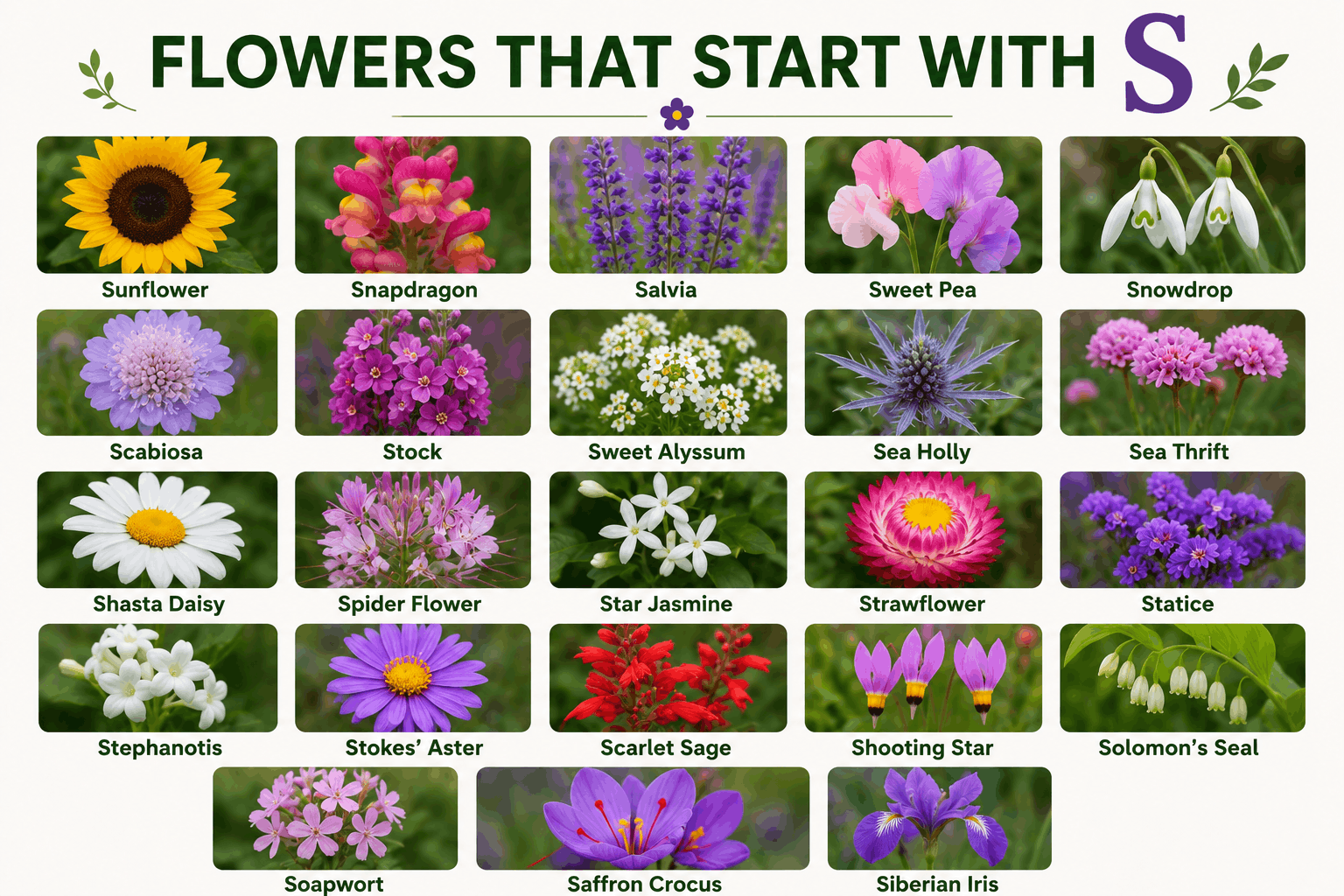
Flowers that start with S include sunflowers, snapdragons, sweet peas, salvias, snowdrops, scabiosa, and many other striking blooms. Some are colorful annuals, while others grow as hardy perennials, bulbs, shrubs, vines, or tropical plants. This guide introduces 25 flowers beginning with S, along with their appearance, growing habits, symbolism, and practical uses in gardens, containers, pollinator plantings, and bouquets.
1. Sunflower
Sunflowers are among the most recognizable flowers beginning with S. Their classic form has bright yellow petals surrounding a large brown or dark central disk, although modern varieties may also bloom in cream, orange, bronze, burgundy, red, or bicolored shades.
Sunflowers prefer full sun and grow best in soil that drains well. Their mature height varies enormously. Dwarf varieties may remain under two feet tall, while giant sunflowers can grow well above a person’s head.
Many sunflowers provide pollen and nectar for insects, while mature seed heads can feed birds later in the season.
Sunflowers commonly symbolize happiness, loyalty, optimism, warmth, and admiration.
2. Snapdragon
Snapdragons produce upright spikes covered with colorful flowers that resemble small dragon mouths when gently squeezed.
Colors include white, cream, yellow, orange, pink, red, burgundy, purple, and many bicolored combinations. Varieties range from compact bedding plants to tall flowers grown specifically for cutting.
Snapdragons prefer cool to mild weather and plenty of sunlight. They often bloom heavily in spring and fall but may slow down during extreme summer heat.
Their vertical form makes them excellent for adding height to borders and bouquets.
3. Salvia
Salvia is a large group of flowering plants commonly known as sages. Their flowers grow along upright spikes and may be red, pink, purple, blue, white, or coral.
Some salvias are grown as annuals, while others are long-lived perennials or woody shrubs. Many tolerate heat and drought once established.
Red tubular salvias are particularly attractive to hummingbirds, while blue and purple varieties draw bees and butterflies.
Salvias work well in pollinator gardens because different species can provide flowers from spring through fall.
4. Sweet Pea
Sweet peas are climbing annuals famous for delicate ruffled flowers and a soft fragrance. Their colors include white, cream, pink, peach, red, lavender, purple, blue, and multicolored forms.
They prefer cool weather and often perform best when planted early enough to flower before intense summer heat arrives.
Sweet peas need a trellis, netting, or other support for their curling tendrils. Regular cutting encourages the vines to keep producing flowers instead of directing their energy into seed pods.
Sweet peas symbolize gratitude, pleasure, friendship, and gentle goodbyes.
5. Snowdrop
Snowdrops are among the earliest bulbs to flower, sometimes emerging while snow remains on the ground.
Their small white flowers hang downward from slender stems and usually have green markings on the inner petals.
Snowdrops grow well beneath deciduous trees, where they receive winter and early-spring sunlight before the canopy fills with leaves.
Over time, established bulbs can multiply into attractive colonies. Snowdrops commonly symbolize hope, purity, renewal, and the end of winter.
6. Scabiosa
Scabiosa is commonly known as pincushion flower because its rounded centers resemble small cushions filled with pins.
Flowers may be lavender, blue, purple, pink, burgundy, white, or cream. They grow on slender stems that give the plant an airy appearance.
Scabiosa prefers full sun and well-drained soil. Removing faded blooms can keep the plant flowering for much of the summer.
The flowers attract butterflies and also work beautifully in cottage-style bouquets.
7. Stock
Stock produces upright stems covered with highly fragrant flowers. Blooms may be white, cream, pink, lavender, purple, red, yellow, or peach.
The scent is sweet and slightly spicy, making stock a popular choice for wedding arrangements and spring bouquets.
Stock generally performs best in cool weather and may struggle during intense summer heat.
Double-flowered forms are especially popular with florists because of their fullness and texture.
8. Sweet Alyssum
Sweet alyssum forms low cushions covered with hundreds of tiny flowers. White is the most common color, although lavender, pink, purple, and peach varieties are also available.
The flowers release a light honey-like fragrance and attract numerous small pollinating insects.
Sweet alyssum works well along paths, at the front of borders, and around the edges of containers. It prefers mild temperatures and may slow flowering during very hot weather.
Its low growth also makes it useful for filling spaces between taller plants.
9. Sea Holly
Sea holly produces unusual metallic-looking flower heads surrounded by sharp decorative bracts. Blue and steel-blue are the most recognizable colors, although green, silver, and purple forms also exist.
The plant prefers full sun, excellent drainage, and relatively dry conditions once established.
Sea holly is especially useful in coastal-style, gravel, and drought-tolerant gardens.
Its stiff flowers retain their form well when dried, making them excellent for long-lasting arrangements.
10. Sea Thrift
Sea thrift produces rounded clusters of pink, white, or purple flowers held above narrow grassy leaves.
The plant naturally tolerates windy, exposed, and coastal environments. It grows well in rock gardens, gravel beds, along walls, and beside sunny pathways.
Sea thrift prefers poor to moderately fertile soil with excellent drainage. Rich, wet soil can encourage weak growth.
Its compact size makes it particularly useful in small gardens.
11. Shasta Daisy
Shasta daisies produce classic white petals surrounding bright yellow centers. Their clean, simple appearance makes them a familiar summer perennial.
The plants prefer full sun and well-drained soil. Depending on the variety, they may grow from compact border plants to tall flowers suitable for cutting.
Removing faded flowers encourages continued blooming and keeps the plants looking neat.
Shasta daisies are often associated with simplicity, innocence, cheerfulness, and fresh beginnings.
12. Spider Flower
Spider flower, commonly known as cleome, produces clusters of airy blooms with long projecting stamens that resemble spider legs.
Flower colors include pink, purple, lavender, white, and rose. Tall varieties may reach several feet in height and work well at the back of borders.
Cleome thrives in warm weather and full sun. Once established, many varieties tolerate periods of dryness.
The plant may reseed naturally, especially in loose garden soil.
13. Spider Lily
Spider lily is a common name used for several bulbous plants with narrow, curved petals and long stamens.
Red spider lilies are particularly dramatic, producing scarlet flowers on bare stems in late summer or fall. White spider lilies are also widely grown.
Many appear suddenly after seasonal rain, sometimes without visible foliage around the flowers.
Because the common name covers several botanical groups, identify the exact plant before deciding where to grow it or whether it is safe around pets.
14. Star Jasmine
Star jasmine is an evergreen climbing plant with small white pinwheel-shaped flowers and an intense sweet fragrance.
Despite its common name, it is not a true jasmine. It can climb fences, trellises, walls, and pergolas or be allowed to spread as a dense ground cover.
Star jasmine performs best in warm or mild climates and flowers most heavily with plenty of light.
Its evergreen foliage makes it useful even when the plant is not blooming.
15. Starflower
Starflower is a common name used for several plants with star-shaped blooms. One familiar woodland starflower produces delicate white flowers with pointed petals.
These plants are often most suitable for naturalistic gardens, woodland edges, or shaded areas where their subtle flowers can be appreciated up close.
Because the name starflower can refer to different species, growing requirements vary. Check the botanical name before planting.
16. Strawflower
Strawflowers produce colorful papery blooms that feel dry even while fresh. Colors include yellow, orange, red, pink, purple, white, and cream.
The flowers are especially popular for drying because they retain much of their shape and color.
Strawflowers prefer warm weather, full sun, and well-drained soil. They can be grown in cutting gardens specifically for fresh and dried arrangements.
For drying, harvest the blooms before they are fully open and hang the stems upside down in a dry, ventilated location.
17. Statice
Statice produces branching sprays of small papery flowers in purple, blue, pink, yellow, white, or lavender.
The plant is widely used as a bouquet filler because its flowers keep their color well after drying.
Statice prefers full sun and soil that drains freely. It tolerates dry conditions better than constantly wet soil.
Its long-lasting flowers are useful in fresh arrangements, wreaths, and preserved floral displays.
18. Stephanotis
Stephanotis produces waxy white star-shaped flowers with a rich fragrance. It is sometimes called Madagascar jasmine, although it belongs to a different botanical group from true jasmine.
The plant is a tropical evergreen vine that prefers bright light, warmth, humidity, and well-drained soil.
Stephanotis flowers have traditionally been used in wedding bouquets because of their clean white appearance and perfume.
In cooler regions, the vine is usually grown indoors or in a greenhouse.
19. Stokes’ Aster
Stokes’ aster produces broad daisy-like flowers with fringed petals, usually in blue, lavender, purple, white, or pale pink.
This perennial prefers full sun and soil with reliable drainage. Established plants can tolerate moderate dry periods.
The flowers attract butterflies and other pollinating insects while adding a cool blue-purple tone to summer borders.
Removing faded flowers can encourage additional blooming.
20. Scarlet Sage
Scarlet sage produces bright red tubular flowers on upright stems. Pink, white, purple, and bicolored forms are also available.
The classic red varieties are especially attractive to hummingbirds and can provide nectar through much of the warm season.
Scarlet sage prefers sunny conditions and blooms strongly in warm weather. In frost-free areas it may survive as a perennial, while colder regions usually grow it as an annual.
21. Shooting Star
Shooting star is a distinctive wildflower with backward-swept petals that make each bloom resemble a tiny comet or falling star.
Flowers may be pink, lavender, purple, or white with contrasting centers.
Many species grow naturally in meadows, prairies, and open woodland environments. They usually flower in spring and become less noticeable afterward.
Shooting stars work best in native or naturalistic gardens where their seasonal growth can follow its natural cycle.
22. Solomon’s Seal
Solomon’s seal is a woodland perennial with arching stems and small bell-shaped flowers that hang beneath the leaves.
The blooms are usually white or cream, sometimes with green tips. After flowering, some varieties produce dark berries.
Solomon’s seal grows well in partial or full shade with rich, moist soil. It spreads gradually through underground rhizomes and can form elegant colonies beneath trees.
The plant should not be casually consumed, as several parts can cause digestive problems.
23. Soapwort
Soapwort produces clusters of small pink or white flowers, often with a light fragrance. The plant has traditionally been called soapwort because its roots and leaves contain natural compounds that can create foam in water.
It prefers sunny or lightly shaded conditions and can spread strongly through underground growth.
Soapwort works well in informal or cottage-style gardens where its tendency to spread can be accommodated.
In small, carefully controlled borders, regular management may be necessary.
24. Saffron Crocus
Saffron crocus produces delicate purple flowers with vivid red-orange stigmas. Those stigmas are the source of the culinary spice saffron.
Unlike many spring crocuses, saffron crocus flowers during fall. The corms prefer sunny locations and well-drained soil.
Each flower produces only a tiny amount of saffron, which is one reason the spice is so expensive.
Saffron crocus should not be confused with autumn crocus or meadow saffron, which can look similar but is highly poisonous.
25. Siberian Iris
Siberian iris produces graceful flowers on upright stems above narrow, grass-like foliage. Blue and purple are the most familiar colors, although varieties also bloom in white, yellow, pink, and mixed shades.
These hardy perennials prefer consistent moisture but tolerate ordinary garden soil better than some water-loving irises.
Siberian irises are attractive near ponds, in rain gardens, and in perennial borders where their vertical foliage provides structure after flowering ends.
Mature clumps can be divided when flowering begins to decline.
Which S Flowers Are Best for Containers?
Snapdragons, salvias, sweet alyssum, sea thrift, strawflowers, statice, scarlet sage, and compact sunflowers all work well in containers.
Choose a variety that matches the size of the pot. Dwarf sunflowers and compact snapdragons are better suited to patio containers than varieties that grow several feet tall.
Make sure every container has drainage holes. Water requirements vary considerably, so group plants with similar needs rather than combining moisture-loving and drought-tolerant flowers in the same pot.
Which S Flowers Attract Hummingbirds?
Salvia, scarlet sage, some snapdragons, and other tubular S flowers can attract hummingbirds.
Red and coral salvias are particularly useful because their long floral tubes contain nectar that hummingbirds can reach while hovering.
Rather than planting one hummingbird flower, combine several plants with overlapping flowering periods. This creates a more dependable food source throughout the growing season.
Which S Flowers Attract Bees and Butterflies?
Sunflowers, scabiosa, salvia, sea holly, sweet alyssum, Stokes’ aster, and several other S flowers support bees, butterflies, and beneficial insects.
Sunflowers with open centers are particularly valuable because they can provide large amounts of pollen and nectar.
Avoid heavily treating pollinator flowers with broad-spectrum insecticides, especially while they are blooming.
Which S Flowers Work Well in Bouquets?
Sunflowers, snapdragons, sweet peas, scabiosa, stock, sea holly, strawflowers, statice, and Stephanotis can all be used in floral arrangements.
Snapdragons provide height, while sunflowers create strong focal points. Sweet peas add fragrance and softness, scabiosa brings an airy garden style, and sea holly adds unusual texture.
Strawflowers and statice are particularly useful when the arrangement will eventually be dried.
Which S Flowers Are Best for Shade?
Solomon’s seal is one of the strongest S choices for shaded woodland conditions. Some starflowers also grow naturally in partial shade.
Most sunflowers, salvias, strawflowers, sea thrift, and saffron crocuses require much brighter conditions to flower well.
Before choosing a shade plant, consider whether the location has light shade, deep shade, or only afternoon shade. Those conditions can produce very different results.
Which S Flowers Need Extra Caution?
Several S flowers require careful identification. Spider lily and starflower are common names used for multiple plants, and their toxicity can differ by species.
Saffron crocus also needs particular attention because it can be confused with poisonous autumn-flowering plants. Never harvest a crocus-like flower for food unless its identity is certain.
Some ornamental plants can also cause digestive irritation when eaten, so keep unfamiliar flowers away from pets and young children until their safety is confirmed.
The Bottom Line
Flowers that start with S include familiar garden favorites such as sunflowers, snapdragons, salvias, sweet peas, snowdrops, and Shasta daisies. The group also contains distinctive flowers such as sea holly, strawflower, Stephanotis, shooting star, and saffron crocus.
There are S flowers for nearly every setting. Sunflowers thrive in sunny summer gardens, Solomon’s seal prefers woodland shade, snowdrops bloom near the end of winter, and scarlet sage provides nectar for hummingbirds during warmer months.
When choosing an S flower, consider its sunlight, moisture, climate, mature size, toxicity, and potential to spread. Matching each plant to the right growing conditions will lead to healthier growth, stronger flowering, and a garden that stays colorful across more of the year.