Flowers That Start With D: Twenty-Five Beautiful Blooms for Gardens and Bouquets
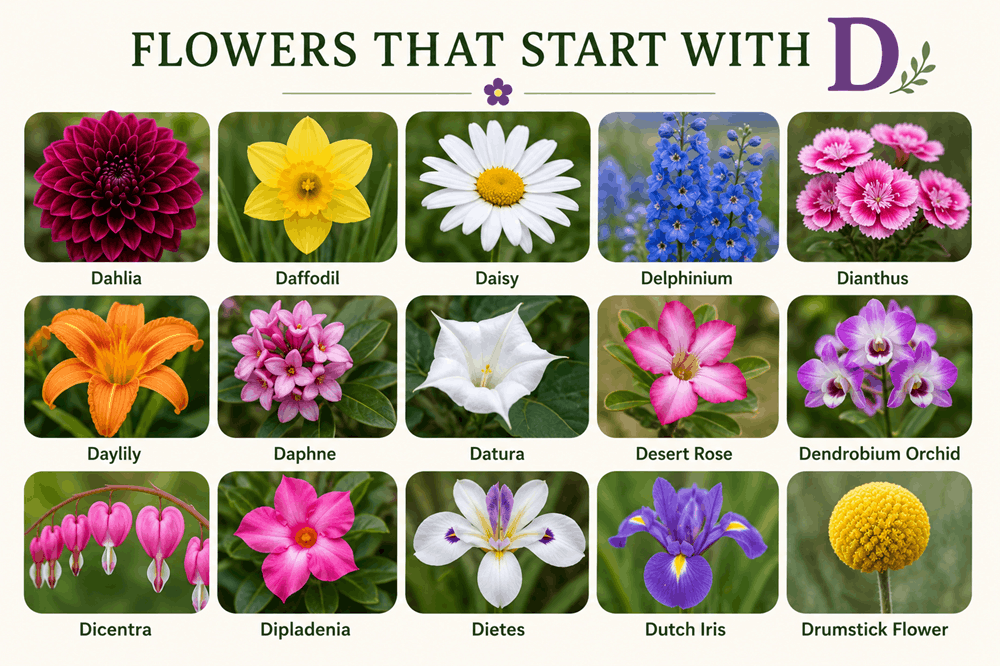
Flowers that start with D include dahlias, daffodils, daisies, delphiniums, dianthus, daylilies, and many other colorful plants. Some are familiar garden classics, while others are unusual wildflowers, tropical shrubs, orchids, or shade-loving woodland plants. This guide introduces 25 flowers beginning with D, along with their appearance, growing habits, symbolism, and practical uses in gardens and floral arrangements.
1. Dahlia
Dahlias are among the most diverse flowers beginning with D. Their blooms range from tiny pom-poms to enormous dinner-plate flowers more than eight inches across.
Colors include white, cream, yellow, orange, coral, pink, red, burgundy, purple, and nearly black. Some varieties have striped, tipped, or multicolored petals.
Dahlias grow from tubers and flower from midsummer until frost. They prefer full sun, fertile soil, and regular watering. Tall varieties may need staking because the large flower heads become heavy.
Dahlias commonly symbolize creativity, inner strength, commitment, and lasting elegance.
2. Daffodil
Daffodils are classic spring bulbs with trumpet-shaped centers surrounded by six petal-like segments. Yellow is the most familiar color, but varieties also bloom in white, cream, orange, peach, and pale pink.
They are among the first dependable flowers to appear after winter and often naturalize into larger colonies over time.
Daffodils prefer full sun or light shade and soil that drains well. Their foliage should be allowed to remain until it naturally yellows because the leaves feed the bulb for the following year.
They symbolize renewal, hope, rebirth, and new beginnings.
3. Daisy
Daisy is a broad common name used for many flowers with petals arranged around a central disk. The classic English daisy has white petals and a yellow center, while other daisy-like flowers may be pink, red, orange, purple, or yellow.
Daisies generally create a cheerful, informal appearance and are common in lawns, cottage gardens, meadow plantings, and bouquets.
They are often associated with innocence, simplicity, happiness, and fresh starts.
4. Delphinium
Delphiniums produce tall, dramatic flower spikes that may reach several feet in height. Their blooms are commonly blue, purple, lavender, pink, or white.
They are especially popular in cottage gardens and at the back of perennial borders. Their strong vertical shape also makes them valuable in large cut-flower arrangements.
Delphiniums prefer cool conditions, rich soil, good drainage, and consistent moisture. Taller varieties often need staking.
All parts of the plant are toxic if eaten, so delphiniums should be grown carefully around children and pets.
5. Dianthus
Dianthus includes carnations, sweet William, and many smaller garden pinks. Their flowers are often fringed or ruffled and may have a spicy clove-like fragrance.
Colors include white, pink, red, magenta, purple, and bicolored combinations.
Dianthus generally prefers full sun and well-drained soil. Many compact varieties are excellent for borders, rock gardens, and containers.
The flowers commonly symbolize admiration, love, gratitude, and affection.
6. Daylily
Daylilies produce trumpet-shaped flowers in an enormous range of colors, including yellow, orange, red, pink, purple, cream, and near-white.
Each individual flower usually lasts only one day, which gives the plant its common name. Mature clumps compensate by producing many buds over an extended period.
Daylilies are durable perennials that tolerate a wide range of soils and conditions. They perform best with good sunlight and regular moisture during flowering.
Daylilies are highly toxic to cats and can cause severe kidney failure if any part is eaten.
7. Daphne
Daphne is a flowering shrub valued for its intensely fragrant blossoms. Depending on the species, the flowers may be pink, white, cream, or purple.
Many varieties bloom in late winter or early spring, providing fragrance when relatively few other shrubs are flowering.
Daphne prefers well-drained soil and often dislikes being moved once established. It can be somewhat difficult to grow, particularly in heavy or waterlogged soil.
The plant is toxic if eaten, including its berries.
8. Datura
Datura produces large trumpet-shaped flowers that may be white, cream, yellow, or pale purple. Many varieties open in late afternoon or evening and attract large moths.
The flowers are followed by distinctive spiny seed capsules. Datura thrives in warm, sunny conditions and tolerates relatively dry soil once established.
Every part of the plant is highly poisonous. It should never be consumed or used in homemade remedies and should be kept away from children and pets.
9. Desert Rose
Desert rose is a tropical succulent shrub with a swollen trunk and brightly colored flowers. Its blooms may be pink, red, white, purple, or multicolored.
The plant stores water in its thick trunk and roots, making it well suited to hot, dry conditions. It performs best in strong sunlight and sharply drained soil.
In colder climates, desert rose is commonly grown as a container plant and brought indoors before frost.
Its sap is toxic, so gloves are useful when pruning or repotting.
10. Desert Marigold
Desert marigold produces bright yellow daisy-like flowers above gray-green foliage. It is adapted to hot, dry environments and performs particularly well in desert and xeriscape gardens.
The plant prefers full sun and sandy or gravelly soil. Too much water can shorten its life.
Desert marigold can flower repeatedly during warm periods and provides cheerful color without demanding frequent irrigation.
11. Dendrobium Orchid
Dendrobium orchids produce elegant flowers along upright or arching stems. Their colors include white, purple, pink, yellow, green, and bicolored combinations.
Different dendrobium species have very different growing requirements. Some need warm tropical conditions, while others require a cooler or drier resting period before flowering.
Many are popular as houseplants and florist orchids because their flowers can remain attractive for weeks.
Dendrobiums often symbolize beauty, refinement, affection, and lasting friendship.
12. Dicentra
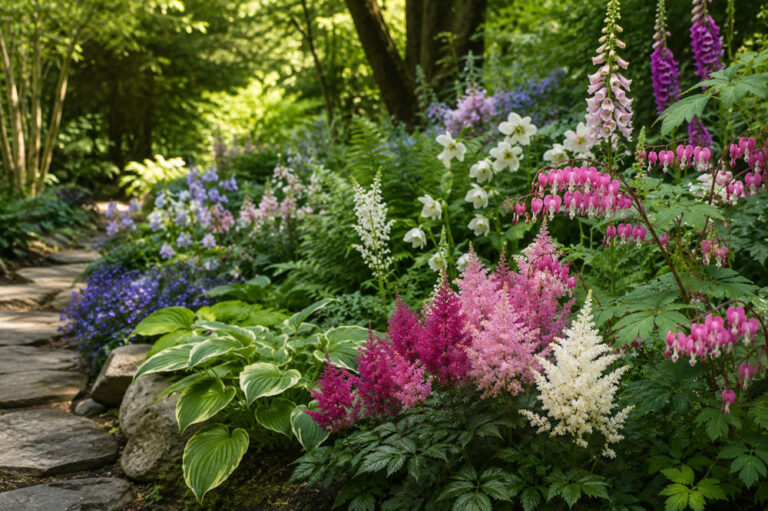
Dicentra is best known through bleeding heart, a woodland perennial with heart-shaped flowers hanging from arching stems.
The classic form has pink outer petals and white inner petals, although white and red varieties are also available.
Dicentra grows best in cool, partly shaded areas with moist, well-drained soil. In hot climates, the foliage may die back during summer after flowering.
The flowers are associated with love, compassion, sensitivity, and emotional openness.
13. Dipladenia
Dipladenia is a tropical flowering plant closely related to mandevilla. It produces trumpet-shaped flowers in pink, red, white, or yellow.
Compared with vigorous climbing mandevillas, many dipladenias have a bushier and more compact growth habit, making them useful in containers and patio planters.
The plant prefers warmth, bright light, and well-drained soil. In cold climates, it is usually treated as an annual or overwintered indoors.
14. Dietes
Dietes is commonly called African iris or fortnight lily. It produces iris-like flowers in white, yellow, or cream with colorful markings near the center.
The plant forms clumps of narrow, upright leaves and performs well in warm climates. It is often used in borders, mass plantings, and low-maintenance landscapes.
Dietes can tolerate occasional dry conditions once established, although regular moisture usually produces stronger flowering.
15. Dutch Iris
Dutch iris produces elegant flowers on long, straight stems. Its blooms commonly appear in blue, purple, yellow, white, bronze, and bicolored combinations.
The flowers grow from bulbs planted in fall for spring or early-summer flowering.
Dutch irises are especially popular as cut flowers because their upright stems and sophisticated shape fit easily into bouquets.
They prefer sunny locations and well-drained soil.
16. Dutchman’s Breeches
Dutchman’s breeches is a woodland wildflower with unusual white flowers that resemble tiny upside-down pants hanging from an arching stem.
The flowers appear in early spring before the tree canopy becomes dense. Finely divided gray-green foliage grows beneath them.
Dutchman’s breeches performs best in rich woodland soil with spring moisture and summer shade.
It naturally goes dormant after flowering, so its disappearance later in the year is normal.
17. Douglas Iris
Douglas iris is a native wildflower of western North America. Its flowers may be blue, purple, lavender, cream, or occasionally white.
The plant forms dense clumps of narrow evergreen leaves and grows naturally along coastal areas, meadows, woodland edges, and slopes.
It is particularly useful in naturalistic and native gardens where the local climate matches its native range.
18. Drummond Phlox
Drummond phlox is a colorful annual with clusters of small flowers. It is available in pink, red, purple, lavender, white, peach, and bicolored forms.
The plant works well in borders, containers, and wildflower-style plantings. It prefers full sun and moderate temperatures.
In very hot climates, flowering may decline during midsummer. Deadheading can extend the display.
19. Drumstick Allium
Drumstick allium produces small oval flower heads that begin green and gradually become burgundy or purple. The flowers sit on tall, narrow stems above low foliage.
They bloom in early to midsummer and work well in modern, cottage, and pollinator gardens.
Drumstick alliums prefer full sun and well-drained soil. Bees are strongly attracted to the flowers.
The dried seed heads can remain attractive after blooming and may be left standing for structure.
20. Drumstick Flower
Drumstick flower, commonly known as craspedia, produces round golden-yellow flower heads on slender stems.
Its simple geometric shape has made it popular in modern bouquets, dried arrangements, and wedding flowers.
Craspedia prefers full sun and good drainage. It tolerates heat and moderate dryness once established.
The flowers hold their shape and color extremely well when dried.
21. Dragon Arum
Dragon arum is an unusual Mediterranean plant with a large dark purple spathe surrounding a nearly black central spike.
The flower has a dramatic appearance but produces an unpleasant odor designed to attract flies and other pollinating insects.
Dragon arum grows from a tuber and prefers dry summers with well-drained soil. It is best used as a botanical curiosity rather than near patios or windows where its smell may be unwelcome.
22. Devil’s Bit Scabious
Devil’s bit scabious produces rounded purple-blue flower heads on slender stems. It is a valuable late-season wildflower for bees, butterflies, and other pollinating insects.
The plant prefers moist meadows, grasslands, and open areas with moderate sunlight.
Its unusual common name comes from old folklore claiming that the root looked as though the devil had bitten off its end.
23. Dwarf Morning Glory
Dwarf morning glory produces funnel-shaped blue, purple, lavender, pink, or white flowers on a compact spreading plant.
Unlike vigorous climbing morning glory vines, dwarf forms remain low and can be used in containers, borders, and ground-level plantings.
They prefer warm weather, full sun, and soil that drains well. Their blue-flowered varieties are especially valued because true blue is relatively uncommon among garden flowers.
24. Dwarf Iris
Dwarf iris is a compact spring-flowering bulb that produces purple, blue, yellow, or white flowers close to the ground.
Many varieties bloom extremely early, sometimes while snow is still present.
Dwarf irises are useful in rock gardens, containers, path edges, and beneath deciduous shrubs. Planting several bulbs together creates a stronger display than scattering individual flowers.
They prefer full sun during their spring growth period and well-drained soil.
25. Dame’s Rocket
Dame’s rocket produces clusters of four-petaled flowers in purple, lavender, pink, or white. The flowers often release their strongest fragrance in the evening.
The plant resembles garden phlox but can be distinguished by its four petals, while phlox flowers typically have five.
Dame’s rocket can spread aggressively and is considered invasive in some regions. Check local recommendations before planting it, and choose non-invasive alternatives where necessary.
Which D Flowers Are Best for Containers?
Dahlias, dianthus, desert rose, dipladenia, dendrobium orchids, dwarf morning glory, and dwarf iris can all grow successfully in containers.
Compact dahlias and dianthus are well suited to sunny patios. Desert rose needs excellent drainage, while dendrobium orchids require specialized orchid potting material rather than ordinary garden soil.
Choose a container appropriate for the mature size of the plant and make sure excess water can escape freely through drainage holes.
Which D Flowers Attract Pollinators?
Dahlias with open centers, drumstick alliums, devil’s bit scabious, desert marigolds, Drummond phlox, and daisies can all attract bees, butterflies, or other pollinating insects.
Flowers with highly doubled petals may provide less accessible nectar and pollen than simpler forms.
For a pollinator-friendly garden, combine several plant types that bloom at different points in the year. This gives insects a more consistent food supply.
Which D Flowers Work Well in Bouquets?
Dahlias, delphiniums, dianthus, Dutch iris, dendrobium orchids, drumstick alliums, drumstick flowers, and daisies are all useful as cut flowers.
Dahlias provide dramatic focal blooms, while delphiniums add height. Dianthus offers fragrance and good vase life, and craspedia contributes a distinctive round shape.
Dendrobium orchids work particularly well in elegant tropical arrangements because their flowers can remain attractive for a relatively long time.
Which D Flowers Are Toxic?
Several flowers beginning with D require caution. Datura is highly poisonous, while delphiniums, daffodils, desert rose, and some other species contain compounds that can cause serious illness if eaten.
Daylilies are particularly dangerous to cats. Even small amounts can cause severe kidney damage.
Do not assume that an ornamental flower is edible because it grows in a home garden. Check the exact botanical species before planting unfamiliar flowers around children or animals.
The Bottom Line
Flowers that start with D include familiar favorites such as dahlias, daffodils, daisies, delphiniums, dianthus, and daylilies, along with less familiar plants such as dragon arum, devil’s bit scabious, Dutchman’s breeches, and drumstick flower.
The group contains plants for nearly every type of garden. Desert rose thrives in heat, dicentra prefers woodland shade, dwarf iris flowers early in spring, and dahlias provide color from summer until frost.
When choosing a D flower, consider its climate needs, mature size, flowering season, soil requirements, potential invasiveness, and toxicity. Matching each plant to the right location will produce healthier growth and a stronger display than choosing flowers by appearance alone.