How to Make Flowers Last Longer With Simple, Reliable Care Methods
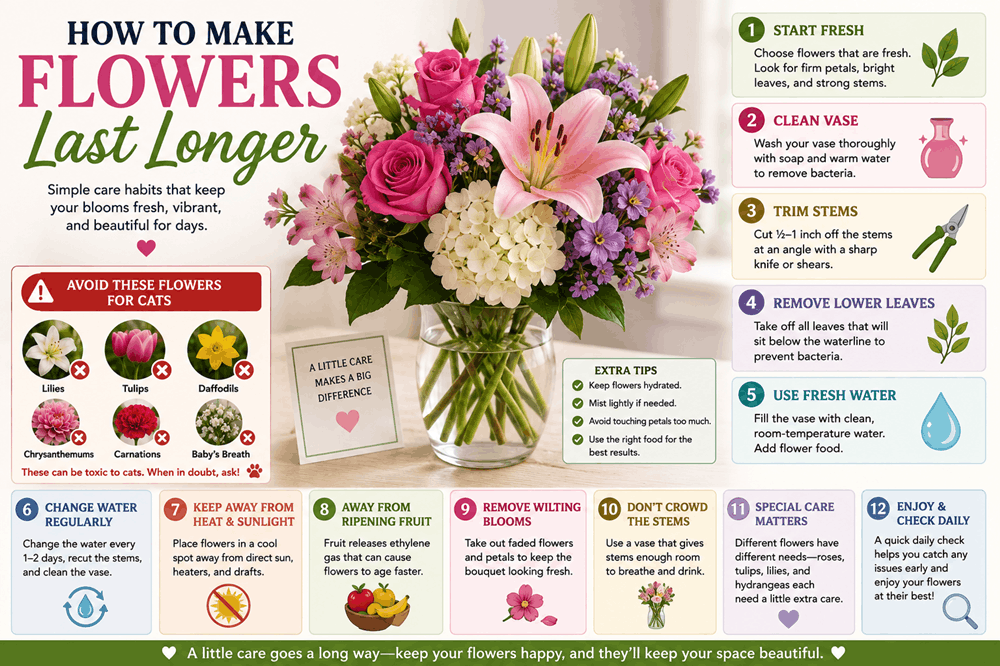
To make flowers last longer, place them in a clean vase, trim the stems at an angle, remove leaves below the waterline, and add fresh water with flower food. Keep the arrangement away from direct sunlight, heat, drafts, and ripening fruit. Change the water every two days and remove fading flowers before they affect the rest of the bouquet.
Start With the Freshest Flowers Possible
The life of a bouquet begins before the flowers reach the vase. Flowers that have already spent several days in storage will naturally fade sooner than freshly cut blooms.
When choosing flowers, look for firm stems, bright leaves, and petals without brown edges, transparent spots, or heavy bruising. Avoid bouquets with slimy stems, unpleasant-smelling water, or leaves that have already turned yellow.
Different flowers should be purchased at different stages of opening. Roses usually last longer when their buds are beginning to loosen but have not fully opened. Tulips should have firm stems and closed or partially colored buds. Lilies may be purchased with several unopened buds so the arrangement continues blooming over time.
A flower does not need to be completely closed to be fresh. Some varieties are harvested at a more open stage. The important signs are firm petals, healthy foliage, and stems that do not feel soft or slippery.
Use a Completely Clean Vase
A vase that looks clean may still contain bacteria, yeast, mineral deposits, or old plant residue. These microorganisms multiply in water and can block the tiny vessels that carry moisture through the stems.
Wash the vase with warm water and dish soap before adding the flowers. Use a bottle brush to reach narrow bases and corners. Rinse it thoroughly so no soap remains.
For a vase that previously held decaying flowers, clean it more carefully before reusing it. A dishwasher-safe vase can usually be placed in the dishwasher, while delicate glass or ceramic containers should be washed by hand.
Do not simply pour fresh water into a vase that still contains residue from the previous arrangement. Replacing the water without cleaning the container leaves much of the bacterial buildup behind.
Trim the Stems Before Arranging the Flowers
Cut approximately one-half to one inch from the bottom of each stem before placing it in water. Use a clean, sharp knife, floral knife, or pruning shears.
A dull blade or ordinary household scissors may crush softer stems instead of cutting them cleanly. Crushed tissue can reduce the stem’s ability to absorb water.
Make the cut at an angle. An angled cut creates a larger exposed surface and helps prevent the bottom of the stem from sitting flat against the base of the vase.
Trim the stems again whenever you change the water. You do not need to remove a large section each time. Cutting away a small amount can expose fresh tissue and improve water absorption.
Cut Stems Under Water When Practical
Some florists recommend trimming stems under clean water, particularly for flowers that wilt easily. Cutting under water can reduce the chance of air entering the stem.
This method is not essential for every bouquet, but it may help with roses and other flowers that are struggling to take up water.
Use a clean bowl or sink rather than cutting stems in old vase water. Once trimmed, move the flowers promptly into the prepared vase.
Remove Leaves Below the Waterline
Any leaf submerged in vase water will begin to break down. Decaying leaves feed bacteria, cloud the water, and create an unpleasant smell.
Remove all leaves that would sit below the waterline. Keep healthy leaves above the water because they contribute to the appearance of the bouquet and continue supporting the flower.
Do not strip every leaf unless the arrangement requires it. Removing too much foliage can damage the stem and make the bouquet look bare.
Check the vase each day because settling stems may cause a previously dry leaf to enter the water.
Use Fresh, Room-Temperature Water
Most cut flowers do well in clean, room-temperature or slightly lukewarm water. Water that is extremely hot can damage plant tissue, while ice-cold water may slow absorption in some flowers.
Fill the vase deeply enough to cover a substantial portion of the stems without submerging leaves. The exact water level depends on the vase and flower type.
Tulips generally prefer shallower water than thick-stemmed flowers. Hydrangeas and roses often benefit from having more water available because they can lose moisture quickly.
Check the level daily. A large arrangement may drink much more water than expected during its first day.
Add the Flower Food Provided With the Bouquet
Commercial flower food usually contains three useful components:
- Sugar to supply energy to the cut flowers
- An acidifying ingredient that helps the stems absorb water
- An antimicrobial ingredient that slows bacterial growth
Follow the packet instructions and mix it with the correct amount of water. Using too much flower food can create an overly concentrated solution, while using too little may reduce its effectiveness.
Do not divide a small packet among several large vases unless the label indicates that the packet is intended for that amount of water.
When changing the water, add a fresh packet if one is available. Pouring clean water into an old flower-food solution changes the concentration and does not remove bacteria from the vase.
Be Cautious With Homemade Flower Preservatives
Many homemade methods promise to extend the life of cut flowers. Common suggestions include sugar, vinegar, bleach, aspirin, coins, vodka, lemon juice, and soda.
Some ingredients imitate one part of commercial flower food, but incorrect proportions can do more harm than good. Sugar may feed flowers, but it also encourages bacterial growth when no suitable antimicrobial ingredient is present. Too much bleach can damage the stems, while acidic ingredients may make the solution unsuitable if used excessively.
Commercial flower food is usually the simplest and most predictable option. When no packet is available, clean water changed frequently is often safer than an improvised mixture with uncertain measurements.
Change the Water Every One or Two Days
Water quality is one of the most important factors affecting bouquet life. Even when the water looks clear, bacteria may be multiplying.
Every one or two days:
- Remove the flowers from the vase.
- Discard the old water.
- Wash and rinse the vase.
- Trim a small amount from the stems.
- Remove damaged leaves and petals.
- Refill the vase with clean water and flower food.
Do not wait until the water becomes cloudy or smells unpleasant. By that stage, the stems may already be clogged.
Large bouquets may need more frequent attention because they contain more stems, leaves, and organic material.
Keep Flowers Away From Direct Sunlight
Cut flowers last longer in a cool location with indirect light. Direct sunlight warms the water and causes flowers to lose moisture more quickly.
A sunny windowsill may make a bouquet look beautiful temporarily, but it often shortens its vase life. Move the arrangement away from windows that receive strong afternoon sun.
Heat from radiators, fireplaces, ovens, televisions, lamps, and heating vents can have a similar effect. Avoid leaving flowers inside a hot vehicle, even for a short period.
Avoid Strong Drafts and Air Conditioning
Continuous air movement can dry the petals and foliage. Do not place the bouquet directly beneath a ceiling fan, air conditioner, heating vent, or frequently opened exterior door.
A cool room is helpful, but a blast of cold air is different from a naturally cool environment. Some tropical flowers may also develop damage when placed too close to strong air conditioning.
Keep Flowers Away From Ripening Fruit
Ripening fruit releases ethylene gas, a natural plant hormone that accelerates aging in many flowers. Apples, bananas, pears, peaches, tomatoes, and avocados can all contribute to the problem.
A fruit bowl and flower arrangement may look attractive together, but keeping them close can cause petals to drop and flowers to fade sooner.
Place the bouquet on a separate surface, especially when it contains ethylene-sensitive flowers such as carnations, lilies, roses, and snapdragons.
Remove Wilting Flowers Promptly
Not every flower in a mixed bouquet ages at the same rate. One variety may begin fading while the rest remain healthy.
Remove wilted flowers, yellow leaves, and fallen petals as soon as you notice them. Decaying material increases bacterial growth and may release ethylene.
Taking out one failing flower can help preserve the appearance and cleanliness of the entire arrangement. The bouquet may also look better after being rearranged into a smaller vase as stems are removed.
Give Crowded Flowers More Space
A tightly packed bouquet can restrict airflow and crush delicate petals. Stems may also compete for limited water when the vase is too small.
Choose a vase with an opening wide enough to hold the bouquet without forcing the stems together. The arrangement should feel supported, not compressed.
If a bouquet seems crowded, divide it between two containers. Smaller arrangements can sometimes last longer because each stem has better access to water.
Special Care for Roses
Roses often wilt when air or bacteria blocks water uptake. Recut the stems with a sharp blade and place them in fresh water immediately.
Remove any protective guard petals that are bruised or damaged, but do not peel away healthy outer petals unnecessarily. Some outer petals naturally look darker or firmer than the inner petals.
If a rose bends just below the flower head, recut it and place it in deeper lukewarm water in a cool location. Recovery is not guaranteed, but improved hydration may help when the stem has not been permanently damaged.
Special Care for Tulips
Tulips continue growing after they are cut, so their stems may lengthen and bend toward light. This movement is normal.
Use a tall vase for support and keep the water clean and relatively shallow. Rotate the vase periodically if the tulips are leaning strongly toward a window.
Do not overcrowd them with heavy flowers that may crush their stems. Tulips often look best when allowed to move naturally rather than being forced into a rigid arrangement.
Special Care for Hydrangeas
Hydrangeas have large flower heads and can lose moisture quickly. Cut the stems cleanly and place them in water without delay.
Some florists lightly mist the flower heads because hydrangeas can absorb a small amount of moisture through their petals and sepals. Avoid soaking the flowers continuously, as excessive moisture may encourage spotting or decay.
If a hydrangea wilts suddenly, recut the stem and submerge the flower head in clean, cool water for a limited period. This can sometimes restore a bloom that has become dehydrated.
Special Care for Lilies
Lilies often open gradually, making them long-lasting arrangement flowers. Remove fading flowers so the unopened buds have room to develop.
Once a lily opens, the pollen-bearing anthers can be removed carefully to prevent stains on clothing and furniture. Avoid touching the pollen directly because it transfers easily.
Lilies are extremely dangerous to cats. Even small exposures to true lilies, including pollen and vase water, can cause fatal kidney failure. Homes with cats should avoid lilies entirely rather than relying on keeping the bouquet out of reach.
Can Refrigeration Make Flowers Last Longer?
A cool environment can slow flower aging. Florists store many cut flowers in temperature-controlled coolers for this reason.
A household refrigerator may help overnight, but it is not always ideal. Fruits and vegetables can release ethylene, shelves may be too cold for tropical flowers, and cramped conditions may crush petals.
When refrigeration is practical, keep the bouquet away from produce and avoid placing it near the freezer vent. A naturally cool room is usually easier and safer for everyday care.
How Long Should Cut Flowers Last?
Vase life depends on the flower variety, freshness, storage history, and home care. Some delicate flowers last only several days, while carnations, chrysanthemums, orchids, and alstroemeria may remain attractive for two weeks or longer under good conditions.
A mixed bouquet will change over time. Removing fading flowers and transferring the remaining stems to a smaller vase can extend the useful life of the arrangement.
The goal is not to keep every flower looking newly cut indefinitely. Consistent care helps the bouquet age more slowly and attractively.
The Bottom Line
To make flowers last longer, begin with fresh blooms and a thoroughly cleaned vase. Trim the stems at an angle, remove all leaves below the waterline, and use clean water with properly mixed flower food.
Change the water every one or two days, wash the vase, and recut the stems. Keep the bouquet away from direct sunlight, heating vents, drafts, and ripening fruit. Remove fading flowers and damaged foliage before they contaminate the water.
Simple, consistent care is more effective than relying on coins, aspirin, soda, or other household tricks. Cleanliness, hydration, cool temperatures, and early removal of decaying material give cut flowers their best chance of lasting as long as possible.